UN Report Details Killings, Torture, and Rape of Migrants in Libya: Who Bears Responsibility?
“The solutions are not complex; what is missing is real will.”
Amid Libya’s political fragmentation and security breakdown, migrants and refugees have been left exposed to grave dangers, with their safety and basic rights under constant threat.
A UN report released on 17 February 2026 highlights the systematic and brutal human rights abuses they face, including killings, torture, sexual violence, and human trafficking.

Horrific Abuses
The UN report details how migrants in Libya are routinely rounded up and kidnapped by human trafficking networks, often with links to Libyan authorities and criminal groups abroad. Families are separated; people are detained in facilities without due process, often under threat of weapons, amounting to arbitrary detention.
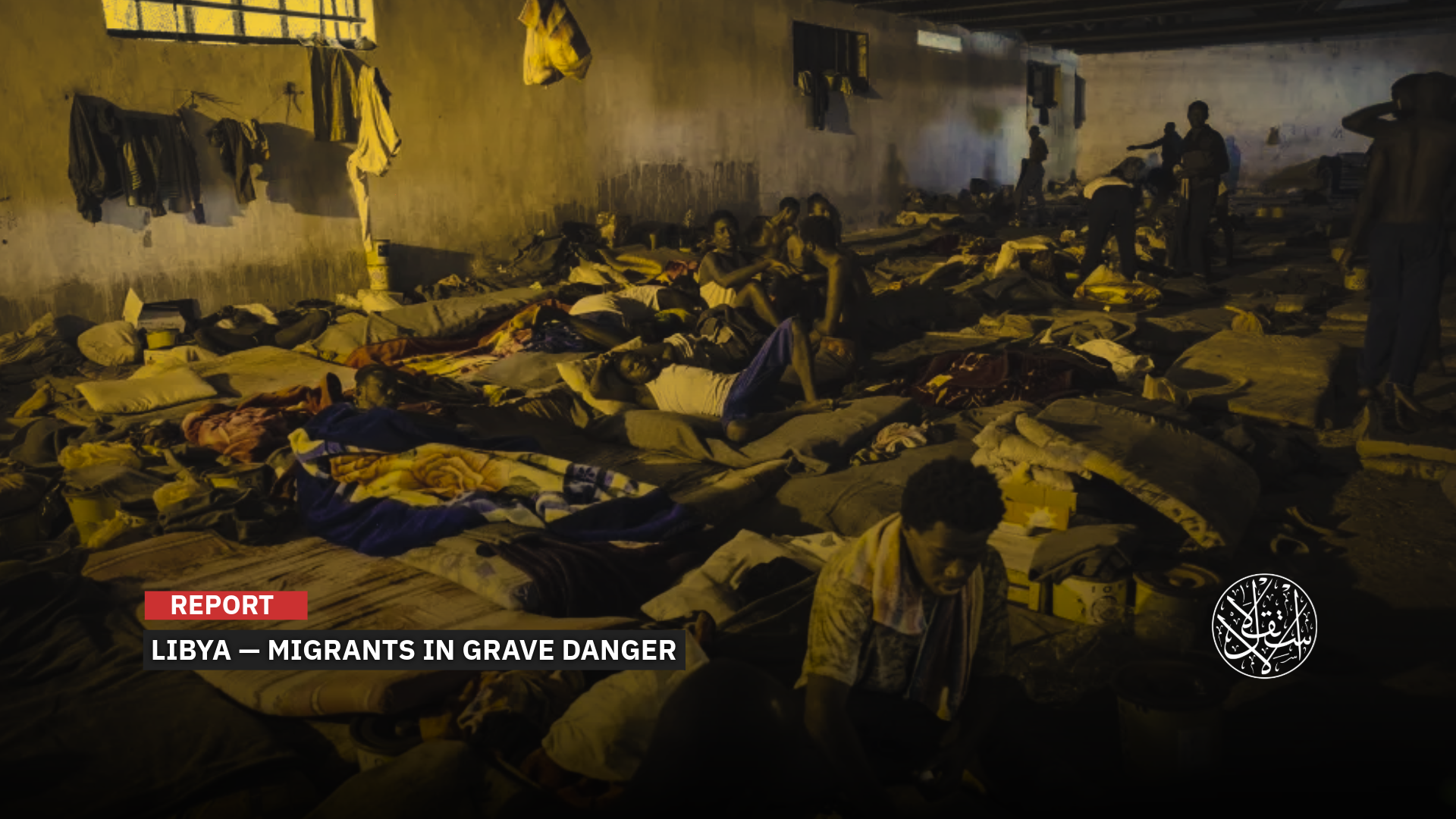
Inside these detention centers, migrants face systematic abuses, including enslavement, torture, mistreatment, forced labor, coerced prostitution, sexual violence, extortion, and the confiscation and resale of personal belongings and identity documents.
The report also describes perilous journeys across the central Mediterranean, noting that interceptions by Libyan authorities were often dangerous, involving threats, reckless maneuvers, and excessive use of force, putting lives at risk. Many of those intercepted are forcibly returned to Libya, only to face the same cycle of abuses again.
Repeated mass deportations to other countries also violate international human rights law and refugee protections, including the African Union Refugee Convention. Forced returns often occur without individual assessments, denying people the right to seek asylum and exposing them to life-threatening conditions with no access to food, water, or healthcare.
Calls From the UN
The report urges Libyan authorities to immediately release all arbitrarily detained individuals, halt dangerous interceptions, and decriminalize irregular entry, stay, and exit from the country. It calls for an end to all forms of modern slavery, forced labor, and human trafficking, with accountability for rights violations.
It emphasizes the need for effective maritime search and rescue operations and urges the international community, including the EU, to suspend returns to Libya until adequate human rights protections are guaranteed.
The report stresses that all technical, financial, and material support involving Libyan authorities proven to be involved in severe human rights abuses must comply with strict human rights due diligence. Aid should be restricted to actors who demonstrate sustained commitment to international human rights standards.
Covering the period from January 2024 to December 2025, the report exposes a system that profits from the suffering of migrants, asylum seekers, and refugees living in increasingly precarious conditions—a brutal status quo that has become normalized.
The findings are based on interviews with around 100 migrants, asylum seekers, and refugees from 16 countries across Africa, the Middle East, and South Asia.

Multiple Reports
The UN report echoes findings from the January 2026 report by Libya Crimes Watch (LCW), which documented ongoing serious human rights violations and international crimes against civilians across Libya.
The organization noted a persistent failure by authorities in both eastern and western Libya to uphold their legal obligations to protect human rights, investigate abuses, and hold perpetrators accountable.
During January, LCW documented patterns of violations, including unlawful killings and abductions. Its field teams recovered the bodies of three minors in Sabratha, a kidnapped Sudanese asylum seeker in Tripoli, and an unidentified body believed to be a migrant on a desert route in al-Jufra.
Along migration routes, the field team also retrieved 21 bodies from a mass grave near Ajdabiya, highlighting the deadly risks faced by those attempting to cross Libya.
LCW holds the security and military authorities in both East and West Libya legally responsible for these abuses, whether through direct involvement, complicity, or failure to prevent harm and protect victims. The organization has called on the Libyan attorney general to launch urgent investigations and ensure accountability.
Authorities were also urged to implement effective measures to safeguard migrants along migration routes, investigate abuses against them, and ensure that perpetrators face justice.
LCW notes that the cases included in this report do not necessarily reflect the full scale of violations committed during the month but only those that the field monitoring team was able to verify using a systematic documentation methodology, with full adherence to confidentiality, privacy, informed consent, and risk assessment related to publishing the information.
Recent Incidents
Tragic events continue weekly. In the latest, seven bodies of irregular migrants from sub-Saharan Africa were found on the shores of Qasr al-Akhyar, about 70 kilometers east of Tripoli, after being washed ashore by the sea. Photos released by the local Mohager website on February 23 showed the grim scene, some bodies partially buried in the sand.
According to Hassan al-Ghweil, head of investigations at Qasr al-Akhyar police, locals reported seeing the body of a child swept ashore and then carried back to sea by high waves. All recovered bodies were identified as Black Africans, including three children.
Earlier, 53 migrants, including two infants, died or went missing off the Libyan coast on February 6 after a rubber boat capsized near Zwara. Only two Nigerian women survived the rescue; one lost her husband and the other her infants.
Libya, located about 300 kilometers (200 miles) from the Italian coast, remains one of North Africa’s main departure points for migrants—mostly from sub-Saharan Africa, along with people from Asia and the Middle East—attempting the perilous crossing of the Mediterranean.
Human traffickers exploit the vulnerability of these migrants, fleeing war and crises in their home countries, by packing them into overcrowded, unseaworthy boats for profit.
According to the International Organization for Migration (IOM), over 2,100 irregular migrants died or went missing while trying to cross the Mediterranean to Europe in 2025.
The start of 2026 has already seen the highest migrant death rates on the Mediterranean since data collection began in 2014. Most fatalities continue to occur in the central Mediterranean, where 547 deaths were recorded so far this year. Since 2014, the total number of deaths in the Mediterranean has reached 34,129, including 26,361 in the central Mediterranean alone.

Migrant Deportations
Libyan authorities continue to deport migrants under their control. In one of the latest operations, the Anti-Illegal Migration Agency (DCIM) announced the deportation of 155 migrants through the Umm Sa’ad land crossing, part of what it described as intensified efforts to control borders and combat illegal migration in the east.
According to the local site Alwasat on 22 February 2026, DCIM said the deportations aimed to curb migration flows and strengthen security measures in border regions. The migrants were sent in two groups: the first included Egyptians deported via the border with Egypt, while the second included Eritreans, Somalis, Bangladeshis, and Guineans, who were transferred to the Qanfouda detention and deportation center pending return to their home countries.
The agency emphasized that daily operations continue across its offices and units as part of a broader plan to fight illegal migration, framing the measures as necessary to protect borders and public safety.
At a national level, Libya has accelerated and expanded the deportation of irregular migrants as part of a new program launched in October 2025. According to the Interior Ministry, the program seeks to prevent any “permanent settlement” of migrants in Libya amid growing public tension and official concerns over demographic and security impacts.
Interior Minister Imad al-Trablesi stated at a 2 December 2025 press conference that Libya is working rapidly to return irregular migrants to their home countries, including Egypt, Niger, Nigeria, and Bangladesh. Thousands have already been deported via special flights under full legal procedures overseen by their respective embassies.
Al-Trablesi noted that since 2010, Libya has seen nearly three million irregular migrants arrive, around 70 percent of whom were families, raising fears of lasting demographic shifts. He added that Sudanese migrants would be treated differently, with access to health and education services, given the worsening security situation in Sudan since the outbreak of war in April 2023, which drove 500,000 to 700,000 people toward Libya.
General Overview
For human rights observers, these practices are far from surprising. Tariq Lamloum, head of the Benghazi Center for Migration and Refugee Studies, told Al-Estiklal that reports of abuses against migrants in Libya, including those in the UN report, “reflect long-standing patterns.”
“Since I began working on migration in 2012, through field monitoring and reports from Belaady Organization for Human Rights, we have documented repeated violations,” Lamloum said. “These include arbitrary detention, violence and humiliation, extortion, and near-total lack of transparency about detention sites and the number of detainees.”
He added that migration is primarily managed with a security mindset across multiple agencies with overlapping authority and weak judicial oversight. “This environment allows abuses to flourish and fosters impunity. The absence of a clear national migration policy, coupled with political division and institutional chaos, keeps migrants in the most vulnerable position.”
Lamloum also criticized European policies, which he said focus more on prevention and interception at sea rather than protection and legal pathways.
Addressing the crisis, he said, “The solutions are not complex; what is missing is real will.”
Key steps, according to the activist, include clearly disclosing all detention centers and responsible authorities, ending arbitrary detention, ensuring judicial review for each case, and opening centers to independent oversight from prosecutors and local and international human rights bodies.
“Anyone found responsible for torture, extortion, or enforced disappearance must be held accountable without exception,” he added.
Lamloum stressed the importance of shifting from seasonal security campaigns to a comprehensive legal policy that both protects borders and respects human dignity. He called for international pressure to expand resettlement programs and safe pathways, rather than relying solely on deportation or Coast Guard support.
“Libya’s reputation will not improve through statements or media campaigns. It will improve when the law is enforced and human dignity is respected, whether for Libyans or migrants,” he said.
“Under the current political division, with two governments and armed groups controlling some detention facilities, the crisis is likely to worsen.”
“Frankly, we see no serious signs of comprehensive improvement in the near future without genuine institutional reform and unified management of migration,” the activist added.
Sources
- Seven African Migrants Found Dead on Beach East of Libya’s Capital, Tripoli [Arabic]
- Migrants in Libya victims of “violent business model” of systemic violations and abuses – UN report
- Report: Human Rights Violations in Libya During January 2026 [Arabic]
- Libya Deports 155 Migrants via Eastern Border Crossing in Anti-Migration Drive [Arabic]