Madrid Moves to Redefine Ceuta and Melilla’s Place in the European Union: What’s Behind the Shift?
Spain is seeking to complicate Morocco’s longstanding demands and rally support from the European Union.
Following the mass crossing into the Spanish-administered city of Ceuta, Madrid is no longer focused solely on securing the border fence and coastline, returning those who crossed, or addressing the security gaps exposed by the crisis. Instead, it has begun working to redefine Ceuta and Melilla’s status within the European Union itself.
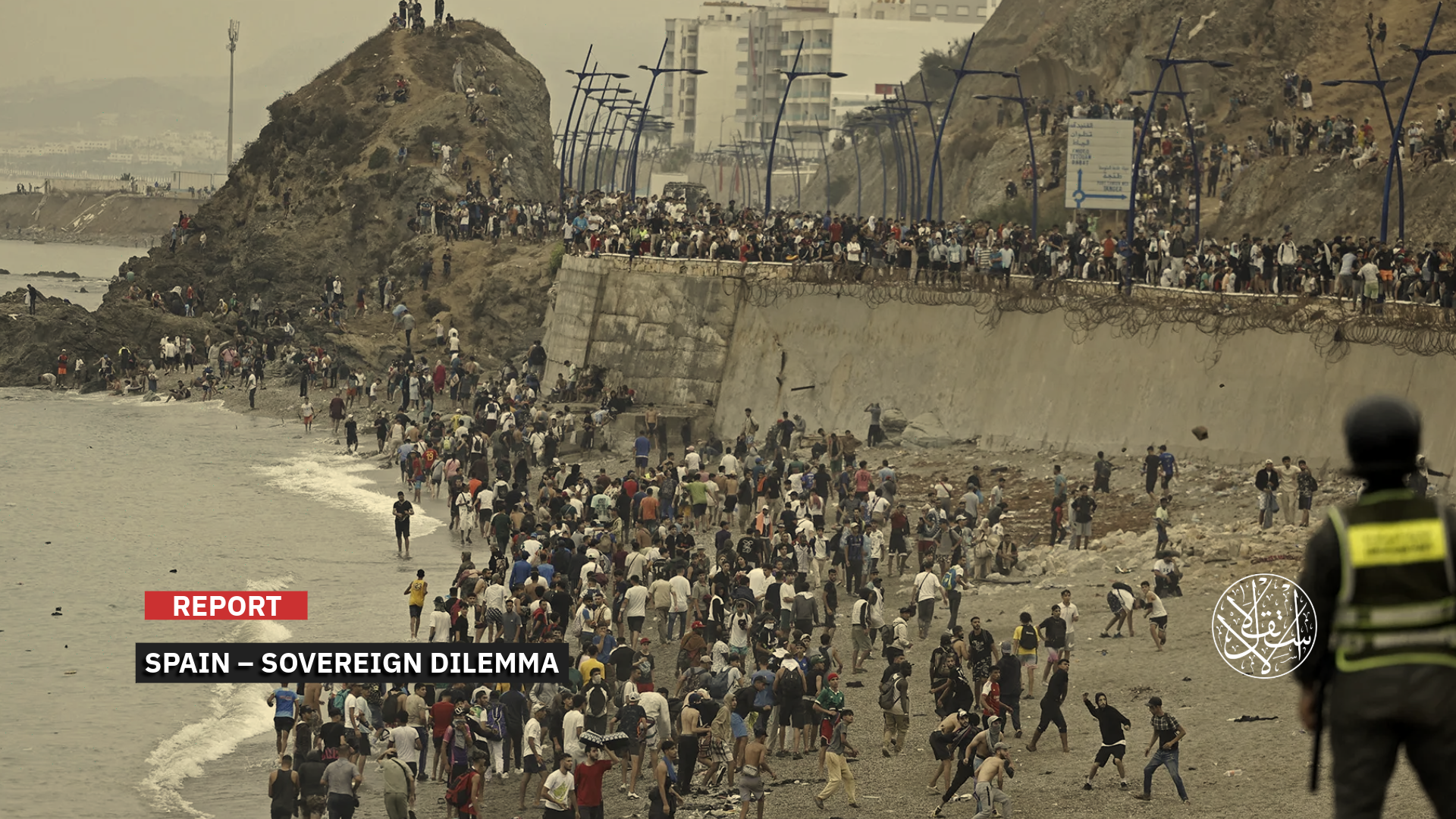
In late July 2026, more than 70,000 people crossed from Morocco into Ceuta in an attempt to enter Europe illegally after receiving calls on social media urging them to make the crossing.
Ceuta and Melilla lie along Morocco’s northern coast and are administered by Spain, while Rabat continues to demand sovereignty over both cities. They are also among the main entry points for irregular migrants traveling from Africa to Europe.
Three Proposed Pathways
In the immediate aftermath of the mass-crossing crisis, Spain unveiled a new plan to strengthen Ceuta and Melilla’s integration into the European Union. The proposal outlines three main pathways.
The first is membership in the EU customs union. Madrid has proposed bringing both cities into the bloc’s customs territory while preserving a special tax regime suited to their particular circumstances.
The second involves securing permanent representation on the European Committee of the Regions.
Spain currently has 21 full members on the committee and an equal number of alternate members, representing its autonomous communities and regions.
The government wants to guarantee Ceuta and Melilla permanent seats within Spain’s delegation, rather than leave their representation subject to existing arrangements and rotation.
The third pathway involves securing recognition as the EU’s “outermost regions,” or obtaining a comparable status.
This designation allows the EU to adapt certain rules to a region’s specific circumstances in areas such as customs, taxation, state aid, agriculture, fisheries, and access to European funding.
Although EU treaties apply to Ceuta and Melilla, both under Spanish administration, their integration into the European framework has remained incomplete and exceptional since Spain joined the European Communities in 1986.
Neither city is part of the EU customs territory. As a result, the movement of goods between them and the rest of the bloc’s customs territory is subject to special procedures, even though locally produced and EU-origin goods benefit from customs exemptions under Spain’s accession protocol.
The two cities are also outside the EU’s value-added tax system. Instead, they apply a local tax on production, services, and imports.
There is also an exceptional arrangement governing the movement of people. Ceuta and Melilla form part of the Schengen Area’s external border with Morocco, but Spain has retained additional checks on travelers arriving by sea or air from the two cities and heading to the rest of Spanish territory.
In practice, this means that someone entering Ceuta from Morocco crosses an external border but must undergo another check if they wish to travel from the city to mainland Spain.
Spain’s Foreign Ministry now describes this arrangement as a unique “double filter” within Europe.
The system dates back to Spain’s decision to preserve a distinct economic and commercial model for Ceuta and Melilla even after joining the European Communities. Historically, that model has relied on low taxes, cross-border trade, and direct commercial ties with neighboring Moroccan regions.
Four decades later, however, the Spanish government has begun to view this same arrangement as a constraint that needs to be overcome.
A New Strategic Bet
In the wake of the Ceuta crisis, Madrid appears to have adopted a new strategic approach: if Ceuta and Melilla constitute virtually the only land border between the European Union and the African continent, Spain should not have to bear the cost of protecting them alone.
Driven by this calculation, Madrid has stepped up efforts to deepen the two cities’ integration into the EU through a series of official statements and visits by senior government officials. The latest was King Felipe VI’s visit to both cities, alongside a series of statements by European leaders backing their European status.
On 3 September 2026, Prime Minister Pedro Sanchez told Parliament that the time had come to address what he described as a “lack of ambition” in Spain’s accession to the European Communities in 1986.
Sanchez proposed incorporating Ceuta and Melilla into the EU customs union while preserving an appropriate tax regime, granting them permanent representation on the European Committee of the Regions, and recognizing them as EU “outermost regions.”
Foreign Minister Joss Manuel Albares subsequently traveled to Brussels, where he held meetings with European Commission and EU officials on 8 and 9 September 2026.
According to Spain’s Foreign Ministry, Albares discussed possible “options” for bringing the two cities into the customs union and arrangements that could recognize their geographical particularities. He also pushed for permanent representation for Ceuta and Melilla within Spain’s delegation to the European Committee of the Regions.
Brussels then provided a concrete indication that the Ceuta crisis had become a European issue. On 9 September 2026, the European Commission announced €114.7 million in emergency funding for Spain to address the fallout from the events of 30 and 31 July. The funding included support for border surveillance, security equipment, reception facilities, and returns.
This was followed by the first visit by King Felipe VI and Queen Letizia to Ceuta and Melilla, on 13 and 14 October 2026.
It was Felipe VI’s first visit to the two cities since ascending the throne in 2014 and only the second visit by a Spanish monarch. His father, King Juan Carlos I, visited Ceuta in November 2007, triggering a diplomatic crisis with Rabat.
During the visit, Felipe VI reaffirmed that Ceuta and Melilla were an integral part of Spain’s national and political identity and stressed that the country’s sovereignty and territorial integrity were nonnegotiable.
Described by Spanish media outlets as “historic,” the visit was intended to demonstrate solidarity with the cities’ residents following the mass crossing into Ceuta, an incident that left 141 people dead by drowning.
Beyond its domestic efforts, Madrid has also received backing from several European leaders and countries. Among the most prominent was French President Emmanuel Macron, who described the mass crossing into Ceuta as an “attack on Europe.”
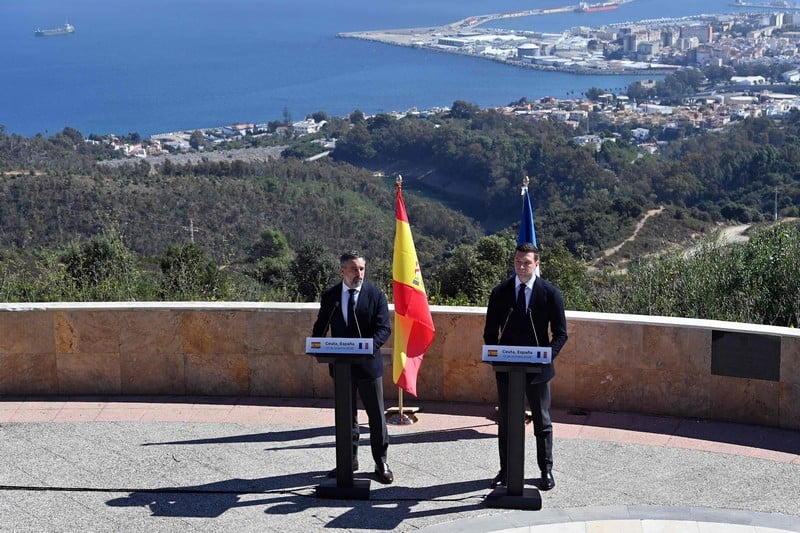
On 30 September 2026, during a joint press conference with Sanchez in Madrid, Macron said Spain had been “the victim of a multifaceted attack.”
His remarks aligned with the position expressed in a European Union statement on 17 September 2026 and by European Commission President Ursula von der Leyen, both of whom described what happened in Ceuta as an “attack” and characterized the city as a “European border.”
Jordan Bardella, leader of France’s National Rally, also declared that Ceuta was “Spanish and European territory and should remain so.” He made the remarks during a visit to the city with Santiago Abascal, leader of Spain’s far-right Vox party, coinciding with Spain’s National Day celebrations.
On 12 October 2026, Bardella, one of the most prominent figures on the French far right, said the situation in Ceuta reflected what he called an “existential threat” facing Europe. He added that the city offered a glimpse of the future awaiting the continent unless European countries urgently regained control of their national and external borders.
Bardella also claimed that residents had faced threats of looting and physical attacks, citing incidents he said had been documented by the Spanish press. However, he provided no detailed information to establish the scale of these incidents or the findings of any investigations.

Settling the Sovereignty Question
Commenting on Spain’s stepped-up efforts to deepen Ceuta and Melilla’s integration into the European Union, Nabil Driouch, a journalist and writer specializing in Spanish affairs and Moroccan-Spanish relations, said that “bringing the issue of Ceuta and Melilla into the European Union is nothing new. It dates back to the mid-1980s, when Spain joined the European Economic Community.”
“Since then, Spain has sought to shift the debate over the two cities, in its dispute with Morocco, onto the European stage in an effort to strengthen its position. In reality, this is a sign of weakness, not strength,” he told Al-Estiklal.
“This strategy was particularly evident during the 2021 crisis, when Madrid drew Brussels into an open confrontation with Morocco. Spain’s appeals to Brussels intensified throughout the crisis, involving politicians from both the right and the left. King Felipe VI himself even told Macron at a recent official dinner in Madrid that Ceuta’s border was a “European border.”
On 29 September 2026, Macron made the first state visit to Spain by a French president since 2009. The visit aimed to strengthen French-Spanish relations and advance implementation of the friendship treaty signed by the two countries in 2023, as well as discuss economic cooperation and shared European issues.
“Another unprecedented move was made by Santiago Abascal, leader of the far-right Vox party, when he celebrated Spain’s National Day in occupied Ceuta and brought Jordan Bardella, leader of France’s National Rally, with him to the occupied city, as if seeking to bolster his position through Bardella’s presence,” Driouch added.
He stressed that Spanish politicians and the monarchy were making every effort to “Europeanize” the border, erecting further barriers to Morocco’s longstanding demands and making the dispute even more complicated by placing it under the EU’s umbrella.
Driouch pointed out that during King Felipe VI and Queen Letizia’s visit to occupied Ceuta, large EU flags were raised alongside Spanish flags, calling it “a deliberate and unmistakable message.”
Observers believe Madrid’s push to deepen Ceuta and Melilla’s integration into the European Union gives Spain greater scope to portray any border or migration crisis as an issue affecting not only Spain but also the EU’s borders and interests.
They conclude that through its efforts to “Europeanize” Ceuta and Melilla, Spain is seeking to draw Brussels more deeply into safeguarding the status quo it maintains in the two cities.
Sources
- EU Gives Spain €115 Million to Strengthen Its Borders After Ceuta Crisis [Arabic]
- Bardella Provokes Morocco From Occupied Ceuta: “It Will Remain Spanish and European Territory” [Arabic]
- Amid Moroccan Silence, Felipe VI Visits Ceuta for the First Time and Reaffirms It Is “An Integral Part” of Spain [Arabic]