Yousef Jabareen: What Cards Does the Leader of the Joint List Hold in the Battle to Form the Government in ‘Israel’?

The turnout expressed Palestinians’ desire to defend their civil rights.
The results of the latest Israeli elections have put Palestinian parties back at the heart of the government-formation equation. They won 19 seats in the Knesset (parliament), compared with 53 for the camp of the occupation’s outgoing prime minister, Benjamin Netanyahu, and 48 for his opponents.
These results gave Yousef Jabareen, head of the Joint List, a chance to influence the future of the government. The alliance he leads holds 11 seats. Opposition leaders, however, disagree over whether to rely on Palestinian votes to unseat Netanyahu.
Jabareen, a law professor and former human rights activist, is facing his biggest political test after reuniting three Palestinian political parties.
He has declared that his list is ready to support an alternative government from outside its coalition. In exchange, he wants commitments on ending the occupation, equality, and fighting crime.
However, his efforts are running up against conditions set by Gadi Eizenkot—leader of the Yashar party and former Chief of Staff of the occupation army—and his allies, as well as internal divisions within the Joint List itself.
This comes at a time when negotiations to form a new government are intensifying, even before the constitutional procedures for the transfer of power have been completed.
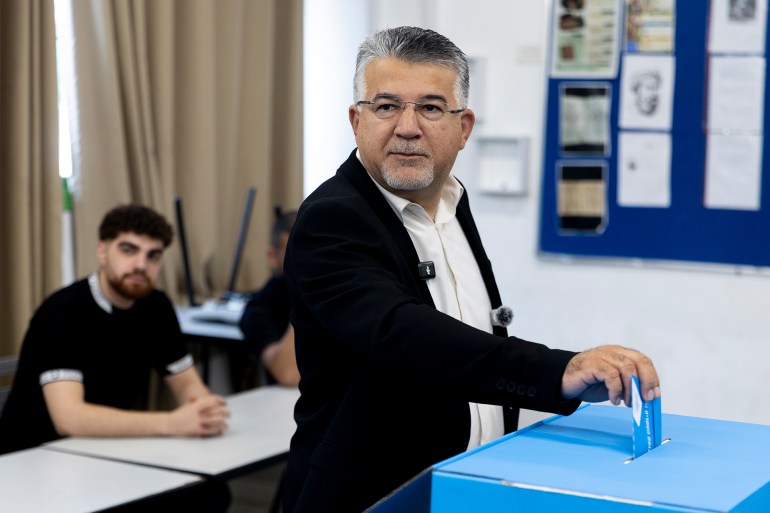
Who Is Jabareen?
Yousef Tayseer Jabareen was born in 1972 in Umm al-Fahm, in the Triangle region inside the Palestinian territories occupied in 1948. He studied law at the Hebrew University of Jerusalem, earning his bachelor’s degree in 1995, before moving to the United States.
He earned a master’s degree in international law from American University in Washington in 1997, then a doctorate in juridical science from Georgetown University in 2003.
He later lectured in law and human rights at academic institutions including Tel-Hai College, the University of Haifa, and Tel Aviv University.
Before entering the Knesset, Jabareen headed the legal department of the Haifa branch of the Association for Civil Rights in “Israel” from 1997 to 2000.
The organization works on freedoms and equality. He took part in cases on discrimination in government budgets, the status of the Arabic language, and Palestinian rights.
In 2006, he founded the Arab Center for Law and Policy, “Dirasat”, in Nazareth and directed it until 2015. He was also active in civil and educational institutions.
Jabareen entered the Knesset in 2015 representing the Democratic Front for Peace and Equality (Hadash), a left-wing Arab-Jewish alliance that includes the Israeli Communist Party. Hadash ran as part of the Joint List, which at the time brought together the main Palestinian parties.
During his time in the Knesset, which lasted until 2021, he focused on education, children’s rights, and discrimination against Palestinians.
He chaired the Knesset Committee on the Rights of the Child from 2020 to 2021. He also handled the Joint List’s international relations, which allowed him to engage with European and UN institutions on the Palestinian cause.
On May 16, 2026, he was elected chairman of Hadash with 82 percent of the vote in its internal election. He succeeded Ayman Odeh, who had led the party since 2015.
Jabareen made reuniting the Palestinian parties a priority. On August 19, he reached an agreement to run in the Knesset elections as the Joint List with the Arab Movement for Renewal (Ta’al), led by MK Ahmad Tibi, and the National Democratic Assembly (Balad), led by former MK Sami Abou Shehadeh.
The agreement followed negotiations marked by disputes over the order of candidates and the distribution of seats, especially with Ta’al, which wanted better representation in the alliance.
Under the deal, Jabareen headed the list, with Tibi second and Abou Shehadeh third. The parties then faced a legal crisis that threatened their participation in the elections.
On September 23, the Israeli Central Elections Committee decided to disqualify the two Arab lists and several of their candidates.
The Supreme Court overturned the decision and allowed both lists to run. By a majority of seven justices to two, it also upheld the candidacy of MK Ofer Cassif, a Hadash representative.
Abou Shehadeh, however, withdrew his candidacy after Supreme Court President Yitzhak Amit told him that a majority of the justices supported disqualifying him.
Adalah, a legal center that defends the rights of Palestinians in “Israel”, said the disqualification proceedings targeted Palestinian political participation and relied on insufficient evidence.
On October 2, the center warned of the consequences of removing Abou Shahadeh from the race, even though his party remained part of the Jabareen-led Joint List.
Jabareen supports ending the occupation and establishing a Palestinian state on the 1967 borders. He ties his parliamentary work to defending the national and civil rights of Palestinians in the 1948 territories.
In September 2026, he described the elections as existential for Palestinians. He warned against the continuation of the occupation government’s policies toward Gaza, the West Bank, and Arab towns, and stressed the importance of preserving Palestinian national identity while working politically inside the Knesset.
In an interview with the Israeli Channel 12 at the end of October, Jabareen condemned what he called “the killing of civilians” during the Al-Aqsa Flood Operation.
However, he declined to describe the Islamic Resistance Movement, Hamas, as a terrorist organization, despite being asked repeatedly.
This position matters because some Israeli opposition leaders have made accepting the Israeli designation of the movement a condition for joining the governing coalition. The Joint List’s electoral rise, meanwhile, came alongside a sharp increase in Palestinian voter turnout.
According to a study published by the “Israel” Democracy Institute in early November 2026, turnout in Arab and Druze towns reached 77 percent, compared with 53.2 percent in the 2022 elections. In Umm al-Fahm, Jabareen’s hometown, turnout rose from about 38 percent to nearly 80 percent.
The study linked this shift to accumulated anger at the occupation government’s policies and to rising violence and crime. It cited a survey published in May 2026 in which 75 percent of Arab respondents named crime as the greatest domestic threat.
Another survey, published in October, found that 78.5 percent of Arab respondents were pessimistic about the future of democratic governance in “Israel”.
The institute’s study concluded that the turnout expressed Palestinians’ desire to defend their civil rights and to influence political decisions through the ballot box.
The high turnout helped the Joint List win 11 seats, while the United Arab List (Ra’am) won eight. Together, the two lists hold 19 seats, the highest representation for Arab parties in the Knesset’s history. The previous record was 15 seats in 2020.
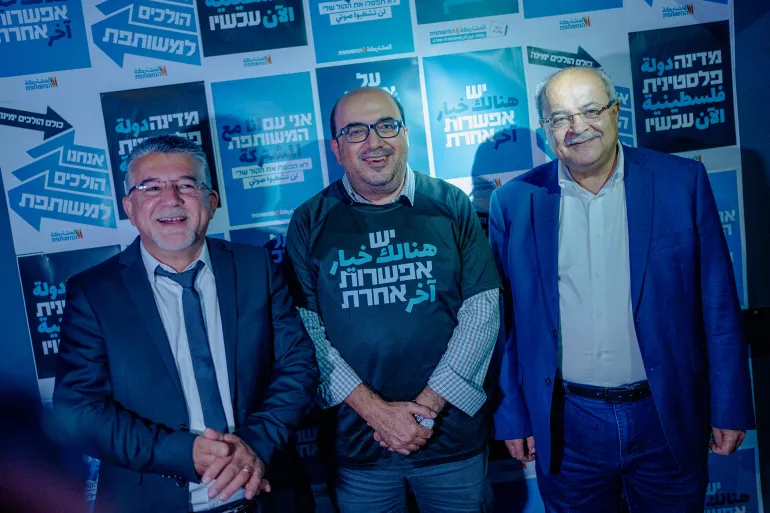
What Cards Does He Hold?
In a speech on October 10, Jabareen said that higher Palestinian turnout would give Arab parties the power to shape the next government.
He declared that his list was ready to provide a parliamentary “safety net” for any government that ends Netanyahu’s rule.
Jabareen said political influence requires negotiating over Palestinian demands, and he pledged to use every available parliamentary tool to change the government.
In an interview with the Israeli radio station 103FM on October 13, Jabareen set out several demands for negotiations with political forces.
At the top of the list was a comprehensive, funded government plan to fight organized crime in Palestinian society. He also called for developing Arab towns, expanding the jurisdiction of their local authorities, and stopping home demolitions.
The demands also included education, social welfare, and youth employment programs. They called for a political track based on recognizing the Palestinian people’s right to self-determination and establishing a state on the 1967 borders.
He also demanded action on the housing and urban planning crisis, plans for residential and industrial zones, and the repeal of penalties under the Israeli Kaminitz Law, which tightened the enforcement of building laws.
On October 11, the Israeli Channel 12 revealed that the Joint List was preparing professional programs for use in government negotiations. The programs drew on civil society proposals for fighting discrimination and developing Arab towns.
On the demand for a Palestinian state, Jabareen acknowledged in his radio interview that it would be hard to achieve as soon as a government is formed. He called for a change in Israeli policy and for negotiations with the Palestinian leadership.
He stressed that the Joint List would discuss its demands with any forces willing to cooperate with it. Recommending a candidate to form the government, or supporting that government, would depend on negotiations over its program.
In his October 10 speech, Jabareen also set limits on this cooperation. He refused to vote for budgets that fund aggression and settlement, to accept the Israeli Nation-State Law, which grants the right to national self-determination in the state exclusively to Jews, or to stay silent about the aggression on Gaza.
He stressed that any civil gains must respect Palestinians’ national positions, given the ongoing occupation and settlement expansion in the West Bank.
He also rejects compulsory military conscription for Palestinian youth and has reservations about national service in its security-oriented form.
He insists that any new arrangements be agreed with the High Follow-Up Committee for Arab Citizens, the umbrella representative body of Palestinians in the 1948 territories, and with the heads of Arab local authorities.
Jabareen refuses to join any governing coalition while the Israeli occupation of the West Bank continues. He is, however, willing to support from outside the coalition an alternative government that ousts Netanyahu.
This differs from the approach of Mansour Abbas, head of the United Arab List (Ra’am). In 2021, Abbas brought his party, which then held four seats, into the coalition of former Israeli prime ministers Naftali Bennett and Yair Lapid. In exchange, he secured understandings on budgets, fighting crime, and improving services in Arab towns.
In the 2026 elections, Abbas strengthened his push for a role in government by placing Yoav Segalovitz second on his list. Segalovitz is a former Israeli deputy minister of public security, a former police officer, and a former member of the Yesh Atid party.
The move was part of an effort to broaden Arab-Jewish political partnership. Jabareen criticized the approach, stressing that he prefers unity among Palestinian parties and has reservations about joining governments that continue the occupation’s policies.
Jabareen’s position did, however, show some flexibility after the election results. On October 31, he told Channel 12 that his list was ready to make difficult political decisions to change the government. These included recommending Eisenkot to form the government and postponing some issues related to the Palestinian political track.
In an interview published by The Guardian in early November, Jabareen explained that Eisenkot’s conditions apply to Arab parties joining the coalition. They are different from the outside-support arrangement the Joint List is seeking.
He stressed that the ongoing occupation prevents his list from joining the government, but that it can still use its parliamentary power to change policies toward Palestinians.
He also demands that any alternative government tackle discrimination in budgets and services, stop the aggression, and revive negotiations with the Palestinian leadership.

How Much Influence Can He Wield?
The election results gave Netanyahu’s camp 53 seats. Likud won 27; Jewish Power (Otzma Yehudit), led by National Security Minister Itamar Ben-Gvir, won 7; the Haredi alliance United Torah Judaism won 7; the religious Shas party won 6; and the Religious Zionism alliance, led by Finance Minister Bezalel Smotrich, won 6.
On the other side, Eisenkot’s Yashar party won 21 seats and the Together alliance, led by Bennett and Lapid, won 12.
The Democrats, led by former deputy chief of staff Yair Golan, won eight, and Avigdor Lieberman’s Yisrael Beitenu won seven. That brings the opposition camp to 48 seats.
Adding the Joint List’s 11 seats and Ra’am’s eight would give the opposition 67 seats, above the 61-seat majority. With only one of the two lists, the opposition would reach 59 seats with the Joint List or 56 with Ra’am.
The main obstacles lie within the opposition camp itself. In mid-October, Lieberman said he would not form a government that relies on Arab or Haredi parties, and called for a coalition made up only of Zionist parties.
At the end of October, Eisenkot repeated his conditions for joining any government he leads. They are: recognizing “Israel” as a Jewish, democratic, and liberal state; committing to the principles of its Declaration of Independence; accepting military or civilian service for all citizens; and recognizing Hamas as a terrorist organization whose military and governing capabilities must be dismantled.
These conditions clash with the Joint List’s positions, particularly on the identity of the state, conscription, and the Palestinian issue. Bennett, for his part, wants a government based on Zionist parties.
Golan, by contrast, called for recognizing the legitimacy of Palestinian voters’ ballots and negotiating with their representatives.
He considers excluding them from government-formation calculations a discriminatory practice that violates the principle of equality among citizens.
In his Channel 12 interview, Jabareen revealed initial contacts with Golan, with figures in Eisenkot’s party, and with the Bennett-Lapid alliance.
He said these contacts were limited to exploring whether positions could be coordinated, and that there had been no similar contact with Lieberman.
In his Guardian interview, he said informal consultations among opposition parties were continuing, but that he had not yet held direct talks with Eisenkot.
The contacts moved forward in early November, when Golan spoke by phone with Jabareen and Tibi. The Joint List said they discussed possibilities for political and parliamentary cooperation between the two sides. The call was part of preparations for the consultations on nominating a prime minister and for planning joint steps in the new Knesset.
The Together alliance, led by Bennett and Lapid, had announced that it would formally recommend to Israeli President Isaac Herzog that Eisenkot be tasked with forming the government. Golan signaled that he was leaning the same way.
Eisenkot’s efforts ran into an obstacle from Lieberman. The official Israeli public broadcaster, Kan, revealed that the Yisrael Beytenu leader refused to commit to recommending Eisenkot when the two met after the elections.
In early November, the Yedioth Ahronoth website reported, citing sources familiar with the meeting, that it was tense. Lieberman accused Eisenkot of hurting the opposition camp’s chances through his election campaign and his talk of a possible minority government.
Lieberman also criticized Eisenkot’s demand that the Knesset speakership go to a member of his party, and insisted on nominating MK Oded Forer of Yisrael Beytenu instead. The Joint List refused to back Forer to replace the current Knesset speaker, Amir Ohana, a senior Likud figure.
Jabareen proposed using the votes of the 67 MKs opposed to Netanyahu to replace the Knesset speaker and take control of the Arrangements Committee, which sets the legislative agenda, before any agreement on forming a government. His priorities include repealing laws passed by the outgoing government that he believes weakened the independence of the judiciary.
Separately, the Yedioth Ahronoth website revealed that Eisenkot agreed to examine a scenario for a minority government. It would take office with United Torah Judaism and the United Arab List abstaining rather than voting against it.
By the website’s calculations, Eisenkot’s camp could win 49 votes to 46 for Netanyahu’s camp if three groups abstained: United Torah Judaism’s seven MKs, the remaining seven United Arab List MKs, and the Joint List’s eleven MKs.
The Israeli parliamentary system allows a government to be sworn in with a majority of those voting in the confidence vote, so a minority government is possible if the necessary understandings are reached. The scenario faces a dispute over exempting yeshiva students from conscription, as well as Mansour Abbas’s wish to join the coalition.
Yedioth also reported that Eisenkot’s camp is considering whether United Torah Judaism could provide temporary outside support until an understanding is reached on the conscription law. That would pave the way for the party to join the government later.
Responding to the report, the Yashar party cast doubt on the information circulating about closed-door negotiations. It said the leaks were not authorized and may not reflect what is actually happening in the talks.
The official results were scheduled to be submitted to President Herzog on November 4. Consultations on tasking a Knesset member with forming the government would follow, before MKs are sworn in on November 10.
The Israeli Basic Law gives the designated candidate 28 days to form a government, with a possible 14-day extension. If the first attempt fails, the president can task another candidate. After that, other procedures follow that may end in new elections.
A unity government between Netanyahu and some of his opponents remains one of the options in the Israeli political debate. Prominent opposition leaders, however, have rejected the idea of the current prime minister staying in power.
Yedioth noted that the minority-government scenario could serve as a bargaining chip in future negotiations over a unity government.
Jabareen’s ability to influence the formation of the government, meanwhile, depends on whether opposition parties are willing to cooperate with the Joint List and on what understandings can be reached on Palestinian demands.
Sources
- Israel has ‘historic’ opportunity to change direction, says leader of Arab coalition
- “The Plan Is a Palestinian State on the ’67 Borders – Alongside ‘Israel’” [Hebrew]
- After the “Safety Net” Announcement: The Joint List’s Demands Revealed [Hebrew]
- Adalah: Supreme Court Rejects Disqualification of the Joint List, Ra’am and MK Cassif, and Pushes Abou Shahadeh to Withdraw from the Race [Arabic]
- Yousef Jabareen’s Original Academic CV [Arabic]
- Yousef Jabareen to Al-Araby Al-Jadeed: “Existential Elections for Palestinians of the 1948 Territories” [Arabic]
- “Qatari Money? We Voted En Masse Because of Ben-Gvir”: Joint List Chairman in an Exclusive Interview [Hebrew]
- Eisenkot Orders Examination: A Government with Ra’am and United Torah Judaism Abstaining [Hebrew]