Lana Nusseibeh: A Palestinian-Born Figure Who Supports Normalization With ‘Israel’ Is Being Considered by the Uae To Lead the United Nations
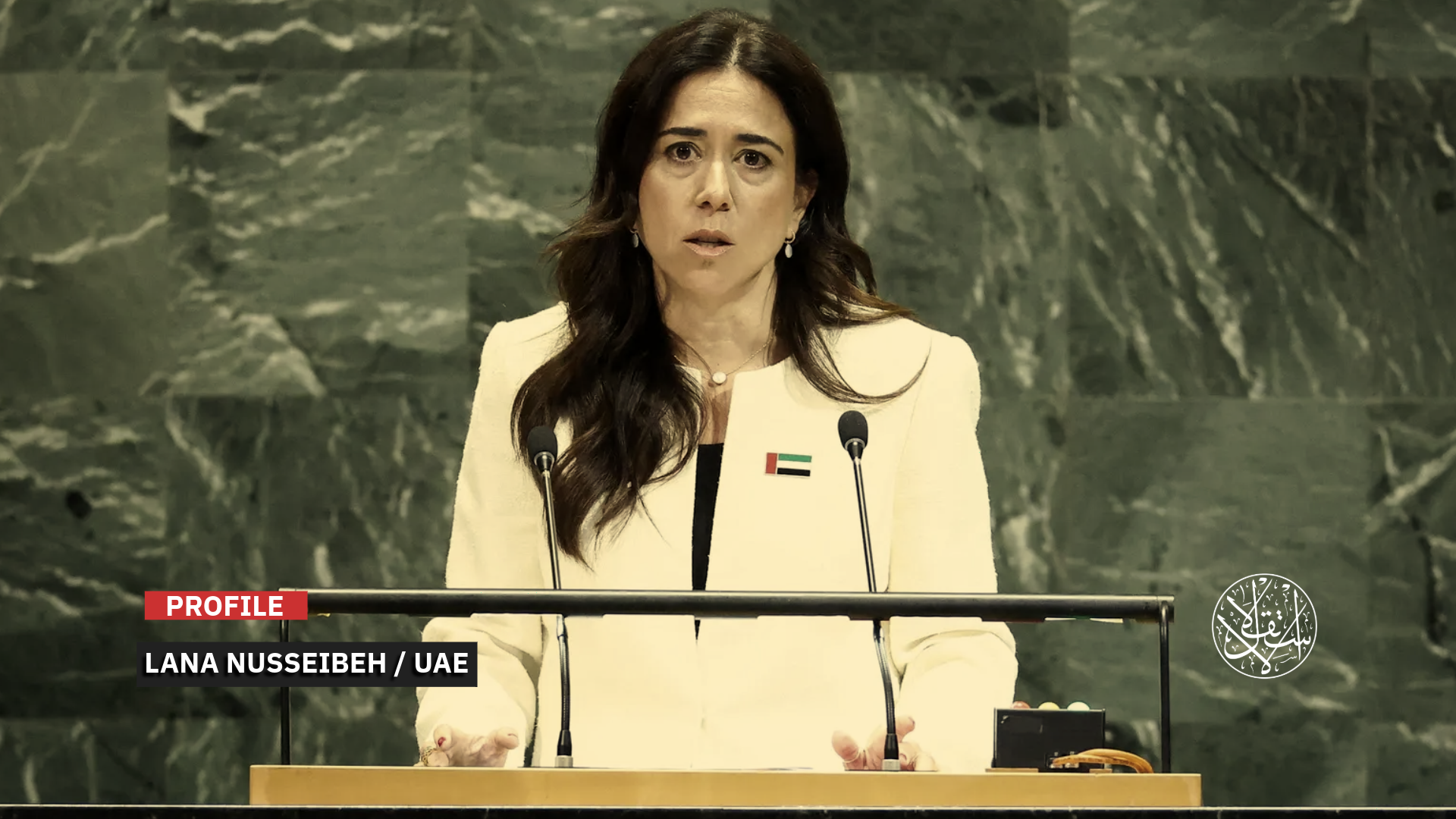
Lana Nusseibeh recently emerged as a prominent figure in responding to accusations that the UAE was arming Sudan’s RSF militia.
From her role in the UAE Foreign Ministry’s Political Planning Department to representing Abu Dhabi at the United Nations and now seeking to lead the international organization, Lana Nusseibeh has built a diplomatic career spanning a range of complex regional and international issues.
These include defending normalization agreements with the Israeli Occupation, taking part in negotiations on Gaza, and responding to accusations that the UAE supports Sudan’s Rapid Support Forces (RSF) militia.
Nusseibeh comes from a Palestinian family originally from occupied Jerusalem that has been close to the UAE’s ruling circles since the era of the country’s founder, Sheikh Zayed bin Sultan al-Nahyan.
She is now entering the race for UN secretary-general with Gulf and Palestinian backing, amid objections over the UAE’s role in Sudan and differing calculations among the major powers that will shape the selection of the next secretary-general.
How Was Her Background Shaped?
Her father, Zaki Anwar Nusseibeh, was studying at the University of Cambridge in the United Kingdom when “Israel” occupied East Jerusalem and the West Bank in 1967. He moved to Abu Dhabi in the late 1960s, bringing a collection of books with him.
Zaki began his career in journalism, working with Western media outlets, before becoming a translator and adviser to the UAE’s founder, Sheikh Zayed bin Sultan al-Nahyan, a role he held until 2004. He later took on several government and cultural positions, including minister of state and cultural adviser to the UAE president.
His family belongs to one of occupied Jerusalem’s prominent Palestinian families, whose name has been associated for centuries with the tradition of opening and closing the Church of the Holy Sepulchre, alongside the Joudeh family, which holds the church’s key.
His father, Anwar Nusseibeh, was a prominent Palestinian political figure who lost one of his legs after being wounded in the 1948 war.
He later held several positions in the Jordanian government, including minister of defense and governor of occupied Jerusalem.
The family’s political presence also extended to Sari Nusseibeh, Lana’s uncle, a Palestinian philosopher and academic who served as president of al-Quds University and as the Palestine Liberation Organization’s representative in occupied Jerusalem.
In 2003, he joined Ami Ayalon, the former head of “Israel’s” Shin Bet security service, in launching the “People’s Voice” initiative, which proposed a framework for a Palestinian-Israeli political settlement.
Born in Abu Dhabi in 1978, Lana grew up surrounded by this family legacy and the close ties her father had forged with the UAE’s ruling family. As a child, however, she considered pursuing a path different from her family’s political tradition.
In a report published on 23 October 2026, Yedioth Ahronoth quoted a previous statement in which she said she wanted to choose a different path from the one her family had traditionally followed.
She received her schooling in Britain and studied history at the University of Cambridge before specializing in Israeli studies and the Jewish diaspora at the School of Oriental and African Studies (SOAS), University of London.
In 2003, she graduated with a master’s degree with distinction, having studied Hebrew alongside her fluency in Arabic, English, and French.
Her former British professor, Colin Shindler, described her as an outstanding student who produced in-depth research on Israeli history and the Zionist movement.
He said she later played an important role in supporting the “Abraham Accords,” which paved the way for normalization between the UAE and the Israeli Occupation in 2020.
Speaking to Yedioth Ahronoth, Shindler recalled visiting her father’s home in Abu Dhabi, where he saw an encyclopedia of Judaica, covering Jewish history and culture, alongside books on Jewish history.
He also noted that the collection of books Zaki Nusseibeh brought with him when he moved to the UAE eventually grew into a private library containing more than 40,000 volumes, reflecting the family’s longstanding interest in history, culture, and politics.
How Did She Rise Through the Political Ranks?
She began her career in international affairs through consultancy assignments with the United Nations Educational, Scientific and Cultural Organization (UNESCO) in Paris, along with research on security and terrorism.
She later moved into the UAE’s government institutions, where she established the Political Planning Department at the Ministry of Foreign Affairs in 2009 and became its first director.
Over the following years, she worked on files related to Afghanistan and Pakistan and preparations for the 2011 G20 summit.
In September 2013, she was appointed the UAE’s permanent representative to the United Nations, becoming the first woman to hold the post, which she retained until April 2024.
Her work in New York opened the door to several international roles. In 2017, she chaired the executive board of UN Women and served as vice president of the 72nd session of the UN General Assembly.
She also took part in negotiations on Security Council reform and efforts to revitalize the General Assembly.
She chaired the Security Council twice during the UAE’s 2022-2023 nonpermanent membership and contributed to efforts to reform the process for selecting the UN secretary-general to make it more transparent and inclusive.
Nusseibeh also emerged as a prominent figure in the UAE’s rapprochement with “Israel,” which culminated in the signing of the “Abraham Accords” in Washington on 15 September 2020.
She defended the establishment of direct ties with “Tel Aviv,” arguing that boycotts and avoiding dialogue had failed to achieve a political settlement.
She worked with the American Jewish Committee, which advocates for “Israel” and stronger international ties for the country, and took part in events discussing the expansion of the Abraham Accords.
These efforts coincided with growing working relations between Emirati and Israeli diplomats at the United Nations.
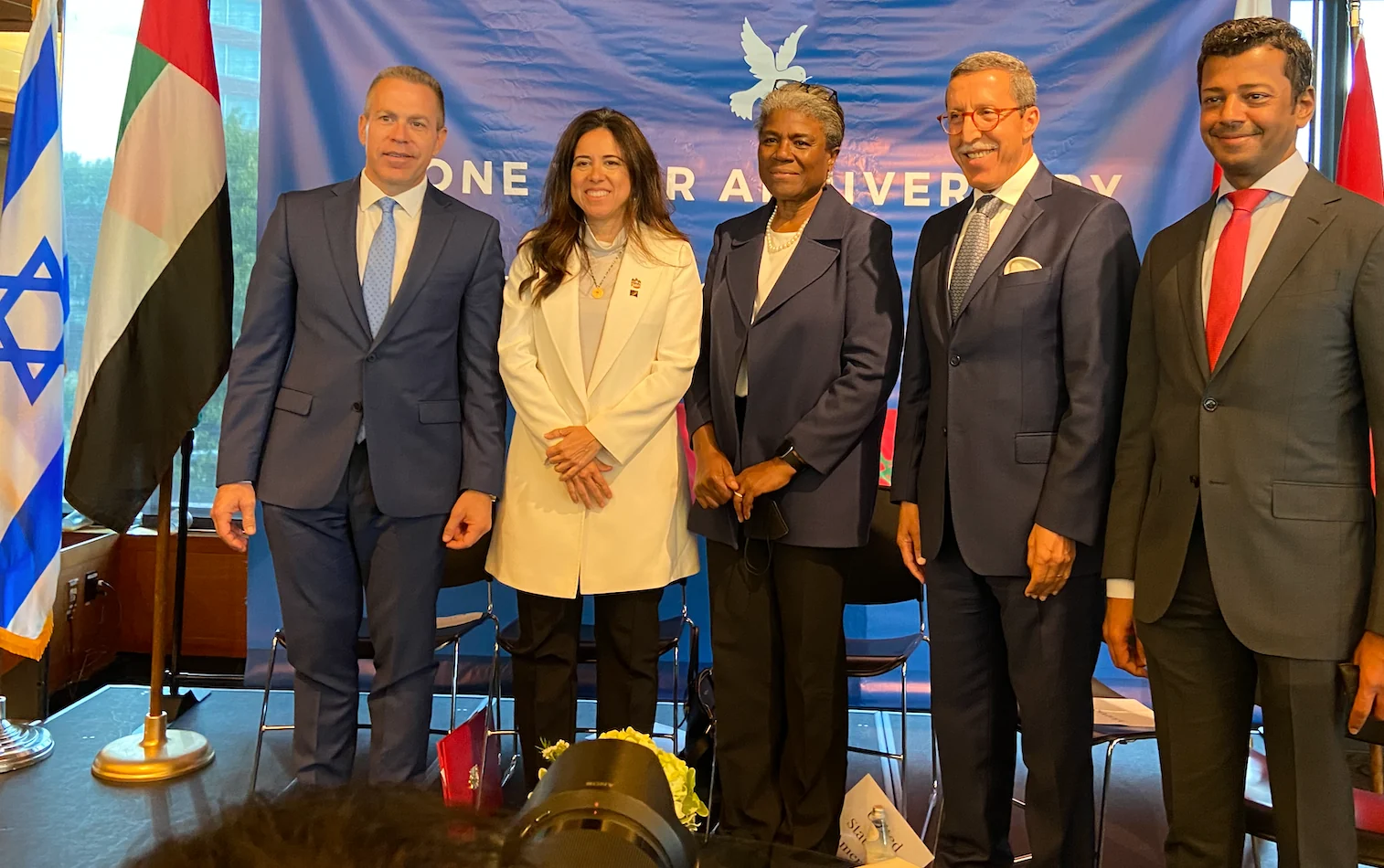
In December 2022, she joined then-Israeli Ambassador to the UN Gilad Erdan in organizing a visit to “Israel” by a delegation of 13 ambassadors.
The delegation met then-Prime Minister-designate Benjamin Netanyahu and President Isaac Herzog, following an earlier visit organized by the UAE side.
During the meetings, Nusseibeh highlighted the growth in trade between the UAE and the Israeli Occupation, which reached $2 billion in the first nine months of 2022, as well as opportunities for cooperation in agriculture, medicine, tourism, and technology.
She continued to defend the Abraham Accords during “Israel’s” aggression on Gaza, arguing that diplomatic relations provided channels for communication and influence over Israeli positions.
On 3 September 2025, she warned against plans to annex the occupied West Bank, describing them as a red line that threatened the future of regional integration the UAE had pursued through normalization with “Israel”.
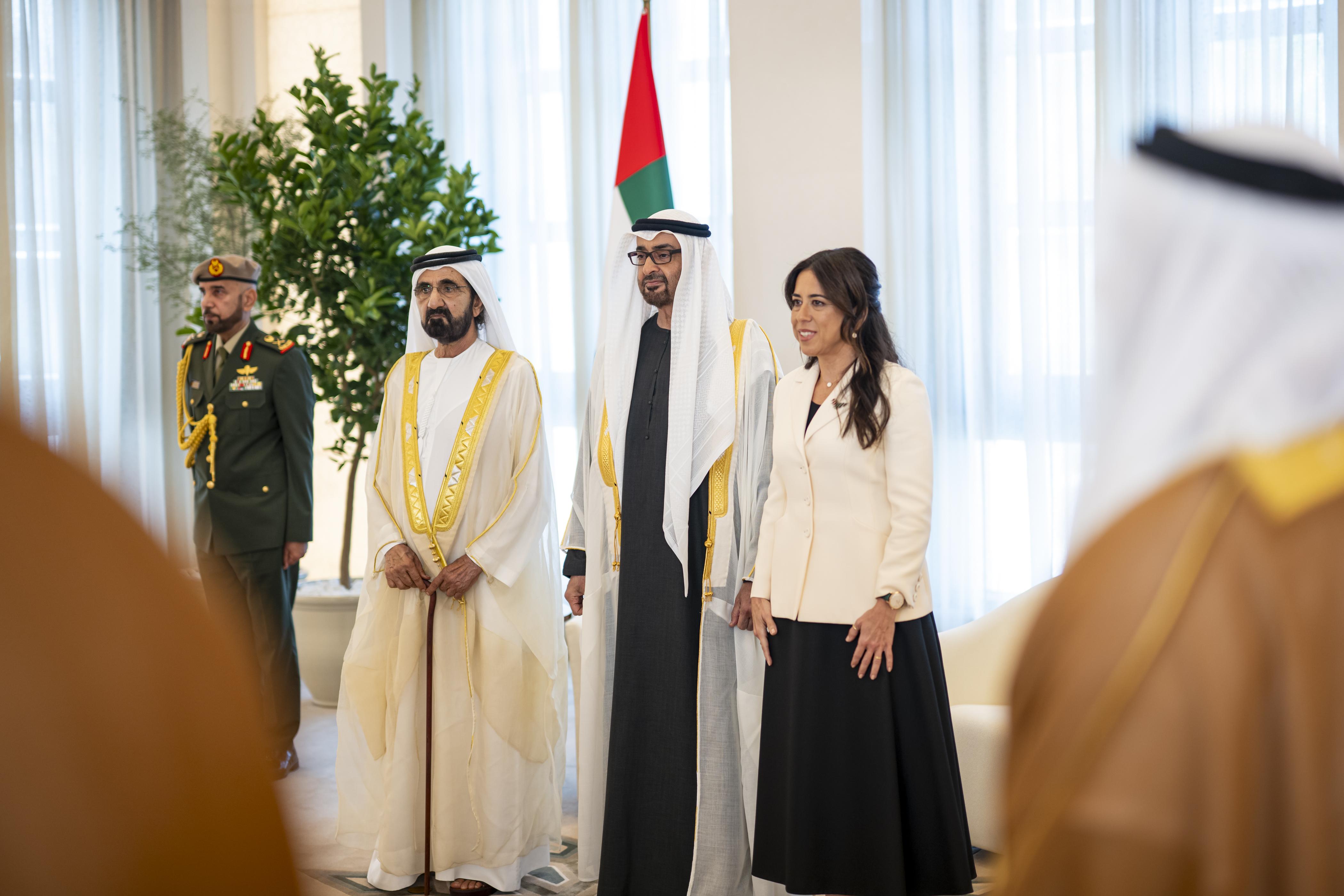
Nusseibeh had also advanced to senior positions within the UAE government. In February 2021, she was appointed assistant foreign minister for political affairs and was granted ministerial rank in December of that year.
After completing her mission in New York, she became an envoy of the foreign minister before being appointed minister of state in September 2025 by order of President Mohammed bin Zayed.
What Does Her Record Reveal?
Lana Nusseibeh points to negotiations over humanitarian aid to the Gaza Strip as one of the episodes that demonstrated her ability to manage divisions within the UN Security Council.
In an interview with Reuters on 21 October 2026, she discussed her role in arranging a visit by Security Council members to the Rafah crossing in December 2023.
She explained that allowing diplomats to see firsthand the restrictions on aid deliveries helped create the conditions for an agreement.
The visit took place amid negotiations following the United States’ veto on 8 December 2023 of a UAE-drafted resolution calling for an immediate humanitarian ceasefire. The draft had received the support of 13 members, while Britain abstained.
On 22 December, the Council adopted Resolution 2720, with 13 votes in favor and abstentions by Washington and Moscow. The resolution called for the appointment of a senior UN humanitarian and reconstruction coordinator and the establishment of a mechanism to accelerate aid deliveries to Gaza. Its wording on a ceasefire had been revised during negotiations.
Nusseibeh’s involvement in the Palestinian issue also extended to the International Court of Justice.
She led the UAE delegation during hearings on the legal consequences of “Israel’s” occupation on 21 February 2024, affirming that the occupation was illegal and must end. She also outlined Israeli violations in Gaza, the West Bank, and East Jerusalem.
Her position on the war in Sudan has drawn renewed criticism following her bid to lead the United Nations. Nusseibeh was among the UAE officials who defended Abu Dhabi against accusations that it was supplying arms to the RSF militia, led by Mohamed Hamdan Dagalo, known as Hemedti, which has been implicated in mass killings, sexual violence, and ethnic cleansing in Darfur.
On 22 April 2024, Nusseibeh, then the UAE assistant foreign minister for political affairs, rejected accusations made by the Sudanese government against her country before the Security Council, describing them as baseless and arguing that they were intended to divert attention from responsibility for the conflict.
Her position came under renewed scrutiny after she announced her candidacy. On 25 October 2026, The Guardian reported criticism of her bid by Kenneth Roth, former executive director of Human Rights Watch, over her defense of the UAE’s denial that it had provided military, financial, or logistical support to parties in Sudan’s war.
The criticism directed at Abu Dhabi draws on international investigations into weapons transfers to the RSF.
In early 2024, a UN panel of experts described as “credible” accusations that Emirati weapons were being transported through Amdjarass Airport in Chad.
In December of that year, Reuters documented cargo flights between the UAE and the airport.
It found that nearly three-quarters of the 86 flights it traced to departures from UAE airports were operated by companies previously accused by UN experts of transporting Emirati military support to Libya.
Investigations also examined advanced Chinese-made weapons found in the hands of the RSF.
In May 2025, Amnesty International concluded that they had almost certainly been re-exported from the UAE, in violation of the arms embargo on Darfur. Abu Dhabi rejected the findings.
In a separate investigation, Human Rights Watch documented on 25 May 2026 networks involved in recruiting Colombian fighters and transferring them to Sudan.
The networks were linked to an Abu Dhabi-based security services company, and the fighters had passed through UAE military facilities.
In early September 2026, a report by the UN Human Rights Council’s Independent International Fact-Finding Mission for Sudan identified roles played by individuals and entities operating from or linked to the UAE in networks involved in recruiting, financing, and transporting fighters, as well as providing military support to the RSF.
The Sudanese government had also taken the UAE to the International Court of Justice (ICJ), accusing it of complicity in genocide against the Masalit tribe through its support for the RSF.
However, on 5 May 2025, the ICJ terminated the case because it lacked jurisdiction, citing the UAE’s prior reservation to Article IX of the Genocide Convention, on which Sudan had based its application. The Court did not rule on the substance of the accusations.
What Are the Prospects?
On 21 October 2026, UAE President Mohammed bin Zayed formally nominated Lana Nusseibeh for the post of UN secretary-general, seeking to replace Portugal’s Antonio Guterres, whose second term ends on 31 December 2026.
Nusseibeh entered the race after six rounds of straw polls within the Security Council, which showed that permanent members continued to object to several leading candidates.
In the 16 October poll, Rebecca Grynspan, Costa Rica’s former vice president and secretary-general of the UN Conference on Trade and Development (UNCTAD), received nine positive votes but faced opposition from two permanent members. Rafael Grossi, director-general of the International Atomic Energy Agency, faced similar objections.
Nusseibeh quickly secured regional backing. On 22 October, Gulf Cooperation Council Secretary-General Jasem Mohamed Albudaiwi announced that all six member states, including Saudi Arabia and Qatar, unanimously supported her candidacy.
The following day, the State of Palestine formally endorsed her. The Palestinian News and Information Agency (WAFA) said its position was based on her diplomatic experience and contributions to supporting the rights of the Palestinian people. Other countries, including Jordan, Albania, and the Maldives, also announced their support.
Gulf backing carries added weight because Bahrain holds a nonpermanent seat on the Security Council for 2026-2027, making it one of the 15 members involved in selecting the next secretary-general.
This gives the Gulf position a presence within the Council itself, while the remaining voting calculations depend on the positions of other members, particularly the five permanent powers.
Opposition has also emerged from Sudan over accusations that the UAE supports the RSF militia, as well as from Iran over Emirati ties with “Israel.” Meanwhile, countries in Latin America and the Caribbean have voiced reservations, arguing that the next secretary-general should come from their region.
These regional concerns carry weight within the Security Council, which includes Colombia and Panama among its nonpermanent members.
On 13 October, before Nusseibeh announced her candidacy, the Community of Latin American and Caribbean States (CELAC) said the time had come to appoint a secretary-general from the region, invoking the principle of geographical rotation.
Although regional rotation is a political convention rather than a binding rule, it presents an additional hurdle for candidates from outside the region, particularly as Costa Rica’s Rebecca Grynspan has led the previous straw polls.
Among the major powers, the Middle East Eye reported on 26 October, citing sources close to the British government, that London was leaning toward supporting Nusseibeh’s candidacy, although no final decision had been made.
By contrast, U.S. Ambassador to the UN Mike Waltz called for candidates’ qualifications to take precedence over considerations of region and gender. Russian Foreign Minister Sergey Lavrov, meanwhile, said in September that Latin America should have priority under the convention of geographical rotation.
The Guardian also reported praise for Nusseibeh from former officials who had worked with her on regional issues.
They included Brett McGurk, a former National Security Council official under the Joe Biden administration, who commended her contribution to facilitating aid deliveries to Gaza.
Another was Nikolay Mladenov, the Bulgarian diplomat and former UN envoy to the Middle East, who praised her experience in building consensus within the Security Council.
The candidates are now awaiting the first straw poll to include Nusseibeh’s name, as she entered the race after the sixth round, amid divisions over the candidates who had already been considered.
Securing the post requires the support of at least nine Security Council members, with no veto from any of the five permanent members. This gives Washington, Moscow, Beijing, London, and Paris decisive influence over the selection of the next secretary-general.
If elected, Nusseibeh would become the first woman to lead the United Nations, the second Arab after Egypt’s Boutros Boutros-Ghali, and the first secretary-general of Palestinian descent.
Sources
- Sudan decries Nusseibeh UN candidacy as ‘whitewashing' Emirati role in civil war
- Hebrew-speaking UAE diplomat of Palestinian descent enters race to lead UN
- UAE affirms its categorical rejection of the baseless allegations made by the Permanent Representative of Sudan in a letter to UN Security Council
- Ambassador Nusseibeh Participates in UN PRs Meetings with Israeli Officials
- UAE warns Israel: Annexing West Bank is a ‘red line’ that would ‘end regional integration’
- CIP Statement on the Selection of the Next UN Secretary-General, Opposition to Nusseibeh Candidacy
- UAE diplomat running for UN chief faces questions on her country’s alleged support for Sudan rebels
- Emirati Experts Program Community [Arabic]