From Estrangement to Consensus: What Changed Eastern Libya’s Position on the Maritime Agreement with Turkiye?
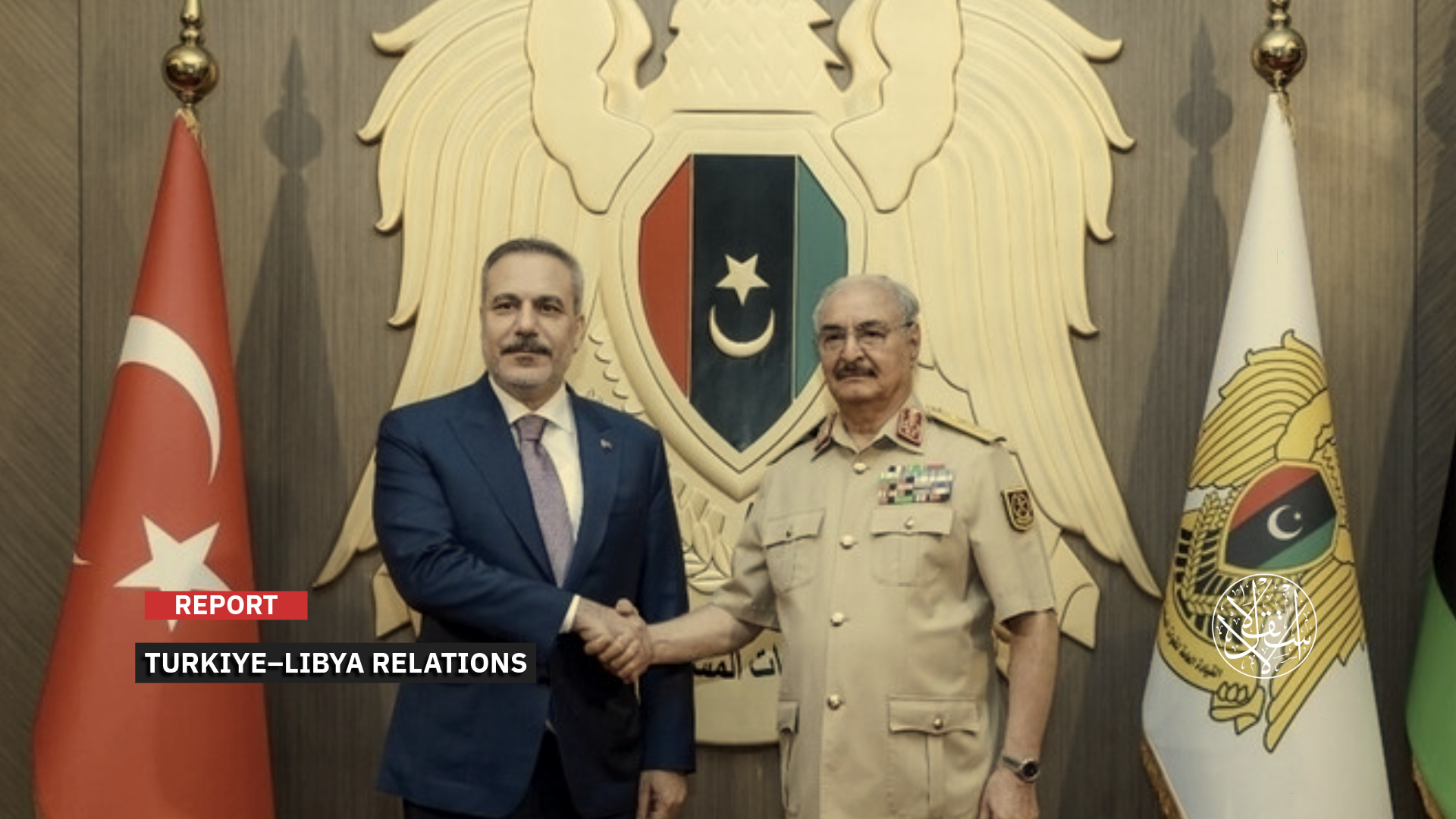
Ankara welcomed the decision as the culmination of a patient diplomatic process.
Six years after rejecting the agreement and severing political ties, Libya’s eastern-based House of Representatives has removed the last domestic obstacle to the maritime memorandum of understanding signed with Turkiye.
On October 20, 2026, it unanimously ratified the agreement during a parliamentary session, overturning its earlier decisions to reject it and sever ties with Ankara.
The vote had barely been announced before it became a regional event with far-reaching repercussions. Ankara saw it as a victory for fairness and its legitimate maritime rights.
It was welcomed by the Tripoli-based Government of National Unity, headed by Abdul Hamid Dbeibah, as well as by the High Council of State.
Cairo, meanwhile, swiftly declared the agreement null and void, while “Israel” condemned it. In Athens, the decision became a subject of political scrutiny, with the opposition portraying it as evidence of the government's foreign policy failure.
What exactly does the agreement entail that has sparked such controversy?
Why has eastern Libya’s political camp changed its position after years of hostility towards Ankara?
Can Turkiye turn this diplomatic gain into a tangible presence in the waters of the Eastern Mediterranean?
How will the Egyptian-Greek axis, which sees the new maritime demarcation line as a direct threat to its own maps, respond?
A Line That Redraws the Map
The agreement dates back to November 27, 2019, when Turkish President Recep Tayyip Erdogan and then-head of Libya’s Government of National Accord, Fayez al-Sarraj, signed two memorandums of understanding in Istanbul.
One concerned security and military cooperation, while the other addressed the delimitation of maritime jurisdiction areas in the Mediterranean Sea.
The signing took place at an extremely sensitive moment, as forces loyal to Khalifa Haftar were mounting an offensive against the capital, Tripoli.
The maritime memorandum moved swiftly through the Turkish legislative process: the Turkish Parliament ratified it on December 5 of that year, and it entered into force later that same month, before being registered with the United Nations Division for Ocean Affairs and the Law of the Sea.
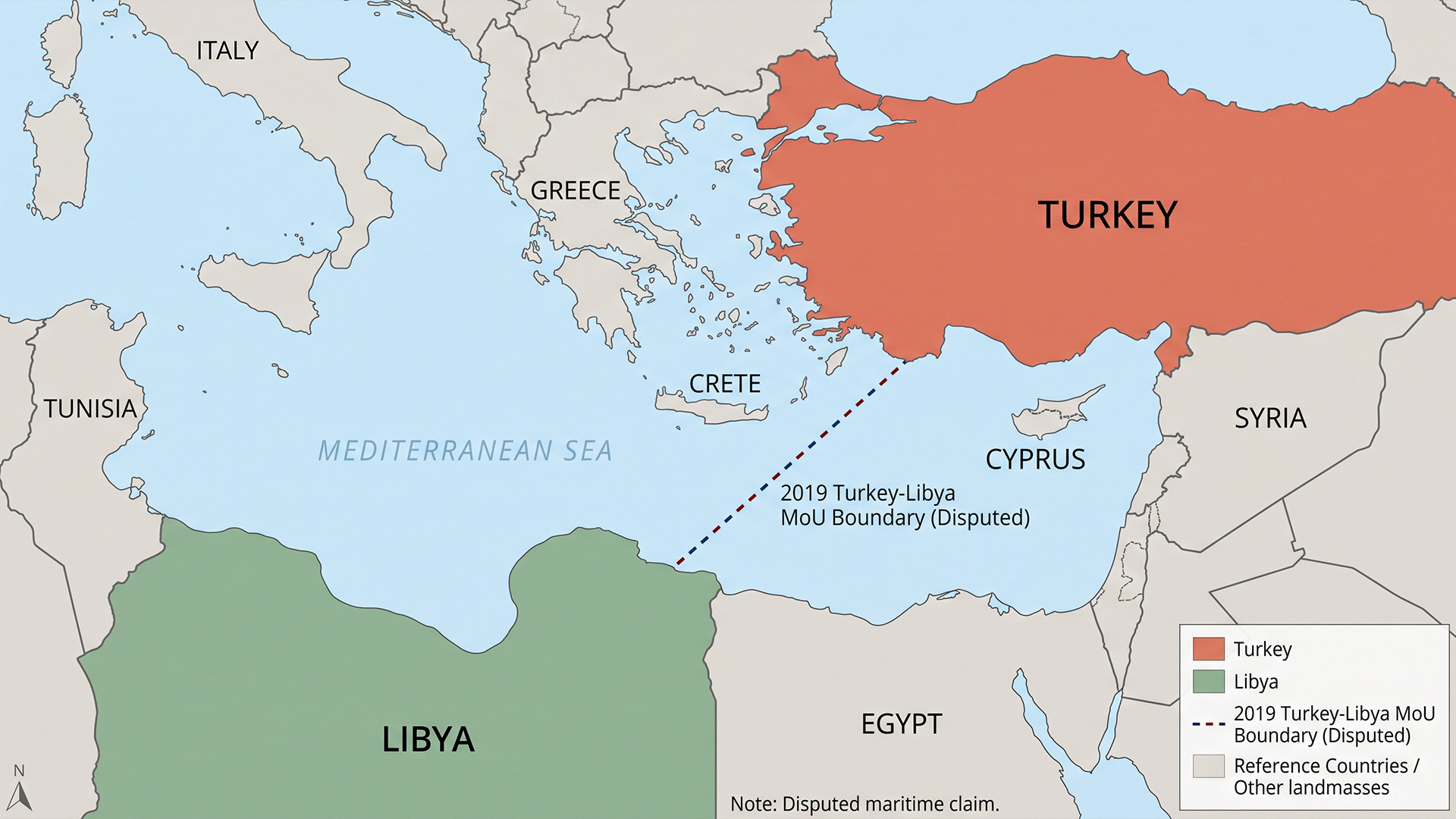
The memorandum delineates the boundaries of the continental shelf and exclusive economic zones (EEZs) between Turkiye’s southern coast and Libya’s eastern coast, using specific geographical coordinates and accompanying technical annexes.
It establishes a maritime boundary connecting the two countries' coastlines while also defining the western limits of Turkiye’s maritime jurisdiction areas in the Eastern Mediterranean.
Under this delimitation, both countries enjoy sovereign rights to explore and exploit natural resources, including oil, natural gas, and other resources found on and beneath the seabed, within their respective designated maritime areas.
The memorandum also provides for joint arrangements to exploit any resources that extend across the maritime boundary between the two countries. It further establishes mechanisms for consultation and the diplomatic settlement of disputes arising over the interpretation or implementation of its provisions.
However, the heart of the controversy lies in the legal principles underpinning the delimitation. The agreement is based on the principle of equity and takes the main coastlines of the two countries into account, rather than granting small or remote islands full and automatic effect in determining maritime zones.
Ankara regards this approach as a fair application of international maritime law that takes the Mediterranean's distinctive geography into account.
However, it puts Turkiye on a direct collision course with the Greek position, making every step toward implementing the agreement an event with implications extending far beyond the two countries.
From Estrangement to Consensus
The road to the October session was far from smooth. In 2020, the authorities in eastern Libya, backed by Khalifa Haftar, were on opposing sides of the conflict with Ankara, which had supported the Government of National Accord in repelling the offensive against Tripoli. At the time, the House of Representatives voted against the memorandum.
Today, however, the parliament regards the agreement as a strategic gain for the country on economic, political, and security fronts, according to two lawmakers who spoke to Reuters.
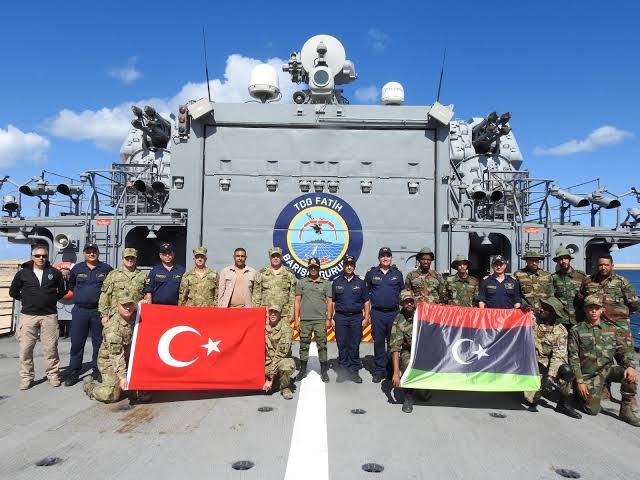
This shift is the result of a lengthy process of Turkish engagement. Ankara did not confine its relations to Tripoli but expanded its channels of communication in recent years with Benghazi and political and military figures in eastern Libya. The city also hosted prominent Turkish officials, including intelligence chief Ibrahim Kalin.
This outreach was accompanied by Turkish rhetoric emphasizing Libya’s unity and territorial integrity, while presenting security and economic cooperation as an alternative to the logic of rival alliances.
In doing so, Ankara succeeded in building a network of relationships that was not dependent on a single political center, effectively paving the way for the ratification.
Within Libya, the change in the House of Representatives’ leadership also helped create favorable conditions for this shift, as a new leadership replaced Aguila Saleh, one of the agreement’s most prominent longtime opponents and the figure behind the decision to sever ties with Ankara.
According to analysts, the vote also came against the backdrop of a rapprochement between Egypt and the Tripoli-based government, which raised concerns within Haftar’s camp.
Cairo, however, rejects this interpretation, insisting that its opening toward Tripoli is aimed at safeguarding Libya’s unity and facilitating elections.
The move is also closely linked to calculations involving energy and reconstruction. Mahjoob Zweiri, an expert on Middle East policy, argues that it could help bring Libya’s two rival centers of power closer together and secure the energy revenues needed for reconstruction, ahead of anticipated talks in London and Libya.
In the same vein, the High Council of State described the ratification as a step toward unifying Libya’s position on its maritime rights. It was a rare moment in which eastern and western Libya found common ground on a matter of national sovereignty after years of division.
Blue Homeland
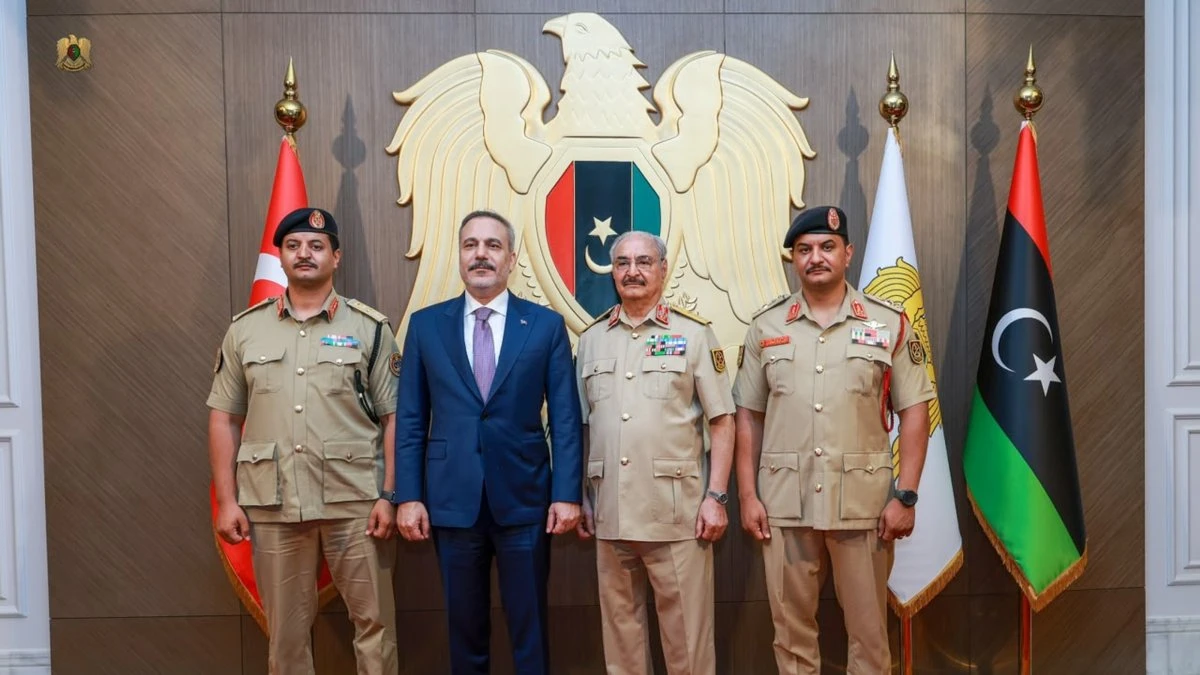
Ankara welcomed the decision as the culmination of a lengthy diplomatic process. The Turkish Foreign Ministry said the memorandum safeguards the two countries’ shared rights and interests and is grounded in international law and the principle of equity.
Foreign Minister Hakan Fidan, meanwhile, emphasized that it enjoys full legal and political legitimacy, while acknowledging that some countries have reasons for opposing it.
In the assessment of researcher Ferhat Polat, a specialist in geopolitics and security in North Africa, the ratification removes one of the main grounds for criticism of Turkiye: the absence of approval from Libya’s legislative authority.
Ironically, Cairo itself sent a letter to the UN Security Council in late 2019, according to Egyptian media reports at the time, arguing that the agreement required approval from the House of Representatives, a condition that has now been met.
Turkiye’s gains extend beyond the Libyan context to the broader energy equation in the Eastern Mediterranean. Since its signing, the memorandum has served as a response to projects designed without Ankara’s involvement, most notably the EastMed gas pipeline, whose proposed route was drawn up without the participation of Turkiye or the Turkish Republic of Northern Cyprus.
With broader Libyan backing for the agreement, the political cost of any lasting regional arrangements that disregard Turkish interests increases.
For Ankara, the issue is not simply about potential gas reserves; it is also about securing a seat at the table when maritime boundaries are drawn, and arrangements for exploiting the region’s energy resources are determined.
Retired Admiral Cem Gurdeniz, the architect of the Blue Homeland doctrine, goes further, describing the decision as one of the most important diplomatic achievements Turkiye has secured in recent years in its struggle for the Blue Homeland.
Gurdeniz considers the decision a setback for Greece, the European bloc supporting it, and the United States, as well as a blow to Athens’ strategy of exploiting Libya’s internal divisions to undermine Turkish claims.
He also argues that it strengthens, both legally and politically, the continental shelf boundaries Turkiye submitted to the United Nations on March 18, 2020, and carries implications for any future maritime boundary delimitation agreement between Turkiye and Egypt.
The Opposition Front
Cairo, meanwhile, maintains its position, unchanged since 2019, that the memorandum violates the 1982 United Nations Convention on the Law of the Sea (UNCLOS) and encroaches on Egypt’s continental shelf and exclusive economic zone.
Egypt argues that Turkiye and Libya do not share a direct maritime boundary because Cyprus and Greece lie between them.
In support of its position, Cairo points to the two maritime delimitation agreements it has concluded with those countries and registered with the United Nations.
Geographically, the heart of the dispute lies at a complex intersection of territorial waters and exclusive economic zones claimed by four parties: Turkiye, Egypt, Greece, and Libya.
The wider Eastern Mediterranean basin is also an area of competing claims involving “Israel”, Lebanon, and Syria.
One of the main points of contention is a maritime triangle that Cairo considers part of its waters, while Libya views it as an extension of its maritime zone, on which it based its agreement with Ankara. More importantly, the Turkish-Libyan delimitation line effectively cuts off any direct maritime connection between Egypt and Greece.
Supporters of the agreement, however, argue that it grants Egypt larger maritime areas, prompting Zweiri to describe Cairo’s rejection as “purely political.”
Greece, for its part, argues that the delimitation disregards the legal effect of its islands, particularly Crete, and overlaps with maritime areas it claims under its separate agreement with Egypt.
The European Union has also expressed reservations about the memorandum’s compatibility with the law of the sea and its potential implications for the rights of third countries.
“Israel” adopted a sharper tone. In a statement, its Foreign Ministry said, “Unfortunately, we see Turkiye once again seeking to destabilize the Eastern Mediterranean region.”
A report by the Hebrew-language newspaper Maariv sheds light on a key source of Israeli concern: the Great Sea Interconnector project, which is intended to connect “Israel” to the European electricity grid through Cyprus and Greece.
Ankara maintains that part of the project's route passes through an area under its maritime jurisdiction and insists that prior coordination is required for any field surveys.
The renewed Libyan backing for the agreement could delay construction work, increase costs, and discourage investors, concerns raised in response to this latest development.
From Agreement to Action
The ratification has brought the question of implementation to the forefront. Political backing alone is not enough to redraw exploration maps.
According to Polat, the agreement goes beyond symbolic diplomacy, opening the door to tangible cooperation in exploring untapped hydrocarbon resources beneath the seabed, as well as securing trade routes and maritime shipping lanes.
It also provides Turkiye with a more predictable framework for energy activities, backed by its research infrastructure, naval capabilities, and extensive network of diplomatic relations.
For Libya, whose institutional and security capabilities remain fragmented, the agreement provides a framework to support its claims to offshore resources, while creating opportunities to benefit from technical assistance, logistical support, and capacity building. However, turning potential resources into economic value will remain dependent on investment and stability.
The launch of seismic surveys and drilling operations will nevertheless depend on technical preparations, commercial assessments, and the prevailing legal and regional conditions.
Some voices in Turkiye, however, are calling for a swift move from diplomacy to action on the ground. Gurdeniz wrote: “Diplomatic success must be followed by an actual presence at sea.”
He called for action in response to ongoing activities in Blocks 5 and 6, for which Cyprus has issued exploration licenses, and urged the resumption of seismic surveys and drilling in disputed areas.
This call highlights the extent of Turkiye’s ambition to use the parliamentary vote as a starting point for expanding its maritime activities.
Zweiri, meanwhile, expects Cairo to strengthen its alliances with Greece, Cyprus, and “Israel” in an effort to contain Turkiye’s gains in the Eastern Mediterranean.
He also points to what he describes as an American absence that has come close to a strategic abandonment of support for Egypt’s position.
In his assessment, the developments represent a model of 21st-century warfare centered on maritime corridors and natural resources.
Sources
- A New Era in the Turkiye-Libya Agreement: The House of Representatives’ Approval [Turkish]
- Libyan Parliament Ratifies Maritime Boundary Memorandum with Turkey: Why, and How Did Israel and Egypt Respond? [Arabic]
- Why Has the Turkiye-Libya Maritime Memorandum of Understanding Angered Israel? [Arabic]
- The Turkiye-Libya Maritime Agreement: Its Provisions, Objectives, and Sovereignty Implications [Arabic]