Libya: How Migration Has Become a Tool of Political Conflict and Fuel for Incitement Against Foreigners
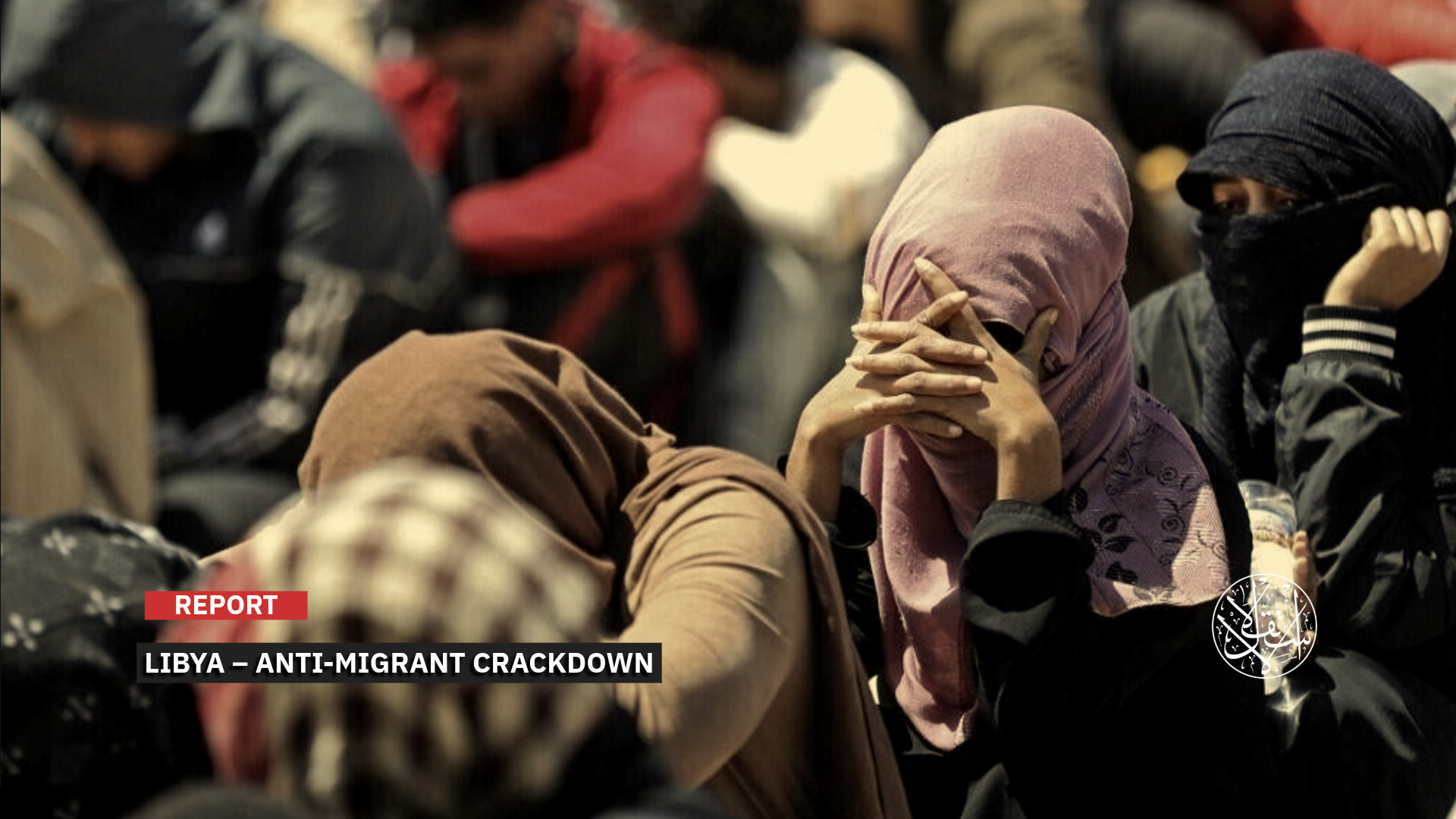
“The municipalities of Tripoli Central and Tajoura have set deadlines for migrants to vacate rented properties.”
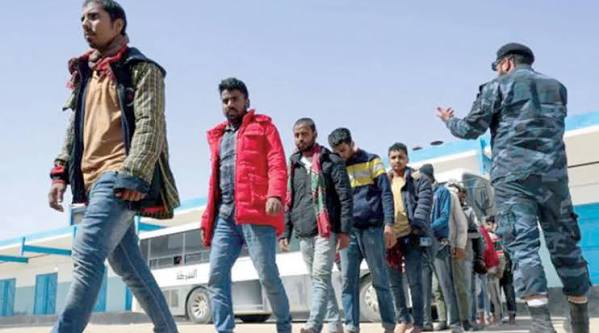
On Thursday, October 8, 2026, a joint government committee met at the headquarters of the Illegal Migration Control Agency in Tripoli to coordinate an intensive inspection campaign targeting workplaces employing foreign workers and their accommodation in the capital, according to an announcement by the Ministry of Labor and Rehabilitation.
The following day, dozens of people gathered in Martyrs’ Square, chanting slogans such as “Libya for Libyans” and “No to resettlement,” continuing a series of demonstrations that have been recurring in the city centre since April 2026.
Two consecutive developments sum up the situation: a state tightening its administrative and security grip, and a public demanding even more.
Caught between them are hundreds of thousands of migrants, who have begun to tread cautiously between their homes and workplaces in a city whose neighbourhoods are divided among rival armed groups and which has spent months amid rumours of an international plot to alter the country’s demographic composition.
So, who is behind the “resettlement” narrative that has fuelled this anger? Has migration become a bargaining chip in the power struggle between eastern and western Libya? To what extent could incitement escalate into violence that the capital is unable to contain? And who will protect those whose only foothold in Libya is their precarious legal status?
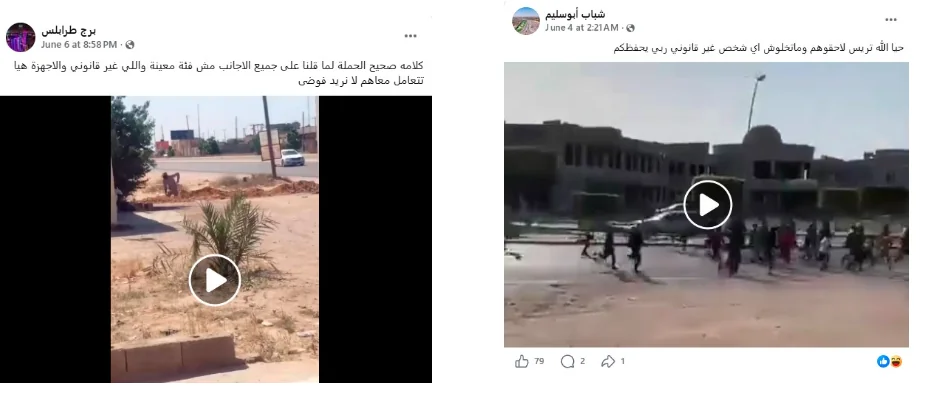
Incitement Moves from Online Platforms to the Streets
For migrants in Tripoli, fear is no longer limited to deadly boat journeys or detention centres; it has become part of everyday life.
During the escalation in June 2026, many people from sub-Saharan African countries were forced to remain indoors for days at a time to avoid arrest or assault, as protests coincided with arrest campaigns carried out by police and armed groups affiliated with the Ministry of Interior in western Libyan cities.
Albert, a 37-year-old Sierra Leonean living in eastern Tripoli, told the British outlet Middle East Eye that he had begun to feel that attacks on migrants no longer carried any risk of accountability. He recounted working at a construction site for two days, only to return home unpaid and hungry.
Kingsley (a pseudonym), a Cameroonian refugee who was arrested twice and released only after paying money to his captors, summed up this shift in one sentence: “The vast majority of Libyans have become a threat in my eyes.”
The organization Crimes Monitoring in Libya documented incidents that went beyond harassment to direct violence, including three migrants being stoned in a Tripoli street amid racist insults; attacks on Ethiopian and Eritrean migrants for wearing crosses; and an armed group dressed in civilian clothes raiding a Sudanese family’s home, stealing its belongings and forcing the family out. The organization maintains that these incidents are not isolated cases but part of a broad, systematic campaign.
The pressure has also extended to housing. The municipalities of Tripoli Central and Tajoura announced deadlines for migrants to vacate rented properties, while the Tajoura Security Directorate required landlords to report foreign tenants. Smear campaigns have also targeted Libyans who rent properties to migrants or employ them.
Shortly before October 1, a date promoted by social media pages as the “final deadline” for foreigners, an activist with the Refugees in Libya organization received a handwritten threat targeting “Black people,” accompanied by a bullet.
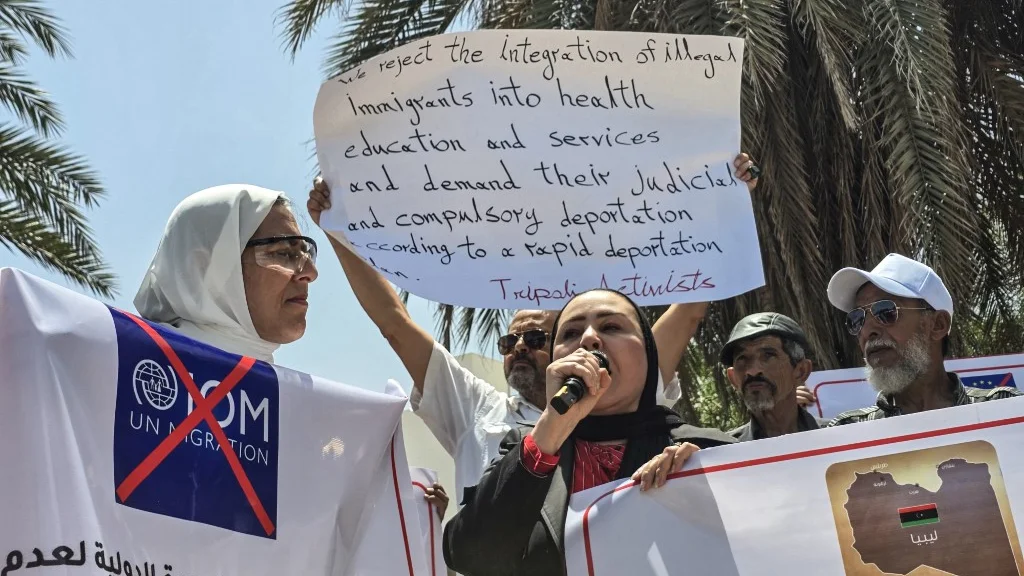
How the “Resettlement” Narrative Took Shape
The “resettlement” narrative is based on accusations that international organizations are seeking to keep migrants permanently in Libya and alter the country’s demographic composition.
However, the available evidence does not support this narrative. UN Special Representative Hanna Tetteh told the Security Council that the United Nations “is not involved in resettling migrants in Libya.”
Libya is also not a party to the 1951 Refugee Convention and has no asylum system, while Law No. 24 of 2023 criminalises migrants’ entry for resettlement, as well as housing or employing anyone intending to settle in the country.
The figures also do not support the claim of a flood of migrants. The International Organization for Migration (IOM) recorded approximately 944,000 migrants in spring 2026, a slight increase compared with the end of the previous year.
By contrast, Imad al-Trabelsi, Interior Minister in the Government of National Unity, claimed in remarks reported by Al-Wasat that there were three million undocumented migrants in Libya, more than three times the IOM’s estimate.
Other sources fuelled the narrative, most notably fabricated statements attributed to the head of the United Nations High Commissioner for Refugees (UNHCR) office in Libya, and social media posts linking the European Pact on Migration and Asylum’s entry into force in June 2026 to an alleged plan to permanently settle refugees in the country.
An investigation by the independent platform Beem Reports uncovered a network of 70 Facebook pages created within days in May 2026.
The pages used the names of Libyan cities, neighbourhoods and tribes, attracted more than two million followers, and published identical content within minutes of one another.
Sponsored-ad data from two of the pages led to an advertising company in Tripoli’s Souq al-Jumaa district, although the investigation did not establish that the company operated the network.
The Libya Observer argues that migration has become “the vessel through which broader fears have found expression,” ranging from state weakness and uncontrolled borders to anxieties about regional displacement. Repeated official denials have therefore failed to dispel public suspicion, as the problem has come to concern trust, not information alone.
Rivals, United by One Narrative
In a country divided between two governments, migration has emerged as a rare issue on which political rivals have converged around a common message.
Between June 1 and 10, 2026, the Government of National Unity, the House of Representatives, the government appointed by the parliament, and the General Command of Khalifa Haftar’s forces issued a series of statements rejecting “resettlement.” This prompted Human Rights Watch to say that the rival authorities had “united in fuelling anti-foreigner protests.”
Yet agreement on the slogan has not eliminated competition over how to exploit it. In eastern Libya, Saddam Haftar ordered mass arrest and expulsion campaigns, while Osama Hammad, head of the parliament-appointed government, issued a decision banning the entry of Sudanese, Eritrean, Ethiopian and Somali nationals.
Meanwhile, media outlets close to the eastern camp have accused Abdul Hamid Dbeibah’s government of using migrants as a means of political and financial blackmail and pursuing “soft resettlement.”
In western Libya, Dbeibah has combined denials of any resettlement arrangements with calls for greater international support for deportation operations. Sadiq al-Ghariani, the mufti and one of his most prominent allies, has also joined calls for the expulsion of the UN refugee agency.
This political competition raises questions about whether public anger is being exploited to divert attention from mounting living-cost pressures, including inflation approaching 14 per cent and strikes in the education and health sectors.
However, the demonstrations surrounding the “October 1 deadline” failed to attract the expected momentum, as they were overshadowed by a widespread teachers’ strike against Dbeibah’s government over salaries. This suggests that migration has not yet eclipsed public anger over living conditions.
With a UN-sponsored political agreement paving the way for elections within two years, observers expect migration to become an electoral mobilisation issue, with rival factions competing to present themselves as defenders of national sovereignty.
The issue offers each side a dual political advantage: greater domestic popularity and credibility with European capitals seeking a partner capable of stopping migrant boats.
From Welded-Shut Gates to Stormed Centers
The escalation did not stop at slogans. In June, protesters blocked the headquarters of the UN refugee agency in Tripoli’s Al-Sarraj neighborhood with an earthen barrier. In August, members of the “No to Resettlement” movement welded its metal gates shut after forcing staff to leave.
Then, on September 7, a group stormed a humanitarian services centre run by the International Organization for Migration (IOM) in the Al-Siyahiya area, drove out those inside and forced the facility to suspend operations.
The danger is compounded by allegations that some of the very agencies expected to prevent violence have been involved in abuses.
Human rights organizations have documented the participation of the General Security Agency and security units affiliated with the Ministry of Interior in the Government of National Unity in arrest campaigns. A UN report published in February 2026 also identified criminal networks often linked to the authorities that collect and detain migrants outside any legal procedures.
These developments are unfolding in a capital divided among armed groups. The Deterrence Apparatus controls eastern Tripoli, while government-aligned formations are spread across the west and south, and forces from Misrata hold areas along the lines of contact between the two sides.
In a city that witnessed deadly clashes between these forces last year, there are fears that armed groups could seize on the current tensions as an opportunity to expand their influence under the banner of protecting neighborhoods.
Against this backdrop, the organization “Refugees in Libya” questioned why incitement pages were concentrated in Souq al-Jumaa, a stronghold of the Deterrence Apparatus, ahead of the International Criminal Court hearing concerning former apparatus commander Khaled El Hishri. The organization stressed that this timing does not establish a connection between the two.
As for accountability, the Ministry of Foreign Affairs referred reports of the attacks to the prosecutor general, but the Ministry of Interior did not respond to press questions about the steps it had taken since the centre was stormed.
Meanwhile, Ahmed Hamza, head of the National Institution for Human Rights, accused the ministry of inaction and silence, warning that the situation could spiral out of control.
Europe Pays, Migrants Pay the Price
Libyan journalist Omar Al-Hassi told Al-Estiklal that the Libyan authorities bear the primary responsibility for protecting people residing in their territory.
He noted that the African Charter on Human and Peoples’ Rights prohibits mass expulsion, while Amnesty International has documented cases in which deported individuals were denied the opportunity to appeal their deportation orders or seek asylum.
He added that the organization Monitoring Crimes in Libya had documented the deportation of at least 50,000 people since last June.
Some were transported in overcrowded trucks across the desert to the border with Niger, amid abuses that he described as an example of exploitative practices.
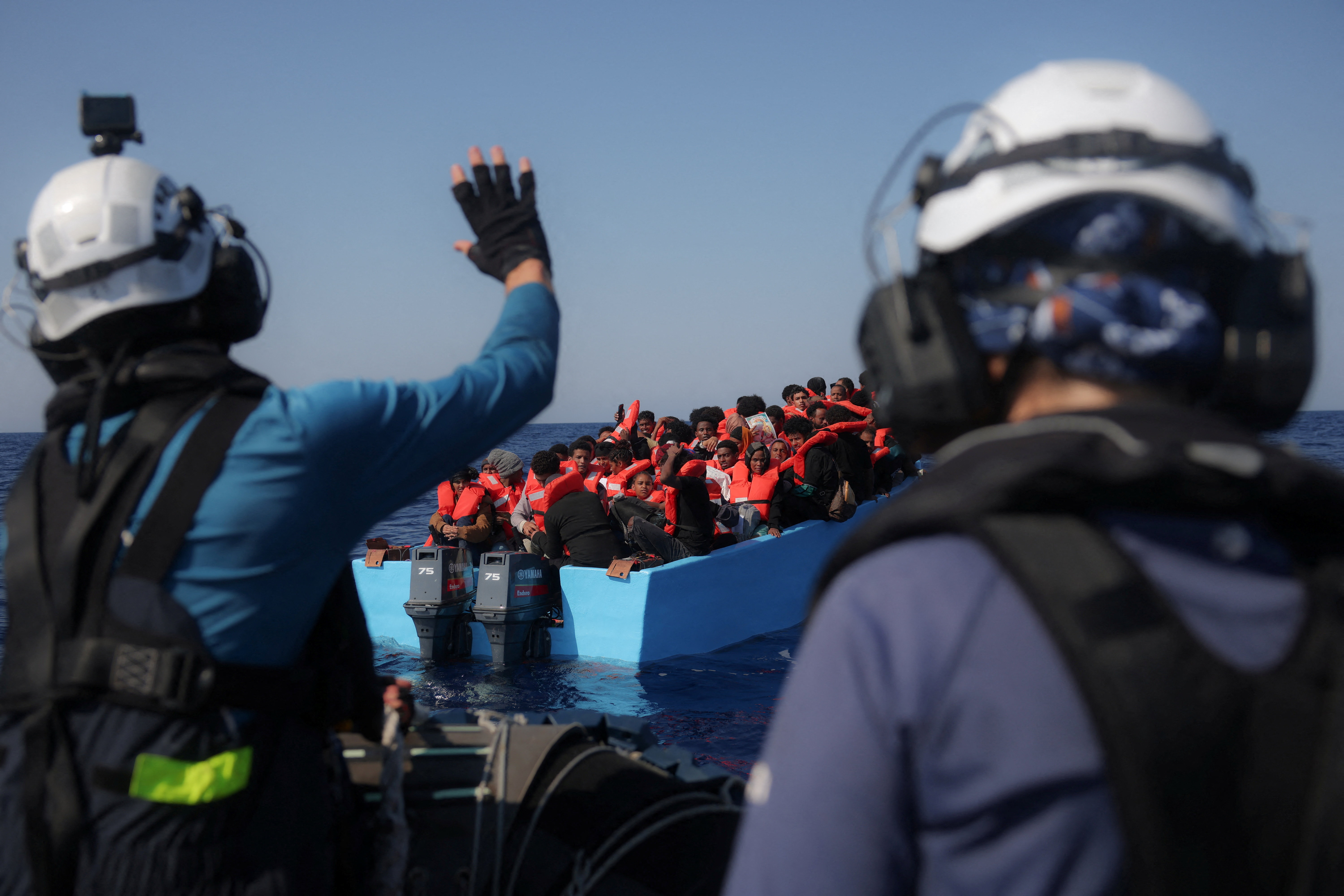
Al-Hassi argued that responsibility also extends to the European Union and Italy, which continue to support security cooperation with Libya despite the fact that thousands of migrants intercepted at sea have been returned to a cycle of detention and deportation.
He said this amounts to complicity and that support should be made conditional on verifiable safeguards to protect migrants.
He argued that the contradiction lies in a European policy aimed at keeping migrants away from its shores while fueling fears of “resettlement” within Libya, leaving migrants to bear the cost of these fears on both sides.
Sources
- Libya: Racism and ‘Resettlement’ Conspiracies Fuel Fear Among Tripoli’s Migrants
- Libya: Anti-Migrant Rhetoric Fuels Abuses [Arabic]
- Intensified Inspection Campaign Targets ‘Foreign Workers’ in Tripoli [Arabic]
- Fake Accounts and Sponsored Ads: A Digital Disinformation and Incitement Network Targeting Refugees in Libya [Arabic]