Mauritania’s 7-Year World Bank Influx Equals Six Decades of Aid: Where Did the Capital Go?
“These enormous figures raise questions about what has actually been achieved on the ground.”
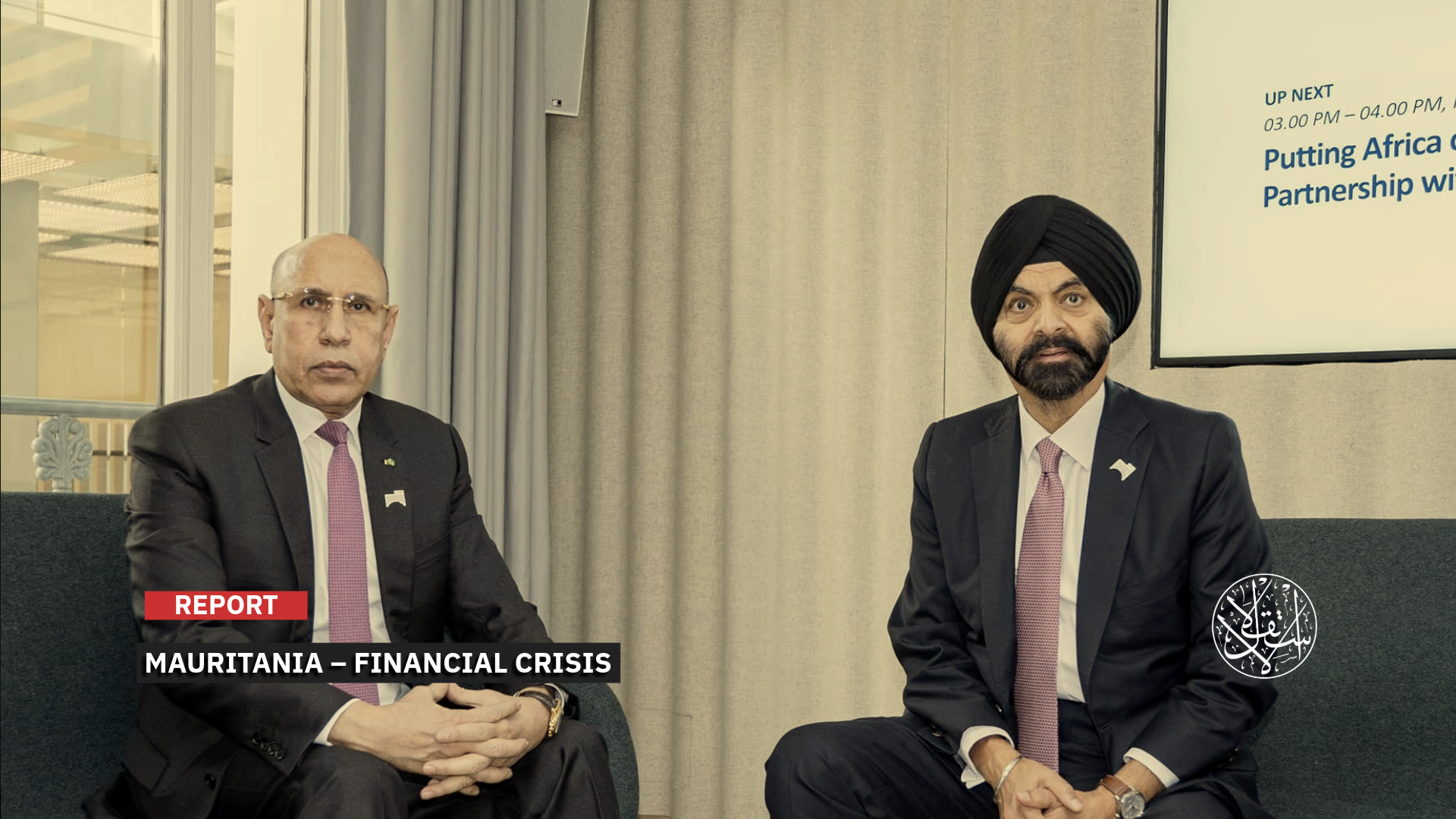
The World Bank has sparked widespread debate in Mauritania’s political and economic circles after releasing figures showing how much funding the country has received under President Mohamed Ould Ghazouani compared with the total it secured in the decades following independence.
In a report published in late September 2026, the World Bank said its financing for Mauritania over the past seven years had exceeded the amount provided over nearly six decades, from independence in 1960 through 2019.
Between 2019 and 2026, Mauritania received $1.64 billion in World Bank financing, compared with $1.63 billion between 1960 and June 2019, when Ghazouani was elected president.
The bank said its total financing for Mauritania since independence had reached $3.27 billion across 112 operations and financing agreements.
The pace of funding accelerated from 2020 onward. In fiscal year 2019, the bank approved just $22.5 million in new commitments for two projects.
Annual financing then topped $290 million in each of the following two years, driven in large part by the bank’s response to the COVID-19 pandemic.
Funding slowed somewhat in 2022, falling to $92 million, before climbing again in subsequent years.
It reached $125 million in 2023 and rose to $271 million in 2024, before hitting a record $325 million in 2025. Financing totaled $231 million in 2026.
The World Bank stressed that this funding consists primarily of long-term concessional loans provided by the International Development Association (IDA), along with grants.
It does not represent cash transfers the government receives immediately, nor does it reflect the country’s outstanding debt.
As of August 31, 2026, Mauritania had repaid approximately $788 million to the bank but still owed it $651 million.
The bank also clarified that the $3.27 billion figure represents the cumulative value of financing approved since independence.
Widespread Reaction
The figures have sparked widespread debate across Mauritania’s political and media circles. Parliamentarian Mohamed Bouya Cheikh Mohamed Vadel described the World Bank’s figures as alarming.
In a Facebook post published on September 27, Cheikh Mohamed Vadel noted that Mauritania had borrowed a total of $1.63 billion over 60 years, compared with $1.64 billion in just seven years.
“This means that nine governments over 60 years borrowed as much as a single government has in seven years,” he wrote.
Writer and journalist Haiba Cheikh Sidaty said in a September 27 post that the government and the World Bank should clearly identify the specific projects funded by the money.
For example, Sidaty asked, “The World Bank lists social protection as one of its funding areas, but what exactly does that mean? Does it refer to cash transfers through the Taazour program, or something else? And what projects has the bank funded in the energy sector?”
He stressed that “only specific answers will make it possible to determine where the money went and how effective the funding has been.” Without such answers, he argued, the loans and grants’ actual impact cannot be measured accurately and transparently.
The nongovernmental organization Mauritanian Comprehensive Transparency (OTI) has also weighed in on the debate, saying its review of World Bank data confirms the widely circulated comparison: the $1.64 billion in financing provided over the past seven years slightly exceeds the total for the period from independence through mid-2019.
OTI, however, shifted the focus of the discussion. In a Facebook post published on September 27, it said Mauritania’s discovered natural gas and gold reserves had strengthened its ability to borrow from financial institutions.
At the same time, it warned against what it called excessive borrowing, describing it as a negative trend in a country where corruption is widespread and influential wrongdoers enjoy impunity.
This position adds an accountability dimension to the debate, raising questions about whether public institutions can turn loans and grants into tangible assets and public services with measurable benefits, rather than simply securing more funding.
In this regard, the Sawab Party said in an editorial published on its Facebook page on September 28, titled ‘Debt, Corruption, and the Direction of Travel’, that the World Bank’s figures raised troubling questions that went beyond financial calculations alone.
“The question is to what extent public debt, government spending, and the budget deficit can help determine the responsibility of the president and his governments for major economic and financial policy choices, given that these are among the key determinants of good governance,” the party wrote.
The party stressed that the scale of the debt and financing, which official reports say was directed toward development projects in vital sectors such as energy, health, agriculture, water, and social protection, raises an even more pressing question: What has actually been achieved on the ground?
“Over the past seven years, all we have seen in practical terms are cries for water, darkness, crumbling roads, leaking water pipes, and a lack of health care or deteriorating services, even as figures on financing, loans, and wealth continue to mount,” the party said.
“As borrowing and wealth increase, money continues to flow out of the pockets of the poor and into the hands of the wealthy. It is a vicious cycle that funnels public wealth into a bottomless pit, with a corrupt elite reaping the benefits and escaping accountability.”
The Question of Impact
In an analysis published on October 6, 2026, the local outlet Elfikr said Mauritania had been caught in the trap of international financing since 1960, receiving a total of $3.27 billion in approved World Bank financing over 66 years.
“Yet these enormous figures, which might initially appear to demonstrate the success of development policies, raise fundamental questions about what has actually been achieved on the ground and whether this debt, which has weighed heavily on the national economy, has delivered meaningful results,” the website wrote.
“How can a country receive more than $3 billion in financing and remain mired in deep-rooted structural crises, while even falling behind on human development indicators? Are these genuine funding commitments or merely promises on paper?”
The local outlet Elfikr said the contradiction in the World Bank’s figures was that this financing boom had not translated into a tangible improvement in people’s lives.
It pointed to a bleak picture of development in Mauritania, where the Human Capital Index stands at just 0.38. This means that a child born in the country is expected to achieve only 38 percent of their potential productivity by the age of 18.
Meanwhile, 95 percent of children aged 10 cannot read and understand a simple text, one of the highest rates in the Sahel region.
As Mauritania continued to receive financing, the website added, multidimensional poverty rose to 56.9 percent, reaching 77 percent in rural areas, according to a 2022 study by UNICEF and the World Bank. Statistics also show that nearly one-quarter of children under the age of five suffer from chronic malnutrition.
It attributed this contradiction to the persistence of a rent-based economic model since 1960.
Although minerals account for 19 percent of gross domestic product and more than three-quarters of exports, the country remains dependent on exporting raw materials and importing almost everything, including food.
Today, after 66 years of financing, the website argued, Mauritanians face a stark contradiction: the state can repay its debts, having paid back $788 million by August 2026, yet has struggled to turn that money into meaningful development.
Mauritania must break this cycle of dependence on resource rents and its failure to convert wealth into human capital, the website concluded. The country has proved it can survive; now it must demonstrate that it can prosper.

Economic Concerns
In response to the debate, the local outlet Alhaqaiq said in an analysis published on September 27, 2026, that it was misleading to portray the entire $1.64 billion as additional debt incurred by Mauritania.
The outlet explained that International Development Association financing includes concessional loans, grants, and guarantees, although concessional loans ultimately remain a form of public debt or debt guaranteed by the state.
“Concessional debt is still debt. Its financial cost may be low and its repayment period long, but it must eventually be repaid. The economic, social and financial returns of the projects it funds must therefore be sufficient to justify the cost of these resources,” it added.
The outlet stressed that borrowing was not necessarily the problem. The problem arose when debt was used to finance spending or projects whose economic, social, and financial returns fell short of the future repayment costs.
A government, it continued, might announce hundreds of millions of dollars in new financing and use the money to improve infrastructure or public services in the short term. But repayment obligations could extend over many years, leaving the burden to future governments. Financing secured today can thus become a constraint on tomorrow’s budget.
Alhaqaiq said this issue was particularly important for an economy whose public revenues remained heavily dependent on extractive industries and volatile commodity prices.
Mauritania, it added, faced a familiar dilemma among developing economies: it needed foreign capital to accelerate its economic transformation, but financing flows could only be sustainable if they also increased the economy’s capacity to generate wealth and revenue.
“The real question is no longer simply how much the World Bank is financing Mauritania, but how much each borrowed dollar generates for the Mauritanian economy. That is the fundamental issue,” the outlet said.
Projects with low returns, spending whose effects quickly faded, or investments that were not adequately maintained could produce a far less encouraging outcome. Their value would erode over time, while the debt remained.
The outlet concluded that other indicators should be examined, including the growth generated, the number of jobs created, the additional tax revenue raised, productivity gains, and the state’s ability to repay its debts without sacrificing essential spending.
The Government Majority Responds
Among the government coalition’s responses to the debate, one of the most prominent came from Zeine Abidine El Mounir, head of the ruling Insaf Party’s parliamentary bloc, who described the criticism directed at the government as misleading.
In remarks reported by the local outlet Alakhbar on September 28, 2026, el-Mounir said the criticism overlooked the most important measure of public debt: its size relative to the economy and the state’s ability to sustain it.
“The figures are clear on this point. The public debt-to-GDP ratio has fallen since 2019, when it stood at around 70 percent. Today, it is around 40 percent, despite all the financing the state has received over the years,” he said.
“Focusing on the World Bank alone raises a simple methodological question: Why do those spreading misleading claims single out one of the state’s financiers and compare its disbursements across two periods instead of comparing total public debt and its share of GDP in both periods? And why have they not presented figures for debt owed to other financiers over the same periods?” he added.
“They have been unable to do so because the figures have improved under this administration, and because this misleading comparison ignores the debts that were repaid or settled during the same period. The amounts owed to some creditors have declined despite continued financing,” he noted,
El-Mounir also warned against comparing debt figures from decades ago with current figures at their nominal value, without accounting for the substantial decline in the dollar’s purchasing power.
“Adjusted for purchasing power, $900 million in today’s dollars is equivalent to only about $351 million at 1990 prices, $221 million at 1980 prices and $104 million at 1970 prices,” he said.
Another equally important factor, he added, was the size of the economy and its capacity to absorb financing. According to the latest estimates for 2026, Mauritania’s gross domestic product had exceeded $14 billion.
“Therefore, roughly $900 million in loans spread over seven years should be assessed in light of the current size of the economy, the terms of the loans and their repayment periods. It should not be treated as though the entire amount was borrowed in a single year, or as though Mauritania’s economy had remained unchanged for decades,” El Mounir said.
He concluded that the loans were not funds of unknown origin or money whose destination could not be traced. The projects they financed, he said, were documented, their target sectors clearly identified, and many were either underway or already operating in energy, health, agriculture, water, social protection, digitalization, youth employment, and public spending efficiency.
A Political Perspective
Political and human rights activist Yacoub Ahmed Lemrabet said the amount cited in the World Bank report was “very large, and we need to know where it went and what it was spent on.”
Speaking to Al-Estiklal, Lemrabet said the question was particularly pressing given the hardships Mauritanians continued to face over access to water and electricity, roads, sanitation, and other basic services.
“These are vital sectors in which financing from the World Bank and international financial institutions should have been invested,” he added.
“Doesn’t this enormous sum, estimated at billions of dollars, warrant a transparent investigation to establish where the money was spent, how it was used and what it achieved, so that the public can be properly informed?” the activist asked.
Lemrabet linked the mismanagement of financing and its results on the ground to the spread of corruption. He warned that corruption in public administration and public finances threatened the country’s future as a whole.
He also cautioned that this damaging culture was spreading rapidly and could not be stopped by targeting journalists, bloggers, and activists, whether inside the country or abroad. His remarks referred to the security crackdown the government had announced against some opposition figures and bloggers.
Sources
- Mauritania: $1.64 Billion in Seven Years, as Development Financing Becomes a Debt Burden for Future Generations [Arabic]
- Mauritania: $3.27 Billion in World Bank Financing Promises, but Where Are the Development Gains? [Arabic]
- Ould el-Mounir: Comparing World Bank Financing Across Periods Is Economically Naive and Selective [Arabic]