Through the Tabah Foundation: How the UAE Shapes Religious Discourse in Egypt
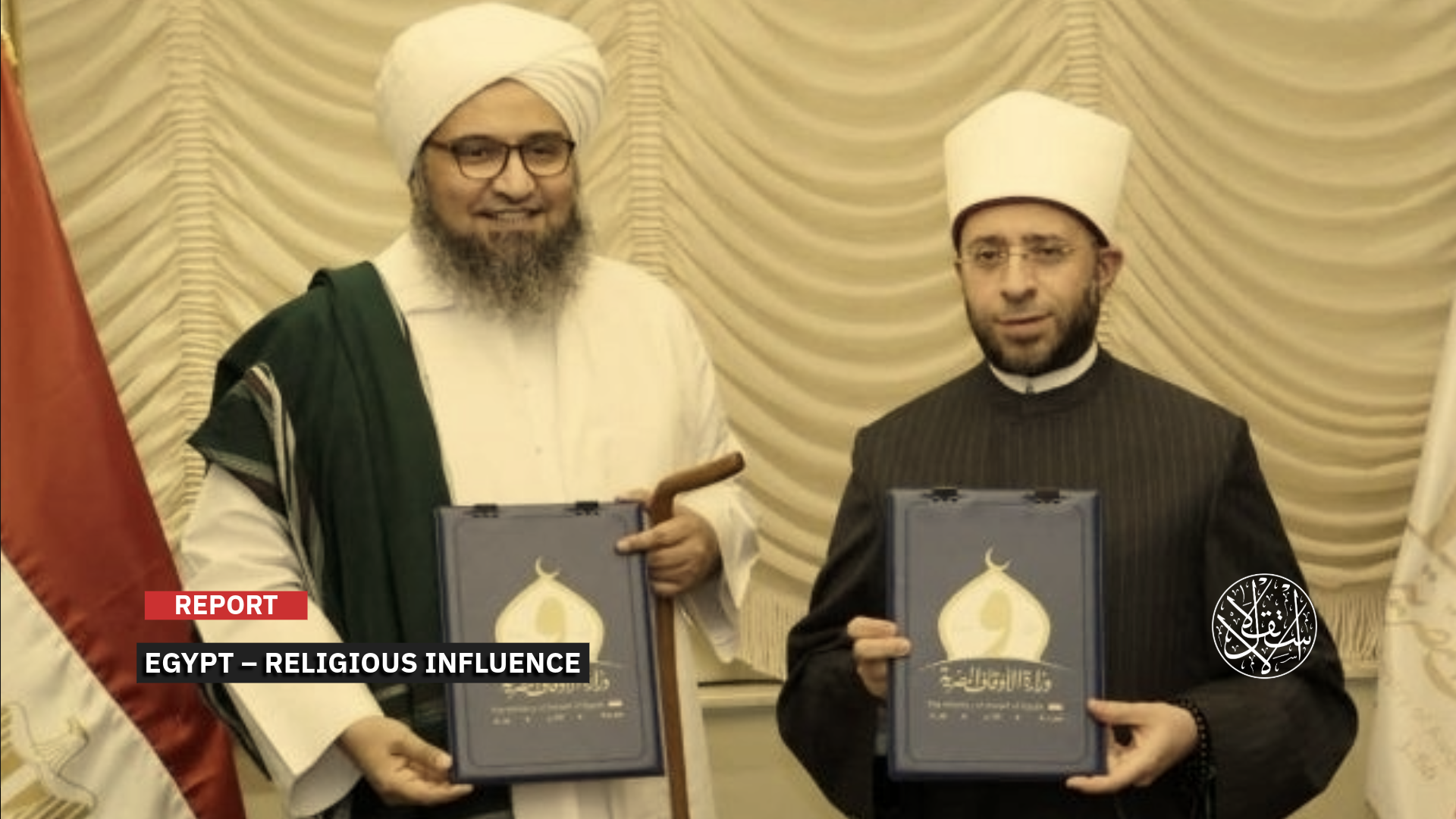
“The Tabah Foundation is headed by Habib Ali al-Jifri, who relocated to the UAE after being expelled from Egypt in 2002.”
The Egyptian Ministry of Endowments’ signing of a cooperation protocol with the UAE-based Tabah Foundation on October 4, 2026, was not merely a routine religious agreement.
The arrangement goes beyond the announced exchange of expertise to include training programs, lectures, conferences, and seminars for Egyptian imams and preachers in Abu Dhabi, delivered by an organization surrounded by suspicions.
The agreement opens the door to direct institutional cooperation in one of Egypt’s most sensitive spheres of influence: shaping religious discourse and training those who work in the field. This raises questions about the reasons for entrusting such a role to a UAE-based institution.
It also raises another question: Does this institution represent an alternative to Al-Azhar, which had previously rejected similar official Egyptian proposals out of concern that they could lead to the distortion of religion and Islamic heritage?
These questions have been further intensified by the nature of the other party. Since its establishment in 2005, the Tabah Foundation has described itself as working to prepare studies, recommendations, and projects aimed at opinion leaders and policymakers, with a focus on reformulating Islamic discourse.
This orientation makes it appear closer to a project aimed at reshaping the religious and intellectual landscape than to a mere educational or religious outreach institution.
It also raises questions about Emirati influence through the instruments of religious soft power, and about who has the authority to shape religious discourse in Egypt.
Concerns surrounding the protocol have grown despite the absence of any publicly announced clause concerning what is known as the “Abrahamic religion.”
The nature of the institution and its alleged questionable ties to Israeli and American entities promoting this orientation have raised concerns about the underlying objectives of the agreement.
This brings the central questions into focus: Does the partnership with Tabah represent a new step toward expanding Emirati influence within Egypt’s religious sphere? What are the limits of this influence? And who sets the rules governing it?
Religious Infiltration
In a strange and suspicious move, Egypt’s Ministry of Endowments announced the signing of a cooperation protocol with the UAE-based Tabah Foundation, headed by Yemeni preacher Habib Ali al-Jifri.
The agreement aims to establish cooperation in areas including developing religious discourse, training those working in religious outreach, and other fields.
The Tabah protocol places the Ministry of Endowments before a test that goes beyond traditional religious cooperation: Can Egypt benefit from regional soft-power networks without allowing them to become an independent force in shaping its religious discourse?
It also raises questions about the sources of funding for the cooperation programs, where the training will take place, which body will review their content, and whether the programs will be subject to scrutiny by Al-Azhar’s scholarly institutions before implementation.
A review of the agreement’s provisions suggests that it has been placed within a broader context than religious cooperation alone, one in which Emirati soft power, which manages and funds the foundation, intersects with efforts to redefine religious discourse and develop new models of influence within the religious sphere.
The announcement of this cooperation has therefore sparked criticism and suspicion among numerous Egyptian intellectuals and thinkers, who have viewed it as an Emirati attempt to circumvent established channels, with official Egyptian backing, to intervene in religious discourse in the country of Al-Azhar.
They have also expressed concerns that Egypt could be drawn into cooperation with entities linked to supporters of ‘the Abrahamic religion’ project promoted by Abu Dhabi.
They fear this could be an attempt to undermine Al-Azhar through the Ministry of Endowments, which is headed by Osama al-Azhari, the current minister and former religious affairs adviser to the head of the regime, Abdel Fattah el-Sisi.
The foundation has been based in Abu Dhabi since its establishment in 2005. Habib Ali al-Jifri is its founder and chairman of its board of trustees, and al-Jifri’s official website confirms that he oversaw the establishment of Tabah in Abu Dhabi in 2005.
The U.S. Department of State’s 2017 report on international religious freedom described the Tabah Foundation and the Forum for Promoting Peace as UAE government-supported organizations working to present interpretations of Islam described as moderate.
More surprising still is that al-Jifri had previously been deported by Egypt’s Ministry of Interior and barred from entering the country in 2002, only to return in 2026 through the Ministry of Endowments.
Al-Jifri confirmed this in interviews with Al-Musawwar magazine, the Al Arabiya website in July 2002, and the Egyptian newspaper Al-Masry Al-Youm in December 2006.
He stated that the Egyptian authorities had expelled him from the country without giving any reason. However, religious affairs journalist Tohamy Montaser said that al-Jifri had been deported because of the danger he posed to public security and Egyptian society, describing him as a cancerous cell that kills religion.
However, he returned to Egypt after el-Sisi came to power in 2014 and was invited to participate in educational sessions for the military, attended by el-Sisi himself, in February 2017.
During these sessions, he praised the regime and the military and described the Muslim Brotherhood as being like the Zionists.
Because of the suspicions surrounding this protocol, Egyptian intellectuals have raised questions about its true objectives.
Writer Khaled Refat Saleh has highlighted what he considers the dangers posed by this UAE-based foundation, asserting that Tabah’s headquarters is nothing more than a small villa, number 35, in Bayn al-Qasrayn, Abu Dhabi.
He claims that the foundation is funded entirely by the Emirati mini-state for the purpose of developing Islamic discourse as part of its Abrahamic religion project.
He also stated that Tabah is headed by Habib Ali al-Jifri, who relocated to the UAE after being expelled from Egypt in 2002 for posing a threat to Egyptian national security, according to a decision by Egypt’s interior minister.
Al-Jifri had also previously entered Jerusalem on an Israeli visa in April 2022, ostensibly to visit Al-Aqsa Mosque.
Furthermore, the Tabah Foundation has a strategic partnership with the Kalam Center for Research and Media, a UAE-based institution whose stated objective is to renew Islamic ilm al-kalam (Islamic Scholastic Theology).
The center is headquartered in a small office, number 114, in the Ibn Battuta complex in Dubai. Its president, Aref Al-Nabed, is a Libyan engineer who holds a master’s degree from the Pontifical Institute at the Vatican and a doctorate from Canada. He is also a member of the Cambridge intelligence program for interfaith dialogue.
Tabah was founded in 2005 and describes itself as a non-profit organization that produces studies, recommendations, and projects targeting opinion leaders and policymakers, with a focus on reformulating Islamic discourse.
What stands out about Tabah’s approach is that it does not present its mission as merely promoting religion or providing religious education.
Rather, it seeks to build an infrastructure for Islamic discourse, encompassing research, personnel training, institutional development, consultancy, and engagement with opinion leaders. This helps explain why its activities extend across various intellectual, academic, and religious circles.
Former ambassador Mohamed Morsy wrote, questioning the UAE’s current role in the region and its embrace of the ideas and advocacy surrounding the new Abrahamic religion promoted by “Israel” and the United States, which, he argued, are using the UAE as a spearhead to advance this project, which Al-Azhar Al-Sharif has rejected.
He raised concerns and posed several questions: Will the UAE fund the development and training programs agreed upon between the Tabah Foundation and the Ministry of Endowments? Will Egyptian imams be sent to the UAE for training?
What is the UAE’s objective in doing so? Will these programs be reviewed and evaluated by Al-Azhar’s Council of Senior Scholars before implementation?
He also asked whether it was appropriate for a newly established organization to be placed on an equal footing with the Ministry of Endowments of a country renowned as the home of Al-Azhar, with a cooperation memorandum or protocol prominently announced between the Tabah Foundation and Egypt’s Ministry of Endowments to jointly develop religious discourse and train those working in the field. He called on Al-Azhar to intervene.
Joint Project
There is a documented and direct relationship between the Tabah Foundation and the Kalam Center for Research and Media (KRM), involving an ongoing partnership and intellectual and research cooperation, as well as overlap in some individuals and projects. Both are UAE-backed initiatives, and in 2013, they announced an expansion of their cooperation through joint initiatives.
The Tabah Foundation, headquartered in Abu Dhabi and chaired by Habib Ali al-Jifri, was established as a non-profit organization aimed at developing Islamic discourse and producing research and projects that serve Islamic values.
Its official mission statement confirms that its frame of reference is Islamic and that it works to develop contemporary Islamic discourse.
The Kalam Center for Research and Media (KRM), meanwhile, was established in Dubai in 2009. It is a research and training center focusing on Islamic scholastic theology (ilm al-kalam), philosophy, science, interfaith dialogue, conflict resolution, and other fields.
The center explicitly states that interfaith dialogue, including dialogue between different religious traditions, is one of its core areas of activity.
This has been linked to the Abrahamic religion project promoted by Abu Dhabi, whose primary objective, according to critics, is to integrate “Israel” into the region and normalize relations with it.
Connections have also been alleged between the two institutions and the so-called Abrahamic religion initiative promoted by the UAE.
On February 16, 2023, the UAE inaugurated what it calls the Abrahamic Family House, a complex comprising a mosque, a church, and a synagogue, under the banner of promoting tolerance and human fraternity.
Opponents of the initiative have argued that its underlying objective is to dilute the Islamic faith and serve the normalization of relations with “Israel”.
The Kalam Center for Research and Media has documented activities in Muslim-Christian and Muslim-Jewish dialogue. It has also collaborated with the Cambridge Interfaith Programme, which focuses on promoting understanding among the three Abrahamic religions: Islam, Christianity, and Judaism.
In 2010, the center published a book by researcher and director Aref Al-Nabed entitled Growing Systems of Peace, Mercy, and Blessing, which explored interactions among the Abrahamic religions.
The center’s advisory board also includes Peter Ochs, a professor of modern Judaic studies and one of the co-founders of the Society for Scriptural Reasoning, an initiative based on dialogue among followers of Abrahamic faiths and traditions.
The Kalam Center for Research and Media is connected to an international network of interfaith dialogue institutions. Its activities and partnerships include programs and academics that employ the concept of Abrahamic religions and shared values, which, according to critics, makes it part of the broader “Abrahamic religion” project.

Emirati Influence
The greatest concern surrounding this cooperation between Egypt’s Ministry of Endowments and the UAE-based Tabah Foundation lies in a fundamental question: What does it mean for an institution with a cross-border agenda to reshape Islamic discourse to work directly with an Egyptian ministry responsible for mosques, imams, religious training, and preaching?
To what extent should religious and intellectual institutions with questionable objectives, operating from outside the country that is home to the historic Al-Azhar institution, be allowed to participate in shaping or developing Egyptian religious discourse? And who determines the limits and standards governing such cooperation?
The response offered by Egyptian intellectuals and thinkers through a series of social media posts can be summarized as follows: the aim is to exploit Emirati soft power through religion, using affiliated institutions to bring about changes that the UAE has been unable to achieve through other means.
In recent years, religion and religious discourse have become arenas of competition for influence, to change Islamic identity, particularly amid Abu Dhabi’s efforts to present itself as a model of moderate Islam.
The details of the cooperation protocol between Egypt’s Ministry of Endowments and the UAE-based Tabah Foundation raise a fundamental question: Are we witnessing normal professional and academic cooperation between two institutions operating in the religious sphere, or is this one of the instruments of soft power Abu Dhabi uses to build long-term influence over the Arab religious landscape?
Several academic studies have shown that, in recent years, the UAE has developed religious soft-power instruments alongside its economic, diplomatic, and political tools.
A study published in the journal Religions on July 5, 2022, entitled “The Religious Soft Power of the United Arab Emirates through Scholars and Organizations,” examined the UAE’s use of religious soft power.
The study argued that Abu Dhabi’s efforts to build a network of institutions and religious scholars were intended to turn this network into an instrument of soft power and strengthen the UAE’s image as a religious and political model based on moderation, tolerance, and opposition to extremism and political Islam.
It pointed to several institutions supported by the UAE, including the Forum for Promoting Peace in Muslim Societies and the UAE Council for Fatwa, as well as religious figures who support its orientation, such as Habib Ali al-Jifri, Abdullah bin Bayyah, and others.
A study published by Georgetown University’s Berkley Center for Religion, Peace, and World Affairs on August 31, 2020, also highlighted Abu Dhabi’s patronage of scholars associated with the neo-Sufi and traditionalist currents, including Habib Ali al-Jifri.
It stated that “this patronage has enabled the UAE to promote a model of non-politicized, peace-oriented Islam in opposition to currents of political Islam, particularly those associated with the Muslim Brotherhood.”
The UAE’s religious project is thus centered on countering political Islam, particularly the Muslim Brotherhood’s model.

Political Islam
A study published in the British Journal of Middle Eastern Studies on September 29, 2024, by a researcher from George Mason University, also argued that the UAE had sought to capitalize on Al-Azhar’s global standing and religious symbolism as part of its foreign policy.
The study concluded that the UAE had sought to leverage Al-Azhar’s international religious stature as a form of religious capital or influence in its foreign policy by building institutional, financial, and personal ties with the institution and drawing on its scholars for peace initiatives, counter-extremism efforts, and interfaith dialogue.
It stated that the broader political objective behind this cooperation with Al-Azhar was to counter political Islam, as part of a wider Emirati policy.
According to the study, leveraging Al-Azhar’s global standing provides Abu Dhabi with religious credibility that a relatively new UAE-based institution could not generate on its own.
The study uses the concept of the transnational transferability of religious capital, meaning that the religious authority Al-Azhar enjoys within Egypt can extend its value and influence internationally through partnerships, institutions, and religious figures, allowing the UAE to benefit from that standing in its foreign policy.
In March 2026, Al-Azhar’s Grand Imam, Ahmed al-Tayeb, received the UAE ambassador to Cairo. Both sides emphasized the depth of relations between Al-Azhar and the UAE and their commitment to cooperation in countering extremist ideology and promoting peace and coexistence.
As part of what critics describe as the UAE’s exploitation of Al-Azhar’s standing to extend its religious influence, the UAE also encouraged the Grand Imam to sign what became known as the Document on Human Fraternity with former Pope Francis in Abu Dhabi in February 2019.
The UAE regards this document as the founding milestone of what has been described as the Abrahamic religion or the Abrahamic Family House.
According to Emirati newspapers on June 15, 2021, the UAE claimed that the Abrahamic Family House was receiving close attention from both the Grand Imam of Al-Azhar and the Pope.
Critics have accused the UAE of seeking, through indirect means, to implicate al-Tayeb in normalization with “Israel” under the guise of the controversial Abrahamic framework.
However, during the celebration marking the tenth anniversary of the establishment of the Egyptian Family House on November 8, 2021, the Grand Imam of Al-Azhar stated that the so-called Abrahamic religion was nothing more than wishful thinking and criticized the idea of normalization.
In 2023, Al-Azhar also issued an explicit statement categorically rejecting the idea of merging the three religions into a single religion under the name of the Abrahamic religion.
Sources
- Egypt’s Ministry of Awqaf and the Tabah Foundation for Research Sign a Cooperation Protocol to Develop Islamic Discourse [Arabic]
- KRM and Tabahh Foundation to Co-operate on Joint Initiatives
- Using Religion for Geopolitical Ends in the Gulf: Disputes Between Abu Dhabi and Qatar
- The United Arab Emirates’ Religious Soft Power Through Ulema and Organizations
- Selling God: Al-Azhar, the UAE, and the Transnational Transferability of Religious Capital