Amid Educational Partnership With the Israeli Occupation: How Secularism Excluded Veiled Female Students in Azerbaijani Schools
"The hijab controversy in Azerbaijan exposes a broader contradiction between the official discourse on secularism and the beliefs of society."
A growing dispute over the hijab is exposing tensions in Azerbaijan’s schools, where new dress code rules have reportedly barred veiled students from classrooms and left teachers facing a choice between removing their hijabs and risking their jobs.
The restrictions have sparked protests among students and the wider public, reigniting a debate over religious freedom and the limits of the secularism promoted by the state.
The controversy has laid bare a gap between constitutional guarantees of freedom of belief and the enforcement of school dress codes that, according to accounts from those affected and media reports, restrict the wearing of hijabs in public schools.
The contradiction is particularly striking in a country where Muslims make up about 96 per cent of the population.
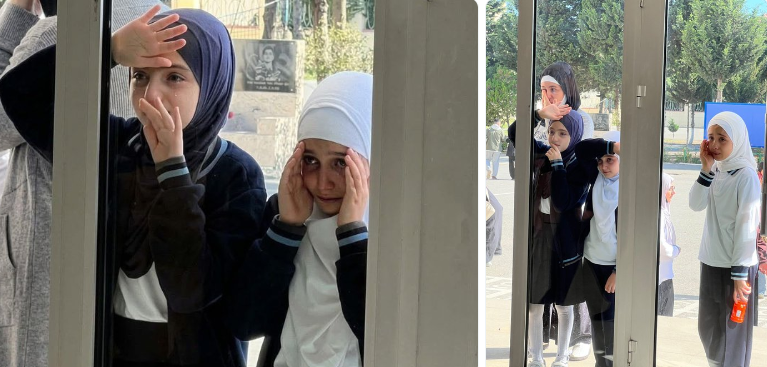
Since late September 2026, footage has circulated showing students being turned away from their schools and others crying after being barred from class. Veiled teachers have also reportedly been told that keeping their jobs depends on complying with the new rules.
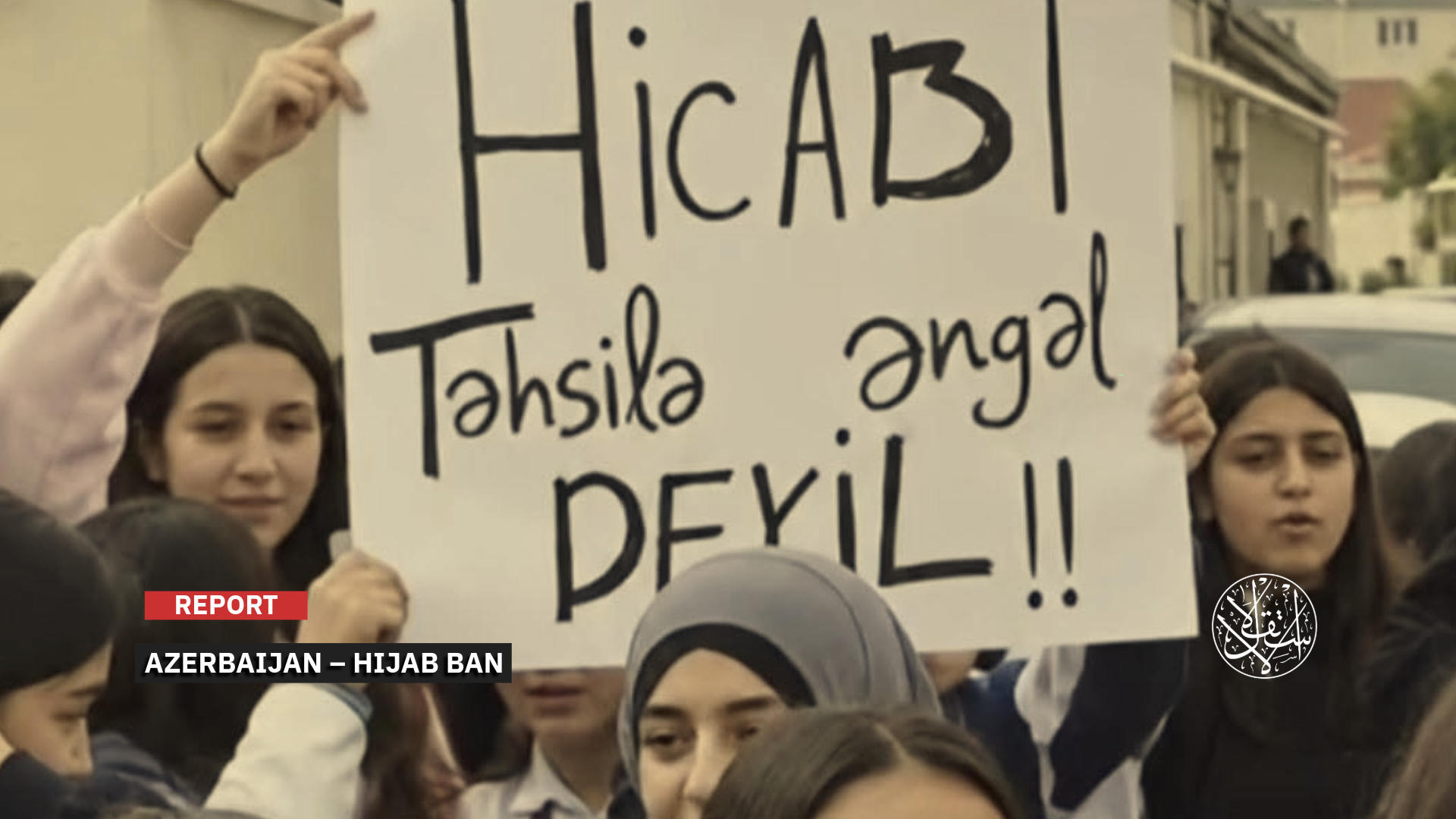
The scenes have prompted an outpouring of support and protests that have spread beyond schools to the streets and social media, with some students who do not wear hijabs joining demonstrations against the denial of education to their classmates.
Reports of protesters being detained, along with religious figures and journalists critical of the measures being taken into custody, have widened the dispute beyond school uniforms to questions of free expression and the rights to education and employment.
At the same time, Azerbaijan’s educational ties with the Israeli Occupation have come back into focus after years of teacher training programs and exchanges of expertise, as well as new official agreements on education and scientific research.
The closer cooperation has prompted critics of the government to question its priorities, particularly as authorities take a stricter approach to religious expression in schools.
The available evidence, however, does not directly establish a link between Azerbaijan’s educational cooperation with “Israel” and the restrictions on hijab. Distinguishing the existing official partnership from political accusations surrounding it is essential to understanding the broader dispute.
https://s3.eu-west-3.amazonaws.com/alestiklal/gallery/2026/10/13/1534413620.png
A New Secular Push
Azerbaijan’s school hijab ban is not new. Its roots date back to 2010, when authorities tried to enforce the restriction through coercive measures but failed.
The dispute flared up again on September 21, 2026, after officials revised school dress code rules. Although the new regulations do not explicitly name the hijab, their restrictions on school attire effectively prohibit students from wearing it.
https://pbs.twimg.com/media/HUQpne8XEAAdKIG?format=jpg&name=900x900
In July 2026, President Ilham Aliyev issued a decree calling for the strengthening of the secular character of public education.
As the school year began on September 21, the Cabinet of Ministers approved amendments barring accessories or clothing that deviate from the standardized school uniform or conflict with the principle of secular public education.
The rules did not explicitly mention the hijab or clarify whether violations of the dress code could justify barring students from school. Yet as classes resumed, veiled students were reportedly turned away and prevented from entering their schools.
The restrictions have now extended beyond students to teachers, following a new Cabinet of Ministers decision issued on October 6, 2026, under No. 325, requiring teachers’ attire to comply with the principle of secular public education.
Although the rules again make no explicit mention of the hijab, local reports say teachers at schools in Sumqayit and at School No. 90 in Baku’s Ramana district were instructed to remove their headscarves or resign.
State television has aired promotional videos targeting girls who wear the hijab, presenting them with an ultimatum: give up the headscarf or give up their education.
The videos contrast unveiled students in Western-style school uniforms with veiled students while portraying both them and their hijab-wearing teachers as unwelcome in public schools.
As veiled students and teachers began being turned away from schools, a series of protests erupted, with public anger growing over whether the dress code rules uphold secularism or use it to effectively restrict the hijab.
Students barred from entering school sat outside the gates to study, with some of the veiled teachers who had also been dismissed helping them.
Analysts say President Ilham Aliyev’s government has opened a door that will be difficult to close by forcibly banning the hijab, repeating Turkiye’s experience, which ultimately ended in victory for the hijab. They warn that the government now faces a choice: back down or risk a popular uprising.
Azerbaijan’s constitution guarantees the right to free and compulsory general secondary education but contains no explicit provision granting individuals the right to wear or not wear the hijab in schools.
Article 18 establishes the separation of religion and state and stipulates that public education must be secular. Article 48, however, guarantees freedom of conscience and belief, including the right to practice a religion and express one’s beliefs.
This raises a fundamental question: Does a school’s commitment to secularism require banning students from expressing their religious beliefs, or can the state maintain institutional neutrality without restricting individual religious expression?
Anger and Protests
Footage showing veiled girls and teachers being fired from schools has sparked widespread anger in Azerbaijan, particularly among students’ families.
Videos have emerged of female students and parents saying they are the children of martyrs who gave their lives in the war to liberate Karabakh from Armenia, yet they are now being expelled from school.
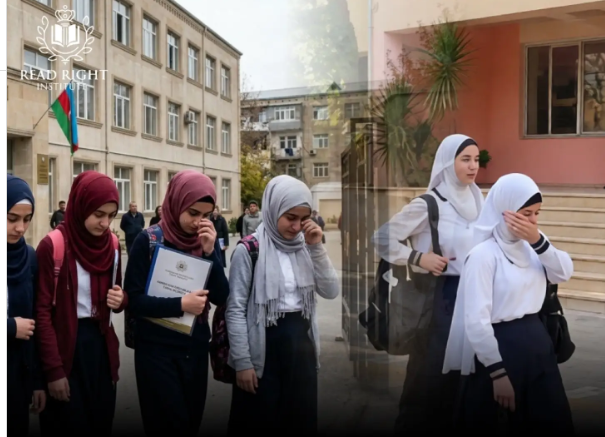
Media outlets have published footage of veiled students being denied entry to schools, with some in tears as their classmates and families object to the restrictions.
Unveiled students also stood in solidarity with their veiled classmates, joining them in a school strike to protest the restrictions on the hijab, according to OC Media, an independent news outlet covering the North and South Caucasus, on October 9, 2026.
The amendments sparked a wave of protests, with students gathering outside their schools and refusing to attend classes in solidarity with their veiled classmates.
Students at Baku’s School No. 69 and B. Shiriyev Secondary School in the village of Mollaoba, in the Masally district, refused to attend classes and demanded that their veiled classmates be allowed to return to school, according to reports by Meydan TV and footage circulating on social media.
Students were seen crying as they said goodbye to their teacher, who was leaving the school because she wears a hijab. The teacher was dismissed from Richard Sorge Secondary School No. 90 in Baku.
Footage showed female students crying and hugging her, grieving her removal from the school for refusing to take off her hijab.
Baku has witnessed a series of protests, including one outside the Education Ministry that drew around 1,000 people, following statements insisting on compliance with school uniform rules and banning the hijab.
Protesters chanted, “We would rather die than take off our hijabs.” Dozens were arrested, while some students and teachers who took part in the protests were expelled or dismissed.
As protests against the secular dress code rules grew, some parents tried to get their veiled daughters into schools despite the ban. On October 12, 2026, Azerbaijan’s Interior Ministry announced the arrest of 37 people in connection with incidents involving compliance with school uniform rules, according to the Baku-based Jam News agency.
Azerbaijani authorities also blocked access to social media platforms amid fears that the protests could evolve into a political movement against the repressive government, as demonstrations against the hijab ban for female students and teachers continued.
In solidarity with the students and teachers affected, Polad Aslanov, the imprisoned editor of the news website Xeberman, announced that he was rejecting the hijab restrictions and had begun a hunger strike to protest measures targeting all veiled female students whose right to education was being restricted, as well as veiled teachers being forced to choose between their jobs and wearing the hijab.
Aslanov said the hunger strike aimed to draw attention to the exclusion of veiled students from schools and restrictions on teachers’ clothing. He added that his own veiled daughter’s right to education had also been restricted.
He said the clothing restrictions violated Article 48 of Azerbaijan’s Constitution, which guarantees freedom of conscience and belief.
Azerbaijani religious scholar Abgul Suleymanov was also arrested after criticizing the school hijab restrictions on social media.
“If they dare to prevent schoolgirls from studying while wearing the hijab, I will choose prison and die there,” Suleymanov posted on Facebook. He described the situation in the country by saying, “Everyone in this country lives a prison life.”
Defending the hijab ban, Rovshan Mammadov, head of Azerbaijan’s state television broadcaster AzTV, said, “We have our own values and national identity.”
He claimed that following the victory in Karabakh, ideological and media attacks targeting Azerbaijan have intensified.
“The state will resist every attempt to introduce Arab-Persian values into our national identity, change our children’s consciousness and outlook on life from school age, and corrupt them,” he said, describing what he called a cross-border ideological attack on the country.
“The state will firmly prevent any attempts to impose Arab and Persian values on our national identity or to change and distort our children’s minds and outlook on life from school age.”
He claimed that the main goal of this ideological attack, which he said was largely directed from abroad by a source whose identity was well known, was to bring Azerbaijan to the dire situation facing some other Muslim nations.

Israeli Model
One striking aspect of the school hijab controversy was the Azerbaijani education minister’s remarks about drawing on “Israel’s” educational model, including Israeli expertise in technology education and teacher development, as part of a broader effort to modernize the curriculum.
“Israel’s experience will help improve Azerbaijan’s education system,” he said, according to Turkiye Haber.
Azerbaijani opposition figures say a powerful “Israeli lobby” operates in the country, helping sustain close ties between Azerbaijan and “Israel.” Azerbaijan is home to around 30,000 Jews and maintains strong relations with the Israeli Occupation state.
On February 2, 2026, Azerbaijan’s Ministry of Education officially announced that Deputy Minister Hasan Hasanli had met with Israeli Education Minister Yoav Kisch to discuss cooperation in general and higher education and the potential use of Israel’s educational model.
An article published by Yedioth Ahronoth on September 23, 2023, examined the background of the educational cooperation and revealed that Israel’s ORT network oversees the initiative, including its curricula.
Since 2019, ORT has regularly hosted Azerbaijani education delegations in “Israel.”
By 2023, seven delegations comprising a total of 350 Azerbaijani education leaders had taken part in three-week training programs in the country.
The report revealed that each Azerbaijani school principal visiting “Israel” is paired with a principal from the ORT network.
The Israeli Jewish principal then travels to Azerbaijan once a year to work with their Azerbaijani counterpart at their school as part of what has been described as comprehensive reforms to Azerbaijan’s education system.
An Azerbaijani journalist living in Turkiye argued that Azerbaijan’s Education Ministry, current Education Minister Emin Amrullayev, and his team were primarily concerned with applying Israeli methods to the country’s education system.
“Emin Amrullayev brings in teachers from Israel and favors them over Azerbaijanis with 30 years of experience, imposing rules on education that are unsuitable for our system,” she said.
Criticizing the school hijab ban, she challenged the minister, “Have you asked the people whether they want the Israeli methods you are trying to bring into this country?”
“Officials working in Azerbaijan in the interests of countries such as Israel, Iran, and Russia are trying to undermine stability in the country through the Education Ministry, then claim that veiled Azerbaijani women are the problem.”
She mocked those who insult veiled teachers and students by claiming they wear Arab clothing, arguing that they overlook one fact: 99 per cent of women who wear what they call Arab clothing, meaning the hijab, include the mother of the former president, who was also the current president’s grandmother.
“That veiled mother raised a son who became president of Azerbaijan, as well as three academic scholars and a doctor. Most of the mothers of those who laid the foundations of the country in 1918, rebuilt modern independent Azerbaijan, and defended its independence also wore the hijab,” she added.
Azerbaijani journalist Nigar Ogeday launched a scathing attack on the government’s decision to ban the hijab in schools, accusing the authorities of undermining education and destroying the future of veiled girls. She also criticized the country’s reliance on “Israel” to develop its education system.
In a video posted on her social media accounts, Ogeday said angrily, “The Zionists have taken over our media. Azerbaijani media is occupied by Zionists.”
“That was not enough for them. Now they have decided to destroy education in Azerbaijan. To destroy a society, you do not need to destroy its army. It is enough to destroy its education to emerge victorious. Today, under the pretext of the hijab, Azerbaijan’s future is being wiped out,” she added.
Ogeday also shared a video of an Azerbaijani soldier who said he had lost the use of his hand during the Second Karabakh War, only to find himself facing the denial of his daughter’s right to attend school because she wears a hijab.
The soldier appealed to the education minister and the Azerbaijani president, saying, “We did not shed our blood so that our children would be left in tears and barred from going to school.”
Ogeday accused officials of targeting young people who had helped liberate Karabakh, asking, “You are taking revenge on the young people who liberated Karabakh, but on whose behalf? On behalf of the Armenians or Zionism? Have we become such slaves to Zionism in Azerbaijan?”
Educational cooperation with the Israeli Occupation has coincided with a broader expansion of Azerbaijani-Israeli ties, which deepened during the Karabakh War, when Tel Aviv announced plans to supply Baku with drones that contributed to the fighting.
The growing relationship extends beyond military and diplomatic ties to cultural cooperation and the protection of the Jewish community, while encompassing major strategic interests, including arms and technology trade.
“Israel” also imports 50 per cent of its imported oil from Azerbaijan, according to Yedioth Ahronoth.
According to the Associated Press (AP) in September 2023, the Israeli Occupation supplied Azerbaijan with drones, munitions, and advanced weapons systems, and the two countries maintained close defense cooperation during the Nagorno-Karabakh War.
Azerbaijan’s location next to Iran, along with its energy and arms interests, is an important factor in explaining its rapprochement with “Israel.”
Iranian sources have accused Azerbaijan of allowing Israeli attacks to be launched from its territory during the U.S.-Israeli War on Iran in February 2026. Baku, in turn, has complained about missiles fired from Iran into Azerbaijani territory.
Shiite Society
A previous study by the University of Cambridge, published on January 24, 2020, noted that the debate over the hijab in Azerbaijan has historically been tied to the state’s views on secularism and national identity, as well as concerns about the political use of religion.
Notably, President Ilham Aliyev’s July 2026 decision to promote the secular character of public education came nearly five months after the U.S.-Israeli War on Iran, following Tehran’s accusations that Baku had participated by allowing attacks to be launched from its territory.
Some Azerbaijani analyses and reports have linked these wartime developments and tensions between Tehran and Baku to the decision to accelerate the secularization of education.
Around 60 per cent of Azerbaijan’s Muslims are Shiite, and Baku is concerned about the role of religious educational activities and seminaries in teaching students Shiite religious ideas that could challenge the country’s secular orientation.
According to allegations published in the Azerbaijani press, one of the main reasons for making school uniforms mandatory was to prevent Iran from spreading its national anthem and ideological teachings through certain teachers and students as a means of promoting Iranian culture. Videos alluding to these allegations have also circulated.
Azerbaijani state television addressed concerns about Iran following protests against the hijab ban on September 21, 2026. It aired a report defending the ban, saying, “We do not want Persian or Arab culture in our schools. That is why we made this decision.”
During a televised interview, an Azerbaijani politician linked the hijab ban to concerns about Iranian Shiite influence over Azerbaijan’s predominantly Shiite society.
Although he said he did not consider the ban a sound decision, he described it as necessary to counter what he called Iran’s use of religion to expand its influence.
Sardar Jalaloglu, chairman of the opposition Azerbaijan Democratic Party, said the controversy over restrictions on the hijab in Azerbaijani schools was linked, in his view, to Baku’s concerns that Iran is using religion and religious symbols to strengthen its influence inside the country.
In an interview on TV, he argued that the issue went beyond school uniform regulations and had political and geopolitical dimensions, amid what he described as Iranian attempts to exploit sectarian and religious ties to build networks loyal to Tehran inside Azerbaijan.
Jalaloglu linked the growing controversy to an earlier visit to Iran by Azerbaijani Deputy Prime Minister Shahin Mustafayev.
He said that during the visit, the Supreme Leader’s adviser Rezaei deliberately humiliated the Azerbaijani official, after which Tehran mobilized media networks in Turkiye to pressure Baku over the hijab issue.
The Azerbaijani politician added that some religious activities, including mourning gatherings and the distribution of food in public squares, could be exploited to build political loyalties to Iran.
He warned of what he considered a threat to Azerbaijan’s independent decision-making.
He also urged Turks not to project their own domestic experience onto Azerbaijan, citing the differences in political and religious circumstances between the two countries.
Other assessments suggest that the restrictions on the hijab, introduced on September 21, 2026, are directly linked to regional tensions and undisclosed political motives.
From this perspective, the measures are not simply about school uniforms but intersect with the state’s efforts to regulate religious activity and its security and political sensitivities toward Iran and Turkiye.
Observers argue that the new hijab restrictions in Azerbaijan go beyond standardizing school uniforms and touch on a broader struggle over the country’s identity and the limits of religious influence in a region where security concerns intersect with regional competition.
Baku, which embraces a secular model and maintains close ties with the Israeli Occupation, is particularly sensitive to Iranian influence among Shiite communities, which make up the majority of its population.
A Rift Between Turkiye and Azerbaijan
The hijab restrictions have also put Azerbaijan in an awkward political position with Turkiye, its strategic ally.
Turkish President Recep Tayyip Erdogan has long criticized hijab bans and led a campaign to overturn the restrictions in Turkiye.
Since the hijab controversy erupted in Azerbaijan, Turkish citizens and media outlets have expressed solidarity with Azerbaijani students and teachers who wear the hijab and criticized the government’s decisions.
Turkish media have widely circulated footage of demonstrations and protests by students and parents, while media outlets and social media users have sustained their criticism of the government in Baku.
Addressing the United Nations General Assembly in September 2026, Erdogan said that banning the hijab in schools in some countries amounted to an attack on women’s most basic rights, without naming any country.
Said Mahmood Kasany, a translator and writer from Tashkent, said the hijab controversy had exposed the limits of Turkish-Azerbaijani solidarity and triggered a crisis with the big brother, meaning Turkiye.
In a Facebook post, he explained that recent disagreements between Baku and Ankara were not merely a passing difference of opinion over foreign policy.
Rather, he said, they revealed a deeper crisis rooted in Azerbaijan’s continued rejection of the “big brother” approach and attempts to exercise control over its national decisions and domestic affairs.
He also pointed to media and political circles aligned with Turkiye’s conservative movement that had seized on the controversy and launched an intensive media campaign accusing Baku of restricting religious expression following the decision to ban the hijab in schools.
This ideologically driven media campaign extended beyond television screens and social media platforms, spilling onto the streets in demonstrations organized by Turks outside the Azerbaijani Embassy in Ankara, reportedly with official approval.
President Ilham Aliyev pushed back against criticism of Azerbaijan’s hijab ban, declaring that the country would not tolerate outside interference in its domestic affairs or attempts to shape its ideological direction. His remarks appeared to be directed at critics in Turkiye.
Sources
- Azerbaijan students launch school strike over hijab restrictions
- 'Take off your hijab and come into class': what is happening in Azerbaijan’s schools?
- Students in Azerbaijan Boycott School Over Hijab Ban; Dozens Arrested and Social Media Restricted
- 'We need you no less than you need us'
- The Politics of the Hijab in Post-Soviet Azerbaijan
- Azerbaijan Blocks Social Media Amid Protests Over Hijab Ban [Arabic]