Amid Opposition From Muslims and the Left: How Meloni’s Government Is Waging War on the Niqab
“In Italy, there is one female student who wears the full-face veil for every 240 classrooms.”
Several European countries continue to impose restrictions on how citizens and migrants of Muslim origin dress, citing reasons related to coexistence and compatibility with local culture.
At the same time, these policies have come under rights-based criticism, with critics linking them to the growing phenomenon of Islamophobia.
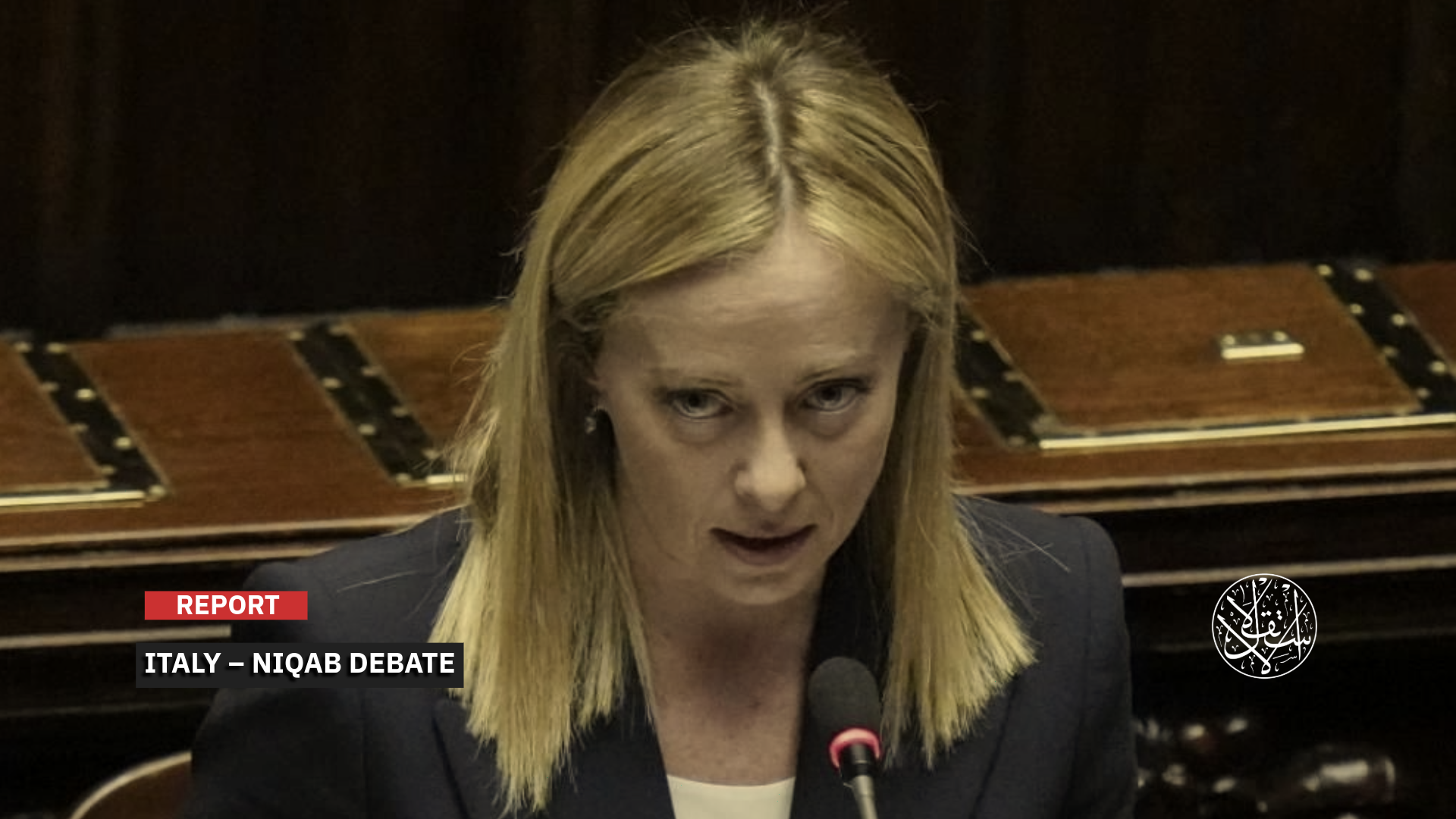
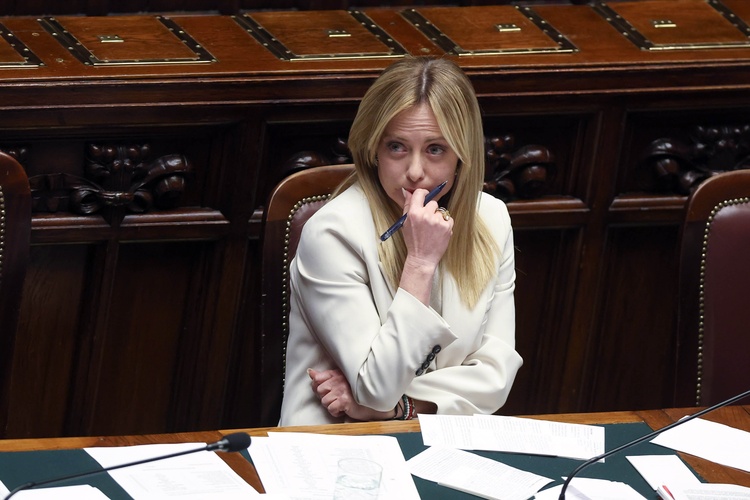
In the latest move of this kind, Italian Prime Minister Giorgia Meloni announced a plan to ban the wearing of the niqab and burqa in Italian schools, insisting that students must attend with their faces uncovered.
The Italian government had approved a decree on September 24, 2026, proposed by Meloni, banning the wearing of the burqa and niqab during classes and school activities, as well as at meetings between parents and teachers.
The measure was justified on the grounds of security concerns and protecting girls’ rights, with exceptions for specific medical or security circumstances.
The plan also includes setting a legal cap on the proportion of foreign students in classrooms, with the aim of preventing their concentration, improving integration, and enhancing the effectiveness of the education process.
It also requires the parents of foreign students whose children face significant difficulties integrating into the school system to participate in Italian-language learning programs.
Speaking to reporters after a cabinet meeting, Meloni said, “We must go further in this direction, without hesitation, because no one in Italy should hide their face in the name of a supposed or genuine tradition.” She also expressed her surprise at the Italian left’s opposition to the measure.
Left-wing forces and other opposition parties, meanwhile, described the decision as a populist measure involving misinformation and aimed at diverting attention from the real problems facing the country.
They argued that some of its provisions were based on identity-based and racist assumptions.
Education Minister Giuseppe Valditara acknowledged that the number of women and girls affected by the decision was limited nationwide, but defended the measure, saying, “Whether there are a few dozen or a thousand, I believe the ban is fair because women’s dignity must always be respected.”
Valditara, who days earlier took part remotely from New York in a press conference held by the Northern League, described the move as a civilizational battle.
During the same meeting, far-right Italian politician Matteo Salvini said that “political Islam is the nation’s number one enemy.”
He added, “Instead of Islamophobia, we should be concerned about Christianophobia, because here in Europe, there will soon be a witch hunt against Christians and Jews.”
Face-Covering Ban
This restrictive approach to wearing the niqab has become a recurring policy choice in several European countries, beginning with France, which approved a law in 2010 banning the concealment of the face in public places.
The French law requires compliance with this ban in almost every public setting, including streets, public transport, shops, museums, cinemas, theatres, libraries, schools, post offices, hospitals, courts, and government offices.
When the European Court of Human Rights was asked to rule on the case, it held that ensuring conditions of living together was a legitimate aim for the French authorities, which enjoy a wide margin of appreciation in this regard.
In 2011, Belgium introduced a ban, with violators facing prison sentences. Bulgaria subsequently followed suit, extending the ban to the private sector, while the burqa and niqab became permissible only in private homes and places of worship.
In Denmark, wearing the burqa and niqab in public places has been prohibited since 2018, but the government recently announced plans to introduce a specific law applying to schools as well.
In Austria, a law banning face coverings has been in effect since 2017; meanwhile, the Austrian parliament passed a new ban—which came into force on September 1—prohibiting girls under the age of fourteen from wearing the hijab. The law is nevertheless still under review by the Constitutional Court.
The Netherlands also enacted a face-covering ban in 2019, while Germany has no nationwide law on the matter, although some states have imposed partial bans.
Among the European countries that allow women to wear the full-face veil are Sweden, Poland, and Spain.
“Islamic Separatism”
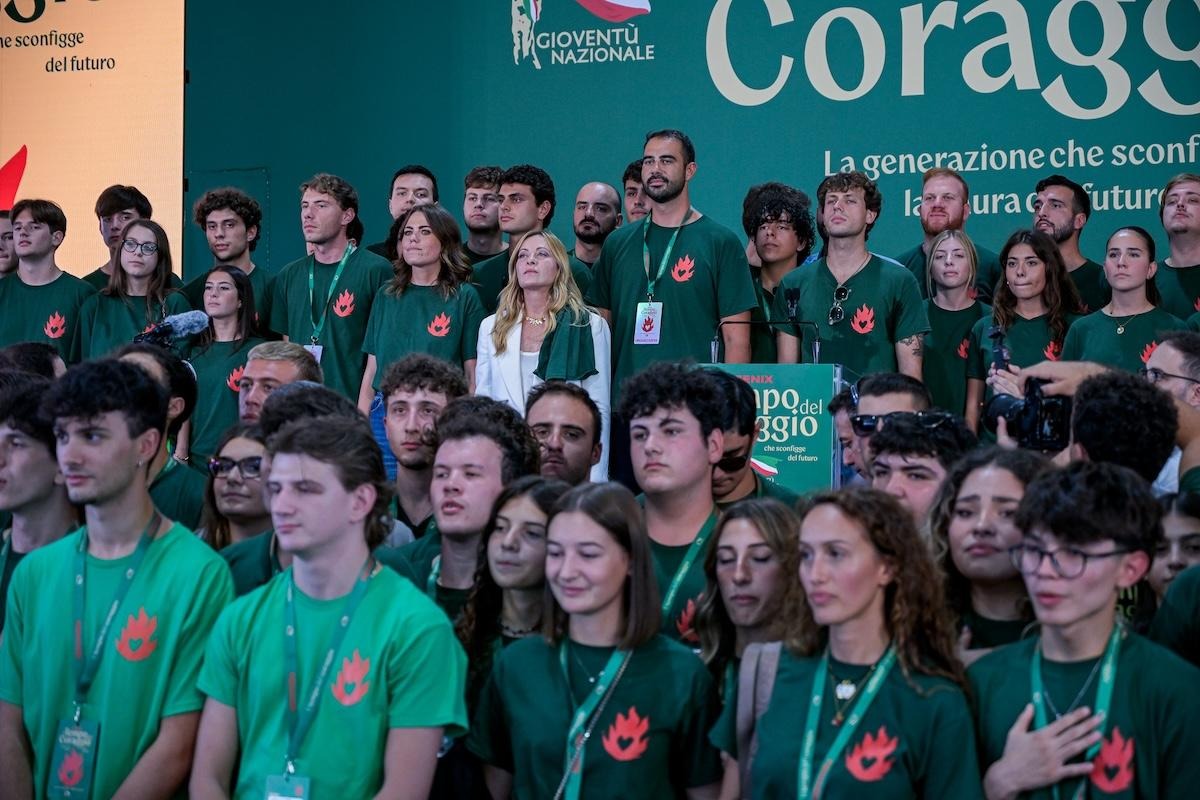
The Italian website Aska News reported in a post dated September 26, 2026, that Giorgia Meloni had announced the start of implementing the measure at the youth festival of the Brothers of Italy party.
It explained that the decree, which is being implemented immediately, imposes fines ranging from €200 to €1,000 on violators.
The website said the move represents the first step toward an explicit ban on wearing the niqab in all public places, as proposed in parliament by the prime minister’s party and Matteo Salvini’s League, amid fierce competition with Roberto Vannacci’s National Future party as the electoral campaign intensifies.
It also reported that on Saturday, September 26, a nationwide signature-collection campaign was launched under the sponsorship of Brothers of Italy to promote a bill submitted to the Chamber of Deputies targeting what it calls “Islamic separatism.”
According to the website, the bill claims that these areas are the result of uncontrolled immigration. Its provisions include banning the niqab in all public places, requiring authorities to track the sources of funding for mosques and places of worship, and criminalising those who embrace ideas based on religious intolerance or hatred.
The Italian website The Journal, in an analysis published on September 25, said that the reaction to the new government measure raises a much broader political question: Where does integration end, and where does the expectation begin that the host society should gradually adapt its rules to different cultural principles and models?
The website continued, “This is the point at which they seek to impose a concept of integration at the expense of reality, that is, the application of political Islam to a process of cultural subjugation.”
The source stressed that this interpretation had met strong opposition from the left, which itself fields Bangladeshi candidates in elections, describing the measure as a campaign of persecution against foreigners orchestrated for electoral purposes.
It continued, “While part of the opposition fears discrimination against Muslim communities, there are also advocates who openly embrace a principle they do not regard as negotiable or as a matter of individual choice.”
It explained that, for many of them, the hijab is not a woman’s right to choose, but rather a divine commandment.
The website also quoted citizens reacting to the measure, with one saying that it was of little significance, since it is rare to find a girl wearing the niqab in Italian schools.
Official Data
The Italian website School Technique, in an analysis published on September 22, 2026, asked what the figures are for those affected by the new measure. What do they show?
It answered, “The latest official data indicate that 931,323 foreign students are enrolled in schools, accounting for 11.6% of all students, a figure higher than the overall proportion of migrants in Italy (8.9%).”
It added, “More than 607,000 students holding foreign citizenship were born in Italy, representing a significant increase from 51.7% eleven years ago.”
In fact, the website added, “Nearly half of non-Italian students, 42.9%, hold European citizenship (with EU citizens accounting for nearly one-fifth), followed by 27.8% of African origin, 20.7% of Asian origin, and 8.5% of American origin, most of them from Latin America.”
It went on, “Of the more than 930,000 enrolled students, Muslims account for slightly more than one-third. Of the approximately 350,000 Muslim students, just over half, or around 150,000, are estimated to be female. However, less than half of these should be taken into consideration, no more than 40%.
The source explained that it is customary for girls to begin wearing the hijab after their first menstruation. Therefore, all female students attending middle school up to approximately the first or second year should be excluded.
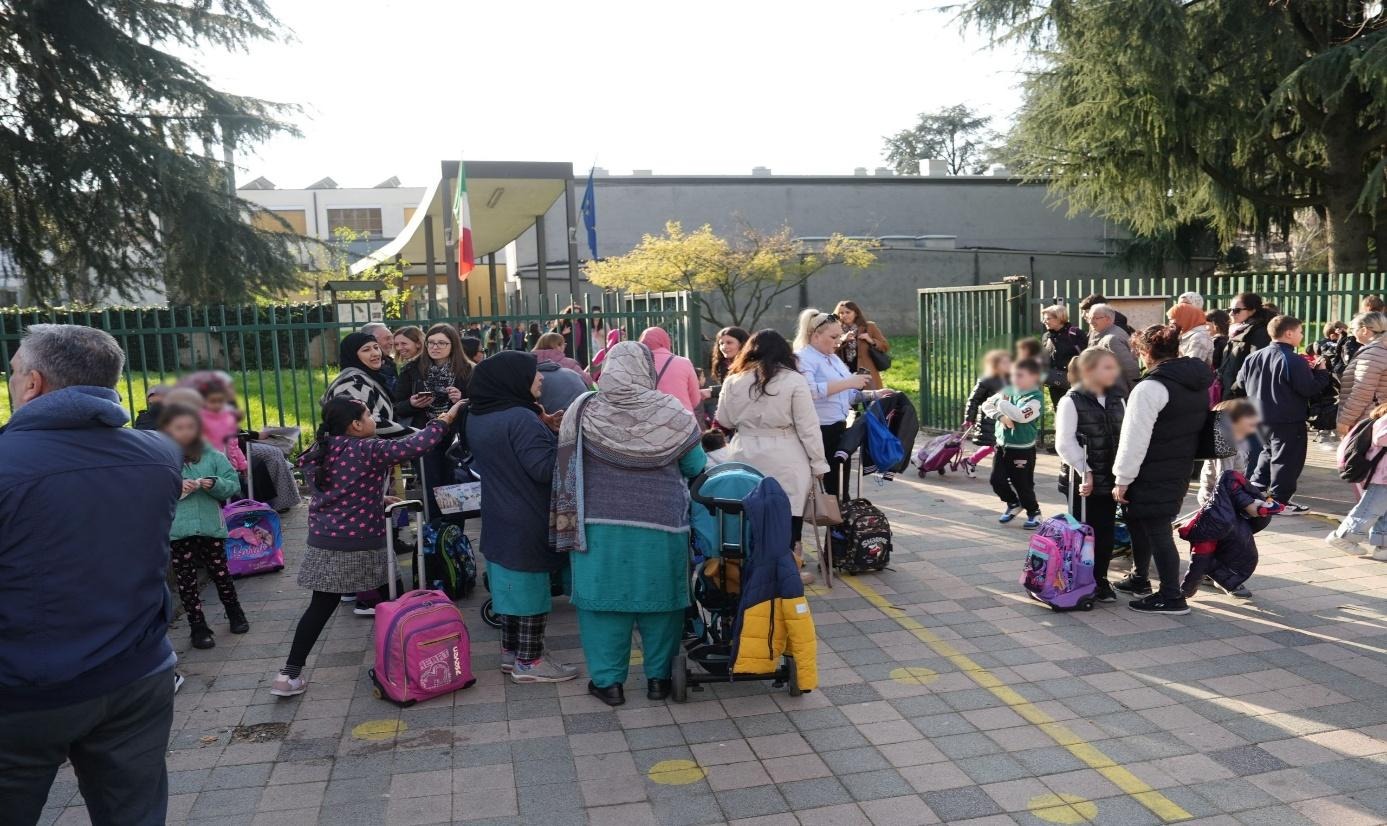
It added, “Of the remaining 60,000, how many wear the Islamic headscarf (or ordinary hijab), and how many wear the burqa? There is no definitive answer to this question, but experts indicate that fewer than 1% of Muslim women generally wear the niqab. Therefore, we are talking about between 500 and 600 foreign female students who are very likely to be wearing the burqa in Italian schools.”
The website noted that, given that Italy has 320,000 classrooms, and 60% of them are excluded, fewer than 130,000 classrooms remain affected.
Dividing the estimated 500–600 female students wearing the niqab among these classrooms leads to the following conclusion:
In Italy, one female student is wearing the full-face veil for every 240 classrooms.
Questionable Integration
Italian-based journalist and migration affairs commentator Abdullah Mashnoun believes that the hijab in Italy is not merely a piece of fabric covering a woman’s hair. Rather, over the past several years, it has become, within the political and social landscape, a point where questions of religion, migration, identity, security and integration intersect.
Mashnoun told Al-Estiklal that, as a result, it has often become a symbol used by different political currents in their debate over the kind of Italy they want to see in the future.
He noted that the issue of the niqab was raised 20 years ago, in 2006, by then-Interior Minister Giuliano Amato, who clearly distinguished between covering the head and concealing the face.
He invoked the image of the Virgin Mary to emphasise that the religious woman closest to the Christian consciousness wears a head covering that does not conceal her face, pointing out that the hijab is one thing and concealing the face is another.
Mashnoun explained that Amato’s statement was based on the idea that head covering should not automatically be treated as a security issue, whereas concealing the face raises questions related to identifying individuals, dignity and security.
The journalist pointed out that, before the current school controversy, Matteo Salvini and the League were among the most prominent voices calling for tighter restrictions on face coverings in public places, linking the issue to security and the protection of women from coercion.
This differs from Amato’s earlier discourse, which called for distinguishing between the hijab and face covering rather than treating them as the same.
He continued that the political current represented by Salvini views face covering as an issue that should be subject to stricter regulation in the public sphere, while emphasising that Islam, migration and religious symbols have become increasingly intertwined in contemporary political discourse.
Mashnoun stressed that a highly sensitive distinction must be made: not every woman who wears the hijab is an extremist, not every Muslim is a migrant, and not every migrant is unintegrated. Likewise, rejecting extremism does not necessarily require viewing every religious practice as a sign of extremism.
He warned that this distinction is important in any democratic society. When the state addresses a specific behaviour, it can establish a clear rule governing it.
But when such a rule becomes a preconceived assumption about an entire religious or cultural group, the debate shifts from law to identity.
Mashnoun stressed that throughout its modern history, Italy has remained a living example and a country often held up for its openness, creative diversity and unique ability to blend different cultures and civilisations.
However, he warned that the growing manifestations of racism, Islamophobia and hate speech pose a grave and immediate threat to the cohesion of Italy’s democratic and social fabric, and to that of Europe more broadly.
He argued that rhetoric based on intolerance and mutual fear does not merely marginalise certain groups; it also poisons the minds of younger generations and fuels a cycle of social division and hostility that undermines the values of tolerance and peaceful coexistence upon which modern societies have been built.
Mashnoun believes that confronting these destructive phenomena requires a serious and firm response from institutions, civil society and individuals, by promoting a culture of dialogue, advancing the values of mutual respect, and dismantling negative stereotypes, so that Italy and Italian schools can remain a true beacon of integration and pluralism.
He noted that many Muslim voices in Italy stress that the solution to the concerns raised by some Italian groups does not lie in walls of fear and exclusion, but in strengthening shared citizenship and equal opportunities.
He added that these voices also emphasise that the strength of democratic societies is measured by their ability to protect pluralism, and that genuine dialogue is the most effective weapon against Islamophobia and hate speech that seek to tear apart the bonds of coexistence.
Mashnoun stressed that the fundamental question raised by all these developments remains whether schools and society can turn integration into a tangible reality that goes beyond electoral and political slogans.
This should be measured by the education system’s success in bringing Italian children and children from migrant families together in the same classroom, enabling them to learn the same language and enjoy the same opportunities, and allowing them to leave school with a genuine sense of belonging to the same society.
He concluded by stressing that true democracy and peaceful coexistence are not measured merely by our ability to agree with those who resemble us, but by our ability to respect, protect and honour difference and human diversity in all its forms.
Sources
- Meloni Bans the Niqab in Schools, but It Is Only the First Step. What Is Happening in the Rest of Europe? [Italian]
- Should We Ban the Niqab to Respect Women, or Are There Other Reasons? [Italian]
- Niqab banned in schools; Meloni: decree coming soon [Italian]
- Imam Backs the Niqab: The Veil Is Not a Free Choice but a Divine Act [Italian]