With Gulf Money: How 'Israel' Tightens Its Grip on Hollywood Studios
"The deal will grant the family immense influence over a broad segment of the American film and media industry."
Despite protests and criticism from various Hollywood artists and filmmakers—citing concerns over monopolistic practices and the fact that the owners of the second company supported the Israeli military during the genocide in Gaza—the deal was ultimately approved.
On September 22, 2026, the U.S. Department of Justice officially approved Paramount’s acquisition of Warner Bros., paving the way for the $110 billion deal to go through.
The approval followed settlements reached between Paramount and 12 U.S. states, as well as the Writers Guild of America.
Under these agreements, the company pledged to produce at least 30 films annually for theatrical release during the first two years following the deal's completion—a move intended to avert antitrust allegations.
The company also committed to investing an additional $1.5 billion in film and television production within the United States over a five-year period.
According to critics, the significance of the deal lies in the fact that it places dozens of Hollywood media and entertainment companies and networks under the management of Paramount’s owners—the Jewish-American Ellison family, who are supporters of "Israel".
This has raised concerns regarding the expanding influence of pro-Israel figures across both the film and media sectors.
Critics argue that this control could grant owners influence over the editorial direction of news networks like CNN and CBS, potentially limiting their ability to criticize U.S. President Donald Trump.
Critics also warn that the deal could increase the owners' influence over television and film content and impose restrictions on actors or filmmakers who criticize "Israel", thereby expanding the sway of the entity's supporters within Hollywood.
The deal is backed by Gulf investments; state-owned companies from three Gulf nations are contributing approximately $24 billion toward the total transaction value of around $111 billion.

Media Dominance
Upon completion of the acquisition, a massive media conglomerate will emerge, uniting Paramount and Warner Bros. studios—along with their respective streaming services and television channels—in a deal that redraws the landscape of the US media and entertainment industry.
This is not merely a case of Paramount acquiring Warner Bros. as a studio; it involves merging one of Hollywood’s largest intellectual property portfolios with Paramount’s own under a single corporate entity.
With a total value of approximately $110 billion according to the official announcement, the deal surpassed a competing $84 billion offer from Netflix. Having cleared the major hurdle regarding antitrust litigation on September 21, only the final closing procedures remain.
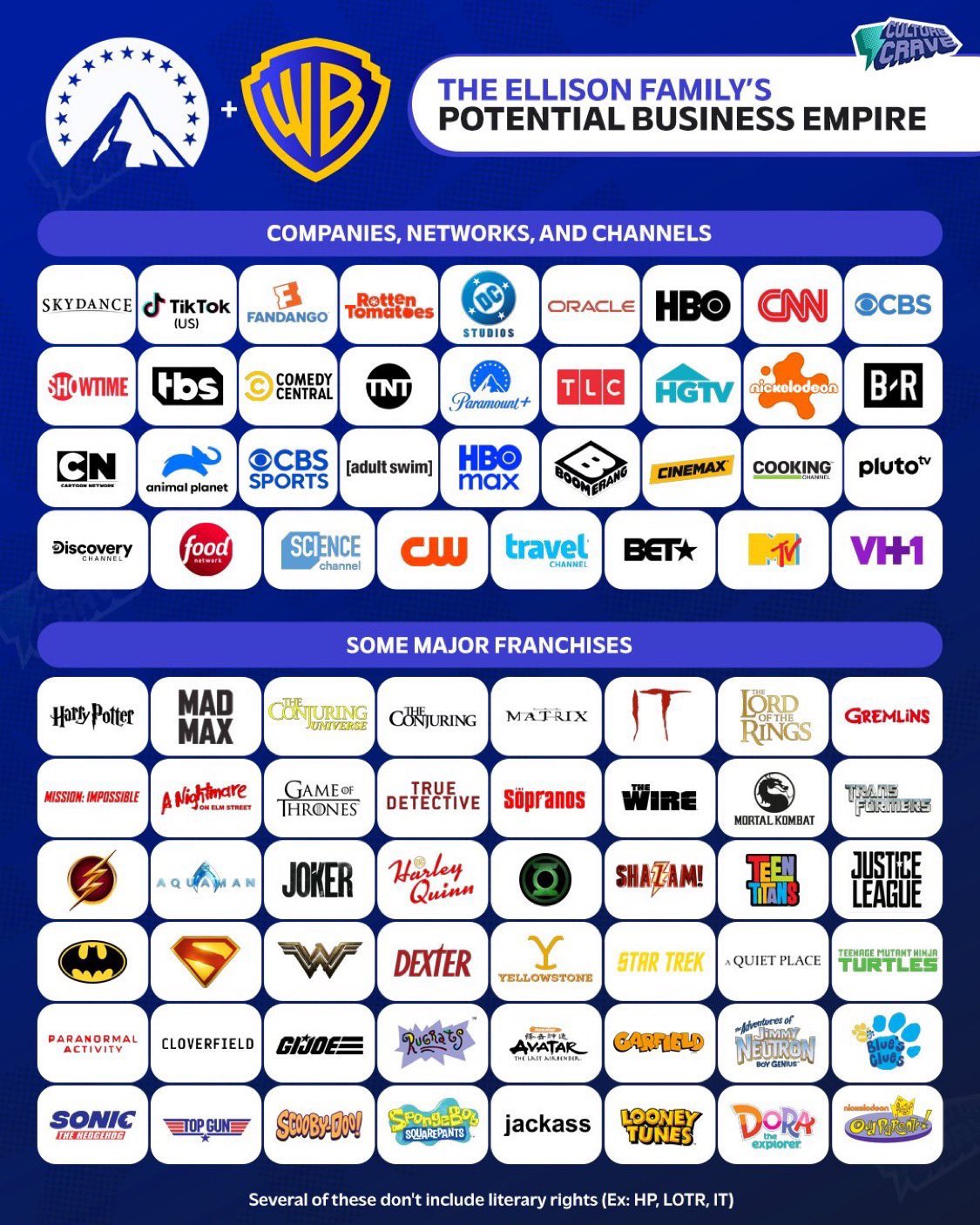
Under this arrangement, the combined group (Paramount–Warner Bros.) would control a portfolio comprising over 35 companies, networks, channels, and streaming platforms, along with 48 franchises—totaling 83 distinct media entities, according to an analysis by Al-Estiklal.
The new unified entity would acquire major news networks—including CBS News and CNN—as well as international networks such as Eurosport, Discovery Español, and HGTV International, and two major film studios: Paramount Pictures and Warner Bros.
The deal would also grant ownership of a film library exceeding 15,000 titles and thousands of hours of television content, alongside streaming platforms like Paramount+, HBO Max, Discovery+, Pluto TV, and CNN’s streaming service, as reported by Variety on September 22.
Furthermore, the portfolio would include entertainment, sports, and cable networks such as MTV, VH1, and Comedy Central, as well as Warner Bros. Discovery networks—including TNT, TBS, TNT Sports, Discovery, TLC, HGTV, Food Network, Animal Planet, and others.
This entity will also acquire studios and production companies, including Warner Bros. Motion Picture Group, Warner Bros. Television Group, Warner Bros. Pictures Animation, Warner Bros. Games, and New Line Cinema, alongside Paramount Pictures, Paramount Television, Turner Classic Movies (TCM), and Discovery Channel.
The deal also encompasses rights and franchises associated with titles such as Harry Potter, the DC Universe, Game of Thrones, The Lord of the Rings, Batman, Superman, Looney Tunes, Scooby-Doo, The Matrix, Mad Max, Dune, and The Conjuring, as well as Paramount franchises like Mission Impossible, Top Gun, Transformers, Star Trek, Teenage Mutant Ninja Turtles, and SpongeBob SquarePants.
Twelve states had filed lawsuits to block the $110 billion deal, arguing that it would grant the merged company an excessive share of the film and pay-tv markets and lead to market monopolization, according to Bloomberg on July 21, 2026.
However, regulators in approximately 70 jurisdictions approved the deal, as did the U.S. Federal Communications Commission and other federal agencies—despite foreign funding linked to the acquisition. Consequently, the deal is expected to close very soon following the removal of the primary legal obstacle.
Hollywood in ‘Israel’s’ Grip
Prior to this deal, the American film industry (Hollywood) was divided: there were those who supported the occupation and its crimes, and those who opposed it—successfully fracturing Israel’s monopoly on defining antisemitism—bolstered by the support of numerous filmmakers, including Jewish individuals who do not support Israel.
Film guilds and artists—including actor Mark Ruffalo—cited two main reasons for opposing the acquisition of Warner Bros. Discovery by Paramount (owned by the Ellison family, one of America’s wealthiest Jewish families):
First, that the move would lead to a monopoly in the film industry and threaten the interests of its workforce; and second, the Ellison family’s complicity in the Palestinian "genocide" through their financial and technical support of Israel—support that facilitated mass killing.
However, now that the deal has been finalized, concerns have arisen regarding the Ellison family—which operates in film, artificial intelligence, and other major sectors. The family includes Larry Ellison and his son David—both prominent American Jews known for their staunch support of Israel and their alliance with Donald Trump.
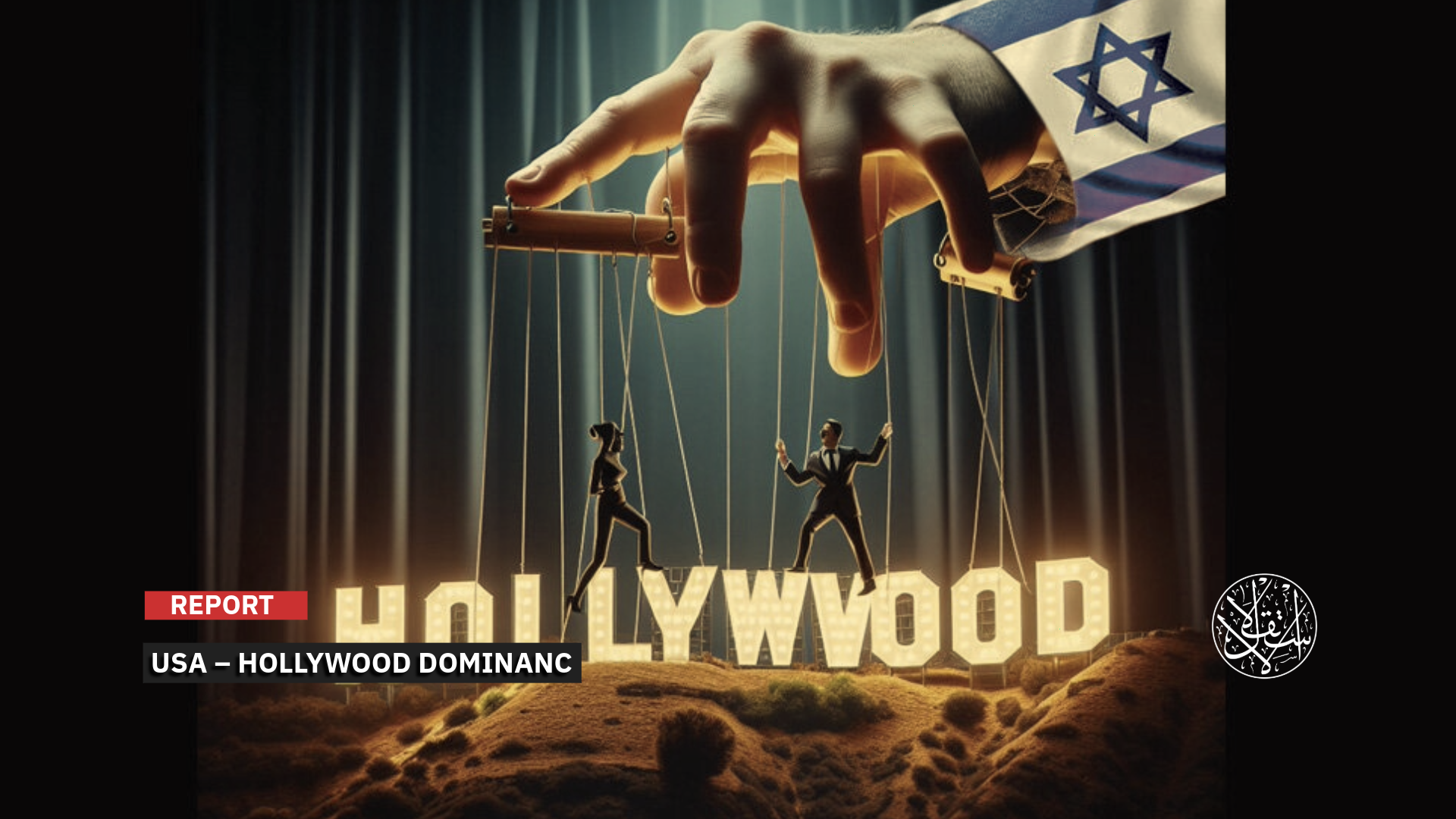
Media professionals and filmmakers alike fear that the media and film industries could fall under Jewish control, potentially curtailing networks' freedom to criticize Israel and allowing the Zionist narrative to dominate entertainment content.
Larry Ellison chairs Oracle, the company he founded, and possesses a fortune of approximately $200 billion; his son, David Ellison, serves as the CEO of Paramount Pictures.
The family's wealth extends beyond the technology and media sectors; in 2012, Larry Ellison purchased about 98 percent of the Hawaiian island of Lanai, in addition to vast real estate holdings in California, Florida, and elsewhere.
Furthermore, their artificial intelligence company, Oracle, maintains technological ties with Israeli institutions; it has supplied the occupation army with smart technologies—utilizing cloud computing and data systems within Israel's security apparatus—to monitor, track, and facilitate the mass killing of Palestinians.
Larry Ellison has previously donated to Israel on several occasions; the most notable documented instance is his 2017 donation of approximately $16.6 million to the Friends of the Israeli Army, an organization that raises funds to support Israeli soldiers and their families.
He also maintains a close relationship with Israeli Prime Minister Benjamin Netanyahu; in 2021, he even offered Netanyahu a seat on the board of his company, Oracle, according to reports by The Times of Israel on April 24, 2026.
The terms of the settlement regarding the deal sought to prevent a monopoly by Paramount; the company was required to negotiate distribution agreements for Paramount and Warner Bros. television channels separately—rather than bundling them into a single agreement with distributors—with the stipulation that failure to comply could force the sale of a group of channels.
The deal also included measures to safeguard the editorial independence of the new company's news divisions by establishing an independent editorial board composed of experienced journalists for both CNN and CBS.
However, some US observers believe that the acquisition of news networks like CBS News and CNN will still influence the editorial stance of broadcasters and media personnel through other means.
This concern arises because these networks—which were relatively critical of, and hostile toward, US President Trump (who had even barred them from the White House)—have now fallen into the hands of Trump supporters (the Ellison family).
The merged network is now owned by Paramount, led by David Ellison—son of Larry Ellison, a close friend of President Trump—according to John Alsop, writing in The New Yorker on September 22.
Larry Ellison had previously suggested to Trump that he consider sidelining broadcasters he disliked, including Erin Burnett—who was barred from the White House on September 21, Alsop notes.
He explained that although the deal includes the creation of an independent editorial board for CBS and CNN, this could serve as an ineffective and deceptive cover; the new company’s board of directors would select the members, meaning the owners could still influence the editorial line.
Media experts have expressed concerns that this independent board might have limited authority—particularly since the company itself would appoint and pay its members, and the agreement does not mandate the publication of the board’s decisions or findings—according to a Reuters report from September 21.
This implies that Trump—through his supporters—could adopt a model of controlling free media through a single entity, similar to Egypt’s state-affiliated United Media Services. This poses a specific risk to CNN, potentially causing it to lose its independence.
The Los Angeles Times reported on September 17 that the Ellison family will retain voting control over the new group, and that the deal will grant the family immense influence over a broad segment of the American film, television, and media industry.

Gulf Funds
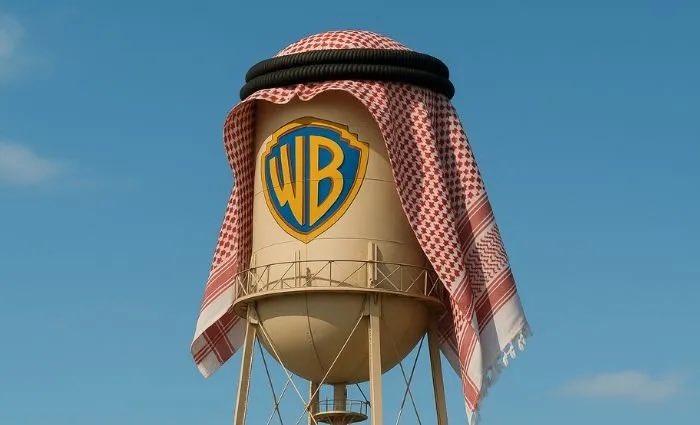
The irony of this deal is that three Gulf states—the UAE, Saudi Arabia, and Qatar—will, through their investments, implicitly contribute to the control of Hollywood by American Jews who support the occupation.
According to the Los Angeles Times, massive Gulf investments are involved in backing the deal, alongside multilateral financial and commercial interests. This situation could result in American Jews who support Israel—and the genocide in Gaza—gaining control over Hollywood using Gulf capital.
American newspapers reported that Paramount successfully raised $24 billion from the three Gulf states (the UAE, Saudi Arabia, and Qatar) out of the deal's total $111 billion valuation.
Paramount and Skydance requested that the Federal Communications Commission (FCC) allow Middle Eastern royal families to hold a significant stake in the merged Paramount-Warner Bros. Discovery entity. The government commission approved the request on September 17, according to the Los Angeles Times.
Under this approval, foreign investors—including sovereign wealth funds from Saudi Arabia, Qatar, and Abu Dhabi—will indirectly own approximately 49.5 percent of the shares in David Ellison’s merged company, according to Variety (September 17).
According to a statement by the US Department of Justice and Emirati sources, the Emirati company L'Emad—headed by the Crown Prince of Abu Dhabi’s Khaled bin Mohamed bin Zayed—acquired approximately 13 percent of Warner Bros. following the ministry's approval of Paramount's acquisition deal.
This could grant Gulf investors a significant stake in networks such as CBS, CNN, Comedy Central, and HBO, in addition to two historic Hollywood studios.
Paramount also asked the commission to eventually allow foreign investors to acquire a larger stake, as the company anticipates needing additional capital to manage the merged entity following the completion of the highly leveraged deal.
In September 2026, the U.S. Federal Communications Commission (FCC) approved the participation of sovereign wealth funds from Saudi Arabia, Qatar, and the UAE as investors in the deal, with announced investments totaling approximately $24 billion.
Approval was required because the transaction would alter the ownership structure of the CBS network.
U.S. media reports indicate that the Gulf investors' indirect ownership is expected to reach nearly 50 percent of the equity, though the deal structure does not grant them voting rights.
Under the Communications Act of 1934, Congress imposes restrictions on foreign ownership of broadcast stations due to national security concerns.
Current regulations prohibit foreign investors from owning more than 25 percent of a company holding a US. broadcast license, unless the FCC determines that such foreign ownership serves the public interest.
Back in December 2025, when the deal stalled, the US outlet Axios confirmed that the financiers had agreed to waive any governance rights—including board seats—to avoid security concerns from the Committee on Foreign Investment in the United States (CFIUS).
According to Axios, Saudi Arabia is linked to the deal both directly, through the Public Investment Fund (PIF), and indirectly, through Kushner’s firm.
The financiers participating in the bid include Saudi Arabia’s Public Investment Fund, L'IMAD Holding (Abu Dhabi), the Qatar Investment Authority (QIA), and Affinity Partners—the firm of Jared Kushner, Trump’s Jewish son-in-law and a supporter of "Israel".
Several entities—including the non-profit organization Free Press, which advocates for First Amendment rights—had urged the Federal Communications Commission (FCC) to consider additional safeguards to protect news organizations like CNN and CBS from foreign control; however, both Paramount and the FCC rejected the proposal.
Sources
- Hollywood Divides Against Itself: Is ‘Israel’s’ Monopoly on Defining ‘Antisemitism’ Beginning to Crack?
- Paramount gets court green light on Warner Bros deal, names Mattel's Kreiz co-CEO
- Gulf money will back Hollywood’s biggest merger
- Inside Saudi Arabia’s Billion-Dollar Bet on Hollywood
- Hollywood's new money comes from Gulf investors