Is Libya Becoming Russia’s Bridge to Africa?
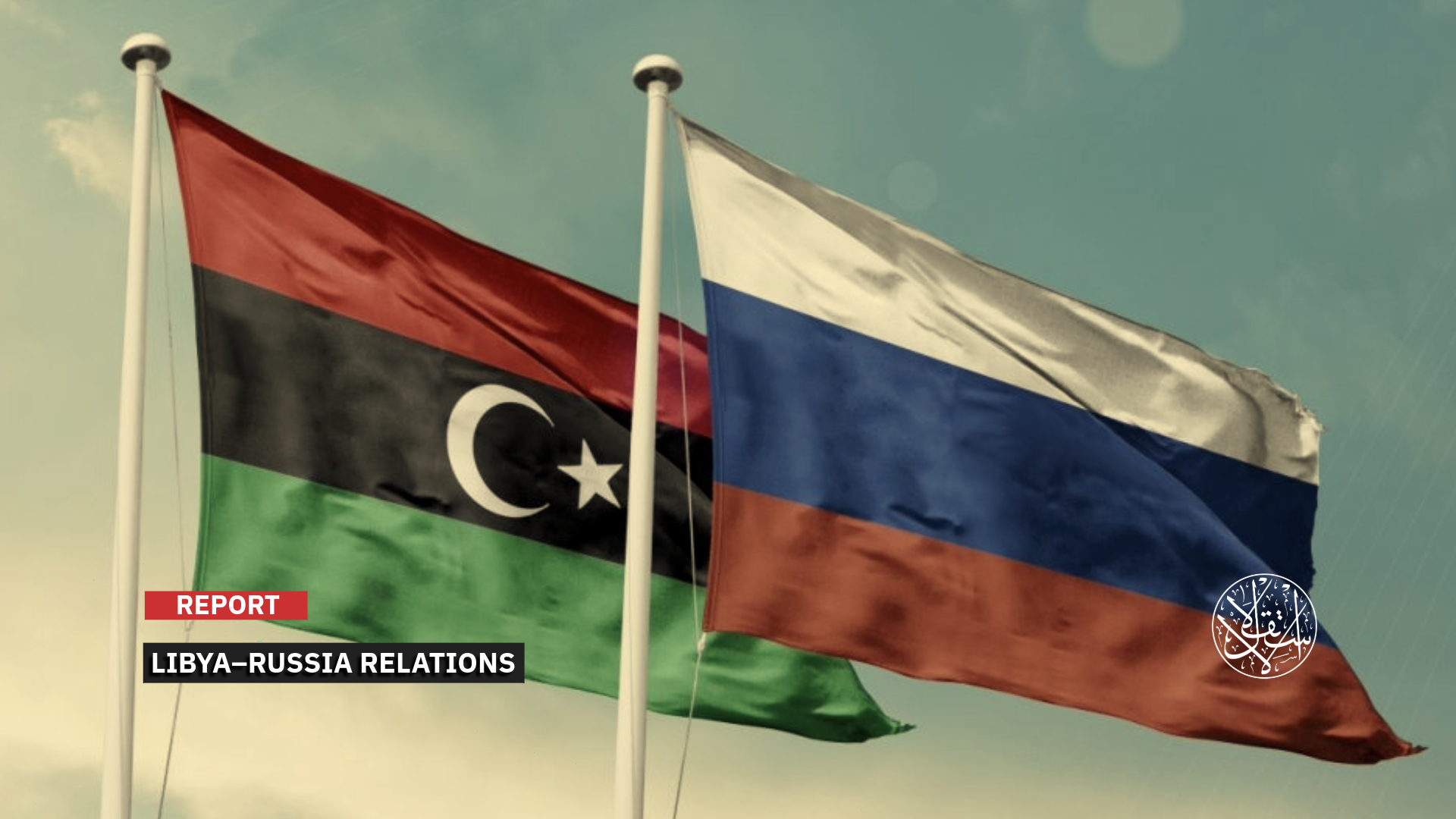
"Russian supply deliveries and maritime activity threatens to turn Libya into a theater of international confrontation."
At the port of Tobruk in eastern Libya, satellite imagery captured on September 13, 2026, revealed the presence of three Russian vessels. This move reignited a question that goes beyond the nature of their cargo: What is Moscow building on the Libyan coast?
Reports linked the convoy's arrival to the transport of armored vehicles and logistical equipment. This coincides with the expansion of inland military facilities, a deepening relationship with General Khalifa Haftar’s forces, and supply routes extending into the African Sahel.
Beyond Tobruk lie airbases and overland routes that provide access to Libya’s eastern, central, and southern regions, positioning the country at the intersection of Russia’s Mediterranean presence and its operations across Africa.
Meanwhile, Western powers are intensifying their monitoring, even as uncertainty persists regarding the shipment's ultimate destination and the scope of the arrangements permitting its arrival.
How is Moscow leveraging Libyan ports to build this network? Do these moves lay the groundwork for a long-term presence, or are they merely facilities contingent on the calculations of local allies?
What does Russia stand to gain, and what price might Libya pay as its coastline becomes part of a rivalry that transcends its borders?
The Port of Tobruk
The convoy consisted of the cargo ships Anastasia and Yuriy Arshenevskiy, and the landing ship Aleksandr Shabalin.
According to an image analysis reported by the Italian agency Nova, the first vessel appeared inside the port of Tobruk, the second at its entrance, and the third further out at sea.
The ships had ceased publicly broadcasting their Automatic Identification System (AIS) data before the images revealed their locations.
As for the cargo, assessments are based on earlier photographs taken at the Russian base of Baltiysk; these showed Ural trucks aboard the Anastasia and armored vehicles—identified as troop carriers and Mine-Resistant Ambush Protected (MRAP) vehicles—near the Yuriy Arshenevskiy.
This is a crucial distinction: while the images link the convoy to military equipment, they do not, on their own, reveal the ultimate recipient or the specific route each vehicle took after arrival.
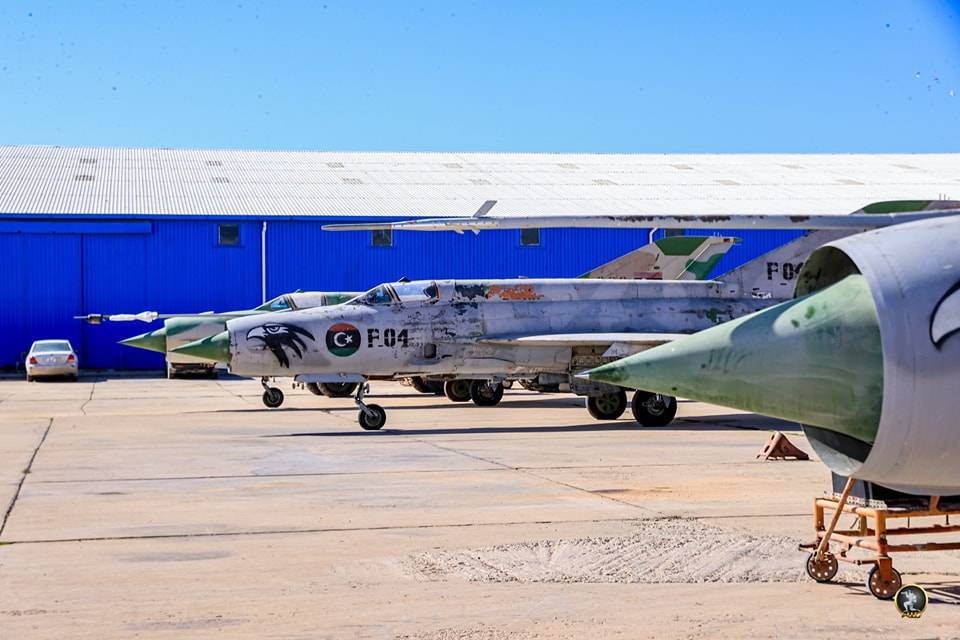
The choice of Tobruk makes sense from geographical, military, and operational standpoints: the port lies within territory controlled by Haftar’s forces and is adjacent to a naval base, while the Gamal Abdel Nasser Air Base is located to the south, in the Al-Adam area.
There are precedents for this type of operation; in April 2024, the port saw the unloading of Russian artillery, trucks, armored vehicles, and missile launch systems, followed by the arrival of naval vessels that Haftar’s command stated were there for training and the exchange of expertise.
In July 2026, the command announced maintenance and upgrade work at the Gamal Abdel Nasser Air Base—covering runways, headquarters, and the establishment of new squadrons—thereby enhancing the capacity to link maritime supply lines with air transport to inland bases.
However, repeated arrivals do not equate to the formal announcement of a Russian base. Transitioning into a permanent supply hub requires knowledge of flight schedules, storage and maintenance capacities, and the nature of the military presence.
Until these details become clear, Tobruk appears to be a gateway with potential for expanded use, though the specifics of the arrangements and the subsequent destinations of shipments remain beyond what available imagery can confirm.

A Bridge to Africa
Beyond the maritime port, a Russian network currently spans the Al-Khadim, Al-Jufra, Al-Qardabiya, Tamanhint, Brak Al-Shati, and Maaten al-Sarra bases.
These are Libyan facilities where a Russian presence has been observed—rather than six independent Russian bases built from scratch—a distinction that illustrates how Moscow leverages existing infrastructure while developing its capacity to utilize it.
A study published by the Terra-Line project in June 2024—conducted by researchers from the University of Texas in collaboration with the U.S. National Geospatial-Intelligence Agency—documented construction and renovation activities at these six sites.
The work included hangars, barracks, runways, and aircraft aprons—such as three new hangars at Al-Khadim—though the study cautioned that the evidence does not attribute the funding for every expansion to the Kremlin, nor does it rule out independent Libyan initiatives.
Nevertheless, researchers believe that the development of these sites—utilized by the Africa Corps—supports Russian operations across North Africa and the Sahel.
Maaten al-Sarra, located near the Chad-Sudan border, provides the network with strategic depth to the south, while its facilities for accommodation, maintenance, and logistics enable sustained operations rather than merely serving as a stopover for transient flights.
In light of this function, developing airstrips and hangars represents a direct investment in the ability to maintain and maneuver forces as operational needs shift.
Flight patterns reveal specific details regarding supply logistics. The Washington-based Center for Advanced Defense Studies (C4ADS) recorded 75 flights linked to Russian military activities in Mali, Burkina Faso, and Niger between January 2025 and July 2026.
It identified a common route originating in Russia, passing through the Khmeimim Air Base in Syria and Libyan bases, before reaching the Sahel.
These data lend practical significance to the deployment; Libya appears to serve as a staging point that facilitates the continued supply of personnel and equipment to forces operating further afield.

Military Presence
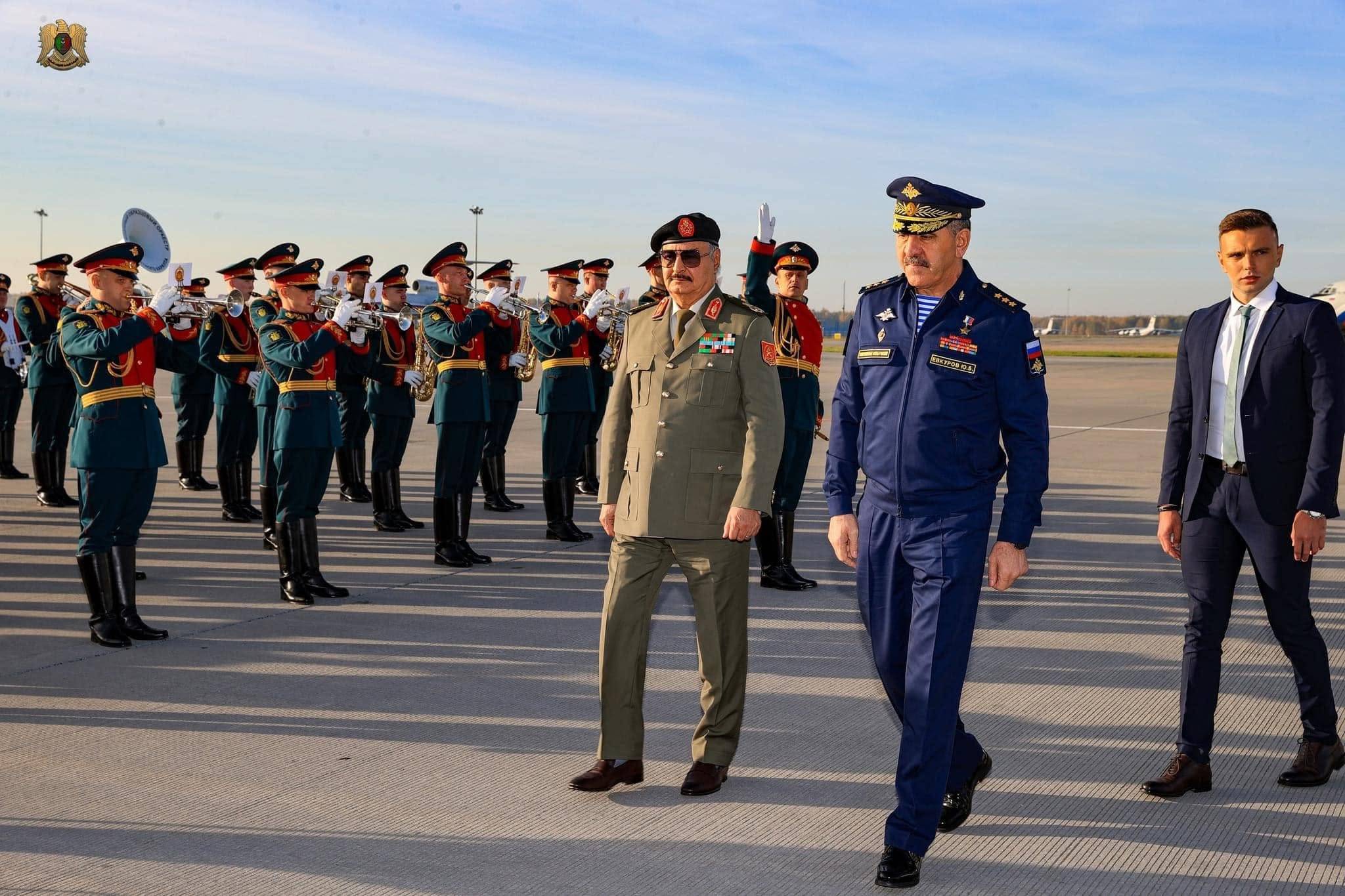
The supply network relies on a partner willing to grant access to ports and bases—a role fulfilled by the relationship between Moscow and Khalifa Haftar.
In January 2017, the commander of the eastern forces boarded the aircraft carrier Admiral Kuznetsov off the Libyan coast and spoke via video link with then-Russian Defense Minister Sergei Shoigu—an event that foreshadowed the subsequent expansion of Russia's military presence.
Subsequently, the Wagner Group expanded into areas under Haftar’s influence, before Moscow began—starting in August 2023—to reorganize this presence under the supervision of the Ministry of Defense.
With the rise of the Africa Corps and the frequent visits of Deputy Minister Yunus-Bek Yevkurov, the connection became more directly linked to the Russian military establishment and less dependent on the front provided by the group.
Jalel Harchaoui, an associate fellow at the Royal United Services Institute (RUSI), views the new convoy as further evidence of a reinforced Russian presence; speaking to Asharq Al-Awsat, he suggests the shipments are likely destined for Haftar’s forces.
This possibility implies that the supplies could influence the balance of power within Libya, alongside the bases' strategic role regarding Africa.
The relationship extends beyond mere equipment delivery; Russian expert Kirill Semenov links the operation of certain air defense systems used by eastern forces to the involvement of Russian personnel, and notes the training of Khaled and Saddam Haftar.
Saddam’s two visits to Moscow this year—including meetings with President Vladimir Putin and the defense minister in August 2026—are part of efforts to build ties with the next generation of leadership.
When the operation of equipment requires experts, maintenance, and spare parts from the original supplier, an arms deal evolves into a long-term relationship of military dependency.
Russian Foothold
On the other side of the Mediterranean, these moves are interpreted as part of a reconfiguration of Russia’s presence, rather than simply an additional arms shipment to an ally.
However, reducing Libya to a mere alternative to Syria overlooks the continued flow of supplies to the Syrian coast; Reuters documented the arrival of four ships in Tartus on September 7, 2026, following an understanding between Moscow and Damascus regarding the Russian military presence.
Consequently, the hypothesis of diversifying access points appears more consistent with reality than the assumption of a complete replacement; Moscow can retain its Syrian facilities while simultaneously developing options in Libya to reduce its reliance on a single set of political arrangements.
In a study published by the UK’s Royal United Services Institute (RUSI) in early 2025, Edward Black and Siddharth Kaushal noted that Tobruk faces limitations regarding maintenance, berthing, and the absence of a dry dock.
They distinguished between securing ship access and possessing a base capable of supporting a long-term presence, noting that the latter requires investments and infrastructure that simple ship berthing does not provide.
After all, the ability to refuel ships does not eliminate the need for repair capabilities, ammunition storage, and facilities dedicated to crew operations and the sustainment of deployments.
Nevertheless, the potential to establish a foothold is sufficient to pique Rome's interest. An Italian patrol aircraft tracked the convoy on September 10, and a US reconnaissance plane subsequently spotted it off the coast of Tobruk four days later.
This transit coincided with a visit to Tripoli by the Italian Chief of Defence Staff, Luciano Portolano.
Portolano stated that Libya remains a pivotal state for safeguarding Italy's vital and strategic interests, linking cooperation to security, counter-terrorism, irregular migration, and the protection of energy supplies.
Thus, the concern extends beyond the ships themselves to the prospect of Moscow gaining a sustained operational capability near European shipping lanes and interests—operating from a country with which Rome maintains significant economic and security ties.
International Rivalry
However, the situation in Libya does not fit neatly into a simple East-West polarization. Haftar’s forces maintain channels with Washington; notably, in April 2026, Sirte hosted part of the US-led Flintlock 2026 military exercises, which also involved Italian participation.
This reveals that local partners are attempting to diversify their relationships, even as external powers vie for control over the same facilities and communication networks.
These complexities also constrain Moscow’s freedom of action. An analysis by a British institute noted that the multiplicity of Haftar’s partners could impose conditions on Russian access—contrasting sharply with the relationship of dependency that characterized Moscow’s ties to the Assad regime.
Furthermore, the Turkish presence in Libya and Egypt’s interests along Libya’s eastern border introduce strategic variables that no single bilateral agreement can simply erase.
An immediate risk is evident along the coast; a CNN report linked attacks on Russia-linked vessels to Ukrainian activity originating from western Libya.
However, the Ministry of Defense of the Government of National Unity has denied the existence of any agreement or coordination permitting the use of Misrata or other Libyan facilities to launch external attacks.
Amidst this contention, the nature and scope of Ukrainian activity remain subjects of conflicting accounts.
Speaking to Euronews, Libyan researcher Mustafa Al-Kout suggests that the coincidence of Russian supplies and naval attacks threatens to turn Libya into a theater of international confrontation.
He adds that the domestic reliance on foreign support to operate weaponry and secure positions presents another dilemma: how can a military institution be unified when parts of it are linked to competing support networks? The more entrenched these ties become, the more difficult it is to sever them.
Sources
- Russian ships and armored vehicles arrive in Libya—why is Italy monitoring Moscow's movements in the Mediterranean? [Arabic]
- Russian presence strengthens in eastern and southern Libya and raises questions [Arabic]
- Russian Presence in Tobruk... Is Libya a Theater for International Escalation? [Arabic]
- Russian Bases in Libya: Moscow’s Plans for Expansion into Africa? [Arabic]