After Fighting Each Other: Why Did Seven Ethiopian Armed Groups Unite Against Abiy Ahmed?
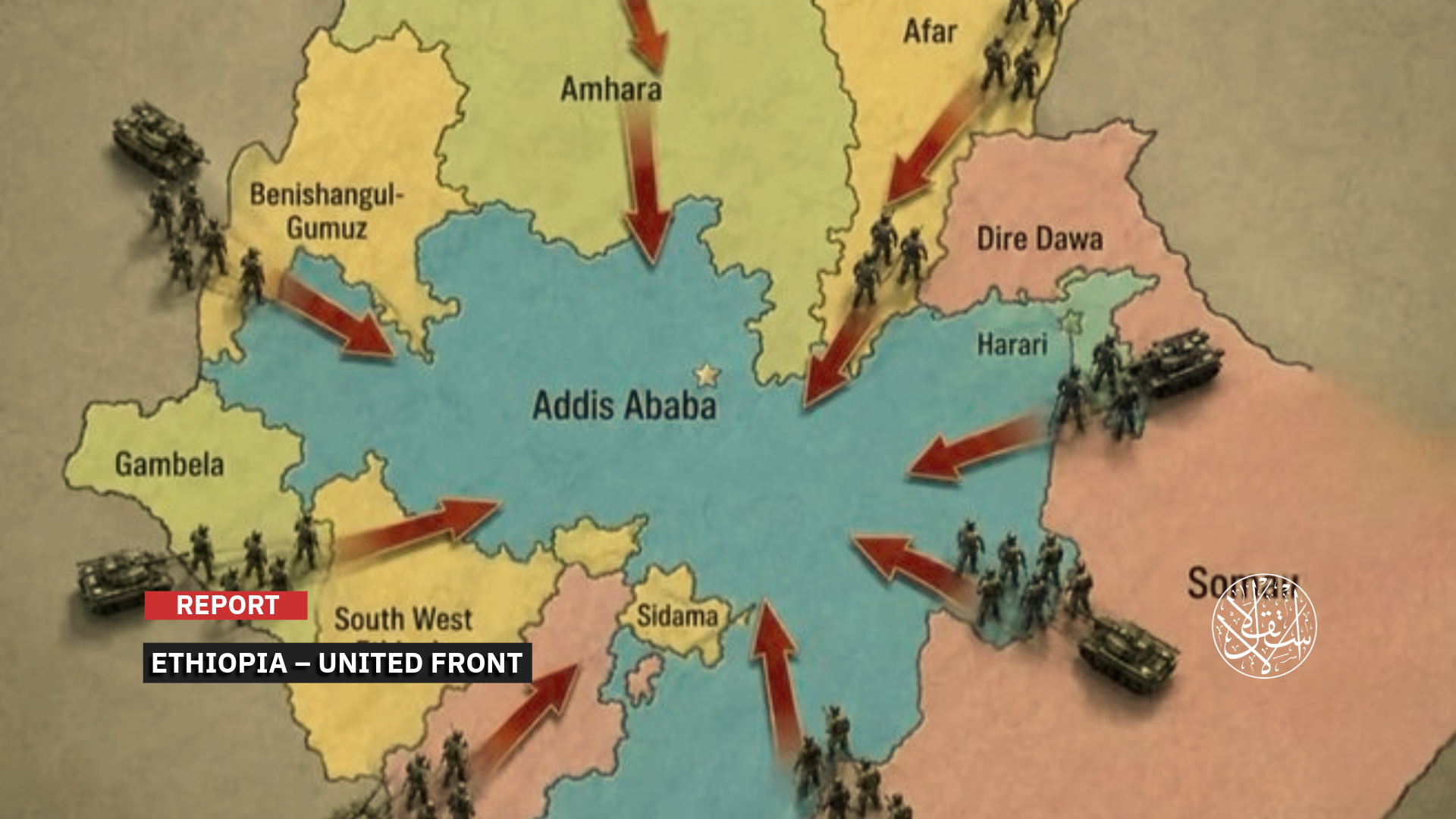
"These developments are attracting the attention of Sudan and Egypt."
After each of them had been fighting the Ethiopian government separately, and some had even clashed with one another, seven armed groups operating across areas stretching from Tigray and Amhara to Oromia and the eastern border have decided to form a united front against controversial Prime Minister Abiy Ahmed.
The unification of these seven groups, led by the Tigray People’s Liberation Front (TPLF), the Oromo Liberation Army (OLA), and Amhara Fano forces, would pose an unprecedented challenge to Addis Ababa if the alliance manages to maintain its political and military cohesion and achieve its stated goal of overthrowing the government and establishing a new authority.
Military developments, particularly the return of tensions to the Tigray region and the threat of reviving the war that ended under the 2022 agreement, could help push the conflict into a more dangerous phase.
That process has already begun. Just three days after the seven groups announced their alliance, TPLF forces seized control of the region’s three airports, Mekelle, Axum, and Shire, which had been under the control of federal forces, while the Ethiopian government suspended civilian flights to the region.
The forces have begun asserting their influence in the areas they seized, amid expectations that their next move could be an advance toward the capital, Addis Ababa.
These developments are attracting the attention of Sudan and Egypt, which are closely monitoring the security situation in Ethiopia amid disputes related to the Nile water issue and Ethiopian threats to control the volume of water flowing downstream.
Ethiopian Prime Minister Abiy Ahmed also supports the Rapid Support Forces (RSF) militia, which is fighting the Sudanese army, according to a report published by Reuters on September 23, 2026.
However, the alliance’s geographic expansion does not necessarily mean that it has a unified capacity to overthrow the government.
The factions within it still differ over their political objectives and regional interests, while their ability to coordinate joint military operations remains unclear, according to African experts who spoke to Agence France-Presse on September 21.
Therefore, the key question is not only whether the alliance can topple Abiy Ahmed, but also whether it can turn the multiple fronts of conflict into coordinated pressure on the central government.
This will determine the scale of the challenge posed by the new coalition and whether it is capable of threatening the government’s survival.
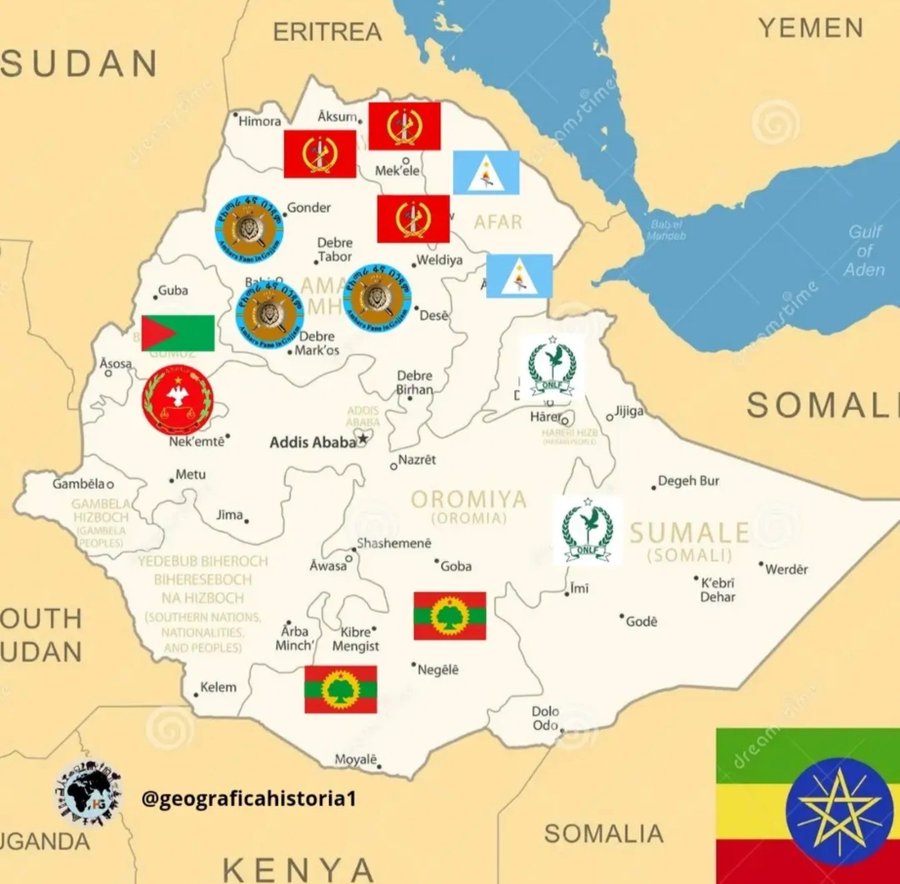
Seven-Group Alliance
On the evening of September 20, seven Ethiopian armed groups announced that they had formed an alliance aimed at overthrowing Prime Minister Abiy Ahmed’s government.
This came after some of the newly allied groups had previously been hostile to one another and had fought on opposing sides during Ethiopia’s civil war between 2020 and 2022.
The newly announced 'Alliance for Survival' brings together ethnically diverse groups operating across the country, from Tigray in the north to the Somali Region in the south. Some of the groups continue to have disputes over issues such as land disputes.
The new alliance includes the Tigray People’s Liberation Front (TPLF), the Fano National Movement in the Amhara region, and the Oromo Liberation Army (OLA), even though Fano fought alongside Abiy Ahmed’s government against the TPLF during the Tigray war from 2020 to 2022.
Subsequently, Fano rose up against the government in a conflict that has claimed thousands of lives in the Amhara region since 2023.
The alliance also includes four smaller groups from three other regions: the Ogaden National Liberation Front (ONLF) from the Somali Region, as well as groups from Afar and Benishangul-Gumuz. Together, these areas account for half of Ethiopia’s 12 regional states.
The Amhara Fano forces, which initially supported Abiy Ahmed before turning against him, have been the main driving force behind the move toward the alliance.
They sought to expand the front against the federal government beyond the Amhara region. Fano leader Zemene Kassie was even the one who read the alliance’s founding statement on Tigray Television.
Fano said that instead of each group confronting the government in a separate region, they should coordinate their efforts to create simultaneous pressure that could bring down the federal government, followed by a transitional period and new elections.
The seven groups accuse Abiy Ahmed’s government of overseeing war, genocide, widespread destruction, and abject poverty, and of exposing Ethiopia to the risk of disintegration.
In their alliance declaration, they identified two main objectives for the proposed transitional period.
The first is to end armed conflicts and address Ethiopia’s security, humanitarian, social, and economic crises.
The second is to hold a genuine, credible, inclusive, and participatory popular constitutional dialogue to address major national and public issues through direct popular participation.
The alliance also pledged to improve relations with neighboring countries and restore what it described as Ethiopia’s regional and international standing.
The most recent general elections, held in June 2026, ended with Prime Minister Abiy Ahmed’s Prosperity Party retaining its overwhelming parliamentary majority.
However, opposition figures said the elections were marred by a climate of repression and low participation by opposition parties.
The Fano militia and the OLA rejected the elections and their results. The Tigray region, along with its six million residents, was also completely excluded from the elections, further raising doubts about the process.
In turn, TPLF Deputy Chair Amanuel Assefa said that the alliance aims to overthrow the government and facilitate the establishment of a democratic transitional government.

Why Now?
The emergence of the alliance coincided with a renewed military escalation in Tigray, following clashes and military build-ups that raised fears of the collapse of the arrangements under the Pretoria Agreement, which ended the previous war in 2022.
After months of military mobilization and mutual accusations between the Ethiopian government and the TPLF, both of which are predominantly Christian, fierce clashes resumed in the Tigray region of northeastern Ethiopia near the border with Sudan in early August 2026.
Like Ethiopia’s other internal conflicts, the Tigray war was political and ethnic, involving the distribution of power within the Ethiopian state, the region’s relationship with the central government, Tigrayan nationalism, and disputed borders and territories. This explains the incentive for Tigray to join the new alliance.
The formation of the alliance was also accelerated by the fact that the government continues to face an armed insurgency in Amhara since 2023, in addition to ongoing fighting in Oromia since 2018.
This allowed opposition groups to capitalize on multiple existing fronts and form an alliance rather than having to create a new front from scratch.
Although the alliance has not yet reached the stage of a unified army in military terms, and has not announced a joint operational command or a unified military plan, simply coordinating the groups’ movements and synchronizing pressure on the government from multiple fronts could further stretch its capabilities and divide its efforts.
If the factions succeed in maintaining and expanding this coordination, the multiple battlefronts could turn into mounting pressure on Abiy Ahmed’s government, potentially opening the way for the political changes these groups are seeking, including the formation of a transitional government.
Analysts say the alliance among these seven forces could reduce the secondary conflicts that had previously taken place between them, allowing them to focus their efforts on overthrowing the government in Addis Ababa and turning their coordination into simultaneous military operations.
If a joint command emerges and attacks are coordinated across Tigray, Amhara, Oromia, and other areas, it would represent a different development that could pose a serious challenge to Addis Ababa. But if each faction continues fighting on its own front, the coalition is likely to remain closer to a political umbrella.
The significance of the alliance, therefore, lies not only in the number of groups participating in it, but also in reducing clashes among them and directing a greater share of their capabilities against the federal government.
If these forces succeed in maintaining this coordination, the government could face simultaneous pressure on multiple fronts. However, continued political and battlefield differences among the coalition’s members could prove decisive in determining whether it can evolve from temporary coordination into a more cohesive military alliance.
Reuters reported on September 21 that the new alliance reflects the depth of the crisis facing the Ethiopian state and places Abiy Ahmed’s government before its most serious challenge since he came to power in 2018.
Ironically, the announcement came about a week after Eritrea publicly accused its neighbor Ethiopia of destabilizing the region and accused the ruling Prosperity Party of hosting and financing subversive groups with an agenda to change the regime in Asmara, in addition to directly accusing Addis Ababa of supporting the Rapid Support Forces (RSF) militia in Sudan’s war.
Eritrea had been a partner of Abiy Ahmed’s government during the Tigray war and was a factor in the reconciliation that contributed to his receiving the 2019 Nobel Peace Prize.
However, relations have deteriorated since then, amidst Eritrea’s increasing coordination with Cairo and Mogadishu within a trilateral alliance focused on Red Sea security.
This followed Ethiopia’s attempts to expand its access to the sea, including through an agreement involving Somaliland, which could affect the strategic competition over access to ports and the Red Sea, an area of interest to international powers seeking military and commercial footholds in the Horn of Africa.
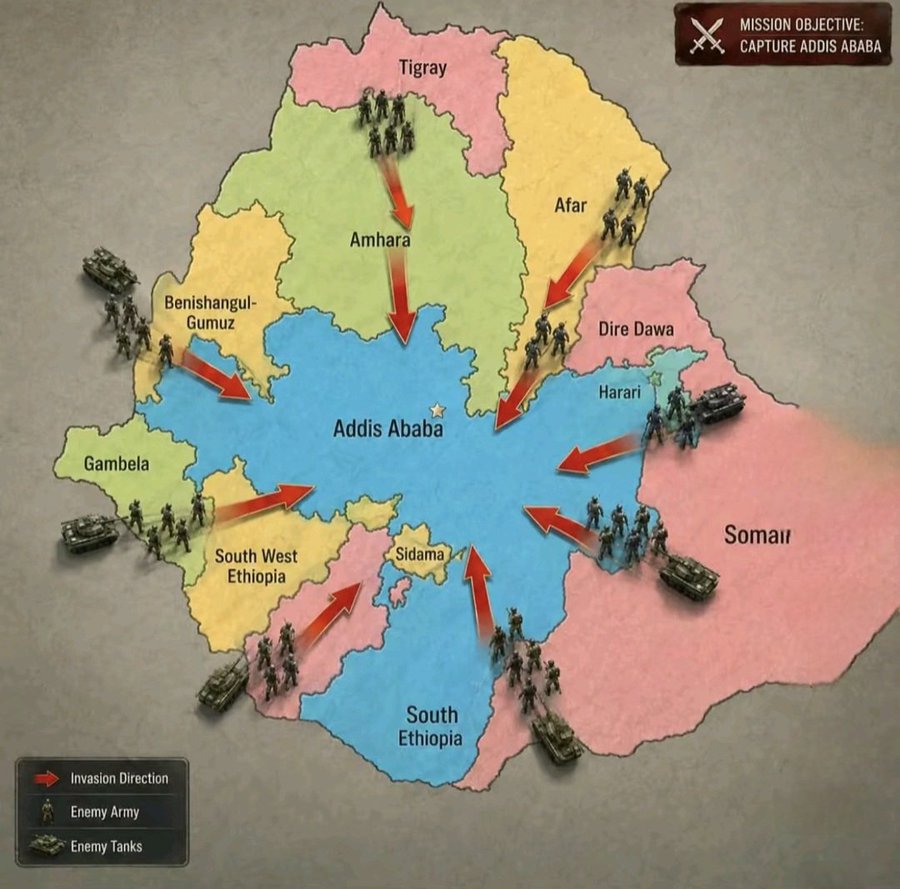
Six Scenarios
The formation of the 'Alliance for Survival' comprising seven Ethiopian armed groups does not automatically mean that the fall of Abiy Ahmed’s government is imminent.
However, it opens up several possible paths that could ultimately lead either to its actual collapse or to the continuation of the current war of attrition.
According to various African assessments, these possible paths could lead to six scenarios.
Scenario One: The coalition becomes a multi-front military alliance. This is the most significant scenario from a military perspective.
If cooperation moves from political coordination to simultaneous operations in Tigray, Amhara, Oromia and other areas, government forces could find themselves facing several fronts at the same time.
This would increase pressure on their military and logistical capabilities and could potentially lead to the collapse of the government.
African affairs researcher Kjetil Tronvoll explained the importance of this point to Agence France-Presse on September 21, saying that coordination under a single military command could make a difference, because the government could find itself facing four or five fronts at the same time.
However, he questioned the factions’ ability to sustain a prolonged war, particularly against government forces equipped with advanced Turkish- and Israeli-made drones, which played a role in turning the tide of the conflict in the government’s favor in 2023, after Tigrayan forces had advanced close to the capital.
The challenges facing the seven-group alliance are not limited to the military sphere. According to Tronvoll, the participating groups also differ over several political and regional issues.
These disagreements include the nature of the political system that would follow the current government, the structure of a transitional government, decision-making mechanisms, constitutional issues, the status of regional administrations, territorial disputes, and the role that armed groups would play in any subsequent political settlement.
Tronvoll believes that the differences in political orientations among the coalition’s components, including Tigrayan nationalism, Amhara expansionist aspirations, and the OLA demands for self-determination, could lead to internal disputes if the alliance achieves a military breakthrough and could complicate arrangements for any transitional period.
By contrast, the position of the OLA indicates that the current cooperation does not represent an agreement on Ethiopia’s future.
Rather, it is a framework for coordinating the opposition and creating conditions for a political process, without granting any single group the right to determine the country’s future on its own.
Scenario Two: A return to full-scale war in Tigray. Even if the alliance remains merely a political umbrella and does not organize unified, simultaneous battles against the government, the mere presence of the TPLF within the alliance means that fighting between it and the Ethiopian army could resume.
Military tensions in the north of the country remain ongoing. According to reports citing the African Union, the government and Tigrayan forces continue to build up troops on both sides of the border, raising fears of a return to the war that ended with the 2022 Pretoria Agreement.
Renewed fighting and fierce military clashes did in fact erupt in the Tigray region of northeastern Ethiopia in early August 2026, but subsequently eased temporarily. The situation remains vulnerable to renewed escalation at any time, and the Tigrayans could be encouraged by the new alliance.
Scenario Three: The alliance remains primarily a political umbrella. Another strong possibility is that the alliance remains more of a political umbrella than a military force, owing to the significant contradictions among its members.
The seven groups do not necessarily share the same political vision, and some of them have previously been in direct conflict with one another.
Amhara Fano forces, for example, previously fought alongside the Ethiopian government against the TPLF in the most recent war.
There are also disputes over contested territories, particularly western Tigray, as well as disagreements between Fano factions and Oromo forces.
According to International Crisis Group analyst Magnus Taylor, speaking to Reuters on September 21, these differences may prevent the groups from working effectively, and attempts by their members to work together could be hampered by the weak nature of many of the groups, the geographical distances between them, and their political differences.
The alliance may therefore succeed in reaching agreement on the goal of overthrowing the government, but it could face a much more difficult test when it comes to the question: What happens afterward? How will power be distributed? What form will the state take? How will regional disputes be resolved?
Scenario Four: The government could launch an escalation and attack the allied groups before their partnership becomes firmly established, seeking to dismantle the alliance before it develops into a joint military command.
This could involve intensifying operations against the factions in their respective areas, exploiting their political differences, or attempting to draw some of them into separate agreements.
This scenario becomes more likely if the groups remain militarily separate, as the government would then be able to deal with each front individually rather than confront a unified force.
Therefore, analysts emphasized that the alliance’s ability to wage a long-term war represents a major weakness.
Scenario Five: The Ethiopian conflict expands and becomes a regional crisis. The multiplicity of factions and the areas in which they operate mean that any new escalation could affect Sudan, Eritrea and the wider Horn of Africa, particularly given the region’s shared borders and interconnected security dynamics.
This was reflected in the government’s initial reaction to the formation of the seven-group alliance, when it accused Eritrea of financially supporting the groups and also accused Khartoum of backing them.
The Sudanese army, which has been fighting the RSF militia since 2023, has accused Ethiopia of allowing its adversaries to operate from Ethiopian territory.
Pro-government figures in Ethiopia have also accused Egypt of attempting to interfere in Ethiopia’s internal affairs and exert influence over domestic decision-making regarding the Grand Ethiopian Renaissance Dam (GERD).
The confrontation between Cairo and Addis Ababa over the GERD has not been limited to negotiations and diplomatic pressure.
Ethiopian actors aligned with the government have repeatedly accused Egypt of attempting to influence Ethiopia’s internal affairs and using the dispute over the dam to pressure political decision-making in Addis Ababa.
The renewed alignment between Eritrea, Sudan and Egypt against Ethiopia could therefore make shifting geopolitical alliances in the Horn of Africa a decisive factor.
Meanwhile, Ethiopia has expanded its cooperation with the UAE and "Israel", while "Israel" has maintained growing security and strategic relations with Addis Ababa.
Israeli President Isaac Herzog visited Ethiopia in February 2026 and met with Abiy Ahmed to discuss security relations.
Kjetil Tronvoll told Deutsche Welle that if a new conflict breaks out, it is likely to draw in neighboring countries such as Sudan and Eritrea.
He said, "It will be like a Second World War for Africa," referring to the Congo War, which lasted from 1998 to 2003 and involved nine African nations.
Scenario Six: The conflict shifts from seeking to overthrow the government to negotiating a transitional phase.
The alliance has stated that its goal is not merely to confront the government, but to remove it and establish an inclusive transitional government.
If military and political pressure weakens the government’s ability to manage several crises simultaneously, there is a possibility that it could move toward negotiations over transitional arrangements rather than attempting to resolve the conflict militarily and risk further fragmentation of the country.
But the obstacle lies in reaching an agreement on the form of this transition, particularly given that the factions hold divergent ethnic and regional agendas.