Hollywood Divides Against Itself: Is ‘Israel’s’ Monopoly on Defining ‘Antisemitism’ Beginning to Crack?
In Hollywood, artistic interests intersect with billion-dollar business deals.
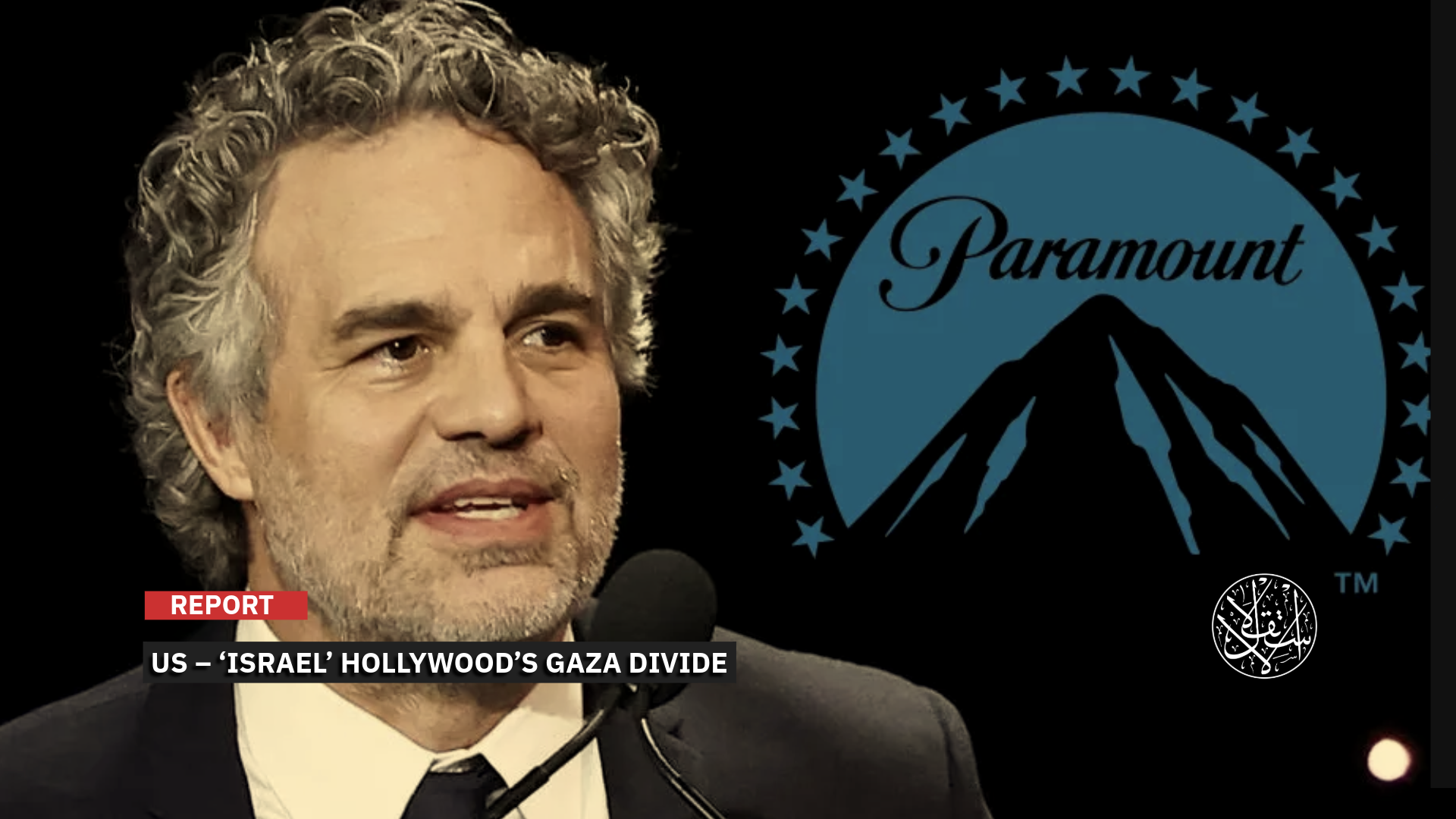
The revelation that more than 170 “Jewish” artists and intellectuals in Hollywood signed an open letter in support of American actor Mark Ruffalo, known for his opposition to the war of annihilation in Gaza, and rejected the accusations of antisemitism leveled against him, has revealed a significant shift within the stronghold of the American film industry.
The widespread expressions of solidarity in Hollywood, particularly those coming from Jewish filmmakers in support of Ruffalo after he was accused of antisemitism, have shown that the monopoly over defining “antisemitism”, according to the conception promoted by “Israel” within the American entertainment industry, has increasingly become a subject of debate and disagreement.
The significance of the issue lies not only in the scale of solidarity with the American star, but also in the fact that it reflects a deeper transformation taking place in Hollywood.
The Israeli war on Gaza is no longer limited to supporting or opposing the war. It has expanded into a battle over defining the “boundaries between criticism of Israel and antisemitism,” as well as over who has the authority to define antisemitism and set these boundaries within one of the most influential industries in the United States.
The case also raises the question of whether accusations of antisemitism can be used as a means of silencing criticism directed at “Israel” or companies associated with it.
The issue is no longer confined to stars publicly expressing support for Palestine; it has evolved into a broader confrontation over freedom of expression itself within the film industry.

Why Did They Attack Him, and How Did It Backfire?
On August 21, 2026, actor Mark Ruffalo attacked Paramount’s attempt to merge with Warner Bros. Discovery in a deal valued at approximately $111 billion. Paramount is owned by the Ellison family, a Jewish family among the wealthiest in the United States.
He cited two reasons for his opposition. First, he argued that the deal would create a monopoly in the film industry and threaten the interests of those working in it.
Second, he objected to what he described as the Ellison family’s complicity in the Palestinian “genocide,” through its financial support for “Israel” and the provision of technological programs that helped facilitate mass killing.
Ruffalo’s point was to link Oracle, the Ellison family, and their media empire, saying that these magnates are “crushing workers and consolidating the world’s wealth for their concentrated power and dominance.”

Ruffalo’s Instagram post, which has nearly 20 million followers, focused on highlighting the ties between Oracle, owned by the Ellison family, and the Israeli military. He also shared a video clip of former Oracle CEO Safra Catz discussing the company’s technologies in support of “Israel’s” offensive in Gaza.
In the clip, the executive spoke about “extremely terrifying technologies” developed by the company that could be used in this context. Actor Mark Ruffalo described this as “genocide” “built on an oppressive apartheid system backed by Oracle.”
Paramount and the Ellison family responded by accusing him of using “antisemitic stereotypes and expressions,” implying that he was hostile toward Jews.
They promoted reports claiming that his opposition to the major merger deal was driven by his relationship with the attorney general, who had objected to the merger, and that the two had shared interests.
The American star thus found himself at the center of an unprecedented legal and media storm in the corridors of Hollywood, where artistic interests intersect with billion-dollar business deals.
The actor, known for his outspoken views and prominent human-rights activism in support of Palestine and other humanitarian causes, now faces accusations of antisemitism for opposing the historic merger bringing together two entertainment giants.
The Hollywood star responded by strongly denouncing these claims, describing them as “horrifying and fundamentally false.”
Ruffalo stressed that his opposition stems solely from his deep concern for protecting the rights of workers in the film industry and preventing monopolies, and not from any intention to direct a personal or racial insult at any group whatsoever.
What Does Jewish Solidarity Mean?
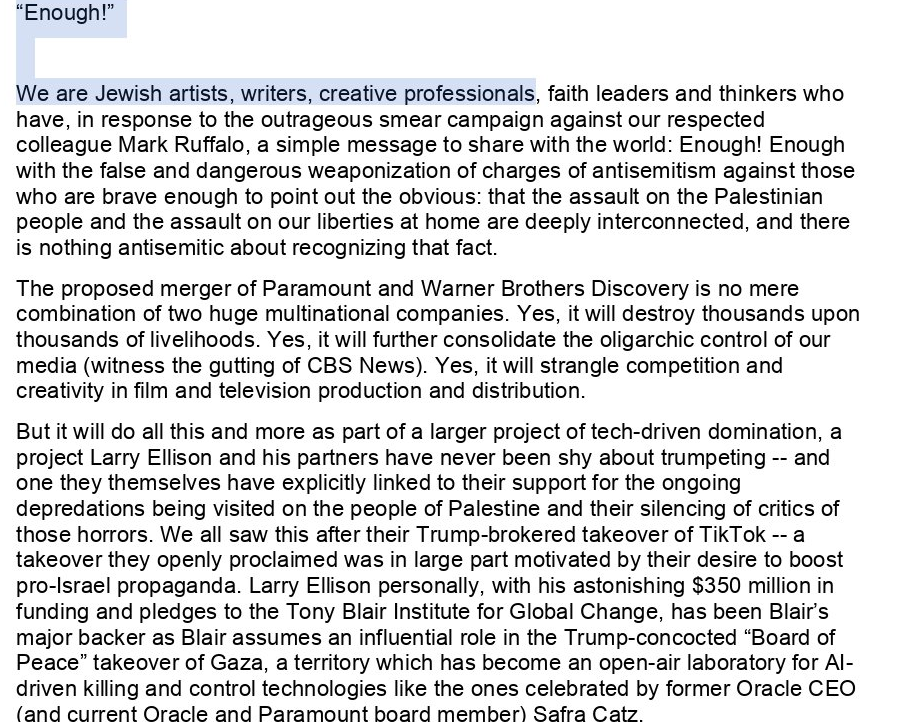
Following the accusations leveled against the American star and Palestine supporter that he had used antisemitic rhetoric or stereotypes, in the wake of his criticism of “Israel” and the war on Gaza, and after he explained his reasons for opposing the Paramount–Warner Bros. merger, Jewish figures in Hollywood issued an open letter in support of actor Mark Ruffalo in response to those accusations.
What is particularly striking is that the solidarity letter did not come only from artists known for their pro-Palestinian views. It was also signed by Jewish figures, artists, and academics who reject equating or conflating criticism of “Israel” or interests associated with it with antisemitism.
The letter stated that “using accusations of antisemitism to silence critical voices has become a tired tactic that has lost its impact and credibility.”
This revealed a clear divide within Hollywood and a growing fracture in the practice of labeling those who oppose “Israel’s” actions in Gaza as “antisemitic.”
The open letter, published in early September 2026 and signed by 170 Jewish artists, writers, academics, and public figures in Hollywood and the broader American cultural sphere, later rising to 180 signatories, expressed support for Ruffalo.
Titled “Enough!”, it described what was happening as a “shameful smear campaign” against the American actor, according to Variety in early September 2026.
It stated, “The era of false accusations of antisemitism is over. This approach has been exhausted and is no longer acceptable.” The signatories emphasized their support for Ruffalo and for anyone who speaks out courageously in the face of centers of influence and power.
The signatories argued that describing Ruffalo as “antisemitic” because of his criticism of the deal and the commercial and political interests connected to it represents an attempt to silence criticism of “Israel” and the war on Gaza.
They also defended Ruffalo’s linking of commercial and technological interests to what is happening in Gaza, stating in the letter, “Pointing to the fundamental connections between what is happening in Gaza and what is happening in Hollywood is the exact opposite of antisemitism. For us, it is at the very heart of Jewish moral responsibility.”
Even more significantly, the protest against and rejection of the campaign targeting Ruffalo came from within the Jewish community itself, giving the letter greater weight because it rejects reducing Jews or Judaism to a single political position.
The letter makes clear that defending Palestinian rights and criticizing the Israeli government or companies linked to it should not automatically be classified as hostility toward Jews or branded as “antisemitism.”
According to an opinion poll conducted by The Washington Post on October 6, 2025, 61 percent of American Jews believe that “Israel” is committing war crimes in Gaza, while four in ten agree that these crimes rise to the level of “genocide.”
Ruffalo had criticized a deal in which the Ellison family, a Jewish, “pro-Israel” family that owns Paramount, sought to acquire Warner Bros. Discovery, warning of its potential repercussions for the American film industry.
He also accused the Ellison family, which also owns Oracle, of complicity in the “genocide” against Palestinians by supplying “Israel” with military technologies for the war, pointing to its ties to the Israeli military establishment through Oracle.
Among the prominent Jewish figures in the film world who signed the letter were directors Joel Coen and Todd Haynes, playwright Tony Kushner, actress Hannah Einbinder, and writer and activist Naomi Klein, according to the British newspaper The Guardian in early September 2026.
Other signatories included Ilana Glazer, Emma Seligman, Jane Schoenbrun, and Wallace Shawn, in a clear indication of the expanding circle of solidarity with Ruffalo within the Jewish artistic community in the United States.
Actress Jane Fonda also strongly criticized Paramount for describing Mark Ruffalo’s statements as “antisemitic,” calling it a “smear campaign to delegitimize criticism of the merger,” according to Variety on August 25, 2026.
She issued a statement supporting Mark Ruffalo after Paramount criticized the four-time Oscar-nominated actor and described him as “antisemitic,” saying, “Mark Ruffalo has a constitutional right to express his opinion on politics, corporations, and this dangerous merger.”
Actor George Clooney also expressed his support for Mark Ruffalo, saying, “I support his right to speak freely, and I think accusing him of antisemitism is ridiculous. We are not going to suppress free speech.”
Clooney said at a press conference at the Venice Film Festival, “I will always support Mark Ruffalo’s ability to speak freely. I love him. He’s a good man,” according to The Hollywood Reporter on September 2, 2026.
Thus, while “Israel’s” supporters sought to target the pro-Palestinian actor, the campaign ultimately turned against them in Hollywood, drawing opposition from both Jews and non-Jews. It was no longer simply a matter of stars expressing support for Palestine, but a broader confrontation over “freedom of expression” itself within the film industry.
The accusation of “antisemitism” shifted from being a tool for pressuring artists who criticize “Israel” or institutions linked to it into a counterweapon, draining the Zionist pressure campaign of its force after this battle.
In this way, the incident implicitly altered the balance of power within Hollywood over how “Israel” and Palestine are discussed, after prominent Jewish figures publicly joined in defending an artist facing accusations of antisemitism because of his political position.
What is now considered acceptable within the American entertainment industry is no longer determined by “Israel” alone, as Hollywood has shifted from embracing Israel to attacking it.
Since October 7 and what followed as “genocide,” the number of people working in the American film industry who have declared their support for Palestinians or called for boycotts of Israeli film institutions has increased.
Thousands of people working in the film industry have previously signed initiatives along these lines, while counter-movements by figures and companies within Hollywood have opposed the boycott, describing it as discrimination against Israelis.
Ruffalo has also signed several letters addressed to U.S. presidents, alongside more than 50 other artists through the organization Artists for Ceasefire, calling for an immediate ceasefire in Gaza.
In September 2025, Ruffalo, along with more than 5,500 others in the film industry, signed a letter pledging to boycott “Israeli film institutions” that they believed were “complicit in genocide and apartheid against the Palestinian people.”
Ruffalo has publicly expressed his support for the Boycott, Divestment and Sanctions (BDS) movement, calling for “boycotting Israel, divesting from it, imposing sanctions on it, and prosecuting it,” during a podcast with journalist Mehdi Hasan.
Merger Secrets and Ruffalo Smear
The roots of this complex conflict can be traced back to early 2026, when Mark Ruffalo led a broad public campaign across social media platforms, urging state attorneys general across the United States to intervene decisively to stop the deal, which he regarded as a monopolistic disaster that would eliminate fair competition and reduce the wages of content creators.
The deal would not only create a monopoly in the film industry; it would also place the news networks CNN and CBS under the same umbrella and under Jewish ownership, potentially affecting their impartial coverage of “Israel’s” crimes.
Prominent legal figures responded to his calls, foremost among them California Attorney General Rob Bonta, who at the time pledged to conduct a rigorous review.
There was also broad legal action by a coalition comprising several attorneys general seeking to block the merger in order to protect consumers and creators from monopolistic practices.
The repercussions of this battle did not stop at the level of mutual media exchanges. Ruffalo’s statements prompted calls for an inquiry and scrutiny into the nature of any ties he might have had with the attorney general at the center of the lawsuit against the deal, according to the “Page Six Hollywood” website, or Page Six, on August 24, 2026.
The purpose of this scrutiny, which was not a criminal investigation, was to determine whether there were undisclosed channels of communication, influence, or mutual interests between the prominent screen star and the legal authorities working to thwart one of the largest economic consolidations in the history of the global film industry.
Mark Goldfeeder, an attorney for Ruffalo’s opponents, requested public records in an effort to obtain correspondence and communications between Bonta’s office and Ruffalo, in order to determine whether the actor’s relationship with the attorney general had influenced the latter’s position on the Paramount–Warner Bros. Discovery merger, according to “Page Six Hollywood.”
Attorney General Bonta officially announced in February 2026 that the California Department of Justice had opened an investigation into the deal. He later joined legal action seeking to block the merger.
Some critics therefore called on Bonta to clarify the nature of his relationship with Ruffalo, particularly after it emerged that their communication had begun before the lawsuit against the deal was filed.
However, this was not an official investigation, but rather calls for clarification regarding their relationship, an effort that served to distract from Ruffalo’s central demand: preventing the monopolistic merger between Paramount and Warner Bros. Discovery. Critics of their relationship, meanwhile, did not explain what interests the two allegedly had behind their opposition to the deal.
Who Are the Ellison Family?
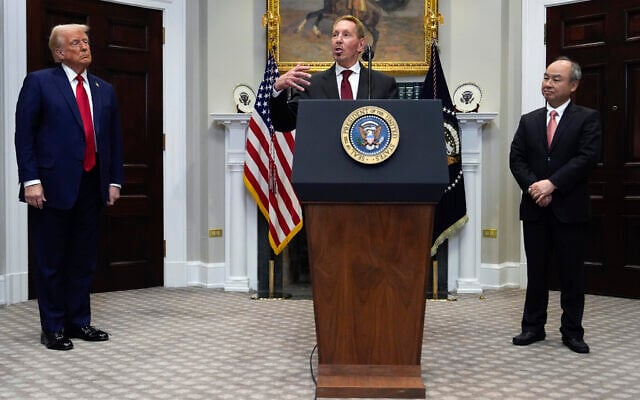
The Ellison family, which operates in the film industry, artificial intelligence, and other major ventures, includes Larry Ellison and his son David Ellison. They are prominent American Jews who strongly support “Israel” and are allies of U.S. President Donald Trump.
Larry Ellison is the chairman of Oracle, the company he founded, and has a net worth of approximately $200 billion. His son, David Ellison, serves as the CEO of Paramount Pictures.
The family’s wealth is not limited to the technology and media sectors. In 2012, Larry Ellison acquired approximately 98 percent of the Hawaiian island of Lānaʻi, in addition to extensive real-estate holdings in California, Florida, and elsewhere.
American actor Mark Ruffalo has criticized the family and opposed the merger between their company Paramount and Warner Bros., citing the Ellison family’s documented record of support for “Israel” and its close ties to Israeli Prime Minister Benjamin Netanyahu.
Their artificial-intelligence company, Oracle, also has technological ties with Israeli institutions and has supplied the Israeli military with advanced technologies used to monitor and track Palestinians and facilitate mass killings through cloud-computing and data technologies within “Israel’s” security infrastructure.
Politically, Larry Ellison has donated to “Israel” on several occasions. One prominent documented example was his donation in 2017 of approximately $16.6 million to the Friends of the Israel Defense Forces (FIDF), an organization that raises funds to support Israeli soldiers and their families.
He also has a close relationship with Israeli Prime Minister Benjamin Netanyahu. The relationship reportedly went so far that, in 2021, Ellison offered Netanyahu a seat on the board of his company, Oracle, according to reports by The Times of Israel on April 24, 2026.
Mark Ruffalo’s criticism of Ellison focused on Oracle’s links to technologies used by Israeli military institutions and, therefore, that it played a role in the aggression against Gaza and the genocide of Palestinians, according to The Hollywood Reporter, August 24, 2026.