How Will the U.S. Midterm Elections Affect Trump’s Influence and Political Future?
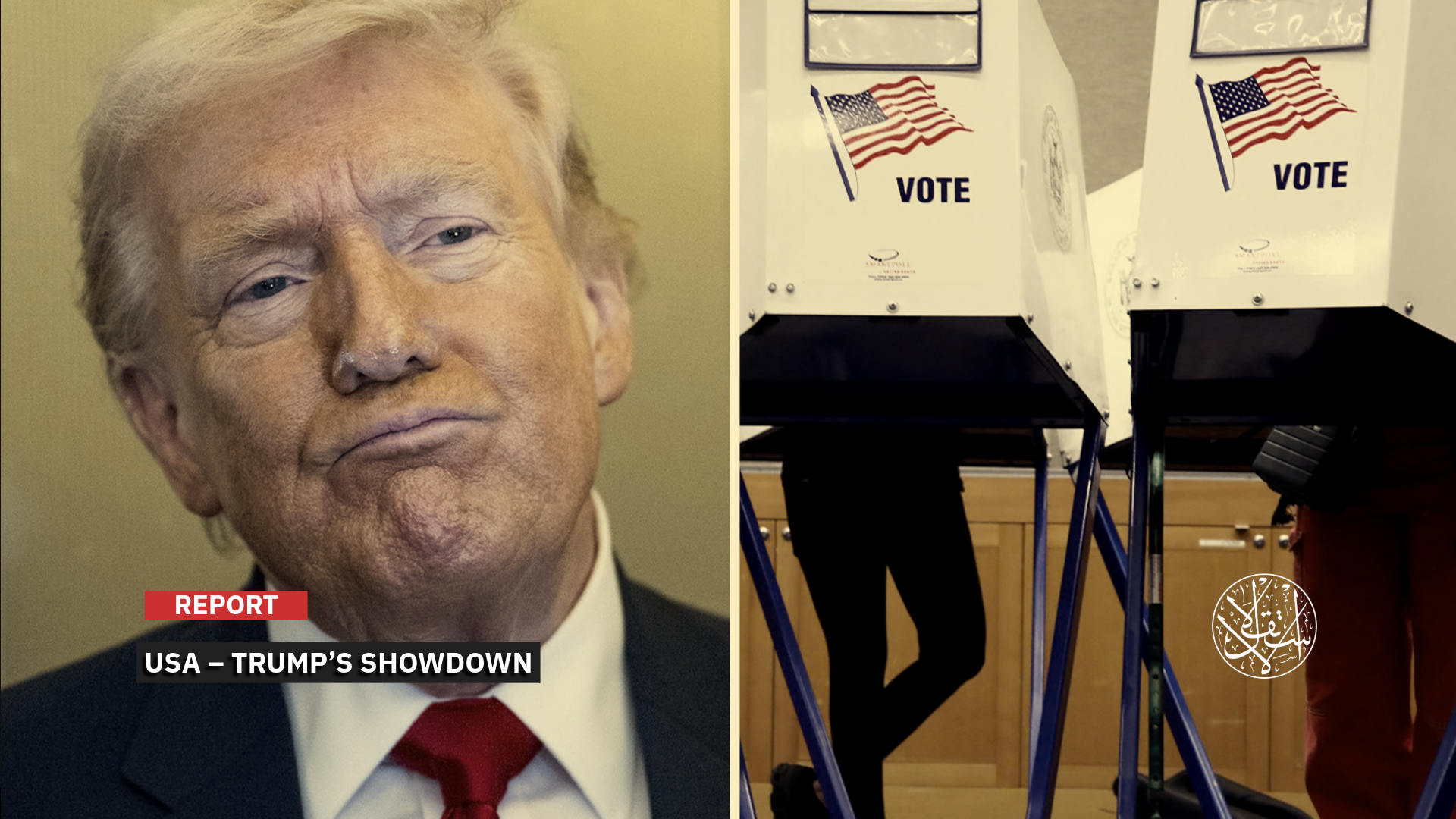
“The U.S. midterm elections are a crucial political test for President Donald Trump.”
The U.S. midterm elections, scheduled for November 3, 2026, are expected to shape President Donald Trump’s political influence and, to a considerable extent, his political future, determining whether he becomes a politically weakened president or maintains his strong influence.
The party that succeeds in controlling one or both chambers of Congress will largely determine the scope of Trump’s political maneuvering in the coming period and shape the final two years of his presidency, 2027 and 2028.
Democrats are threatening to revive their efforts to impeach him, which began in 2021 but were ultimately unsuccessful in removing him from office.
They also intend to intensify scrutiny of what they describe as corruption, accusing Trump and his family of profiting from the war with Iran and alleging that his military adventurism has plunged the United States into economic crises.
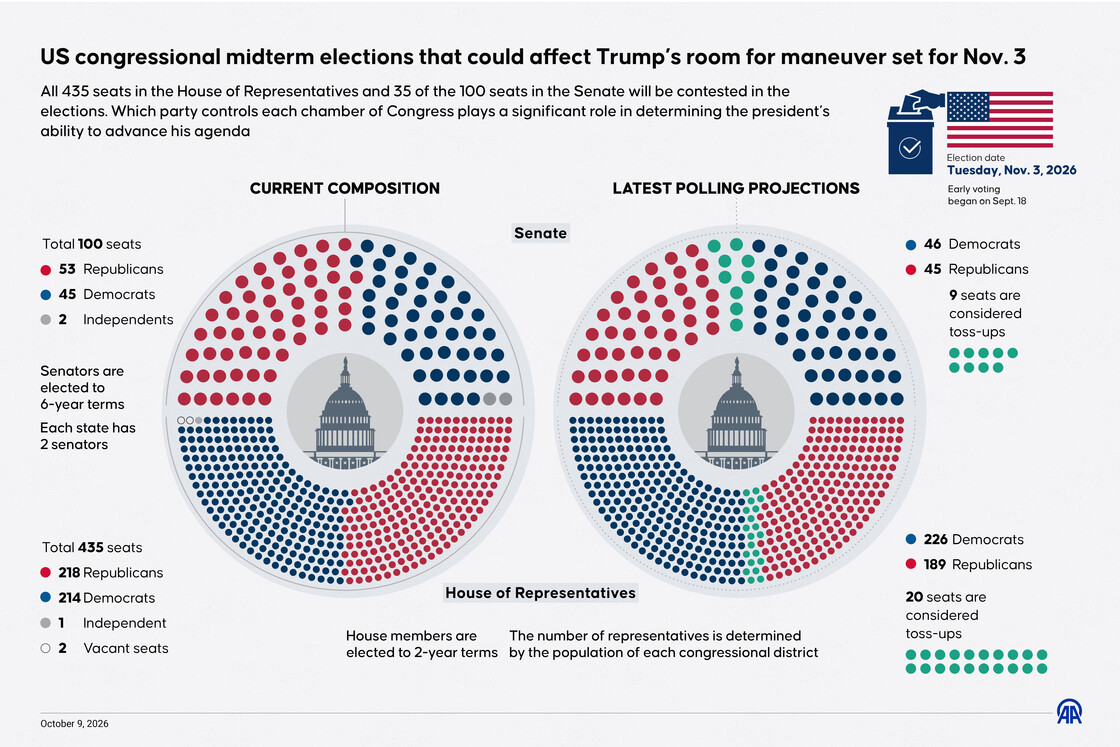
Opinion polls suggest that Democrats could make gains in the House of Representatives, where all 435 seats are up for election, potentially dealing a major blow to Trump’s Republican Party.
Meanwhile, Democrats could also win some of the 35 seats being contested in the 100-member Senate, potentially enabling them to gain control of that chamber as well.
If Republicans lose their majority in either the House of Representatives or the Senate in the November 2026 midterm elections, Trump could face greater difficulties in passing legislation and securing budgetary approval. Congressional investigations into allegations of corruption within his administration could also intensify.
The significance of the elections therefore extends beyond party control of Congress. They will also affect the White House’s ability to pass legislation, fund its policies, and withstand congressional oversight and investigations.
Will Trump become a ‘lame duck’, a term used in American politics to describe an elected president or official whose political influence and ability to advance an agenda have diminished, if his party loses its majority in Congress?
The Seat Count Is Stacked Against Him
The U.S. midterm elections are a crucial political test for President Donald Trump, as they will determine whether Republicans retain their majorities in both the House of Representatives and the Senate or face an opposition majority that could obstruct his agenda during the final two years of his presidency.
Opinion polls suggest that Republicans are entering the race amid declining approval ratings for Trump and growing concerns about economic conditions.
A Pew Research Center poll, released on October 8, 2026, found that only 30% of respondents approved of the president’s performance.
The poll also showed Democrats leading Republicans by eight percentage points among registered voters in congressional voting preferences, with 44% supporting Democrats compared with 36% for Republicans.
Trump’s Republican Party currently holds narrow majorities in both chambers of Congress. In the House of Representatives, Republicans occupy 218 seats, compared with 215 for Democrats, while two seats are vacant.
Democrats need to gain five additional seats to secure a majority, a prospect that several experts and opinion polls suggest is increasingly likely.
On October 16, 2026, the platform On Point Politics published projections suggesting that Democrats could win 236 seats in the House of Representatives, compared with 199 for Republicans, while control of the Senate remains uncertain.
The platform’s analyses indicated that Democrats have a 91% chance of winning the House of Representatives.
In the Senate, Republicans hold a four-seat majority, with 53 seats compared with 47 for Democrats. Some opinion polls and expert analyses also suggest that Democrats could take control of the chamber.
A Washington Post report published on October 14, 2026, titled ‘Why Democrats Are Favored to Win the House, and What Could Go Wrong?’, indicated that the outlook was favourable for Democrats.
The report attributed this to the fact that House elections are usually closely tied to national politics, and all indications point to an extremely unfavourable environment for Republicans right now.
According to public approval polls, Donald Trump ranks among the least popular presidents of recent decades.
As prices continue to rise, growing numbers of Americans are expressing dissatisfaction with his handling of the economy and voicing disapproval of his performance.
A Reuters poll indicates that 78% of voters hold the Trump administration responsible for rising costs and prices.
A Gallup poll also found, for the first time in a decade, that Americans trust Democrats more than Republicans to keep the country prosperous.
Dissatisfaction extends to demographic groups that helped Trump regain the White House, including women, Latinos, and young people, many of whom are now expressing disapproval of his performance, according to the polls cited.
The Washington Post therefore expects Democrats to need a net gain of just three seats in the November midterm elections to win a majority in the Senate, while also having a chance of gaining around 20 seats in the House of Representatives.
However, a Reuters report published on October 12, 2026, warned that six factors could prevent Democrats from achieving a landslide victory in the November midterm elections, despite Trump’s declining popularity.

These six obstacles could limit Democratic gains, with the main challenges including voter turnout, Republicans’ financial advantage, and the difficulty of securing a Senate majority, according to analysts who spoke to Reuters.
Six analysts and experts from both parties told Reuters that several factors could prevent Democrats from turning favourable political conditions into a landslide victory, even if the party ultimately makes some gains in Congress.
First: Fewer competitive House races. The number of congressional districts featuring closely contested House races has fallen sharply over the past three decades.
Partisan polarisation and congressional redistricting, including gerrymandering, have resulted in more seats being considered safe for either Democrats or Republicans.
As a result, analysts estimate that only between 40 and 50 of the 435 House seats will be genuinely competitive this year.
Most analysts expect Democrats to regain control of the House, but with a majority of between five and 25 seats. This would limit their chances of achieving gains on a scale comparable to those recorded in the 2018 elections, when they won 41 additional seats.
Second: The Senate majority is far from certain. Although Democrats are favoured to make gains in the 100-member chamber, securing the four seats needed to establish a 51–49 majority remains highly uncertain, because Trump won many of the states they are targeting by substantial margins in the 2024 election.
Third: Voter turnout. Opinion polls indicate that Democratic voters are more enthusiastic about voting than Republicans.
However, political strategists warn that certain Democratic constituencies, including young people, Black voters, and Latino voters, have historically recorded lower turnout rates in midterm elections than in presidential election years.
Fourth: The Republicans’ financial advantage. Republicans are entering the final weeks of the election campaign with a substantial financial advantage, giving them greater capacity to spend on political advertising.
According to the latest filings with the Federal Election Commission, the Republican National Committee and Republican-aligned congressional political action committees had approximately $614 million in cash on hand, compared with $392 million held by their Democratic counterparts.
Republicans are also relying on a political action committee affiliated with the pro-Trump Make America Great Again movement, which had $416 million in cash on hand at the beginning of September 2026.
According to AdImpact, a firm specialising in tracking advertising expenditure, Republicans had spent approximately $188 million more than Democrats on advertising in states with closely contested Senate races by the end of September.
Fifth: Polling errors. Opinion polls have frequently underestimated the level of support for Republicans in previous election cycles.
A Reuters/Ipsos poll shows registered voters favouring Democrats over Republicans in congressional elections by 43% to 35%.
However, opinion polls have fallen short in some of their most significant past predictions when Trump was a candidate.
Polls also substantially underestimated Republican strength ahead of the 2014 midterm elections, before the party secured a sweeping victory in the Senate.
Sixth: The potential impact of Trump’s attacks on Democrats. Trump and many Republican candidates have sought to portray Democrats as extremists who pose an existential threat to the country.
Their attacks have particularly targeted Muslim Senate candidate Abdulrahman El-Sayed, as well as Muslim men and women serving in Congress.

Trump: A Lame Duck
President Donald Trump, who is 80 years old, could face two difficult years in the White House if Republicans lose control of Congress in the November 3, 2026, elections, amid voter anger over the war with Iran and rising prices.
Congressional investigations and the possibility of a third impeachment could loom on the horizon as his Democratic opponents seek to challenge his policies.
According to Barron's Daily, in a report published on October 4, 2026, the president, who takes pride in projecting his power, could find much of his influence curtailed.
U.S. presidents often see their parties lose seats in Congress during midterm elections, potentially leaving them facing an opposition-controlled Congress. In such circumstances, a president may be described as a ‘lame duck’, a term that refers to a decline in political authority and influence during the remainder of their term.
In American politics, the term ‘lame duck’ refers to a president who remains in office and retains their constitutional powers but whose political influence begins to wane.
If the opposing party controls Congress, it can constrain the president’s ability to advance many of his legislative priorities.
If Republicans lose control of the House of Representatives, Trump could become what is known in American political terminology as a ‘lame duck’, a president whose ability to advance his agenda is diminished because the opposition controls one or both chambers of Congress and obstructs his plans.
If Republicans lose the House, as some analyses predict, and potentially the Senate as well, Trump would face a more difficult political environment.
Democrats could launch investigations into allegations of corruption, profiting from the war, or abuse of power involving the president and his administration.
Trump’s second presidential term ends in January 2029, and the Twenty-Second Amendment to the U.S. Constitution prohibits anyone from being elected president more than twice.
If Trump becomes a ‘lame duck’, passing his legislative proposals could become more difficult because his Republican Party would have lost control of at least one chamber of Congress.
Some Republicans might also become less inclined to follow his lead, particularly as competition to succeed him in the 2028 presidential election begins to intensify.
In terms of oversight and accountability, Democrats could use control of the House or Senate to expand investigations into the Trump administration and intensify congressional scrutiny.
Despite Congress’s constitutional powers, the U.S. president enjoys substantial constitutional and political advantages in directing foreign policy, while Congress’s role in this area has weakened considerably in recent years.
However, foreign governments might approach Trump’s decisions with greater caution if they believe his political influence is waning, according to assessments by Chatham House in a report published on September 3, 2026, examining the impact of the elections on his political authority.
This does not mean that the president would become unable to govern simply because his party loses the elections.
He would retain his constitutional powers until the end of his term, but his position could resemble that of a bird with clipped wings, struggling whenever it attempts to fly.
A Washington Post report published on October 14, 2026, notes that even if Democrats win a majority, they would not be able to enact legislation without support from at least some Republicans.
In the Senate, most legislation requires 60 votes to overcome a filibuster, and Trump can also use his veto power against legislation passed by both chambers of Congress.
Democrats would, however, have the power to subpoena witnesses. With a majority vote, they could compel individuals from the Trump administration to testify at congressional hearings or face legal proceedings for failing to comply with a subpoena.

What Will the Democrats Do?
Democrats say they plan to launch wide-ranging investigations into the Trump administration, including examining how the president, his family, and his allies have enriched themselves, as well as his use of the federal government to benefit political allies and punish opponents.
According to U.S. assessments, if Democrats win, they are expected to pursue several significant measures, including invoking the War Powers Resolution to end the conflict with Iran and repealing the tariffs Trump imposed on Canada.
Congress could also seek to halt the war with Iran by cutting off its funding, as it has the authority to approve government and military spending.
Other measures Democrats might pursue include imposing restrictions on aid to “Israel” or arms sales to the country, cancelling the Russian diesel agreement, and potentially tightening restrictions on technology exports to China.
The key figure here is 34 senators. If both chambers of Congress pass a bill and Trump rejects it by exercising his presidential veto, overriding that veto requires a two-thirds majority in both chambers.
Assuming all senators are present and vote, Trump would need the support of just 34 senators to block an override of his veto.

Will Trump Resign?
On October 3, 2026, former U.S. presidential candidate Ralph Nader raised the possibility that President Donald Trump could resign before the end of his term in January 2029.
Nader outlined five factors that he said could prompt Trump to leave office early, despite the many incentives for remaining president, including political influence, legal immunity, and the ability to use the powers of the presidency to secure political and personal gains.
He argued that these five factors could push Trump towards an early resignation, particularly if Democrats win control of Congress in the midterm elections, intensify pressure on him, and launch investigations into his administration.
In an article published by the Common Dreams platform, Nader explained that the president could face a different set of circumstances over the next two years, especially if he loses a substantial share of his political influence and finds himself unable to project the image of a president capable of delivering major achievements in 2027 and 2028.
Nader identifies what he describes as fatigue and declining health as the first factor that could prompt Trump to resign.
In support of this argument, he cites a statement signed by more than 30 mental health professionals and physicians that was entered into the Congressional Record in April 2026.
Nader argues that, if Trump chose to resign, he could present the decision as an effort to make way for a new generation of Republicans led by Vice President JD Vance.
The second factor is the possibility of avoiding investigations and political pressure directed at Trump's administration.
Nader expects Democrats to launch a series of investigations, accompanied by congressional subpoenas, disclosures by whistleblowers, allegations of contempt of Congress, and negative media coverage.
The third factor concerns the future of the Republican Party itself. Nader believes Trump's resignation could facilitate an orderly transfer of power to Vance, whom he describes as Trump's preferred successor.
According to the writer, such a transition could preserve a degree of continuity within the administration, including policies favoured by Trump.
It could also help the president avoid bearing political responsibility for any Republican losses in the November 2026 elections.
The fourth factor relates to the crises the United States may face in the coming period. According to Nader, Trump receives briefings from his military, intelligence, and domestic policy advisers on scenarios involving numerous threats to the country, both at home and abroad.
The president might decide that distancing himself from these challenges would be in his interest.
The fifth factor is the possibility that Trump could declare that he has fulfilled his promises to voters and use that claim as the basis for announcing that his mission is complete, handing power to a new generation of Republicans led by Vance.
At the conclusion of his article, Nader invokes the example of President Richard Nixon, who resigned in 1974 after losing political support in Congress.
Nader argues that if Trump continues taking confrontational positions abroad and in American cities, he could experience a similar decline in congressional support.