Kais Saied Faces Growing Street Pressure: Can Tunisia’s Opposition Unite?
"The march succeeded in bringing together Tunisia’s fragmented opposition."
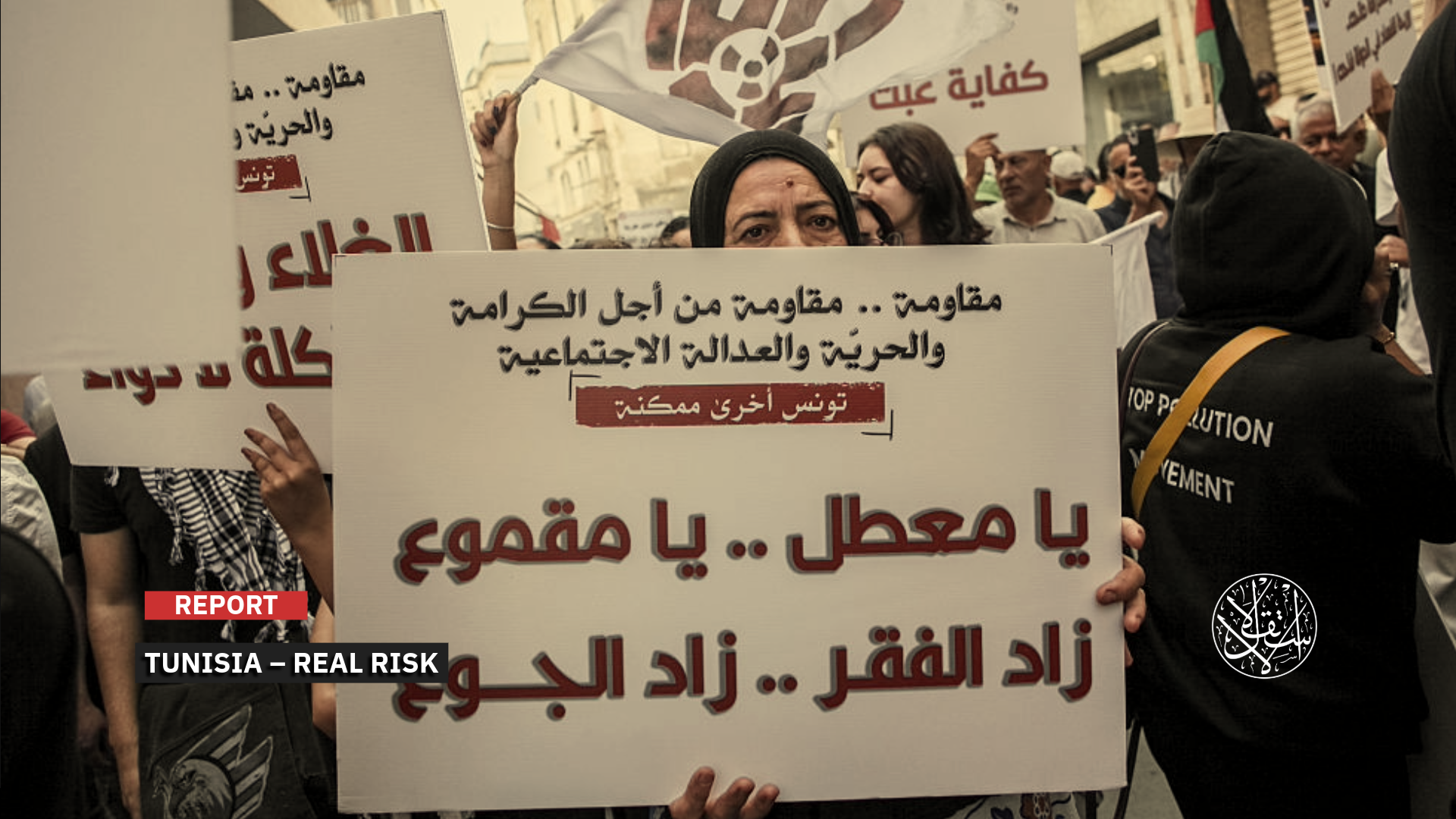
Thousands of Tunisians took to the streets of the capital on Saturday, 17 October 2026, in what Reuters described as the largest protest against the head of the Tunisian regime, Kais Saied, in years.
The march was called by a coalition of nine organizations led by the Tunisian General Labor Union (UGTT), the country’s largest trade union.
The coalition also included the Tunisian Human Rights League, the Tunisian Order of Lawyers, the journalists’ union, and the Tunisian Young Doctors’ Organization.
But once the crowds dispersed, the bigger question was whether this unlikely alliance could hold together beyond a single day of protest.
Having demonstrated its ability to bring Tunisia’s fractured opposition forces into the streets, the coalition now faces the harder task of sustaining that unity against a presidency that has steadily dismantled the country’s political landscape and weakened its most influential political and civil society groups.
Mass March
Protesters began gathering in the morning at Mohamed Ali El-Hami Square—known among trade unionists simply as "al-Batha"—the historic stronghold of the Tunisian General Labor Union (UGTT) and the beating heart of the Tunisian trade union movement.
The site has witnessed some of the defining moments in modern Tunisian history. It served as a major rallying point during the general strike of 26 January 1978, the 1984 Bread Riots,, and the mass protests that swept the country during the 2011 revolution.
Thousands then marched through the capital’s main thoroughfares, passing along Habib Thameur Street, Republic Square, and Paris Street before reaching Habib Bourguiba Avenue, the symbolic heart of the 2011 uprising.
The march rallied around a familiar slogan, “Work, Freedom, National Dignity.” Protesters also revived chants from the 2011 revolution, including “The people want the fall of the regime.”
They blamed Saied’s regime for the country’s deteriorating economic and social conditions and accused it of using the security services and judiciary to silence opponents and imprison critics.
Authorities, meanwhile, adopted a notably cautious approach. There were no reports of major violent crackdowns or systematic attempts to disperse the crowds.
Instead, security forces deployed heavily from early morning, managing the march route and blocking some access points leading to sensitive government and security sites in the capital.
The authorities’ apparent tactical restraint may reflect a desire to avoid scenes of bloody repression that could galvanize domestic and international support for the opposition or trigger a wider wave of unrest that would prove difficult to contain.
A Broader Opposition Front
For observers, the turnout represented more than a successful demonstration. It signaled a potential breakthrough in overcoming the climate of fear fostered by the authorities, whose crackdown has included repeated arrests of protesters.
Most recently, more than 15 activists were charged with insulting the head of the regime following a demonstration in solidarity with detainees from the Sumud Flotilla, which sought to break “Israel’s” blockade of Gaza.
The march also brought together Tunisia’s fragmented opposition, offering a rare display of unity across political and civil society lines.
Organizations and parties that have repeatedly clashed since Saied’s 25 July 2021 power grab joined forces without reopening the familiar disputes that have divided the opposition in the years since. Nor did they draw the usual lines between established civil society organizations and political parties.
Political parties that have faced marginalization and mounting restrictions since 2021 moved quickly to seize the moment. On 7 October 2026, eight progressive, democratic, and left-wing parties issued a joint statement pledging their full support for the street mobilization.
The initial coalition expanded to include several established political forces: the Social Democratic Path, the Pole Party, the Socialist Party, the Workers’ Party, the Democratic Current, the Republican Party, Afek Tounes and Ettakatol.
The Popular Republican Union subsequently joined the declared lineup, followed by the Free Destourian Party, which announced its support for the protest.
Social media was flooded with statements from political parties and civil society organizations urging Tunisians to take part in the 17 October march.
One announcement carried particular political significance: the decision by the People’s Movement, a Nasserist Arab nationalist party, to participate.
For years, the party had been among the most prominent political forces backing the measures Saied announced on 25 July 2021 and defending the head of the regime. Its formal call for supporters to turn out in force marked a notable shift.
The move points to a possible erosion of the political support base that once underpinned Saied’s rule, as elements of that camp joined street protests against his regime.
Disagreements over the handling of economic crises and Saied’s concentration of decision-making power appear to be driving the realignment.
Ennahda, Tunisia’s largest opposition party, took a more limited approach. Rather than issuing a comparable party-wide mobilization statement, it relied on its official spokesman, Imad Khamiri, who urged supporters to join the march in a post on his official Facebook account.
“We remain committed to peaceful civil struggle as a strategic choice, not a tactical one, and as the only path to reclaiming our rights,” Khamiri wrote. “We demand our national rights to work, freedom, and dignity, as well as the release of all political detainees, because their freedom is a prerequisite for everyone’s freedom.”
“Our principled position is not a slogan to be raised; it requires showing up on the front lines of the struggle and putting narrow calculations aside,” he added. “We will all meet, alongside Tunisian men and women, at Mohamed Ali Square on Saturday, 17 October 2026.”
Escalatory Rhetoric
The protesters’ chants were not the only sign of a more confrontational stance toward Kais Saied. In a speech that signaled a new political direction for the UGTT, its secretary-general, Salaheddine Selmi, delivered a pointed message that marked a new phase in the union’s role within the opposition coalition.
“When those in power break off dialogue, the conversation moves to the streets,” Selmi declared at the start of his address.
In his first speech since being elected secretary-general, Selmi made clear that the union was no longer willing to remain on the sidelines.
“We are gathered today for this national march because silence is no longer acceptable, because intimidation cannot be a way of governing, because a country cannot be run through exclusion, because a state cannot be built by concentrating all powers in the hands of one person, and because sovereignty cannot be protected by shutting the doors on the people and the forces that give society life, or by stripping them of their right to participate, evaluate, and hold those in power accountable,” he said.
The union’s unusually forceful rhetoric defied expectations in a political climate marked by the retreat of opposition parties and civil society groups and the growing dominance of the regime.
The timing made Selmi’s stance all the more striking. His remarks came as the authorities stepped up efforts to sideline the UGTT amid a broader campaign of pressure on political parties, civil society, and the media. The union has also faced financial pressure, with authorities withholding membership dues that constitute a key source of its funding.
The UGTT is also still grappling with the fallout from internal disputes that have persisted in the wake of its most recent congress. Those divisions have weakened its ability to mobilize supporters and sustain a confrontation with the regime on explicitly political terms.

The End of the Truce
Speaking to Al-Estiklal, political activist Yassine Gharsallaoui said that despite being the largest protest in years, the march fell short of reflecting the full organizational weight of Tunisia’s major national institutions, particularly the UGTT and the Tunisian Order of Lawyers.
He attributed the gap to what he described as three years of political desertification and a marked decline in street mobilization.
Gharsallaoui also pointed to internal divisions within the UGTT, saying that a union faction aligned with Saied had helped limit labor turnout in Greater Tunis.
Other regions, including Sfax, Gafsa, and Gabes, saw more substantial mobilization, he said, highlighting disparities among regional union branches that could shape the future of the labor movement.
Much of Tunisia’s political and civil society establishment had approached the march with deep reservations, fearing that a poor turnout would give the authorities an excuse to further restrict public space at a time when popular willingness to protest had waned.
Instead, the size of the crowd came as a surprise, giving the UGTT greater confidence to pursue more radical forms of protest. It also demonstrated that political forces could mobilize and coordinate when brought together under a common organizational umbrella, Gharsallaoui said.
Even groups that stayed away, including the Ennahda movement, recognized the march as a positive development that could provide a foundation for further action.
“The march has opened the door to a broader protest movement, but there must be the political will to walk through it,” he said. “Economic and social crises will deepen in the coming months for a number of reasons that would take too long to explain. We will see considerable unrest, and the summer of 2027 will be harsher than the last one, with deeper crises involving electricity, water, and other essential services.”
Political forces must build on the momentum of the 17 October 2026 march and establish a common platform for sustained resistance to the regime’s policies, Garslaoui added.
He argued that the authorities’ approach was not only eroding civil liberties and restricting political activity but also contributing to economic crises through their policy choices.
Ultimately, the 17 October march marked the end of an uneasy truce between the UGTT and other major national organizations, on the one hand, and Saied’s regime, on the other. That period of relative restraint had been shaped by constitutional changes and the authorities’ security-driven approach to dissent.
With channels of dialogue increasingly blocked and economic pressures mounting, the regime faces a choice in the months ahead: Make substantive concessions and pursue a settlement that restores the role of intermediary institutions, particularly labor unions, or double down on its current course of denial and defiance, risking a new wave of open-ended social unrest.
If the authorities continue to ignore these demands and refuse meaningful negotiations over economic and social policy, the UGTT retains its most powerful weapon: calling a general strike capable of bringing essential state services to a standstill. Such a move, Gharsallaoui suggested, is now being seriously considered within the union’s decision-making circles.
Sources
- Thousands rally for biggest protest in years against Tunisia’s Saied
- October 17 March Organizers Tell Ultra Tunisia: “We Took to the Streets to Say Enough Is Enough” [Arabic]
- “Tunisia First, the People Above All” Slogan Marks Peaceful March in the Capital [Arabic]
- Tunisia’s Three Major Organizations Launch Coordination Initiative to Tackle the Country’s Crises [Arabic]
- The Coordination Framework of National Organizations and Civil Society Groups [Arabic]