A Meeting Without Iraqi Officials: What Did Trump Want al-Zaidy to Hear?
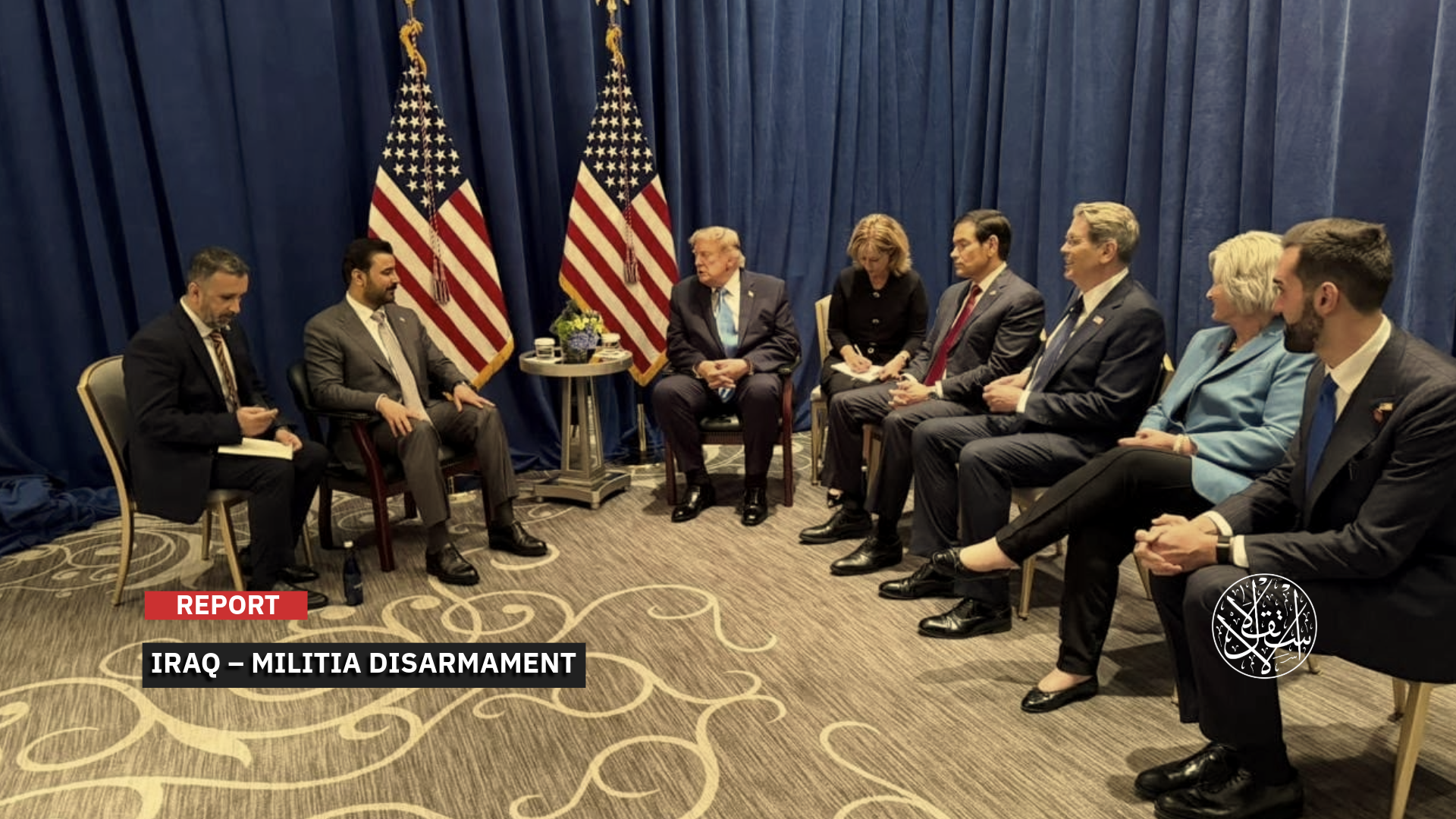
“Trump and his team of officials met with al-Zaidy alone in New York.”
The bilateral meeting between U.S. President Donald Trump and Iraqi Prime Minister Ali Falih al-Zaidy, attended only by an interpreter, has raised questions about its significance, particularly as it came amid growing U.S. interest in the issue of weapons outside state institutions and Baghdad's entry into a new phase of negotiations.
According to a statement issued by al-Zaidy's office on September 23, 2026, the two sides discussed bilateral relations and ways to strengthen political, economic and investment cooperation, as well as regional developments and joint efforts to enhance security and stability.
The meeting coincided with U.S. statements stressing the need to ensure that weapons remain exclusively in the hands of the state.
Individual messages
The meeting took on added significance amid Washington's increasingly firm stance on weapons outside state institutions.
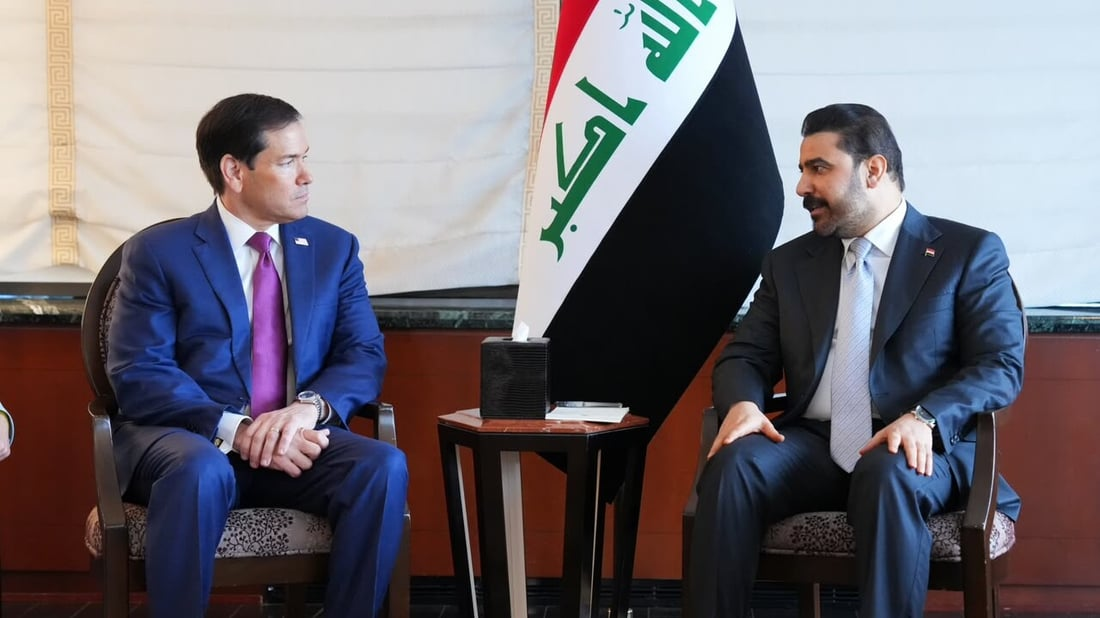
U.S. Secretary of State Marco Rubio reaffirmed Washington's support for the al-Zaidy government's efforts to ensure that weapons remain exclusively in the hands of the state, linking this to preserving Iraq's unity.
Speaking to the press on September 23, Rubio said Washington did not doubt al-Zaidy's commitment to placing weapons under state control.
He stressed the need to disarm militias to prevent the "balkanization" of Iraq, referring to its fragmentation along the lines of the Balkan states that once formed Yugoslavia.
Rubio's remarks came days after he met with al-Zaidy in New York, during which the two sides agreed on the importance of dismantling militias designated as terrorist organisations by Washington, preventing attacks originating from Iraqi territory and strengthening state sovereignty, reflecting a growing focus on the issue.
U.S. Special Envoy to Iraq Tom Barrack also affirmed that the Iraqi state would be the country's sole holder of military power by the end of June 2027, a deadline that coincides with the new plan put forward by the government to resolve the issue of weapons.
In this context, Iraqi writer Nizar al-Awsaji argued in an article published by Eurotimes on September 24 that Rubio's use of the term ‘balkanization of Iraq’ did not appear to be incidental.
He explained that words in international politics carry significance, and some terms convey a warning that goes beyond their literal meaning.
Al-Awsaji argued that by linking the continued presence of weapons outside state control to the possibility of Iraq's balkanization, Washington was elevating the issue to a different level, one concerning the country's unity and political and geographical future, rather than merely addressing a security issue involving weapons and militias.
He clarified that Rubio had not said Iraq would inevitably be divided, nor had he announced that the United States had decided to partition it. He had also not identified any Iraqi sect or Iran as responsible for the possibility of balkanization.
However, the writer argued that Washington's broader position indicated that it viewed weapons outside state control as a problem of Iraqi sovereignty.
He noted that the U.S. had been calling for the dismantling of militias, the prevention of attacks and the full exercise of state sovereignty.
In a separate analysis, Iraqi writer and political analyst Yahya al-Kubaisi wrote in a post on X on September 23 that “Rubio's insistence on the need to disarm militias to avert the balkanization of Iraq was not an offhand remark but, in his view, constituted an implicit threat directed at the Shiite political actor.”
Al-Kubaisi added that the American message was also directed at Iran, estimating that failure to disarm the militias could lead to Iraq's partition.
This interpretation frames Rubio's remarks as a direct political warning to the forces involved in the issue.
In turn, Dr. Liqaa Maki, senior researcher at the Al Jazeera Centre for Studies, said in a post on X on September 23 that “Rubio's remarks constituted a clear hint that the continued existence of armed factions and their retention of weapons threaten to divide Iraq,” linking this to a broader US strategy.
He argued that the matter goes beyond mere threats, representing instead a roadmap that begins with the imposition of economic sanctions—potentially leading to the collapse of the political regime—followed by the creation of conditions for sectarian civil conflict, ultimately resulting in the fragmentation of the country, much like what occurred in the Balkans.
The Balkanization of Iraq
In contrast to these interpretations, Iraqi writer and political analyst Falah al-Mashal offered a different interpretation of the concept of ‘Balkanization’ in a post on X on September 23.
He argued that signs of fragmentation and division have existed in Iraq since the establishment of the power-sharing system.
Al-Mashal said, “The division and fragmentation referred to as balkanization is already occurring in Iraq.”
He pointed to divisions among the country’s various components and political forces, as well as the absence of a unifying national identity, a culture of citizenship and a unified political position.
Al-Mashal argued that the division was not limited to Iraq’s various components but also extended within them. He pointed to divisions among Shiite, Kurdish and Sunni political forces, arguing that this reality had produced a state of ‘Lebanonisation and balkanization’ without formally declared borders.
Meanwhile, writer Iyad al-Dulaimi commented on a photo of the meeting between Trump and al-Zaidy in a post on X on September 23, suggesting that the prime minister’s presence alone, along with an American interpreter, raised questions about the nature of what was discussed.
Al-Dulaimi said, “There was something al-Zaidy needed to hear alone, and something he needed to say alone.”
He added that the U.S. understood what surrounded the prime minister and what was expected of him, linking this to the possibility of changes in US policy toward Iraq.
Iraqi writer Akram al-Mashhadani described it as a strange move, with President Trump and his political, security, and financial team meeting privately with Iraqi Prime Minister Ali al-Zaidy in a closed-door meeting, without the Iraqi flag present.
In a Facebook post on September 23, al-Mashhadani added, “The Americans met with al-Zaidy alone, and members of the accompanying Iraqi delegation were prevented from attending. Even the person sitting to al-Zaidy’s right was an American interpreter brought by the U.S. delegation to the United Nations to translate the conversation. A unique precedent that has never happened before?”
Iraqi journalist Muhannad al-Azami told Al-Estiklal that what stood out about the meeting was al-Zaidy appearing alone before Trump and the U.S. team.
He noted that the interpreter was from the White House, suggesting that this could indicate that Trump wanted to discuss issues or convey threats directly to al-Zaidy.
Al-Azami linked the talk of ‘balkanization’ to the issue of weapons, saying that it was a threat and could be real if they do not hand over their weapons.
He estimated that this came as Sunni forces had, in the preceding days, hinted at establishing a Sunni region if weapons were not surrendered.
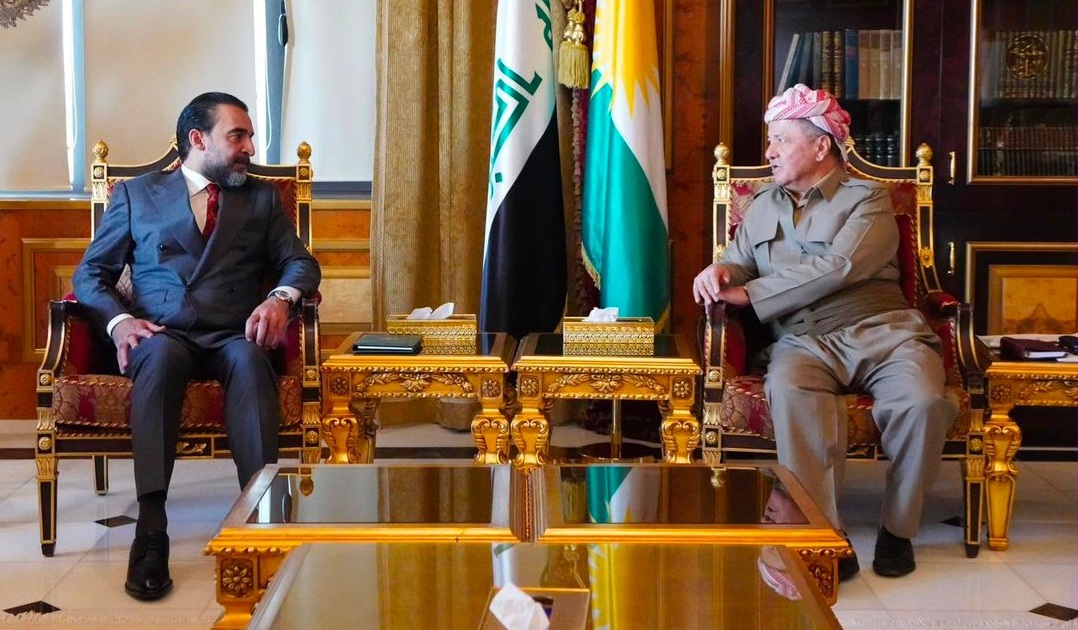
According to information circulated by local media on August 31, a discussion between Sunni leader Mohammed al-Halbousi and Kurdistan Democratic Party leader Masoud Barzani addressed Iraq’s next phase and the possibility of establishing new regions, including regions in the western part of the country.
The reports said that over the past few weeks, Sunni forces have pursued two parallel tracks: aligning their positions with the federal government regarding the war and the disarmament of militias, and moving closer to Kurdish forces—a shift that could pave the way for using the concept of autonomous regions as a political bargaining tool.
Test Deadline
Alongside the political debate, the issue of weapons has entered a new phase after the government moved away from the previous deadline of September 30 and put forward a timeline extending until June 2027. The plan begins with a three-month transitional period that includes a halt to attacks.
In an interview with The New York Times on September 21, al-Zaidy revealed that the first phase would last 90 days, during which the factions would commit to halting attacks in exchange for guarantees that they would not be targeted by U.S. strikes. The process of handing over weapons would then begin in March 2027.
Under al-Zaidy’s plan, the weapons handover process would be completed by June 30, 2027, making the first three months a transitional period between political and security commitments and the subsequent move toward measures related to the weapons and mechanisms for handing them over.
Bahaa al-Araji, Head of the Construction and Development Parliamentary Bloc, revealed during a televised interview on September 22 that the Coordination Framework meeting had agreed to consider the next three months a guarantee that weapons would not be used against neighboring countries, the Gulf states or the Kurdistan Region.
Al-Araji added that the guarantees also included preventing the factions from being subjected to U.S. or Israeli strikes, meaning that the transitional phase is based on an arrangement that combines a cessation of attacks with the provision of political and security protection for the factions.
Iraqi political analyst Ramadan al-Badran, who is based in the United States, said, “The factions remain because they are ideological factions aligned with an ideological state, Iran. They view Iraq as a host state, so they will remain and continue by every means and in every way. Anyone who believes these factions will give up their weapons is mistaken, because that contradicts the ideological dimension of these factions.”
During a televised interview on September 23, he noted that “there is a state with a political system in Iraq, an ideological political system, and there is the Iraqi state, which is a state based on the constitution and citizenship. Iraq now has an ideological state that has been competing with the Iraqi state since 2003.”
Al-Badran stressed that “the U.S. State Department statement consisted of three points, each complementing the other. It did not speak only about the importance of dismantling the factions, but also about preventing any offensive actions carried out from Iraqi territory, in addition to Iraq exercising full sovereignty. Therefore, the presence of the factions constitutes a reduction of Iraqi sovereignty.”
He explained that “the factions must realistically understand that their options for survival are either to confront the state or disband. The political system does not allow for giving up the factions, even though one of the leaders of Harakat al-Nujaba said that the Coordination Framework is negotiating with the factions and signaling to them not to relinquish their weapons.”
The position of the Coordination Framework remains one of the key factors affecting the future of the plan, particularly as disagreements continue over the timeframe and mechanism for handing over weapons, alongside the formation of a political committee to negotiate with the factions, including prominent figures such as Nouri al-Maliki, Hadi al-Amiri, and Mohammed Shia al-Sudani.
Sources
- Rubio Warns of the balkanization of Iraq and Stresses the Importance of Disarming the Factions [Arabic]
- Al-Zaidy Meets Trump in New York to Discuss Strengthening Cooperation Between the Two Countries [Arabic]
- Nizar Al-Awsaji: Rubio and the balkanization of Iraq... Has the Militias Issue Entered a Stage of Breaking Taboos? [Arabic]
- From Al-Nujaifi to a Sunni Region: What Is Happening Behind the Scenes in Iraq? [Arabic]
- The Partition of Iraq: Rubio Escalates and Puts al-Zaidy and the Coordination Framework at a Crossroads [Arabic]