Who Is Yossi Dagan, the Man Directing Israeli Settlement Expansion From Outside the Government?
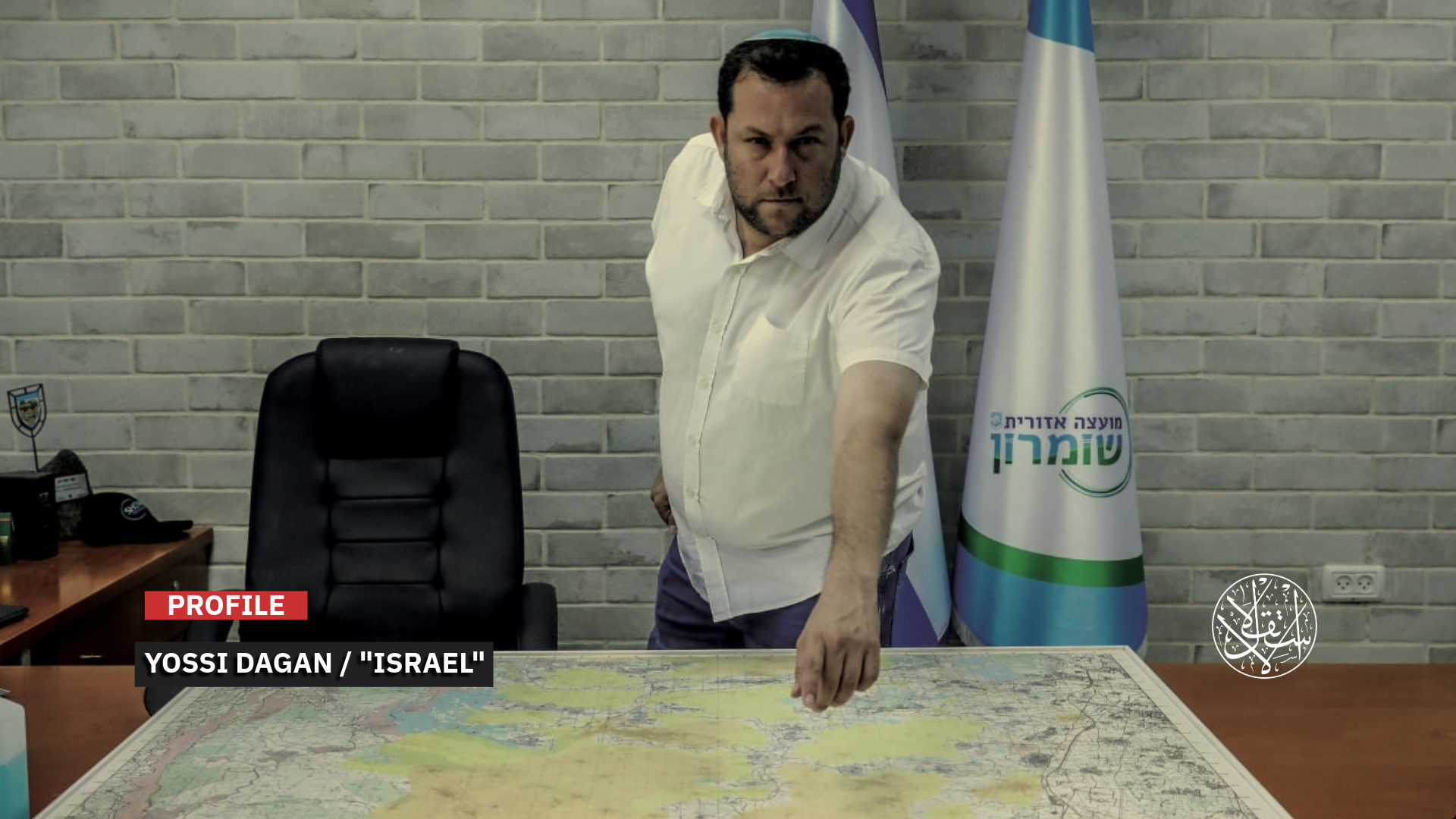
The evacuation of the Sanur settlement in 2005 marked a turning point in Dagan’s career.
Evacuated from the Sanur settlement in the northern West Bank in 2005, Yossi Dagan has since emerged as one of the most influential figures shaping Israeli settlement policy. He has built an extensive network of ties spanning “Israel’s” political and military leadership, the U.S. Congress, and circles close to President Donald Trump.
As head of the Samaria Regional Council, Dagan has helped secure billions of shekels to expand settlements and rebuild those evacuated, while pushing for the annexation of the West Bank and working to prevent the establishment of a Palestinian state.

Who Is Yossi Dagan?
Yossi Dagan, born Yosef Shlomo Dagan in 1980 in the central Israeli Occupation city of “Bnei Brak,” grew up in a religious Zionist environment. When he was 15, his family moved to the “Shavei Shomron” settlement in the northern West Bank.
He became involved early in the religious youth movement Bnei Akiva before taking charge of the youth wing of the extremist far-right Moledet party, founded by Israeli politician Rehavam Ze'evi, one of the most prominent advocates of forcibly displacing Palestinians.
In the 2003 Israeli Knesset elections, Dagan ranked 33rd on the National Union alliance's electoral list but failed to win a seat in parliament.
Dagan studied at Israeli religious institutions, served as an officer in the Israeli military, and earned two law degrees, one from Ono Academic College and another from Bar-Ilan University, according to his official biography.
In the early 2000s, he helped lead a group of settlers who moved to Sanur and served as its coordinator. He later became one of the leading opponents of the disengagement plan implemented by Ariel Sharon's government in 2005, which involved evacuating 21 settlements in the Gaza Strip and four in the northern West Bank.
The evacuation of Sanur in August 2005 proved a defining moment in his political career. Dagan subsequently helped establish the Homesh First movement, which campaigned for the return of evacuated settlements. He also became involved in organizing lobbying campaigns and tours for Israeli Occupation officials across the West Bank.
In 2007, he was elected to represent “Shavei Shomron” on the Shomron Regional Council. He went on to hold several administrative positions within the council before becoming deputy head in 2012. In that role, he oversaw public relations and the promotion of settlement projects while organizing visits by ministers, Knesset members, and journalists to settlements.
On August 4, 2015, Dagan was elected head of the Samaria Regional Council, securing 6,156 votes against 3,658 for his rival, Demsky. He succeeded Gershon Mesika, who had resigned amid a corruption investigation linked to the Yisrael Beiteinu party.
Dagan was reelected in 2018 and secured a third term in February 2024, winning approximately 80 percent of the vote. He has since continued to lead a council representing dozens of settlements across the northern West Bank, drawing on his experience in mobilizing settlers and building ties within government institutions.
In an investigation published in early November 2026 by the Israeli financial newspaper TheMarker, part of the Haaretz Group, a former senior Israeli military officer described Dagan as the "King of Samaria," referring to his political and administrative influence and his extensive connections on the ground.
The investigation's author, Israeli journalist Hagai Amit, examined Dagan's ability to influence ministers and the military, as well as his capacity to mobilize government funding.
The extent of that influence became particularly evident in 2026, when a government agreement worth 8.5 billion shekels was signed to develop settlements and prepare infrastructure for approximately 12,000 planned settlement units. The deal came alongside efforts to resettle the four settlements evacuated 21 years earlier as part of a broader political project that places preventing the establishment of a Palestinian state at its core.
Influence Beyond His Official Position
One of the main sources of Dagan’s influence is the My Likud group, an organized faction within the right-wing Likud party led by Israeli Prime Minister Benjamin Netanyahu. Dagan heads the group alongside activists Yoni Yisraeli and Yaakov Weinberger.
Israeli political analyst Mati Tuchfeld reported on Channel 14 on April 27, 2026, that the group had more than 9,000 members, making it the second-largest organized faction within the party. Reports on the August 2026 internal elections also highlighted its success in mobilizing members and influencing the primary results.
The group seeks to steer members’ votes in internal elections by circulating slates of 12 preferred candidates, based on politicians’ positions on settlements and their willingness to work with settlement leaders.
In the August 2026 Likud primaries, 13 candidates backed by the group finished among the top 20, including seven in the top 10.
The group also reported that more than 70 percent of its members had voted, compared with approximately 54 percent of Likud members overall. This turnout strengthened its ability to influence the political fortunes of ministers and lawmakers seeking to retain their positions within the party.
In TheMarker investigation, one Likud member described Dagan as an organizational heavyweight whose influence compels ministers to listen to him and seek his cooperation. A former senior Israeli military officer, meanwhile, praised his exceptional ability to build relationships.
The former officer explained that regional and divisional military commanders regularly rotate through their positions, while Dagan retains his post and maintains ties with successive military leaders, including former chiefs of staff Gadi Eisenkot and Aviv Kohavi.
These relationships give Dagan a permanent channel to the military establishment, which oversees the occupied territories and security arrangements surrounding the settlements.
His network also includes Netanyahu, Finance Minister Bezalel Smotrich, who also exercises extensive authority over civil affairs and settlement policy within the War Ministry, as well as other right-wing ministers and lawmakers.
Dagan has used these connections to press for the imposition of Israeli sovereignty over the West Bank, even when his positions have clashed with the government's political calculations. This was evident in August 2020, when he accused Netanyahu of misleading the right-wing camp after the annexation plan was suspended as part of the normalization agreement with the United Arab Emirates.
The rift resurfaced in September 2025, when Dagan traveled to New York as part of a delegation of settlement leaders seeking to meet Netanyahu ahead of his meeting with Trump.
In remarks published by Yedioth Ahronoth on September 29, Dagan warned that Netanyahu's government could ultimately agree to the establishment of a Palestinian state. The delegation had left the meeting without securing a clear commitment to extend Israeli sovereignty over the West Bank.
The October 27, 2026, Knesset elections presented another test of Dagan's influence. Netanyahu's bloc won 53 of the 120 seats, compared with 48 for the bloc led by Gadi Eisenkot, the former Israeli military chief of staff and head of the Yashar party, while Arab parties secured 19 seats.
On November 7, Israeli President Isaac Herzog announced his intention to task Eisenkot with forming a government after receiving recommendations from blocs representing 67 lawmakers, compared with 46 who recommended Netanyahu. A further bloc of seven lawmakers declined to endorse either candidate. The formal mandate was scheduled to be issued the following day, November 8.
Although uncertainty remained over Eisenkot's ability to assemble a governing coalition, Israeli journalist Hagai Amit had previously argued in TheMarker investigation that Dagan's influence could survive a change of government, thanks to his longstanding ties within government institutions and the military establishment.
In Washington, Dagan began cultivating ties with Republicans during Trump's first presidential campaign in 2016. At the time, he met David Friedman, who later became U.S. ambassador to the Israeli Occupation.
In the years that followed, he expanded his outreach to include evangelical groups supportive of settlements. Among his prominent connections are U.S. Ambassador to “Israel” Mike Huckabee, Trump's religious adviser Paula White, and influential Republican lawmakers involved in foreign policy.
In January 2025, Dagan backed the launch of the Friends of Judea and Samaria Caucus in Congress, led by Republican Representative Claudia Tenney.
Tenney announced that she was reintroducing a bill with Republican Senator Tom Cotton calling for the use of the term "Judea and Samaria" instead of "West Bank" in U.S. government documents.
In an official statement, Tenney quoted Dagan describing the caucus as a step toward strengthening ties between the United States and the settlements and advancing Israeli sovereignty claims over the territory.
His outreach has also extended to Europe. In 2017, he helped establish the Friends of Judea and Samaria group in the European Parliament, which was reactivated in July 2024 with the participation of lawmakers from right-wing parties.
The group's activities, however, drew objections within the parliament. On November 4, 2026, 49 European lawmakers sent a letter to Parliament President Roberta Metsola calling for an investigation into the group's ties to Dagan and its compliance with transparency rules. The move followed an investigation by Italian investigative website Fanpage into its network of connections in Brussels.
The lawmakers behind the letter, including Brando Benifei of Italy's Democratic Party, said the group was promoting settlement expansion and seeking to counter European opposition to annexation.
Earlier, in June 2026, Norway imposed its own restrictions, adding Dagan to a list of more than 20 Israeli settlers barred from entering the country over accusations of inciting or participating in violence against Palestinians, according to a Norwegian government statement.

His Bigger Project
Dagan's ability to secure government funding for settlement projects became evident in October 2017, when he helped lead a protest campaign outside Netanyahu's residence. The campaign ended with a government pledge to allocate 800 million shekels for bypass roads, street lighting, communications networks, and security systems in West Bank settlements.
The pledge included an initial allocation of 200 million shekels starting in January 2018, followed by another 600 million in subsequent stages. Ministers and Knesset members had joined the settlement leaders in supporting the campaign.
An amendment to the Disengagement Law in March 2023 marked a major step toward reviving the evacuated settlements, with the Knesset lifting restrictions that had prevented Israelis from returning to the four evacuated sites in the northern West Bank.
This was followed by a May 2025 decision by the Security Cabinet to approve the establishment of 22 settlements across the West Bank, including “Sanur.” In December of the same year, it approved 19 more, including “Ganim” and “Kadim.”
The decisions covered both the establishment of new settlement sites and the legalization of existing outposts as part of a broader government expansion policy. Dagan, however, has focused particularly on restoring the four evacuated settlements and advancing related projects in the northern West Bank.
During 2026, settlers began returning to the evacuated sites. In April, 16 families returned to “Sanur,” followed by further steps to reestablish settlements in “Ganim” and “Kadim,” after settlement activity had already resumed in Homesh.
Dagan took part in the return events alongside ministers and other officials as part of a plan launched by the Samaria Regional Council and the Amana settlement movement to establish 19 settlements in the northern West Bank. The plan includes restoring the four evacuated sites and adding 15 new ones.
Implementation accelerated in October 2026, when settler families began moving into the new “Shalom” settlement near “Elon Moreh,” followed by “Giv'at Shmuel,” established on the site of a former military base, and then “Rom Gilboa” in the northeastern West Bank.
Speaking at the inauguration of the latter, Dagan said the project aimed to strengthen the settlement presence between the northern West Bank and the “Gilboa” area, advancing his stated goal of increasing the settler population in “Samaria” to one million.
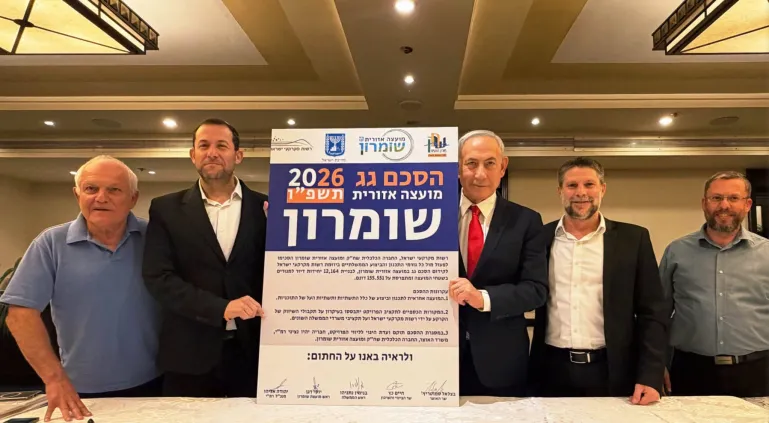
On July 13, 2026, Dagan signed a framework agreement with Netanyahu's government and the so-called “Israel Land Authority” to develop settlements under the Samaria Regional Council. The agreement included government funding commitments worth 8.5 billion shekels to prepare infrastructure for approximately 12,000 planned settlement units.
The agreement was signed in the presence of Netanyahu, Smotrich, and Housing Minister Haim Katz. It provides funding for roads, public facilities, and infrastructure networks, paving the way for faster planning and construction in existing and new settlements over the coming years.
On July 14, 2026, Peace Now, an Israeli organization opposed to settlements, warned that the agreement provided settlement construction projects with long-term financial and planning guarantees. It said the resulting contractual obligations would make it more difficult for future governments to halt the projects.
The organization also noted that, within a single year, the Israeli Occupation government had signed similar agreements with the Karnei Shomron settlement council and the “Ma'ale Adumim” municipality, bringing total government commitments to 13.5 billion shekels. The funding would facilitate faster construction and large-scale settlement expansion.
Road projects and security corridors play a central role in consolidating new settlements and linking them to one another. They also expand areas subject to military restrictions and alter movement routes between Palestinian villages and cities.
These consequences are particularly evident in the northern West Bank, where the restoration of evacuated settlements has coincided with road closures and the seizure of agricultural land.
According to an August 28, 2026, report by the UN Office for the Coordination of Humanitarian Affairs (OCHA), Israeli Occupation forces set up checkpoints and closed sections of Route 60 during the reestablishment of the “Ganim settlement.” This cut off direct access to the city of Jenin for approximately 10 Palestinian villages with a combined population of more than 20,000.
On October 28, 2026, the Israeli military issued two orders to seize 11,205 dunams of land in the Jenin governorate, according to the Palestinian Wall and Settlement Resistance Commission (PWSRC).
The seizures included 8,645 dunams of land in Deir Abu Daif for the construction of a 1,800-meter security corridor around “Ganim settlement,” and another 2,560 dunams in Qabatiya for a roughly 500-meter security road leading to “Kadim settlement.”
On November 3, 2026, the PWSRC said the military orders authorized the seizure of the land through the end of 2028 and would establish security corridors restricting Palestinian movement and access to their property.
These projects are consistent with Dagan's political vision of expanding settlements, imposing Israeli sovereignty over the West Bank, and preventing the establishment of a Palestinian state.
In April 2025, during a meeting with American evangelical leaders, he called for imposing Israeli sovereignty and encouraging Palestinian emigration, arguing that both steps were necessary to prevent another attack like the one on October 7, 2023. He has also continued to pressure Netanyahu to pursue annexation, focusing particularly on open land and areas between Palestinian communities.
This project stands in direct conflict with the advisory opinion issued by the International Court of Justice (ICJ) on July 19, 2024. The ICJ concluded that “Israel's” continued presence in the occupied Palestinian territories was unlawful, affirmed its obligation to end that presence as rapidly as possible, and called for an immediate halt to all new settlement activity and the evacuation of settlers.
As government funding continues, evacuated settlements are restored, and new sites are established, Dagan continues to push to entrench Israeli control over the northern West Bank, drawing on his influence within government institutions and the networks he has built in the United States and Europe.
Sources
- “Enormous Power”: The Hard-Hitting Investigation Into Yossi Dagan [Hebrew]
- Yossi Dagan, Head of the Samaria Regional Council [Hebrew]
- Pro-Settlement Group Becomes Likud’s Second-Largest Faction [Hebrew]https://www.c14.co.il/article/1538443
- “Deeply Concerned”: Settler Leaders Turn Up the Pressure on Netanyahu, With a “Surprise” Guest at the Meeting [Hebrew]
- Congresswoman Tenney Reintroduces 'RECOGNIZING Judea and Samaria Act' and Launches Friends of Judea and Samaria Caucus to Support Israel's Sovereignty
- Eurodeputati Pd e Avs a Metsola, 'vietare il gruppo pro-coloni all'Eurocamera'
- Government Signs Umbrella Agreement with the Samaria Regional Council, Committing NIS 8.5 Billion for Settlement Infrastructure
- The First Families Move Into the New Settlement of Shalom in Samaria [Hebrew]
- Israeli Occupation Seizes Nearly 11 Dunams of Land in Jenin for Settlement Expansion [Arabic]