1948 Palestinians: What Will They Do With ‘Israel’ After Winning 19 Knesset Seats?
The opposition fears that Netanyahu will block certification of the results altogether and obstruct the swearing-in of the Knesset.
The results of the Israeli entity’s elections, held on October 27, 2026, came as a surprise that upended the calculations of the various Zionist parties, both in the ruling coalition and in the opposition.
That is because the Palestinians of the lands occupied in 1948 who remained on their land doubled their representation in the Knesset, from 10 seats in the 2020 elections to 19 seats in the 2026 elections.
This advance shifted the balance of power, both for the extremist currents calling for the expulsion of Palestinians from “Israel” and for the so-called “moderates” in the Zionist opposition parties.
This is especially so because the Arab parties won seats at the expense of both the government and opposition blocs and have become a weighty number that could influence the formation of any future government, giving them an implicit role in determining the shape of power in “Israel.”
This development pushed the coalition of Prime Minister and war criminal Benjamin Netanyahu to raise claims of election fraud, after he had earlier warned that “Islamists” and the “Muslim Brotherhood” could win and join the opposition in forming the next government.
Netanyahu did not stop at talk of election fraud. He added claims of “foreign interference,” alleging that Qatar, and possibly Turkiye, had provided funding to bring down his alliance.
He also demanded that the Shin Bet internal security agency investigate suspicions of foreign interference in the Knesset elections, while the Mossad also entered the picture.
The aim is to inflate the scale of the suspicions and exploit them politically to challenge the election results, to obstruct the opposition’s efforts to take control of the Knesset and its speakership, and to prevent the Arab parties from allying with the opposition to form a government that would topple Netanyahu.
The New Status Quo
The occupation’s newspapers were less interested in the numbers won by the government and opposition camps than in what the “Arabs of the interior,” or “Israeli Arabs” as they are called, had achieved.
From the outset, in allowing them to take part in Knesset elections, “Israel” wanted them to be mere decoration with no influence, so that it could tell the world it is “the only democracy in the Middle East” and a civilized state that lets minorities participate.
Their representation was therefore limited in number and, at best, did not exceed half their electoral weight, even though their real electoral weight would entitle them to 21 to 22 seats.
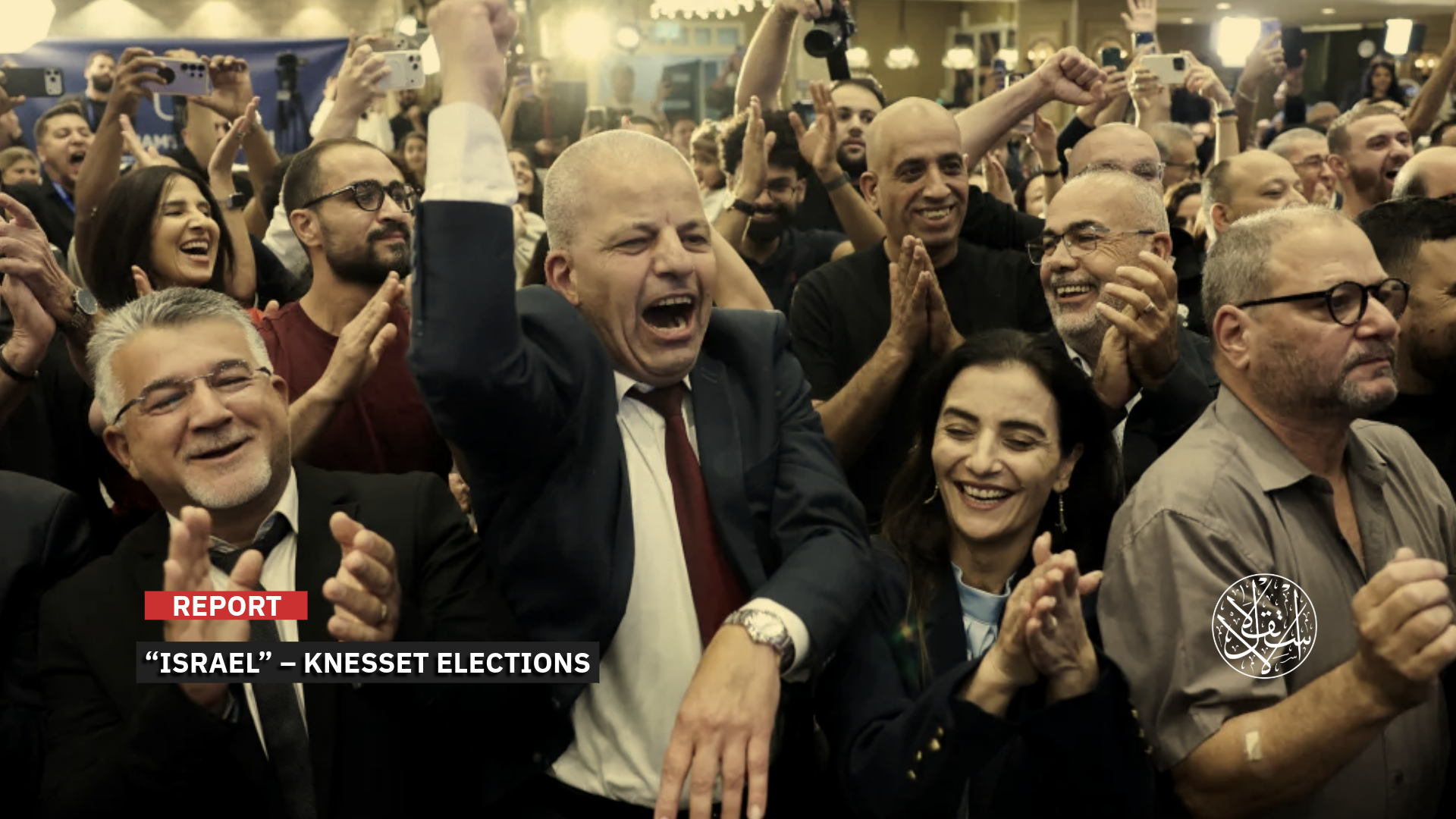
But this time, with Palestinian turnout surging after racism and calls for their expulsion from “Israel” intensified, they managed to double their seats to 19 (out of the Knesset’s 120), making them influential not only in passing laws but also in forming governments, after having long been sidelined.
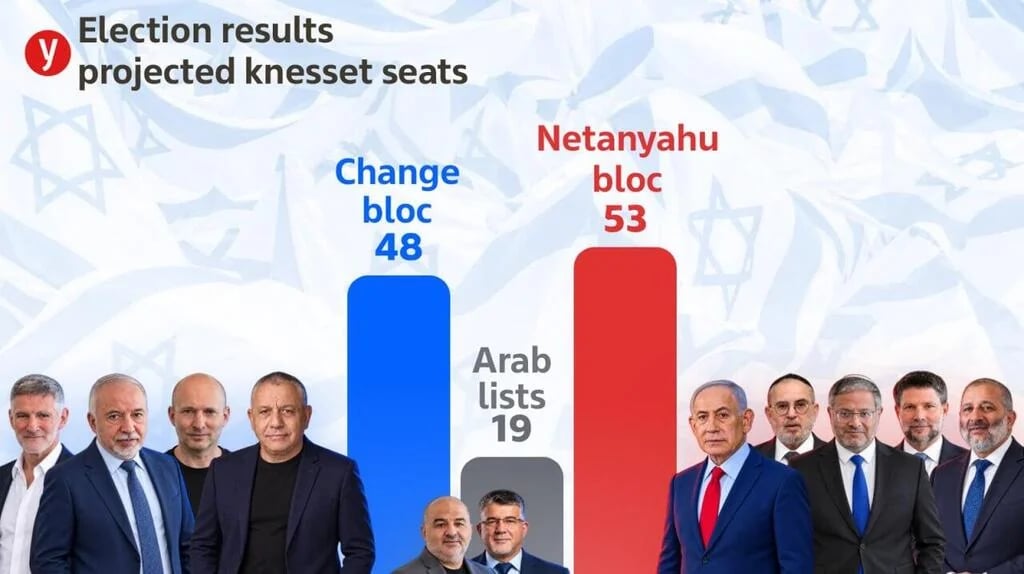
This picture and the new status quo were also shaped by the fact that Netanyahu’s Zionist coalition and bloc won only 53 seats, eight short of what it needs to form a government (61 seats), while the opposition also fell short of the decisive threshold of 61 seats, winning 48 and needing 13 more.
The matter has therefore become almost settled: the support of the Arab parties (11 seats for the Joint List and 8 for the United Arab List), a total of 19 seats, would guarantee the opposition the backing of 68 Knesset members and therefore a comfortable government.
That would hold whether the Arabs join it or, as expected, support it only from outside, in exchange for domestic gains and better living conditions in Arab towns in Palestine occupied in 1948.
These results were driven by the heavy turnout of Palestinians of the interior, which helped double the Arab parties’ seats at the expense of both the opposition and Netanyahu’s camp.
They were also driven by some voters, frustrated by Netanyahu’s failure, his corruption, and his favoritism toward the Haredim, defecting to vote for the opposition, and by a segment of Netanyahu’s Haredi allies staying home in protest at his failure to keep his promises to exempt them from military conscription.
Adding to Netanyahu’s predicament, and driven by the higher Arab turnout, is that even though the number of people who voted for him rose by 83,000, he lost 11 Knesset seats compared with the 2022 elections, according to the newspaper Yedioth Ahronoth on October 30, 2026.
The number of seats is not determined by a party’s vote count alone, but by its share of the total vote and how votes are distributed among the parties. Higher turnout, especially among Palestinians in the interior, led to a drop in Likud’s seats even though the number of people voting for it rose.
As a result, his ruling coalition bloc fell from 64 seats in 2022 to 53 in 2026, while the Arab parties’ seats rose from 10 to 19, thanks to heavy Arab turnout and to seat allocation being based on vote counts, which helped redraw the political map of “Israel.”
Netanyahu’s alliance, which includes Likud, Religious Zionism, Otzma Yehudit, United Torah Judaism and Shas, won 48.38 percent of the vote in the previous elections, a share that fell to 42.1 percent in the 2026 elections.
By contrast, the most notable gains went to the Arab parties thanks to higher Arab voter turnout. In cities such as Umm al-Fahm, where turnout in the previous elections did not exceed half of eligible voters, the number of voters rose, and the city of Sakhnin recorded the highest turnout among Arab cities in “Israel,” at 86.4 percent.
In the previous elections, the three Arab parties received about 511,000 votes. This time, the Joint List and Ra’am together won about 835,000 votes, an increase of more than 63 percent.
Dr. Matan Gutman, an expert in Israeli constitutional law, says the current coalition parties lost 14 seats, going from a parliamentary bloc of 68 seats in the last elections to a bloc of no more than 54 seats according to the unofficial results, a dramatic political change that means the current coalition has lost its parliamentary majority.
He explained that, according to the results, the bloc that was in opposition, including the Arab parties, went from controlling 52 seats to a parliamentary majority estimated at 67 seats.
He said this means that, even without forming a new government, it would be possible to replace the Knesset speaker, repeal Netanyahu’s laws interfering in the judiciary, pass a new conscription law forcing the Haredim to serve in the army, and push through special legislation to establish an official commission of inquiry into the events of October 7.
The Independent wrote on October 30, 2026, that National Security Minister Itamar Ben-Gvir was one of the main factors behind this shift and the rise of the Arab parties because of his anti-Arab rhetoric, along with worsening organized crime, rising murder rates in Arab towns and citizens’ fears that policies of discrimination and marginalization would continue.
It explained that “one of the tools of the right-wing campaign turned against its owners: Netanyahu and Ben-Gvir, who warned Jewish voters about the growing political power of Arabs, found that these fears drove large segments of Arab citizens to turn out in force.”
The Independent argues that the success of the Arab parties confronts the Israeli political system with a question it cannot ignore: If “Israel” celebrates the participation of Arab citizens in elections as proof of its democracy, can it ignore their votes as soon as the voting is over?
Redrawing the Political Landscape
The British newspaper The Guardian argued on October 29, 2026, that the big gains made by Palestinian parties in the Israeli general election pose an urgent and fundamental challenge to the country’s mainstream opposition: either cooperate with the Arabs in “Israel” or hand Benjamin Netanyahu a roadmap to political survival.
It stressed that the biggest change in the new Knesset, with the Arab parties winning 19 seats, up from 10, “redraws the battle lines on the Israeli political landscape; it will no longer be easy to sideline or ignore the Arabs in ‘Israel.’”
This is especially true after the near tie between the opposition bloc led by Eisenkot and the ruling coalition led by Netanyahu, with neither winning a majority.
Mansour Abbas’s United Arab List could now take part in forming the next government with its 8 seats, and the Joint List could support an Eisenkot government from outside with its 11 seats, allowing an opposition government to win the backing of 68 Knesset members and ending the rule of Netanyahu, the longest-serving prime minister in Israeli history at 19 years.
Although the Arab parties have accepted the conditions set by the Zionist forces that make up the opposition bloc, most of the Israeli opposition appears less enthusiastic about relying on Palestinian parties to reach power. The only exception is Yair Golan, leader of the center-left Democrats party, who has endorsed the idea of cooperating and working with the Arab parties.
Golan wrote on X, “We have no future here if we don’t stop being afraid and if we don’t put an end to racism. We can no longer accept the racial discrimination Netanyahu practices between Jewish and Arab voters.”
Many Israelis also backed an Arab-Jewish alliance and demonstrated in “Tel Aviv” and Jerusalem in support of forming a coalition that includes the Arab parties.
This prompted Ahmad Tibi, one of the leaders of the Joint List, to address the Zionist opposition parties, saying, “Netanyahu can be unseated if the opposition is brave enough.”
He said the historic Arab turnout had prevented the formation of a right-wing majority, and that if the opposition parties dared to break the boycott of the Arab parties, they could form a government, according to the newspaper Haaretz on October 28, 2026.
Speaking at a victory celebration in Nazareth, he said, “The Zionist opposition will have to choose between the path of domination and building democracy.”
The New York Times wrote on October 29, 2026, that Netanyahu tried to use fear of Arabs to win the elections in “Israel,” but did not win, so he set out to warn that Arab involvement in forming the next government would be more dangerous than his failure on the day of the Al-Aqsa Flood Operation.
It explained that the election result has put Jewish opposition leaders before an extremely difficult choice: either seeking to join him in a unity government that excludes some of his most extreme allies, or forming a governing majority in alliance with the Arab parties.
It quoted Michael J. Koplow, an analyst at the Israel Policy Forum, a New York-based think tank, as saying that Netanyahu is trying to convince Israeli voters that if they thought what happened on October 7, the most catastrophic day in Israeli history, was bad, it cannot compare with the nightmare of Arab citizens of “Israel” and their political leaders wielding influence over government, and with what could follow from the establishment of a Palestinian state in the West Bank.
Netanyahu therefore sought to portray Arab politicians such as Mansour Abbas, who took part in the government in 2021 and 2022, as enemies from within and a malignant danger to the country if they are allowed to exercise power.
He also released an AI-generated campaign ad depicting them inside a Trojan horse being dragged within the walls of an Israeli fortress to breach it and pave the way for a Palestinian state.
If the Israeli president tasks Netanyahu with forming a government, because his Likud party won the most votes, he would benefit from the 30 days to form his government even though he lacks 61 seats, and perhaps from staying in office longer if new elections are called, by igniting a war alongside Trump against Iran to improve both men’s electoral standing.
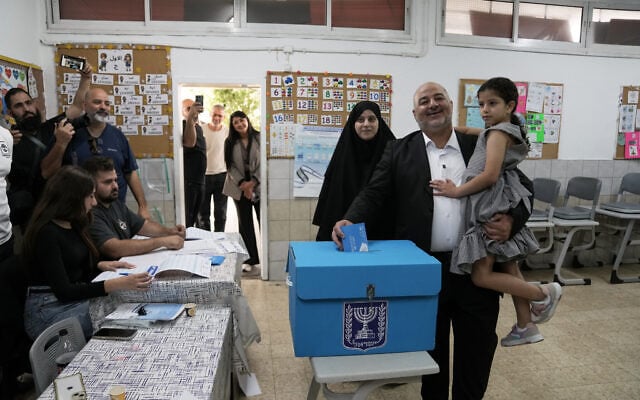
Kingmakers
Following the Arab parties’ big win, especially that of Mansour Abbas’s United Arab List, known in Hebrew as Ra’am, which split from the southern branch of the Islamic Movement, Abbas sought to win acceptance from Jewish lawmakers and the Israeli public.
Because he aspires to take part in the next Zionist opposition government, and even to obtain a ministerial portfolio, he acknowledged that “Israel” is a Jewish state and will remain so, and placed Jewish lawmaker Yoav Segalovitz second on his party’s list. Segalovitz won a Knesset seat as one of the party’s eight members.
United Arab List leader Mansour Abbas affirmed that he would accept the four conditions set by Gadi Eisenkot for a government agreement to form an alternative bloc to Netanyahu, according to Israel’s Channel 12 on October 31, 2026.
He said, “The conditions set by Gadi Eisenkot for forming the government will not be an obstacle,” although he believes the chances of forming a minority government are slim, they still exist if the change camp shows flexibility in its positions, according to the Israeli channel.
Eisenkot’s four conditions are: accepting “Israel” as a Jewish and democratic state; aligning with the values and principles set out in the Israeli Declaration of Independence; accepting that every (Israeli) citizen must perform compulsory service, whether military or civilian; and recognizing that “Hamas is a terrorist organization that must be dismantled.”
United Arab List leader Mansour Abbas revealed that his party has been contacted by politicians from both sides seeking to sound out whether it would support Netanyahu’s bloc or Eisenkot’s.
He said, “Everyone is talking to us, not only the change bloc,” referring to Netanyahu’s bloc opening negotiations with him, as happened in 2020. At that time, however, he chose the opposition and brought down Netanyahu’s government, becoming the first independent Arab party to join an Israeli governing coalition.
The larger of the two Arab parties is the Joint List, an alliance of three smaller parties that is more committed to Arab nationalism and more hostile to Zionism. Its leader, Yousef Jabareen, said he was ready to cooperate to bring down Netanyahu’s government and to provide cover inside the Knesset for an opposition government.
But Arab participation in an opposition government, or providing it with political support to win the right to form a government, has become fraught with risk given the refusal of Yisrael Beitenu leader Avigdor Lieberman to let Arabs join an alternative government to Netanyahu. He said he would not take part in a government that relies on politicians he describes as “supporters of terrorism.”
Lieberman won 7 Knesset seats, which are counted among the 48 seats won by the opposition bloc. If he withdrew from the alliance because it relied on the Arab parties, Eisenkot’s bloc would shrink to only 41 seats.
If the United Arab List joined it with its 8 seats, the total without Liberman would be 49 seats, not enough to reach the 61 seats needed to form a government. If the other Arab party, the Joint List, with its 11 seats, also backed it, the total would rise to only 60 seats, still not enough for a majority for an alternative government to Netanyahu.
The risks of efforts to neutralize the impact of the Arab vote and undo the effects of its 19 seats grew with the disclosure of American attempts to bring together the Zionist parties in government and opposition in a governing coalition that excludes Ben-Gvir.
Haaretz writer Yehoshua Meiri-Lichter wrote that leaks point to a move led by Trump to form an Israeli unity government bringing together Netanyahu and Naftali Bennett, with Netanyahu remaining prime minister.
He explained that the Jewish American billionaire Miriam Adelson, who is close to Trump, intervened in this deal and persuaded Bennett to take the defense portfolio and the post of deputy prime minister and to drop his demand for a rotation of the premiership, with Yair Lapid taking the foreign ministry.
However, this option runs up against the positions of party leaders who have pledged not to join a government led by Netanyahu. Gadi Eisenkot has said he will not sit with him in the same government, and Naftali Bennett and Avigdor Lieberman have taken the same position.
The Times of Israel wrote on October 28, 2026, that the elections have highlighted the Arab parties “as potential kingmakers, presenting the Zionist opposition with a fateful choice.”
It said that opposition leaders’ refusal to rely on the Arab parties could force new elections or a national unity government, either of which would keep Prime Minister Netanyahu in power “not because his opponents lack the numbers to replace him, but because some of them refuse to recognize Arabs as legitimate political partners.”
It predicted that Eisenkot and several of his potential coalition partners would have to back down from their pledges not to rely on Arab lawmakers to form a government, because without the Arab parties’ support the Zionist opposition cannot secure a parliamentary majority, and the alternative would be continued rule by Netanyahu’s government.

The Shin Bet and Mossad Step In
As soon as Prime Minister Benjamin Netanyahu accused the Arab parties on October 28, 2026, of “stealing” the Israeli elections and demanded that the authorities investigate alleged irregularities at polling stations, to obstruct the announcement of the results, the Shin Bet and then the Mossad stepped in.
In a video, Netanyahu addressed Likud voters, claiming, “This is an urgent call because they are trying to steal the election from us,” in reference to the mobilization of Arab citizens in the occupied Palestinian territories (present-day “Israel”).
Netanyahu’s Likud party also accused the Arab parties of “stealing the election,” claiming it had hundreds of pieces of evidence of bribery, fraud, intimidation and ballot box irregularities, and demanded that the police and the Shin Bet investigate.
The chairman of the Israeli Central Elections Committee, Justice Noam Sohlberg, responded to Netanyahu’s claims and instructed David Zini, head of the Israeli General Security Service (Shin Bet), to use the agency’s powers to verify these allegations and gather the evidence needed to prove or disprove them.
The investigations focus on suspicions of money flowing from foreign entities, which are suspected to possibly include Qatar and Turkiye, to influence Arab voter turnout in the Israeli elections, according to The Jerusalem Post on October 30, 2026.
The Mossad joined the Shin Bet in investigating claims of Qatari interference to influence the Israeli elections, as the right escalated its demands to annul the results and rerun the vote, even though the elections committee ruled out changing the vote count, according to Israel’s Channel 12 on October 31, 2026.
But the occupation’s newspapers confirmed on October 31, 2026, that the Shin Bet and Mossad investigation had not established any fraud in the vote count or tampering with ballot boxes, or anything that would warrant annulling the results.
The investigations have therefore focused instead on claims of external influence and suspicions of foreign interference and funding aimed at influencing voters, amid official denials from Qatar and Turkiye.
The Israeli Central Elections Committee had already affirmed that the elections were conducted lawfully and that there was no evidence of systematic irregularities affecting the integrity of the voting process or its results.
The Israeli police said that election day saw a very limited number of irregularities, with no intelligence or investigative evidence supporting claims that the election was “stolen,” as Netanyahu said, according to The Times of Israel on October 29.
The occupation police had arrested three Bedouin men from the Negev on election day, accusing them of planning to offer people money in exchange for voting for the Arab United Arab List party, but released them for lack of sufficient evidence.
Israeli media outlets claimed that the security services had intercepted envelopes containing large sums of cash attached to ballot slips supporting the United Arab List (Mansour Abbas’s party), and that the link between this step and foreign funding from Qatar to raise Arab turnout in the Knesset elections was being examined.
In a statement from his office on October 29, 2026, Mansour Abbas affirmed that the United Arab List had nothing to do with the allegations of election fraud and receiving money from a foreign party, welcoming the investigations and declaring his readiness to cooperate with the authorities to uncover the truth.
Joint List leader Yousef Jabareen accused Netanyahu of incitement against Arabs, saying, “Netanyahu was defeated at the ballot box, but he refuses to accept the fact that the Arab people voted and decided.”
On October 29, 2026, Haaretz military analyst Amos Harel described Netanyahu’s claims as closer to “an influence maneuver cooked up hastily and in a panic, inflated and sewn with thick threads,” describing what is happening as a plot to disrupt the announcement of the election results more than it points to external Qatari interference in them.
Yashar party leader Gadi Eisenkot also accused Prime Minister Netanyahu of leading an influence campaign aimed at delaying the publication of the official Knesset election results on schedule.
The Guardian wrote on October 28, 2026, that Netanyahu is accused of smearing Arab voters to stay in power, noting that he claims Israeli Arab parties used foreign support to steal the elections in which his coalition lost its majority.
Qatar denied the Israeli accusations of interference in the elections, describing what is happening as a disinformation campaign aimed at dragging its name into Israeli domestic political wrangling and reflecting an excessive obsession with Qatar in some Israeli circles.
The American outlet Axios described what Netanyahu did after losing his majority on October 29, 2026, as “trying to demonize and delegitimize the election results” because he lost the chance to form a new government.
It said, “After his far-right coalition lost 11 seats in the election, Israeli Prime Minister Benjamin Netanyahu is trying to discredit the results by claiming there was mass voting fraud in Arab communities.”
It explained that Netanyahu is trying to scare the opposition bloc and prevent it from cooperating with the Arab parties to form a new government, but the opposition fears he has a more dangerous goal: to block certification of the results altogether, obstruct the swearing-in of the Knesset, and avoid losing his majority.
Sources
- How Netanyahu’s Bloc Gained 83,000 Votes but Lost 11 Knesset Seats
- Rise of Palestinian Parties in Knesset Will Redraw Israel’s Political Landscape
- How Netanyahu Used Fear, Again, to Win More Votes Than Anyone Else
- After Losing His Majority, Netanyahu Tries to Delegitimize Election Results
- Election Panel Director Rejects Claims of Widespread Voter Fraud; Shin Bet: Foreign Interference Probe Is ‘Limited’
- Mossad Joins Shin Bet Probe into Alleged Qatar Election Interference
- Arab Parties Emerge as Potential Kingmakers, Presenting Zionist Opposition with Fateful Choice