The French Language Complex: Why Do Ministers in Morocco’s El Mansouri Government Disregard the Arabic Language?
This party has lost its direction and has no remaining vision or project for our language and identity.
Although French colonial rule has ended in several African countries, the French language has remained dominant over local national languages, including in Morocco, prompting calls to turn the page and restore Arabic’s place in official institutional communication.
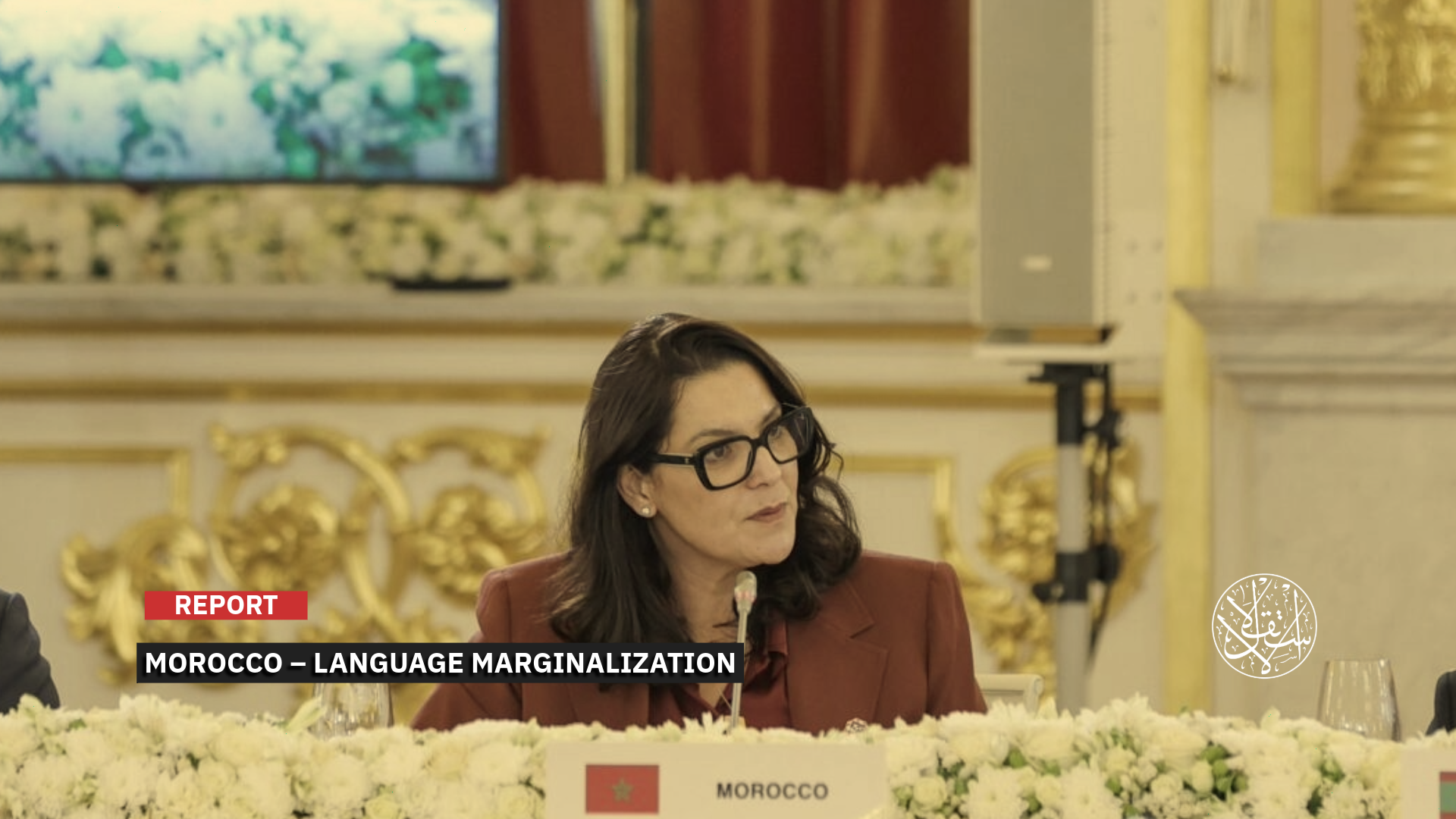
The handover ceremonies between members of the new government, led by Fatima Ezzahra El Mansouri, and those of her predecessor, Aziz Akhannouch, reignited the debate after several ministers spoke in French rather than the kingdom’s constitutional language, Arabic.
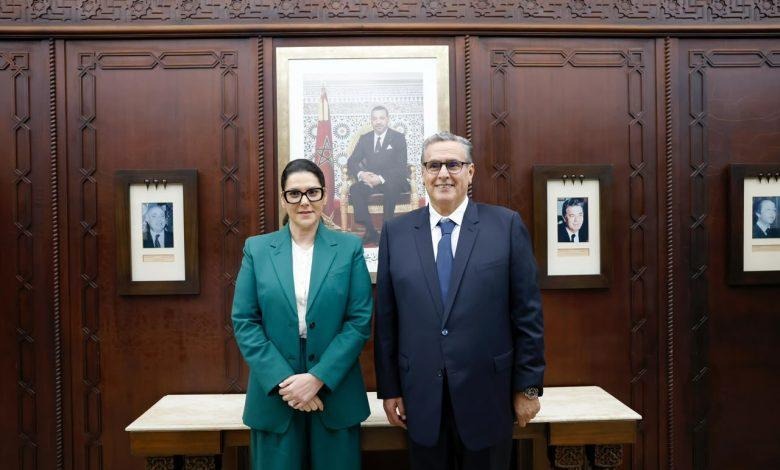
Moroccan citizens watched video clips showing Prime Minister Fatima Ezzahra El Mansouri speaking French during her meeting with Akhannouch on Saturday, October 17, 2026, at the Head of Government’s Office in Rabat.
‘We Are Not a French Country’
In this regard, the Tanger Times website reported that the use of French by both the outgoing and incoming heads of government constituted a flagrant violation of the kingdom’s constitution and a grave insult to the Moroccan people.
In a post on its Facebook account, the website added, “We are not a French country,” noting that “the constitution stipulates that Arabic is an official language, alongside Amazigh.”
Fouad Bouali, head of the National Coalition for the Arabic Language, criticized the use of French during the handover ceremony between the outgoing health minister and his successor.
According to a report published by the Justice and Development website on October 19, Bouali said, “What we heard was not the French health minister speaking, nor part of a press conference by the mayor of Brussels, nor the governor of the city of Bordeaux addressing journalists.”
He continued, “Rather, it was Younes Bjiou, Morocco’s new Minister of Health and Social Protection, delivering a speech in French during the ceremony marking the transfer of authority from his predecessor.”
He went on to ask, “Please tell us, was he taking over the ministry, or was he also acquiring French citizenship?”
He stressed that “the position is Moroccan, the ministry is Moroccan, the problems are Moroccan, and the citizen is Moroccan… Only the speech carries a Schengen visa.”
Political activist Mohamed Amahajour also described the situation as a reminder of the French language complex, or what happens when the foreigner leaves but leaves his shackles behind.
In a post on Facebook dated October 17, Amahajour added, “I imagine a handover ceremony between two French ministers, with both of them addressing each other and everyone in attendance in German. You can imagine such a scene taking place in Spain, England, Japan, China, or any of the Western countries.”
He continued, “Before food and energy sovereignty, and everything that comes with them, there is a form of sovereignty that requires no plan, policy, or budget. It only requires a tongue that turns from right to left…”
Activist Abidallah Fouad argued that the minister’s decision to deliver his first official public remarks in French reflects an explicit crisis of communicative and symbolic legitimacy.
In a post on Facebook, Fouad added, “How can a sector that is the backbone of the social state be run in a foreign language that creates a barrier between the administration and citizens, while preventing direct communication with the pulse of the street?”
The activist argued that resorting to a foreign language from the very first statement undermines the political awareness expected of the majority and reveals a lack of even the most basic tools of political communication needed to mobilize people and rebuild trust.
In response to this trend and in an effort to understand its cost to Morocco and the wider region, civil society advocate Ahmed al-Qari, who focuses on the Arabic language, called for cooperation among specialists and researchers to conduct studies examining the cost of francization in the Maghreb countries.
In a Facebook post dated October 21, al-Qari added, “The work could be divided into sector-specific studies in each country, beginning with an examination of the cost of introducing French into the work of the Ministry of Finance and its agencies, despite their partial obligation to use Arabic due to legal requirements and the fact that both the legislative and judicial branches operate exclusively in Arabic.”
The civil society advocate stressed that the use of Arabic within the ministry demonstrates that moving away from French is possible, but that the historical stubbornness of those who favor French stands in the way of making that decision.
Tribal Structuring
Mohammed Kafil, Secretary-General of the Renaissance and Virtue Party, stressed that the new Moroccan health minister’s use of French during his first media appearance was not merely an incidental detail, but an opportunity to raise a deeper question beyond language itself: Who holds the decision-making power when the elites running the state remain captive to a cultural and economic system shaped beyond its borders?
In an opinion article published by the local website Mawtini News on October 18, Kafil explained that a review of the academic and professional backgrounds of several government members reveals a notable presence of French education and training in their resumes.
He noted that among the names whose backgrounds deserve closer examination are Younes Bjijou, Abdelouafi Laftit, Nizar Baraka, Nabil Benabdallah, Mohamed Mehdi Bensaid, Azzedine El Midaoui, Ahmed Rahhou, Jalal Charaf, Samir Belfkih, and Fatima Ezzahra El Mansouri.
Kafil pointed out that studying in France does not, in itself, imply political or economic dependence. However, the concentration of such backgrounds within the circles that manage public affairs raises necessary questions about the nature of the elites shaping decisions, the intellectual frameworks they rely on, and the national education system's ability to produce independent alternatives.
For this reason, the party's secretary-general continued, “I do not believe it reflects political naivety to ask whether this pattern is merely a coincidence or whether it points to the continued influence of a system that extends beyond education to the shaping of economic and cultural policy.”
Kafil noted that military colonialism has ended, but the raising of a flag alone cannot measure independence. Rather, it must be measured by the extent to which a state controls its economic decisions, achieves cultural independence, and develops the ability to think in its own language without borrowing the legitimacy of knowledge or the tools of modernization from abroad.
“This is where one of Morocco’s most complex contradictions lies,” the writer said. “It is a politically independent state that continues to grant French a status beyond its function as a foreign language, to the point where it has become, across broad sectors, a gateway to influence, privilege, and decision-making.”
He stressed that the problem now is that French has become an unwritten requirement for access to positions of power, while French education is treated as an implicit benchmark of competence, pushing the national language to the margins of administration, the economy, and knowledge production.
Kafil affirmed that “countries do not prosper by borrowing another people's language, but by building their science, institutions, and economies in their own language, while engaging with the world as equals rather than from a position of dependence.”
He warned that cultural independence and liberation from intellectual dependence are essential conditions for genuine freedom.
Accordingly, the party's secretary-general argued that independence that does not translate into linguistic, intellectual, and economic independence remains incomplete.
He warned that Morocco needs to reclaim control over its decisions from all unequal relationships, restore the standing of its national languages, and review its agreements and interests on the basis of transparency and mutual benefit.
Ideological Calculations
Commenting on the issue, writer and academic researcher Driss El-Ganbouri said that the Academy of the Arabic Language, which was mentioned in a royal speech, has remained forgotten in a drawer for a quarter of a century.
In a Facebook post dated October 20, El-Ganbouri added that the National Council for Moroccan Languages and Culture, provided for in the 2011 Constitution, has yet to see the light of day, 15 years after it was stipulated, much like the principle of linking responsibility to accountability.
The writer believes that this delay is part of an ideological struggle against the Arabic language, arguing that the status of Arabic in Morocco is determined by political and ideological power balances rather than national cultural standards.
El-Ganbouri stressed that the silence surrounding the language reveals the existence of a conspiracy against it. He explained that some hardline opponents of Arabic associate it with Islamic identity, while others link it to Islamists and view its marginalization as part of an effort to target that identity.
The academic researcher warned that when this issue is considered alongside the debate over the Family Code and efforts to undermine its religious provisions, it becomes clear that Arabic is not merely a language, but a civilizational heritage that is being targeted.
El-Ganbouri also referred to a previous statement by Nabil Benabdallah, who was appointed Minister of National Education in the Mansouri government.
A year earlier, Benabdallah had said that terms in the Family Code, such as mahr (dowry), iddah (the waiting period following divorce or a husband's death), and talaq ba'in (irrevocable divorce), among others, should be renewed or modernized to make them more contemporary. This, al-Kanbouri argued, demonstrates that Arabic is present in all issues relating to Islam in Morocco and is not merely a tool of communication, but a vessel for Islam.
El-Ganbouri concluded by stressing that Morocco’s Islamic identity is under threat, and that its plight lies in the large number and diversity of its adversaries, ranging from radical Amazigh activists and Francophones to Zionists, advocates of the Moroccan vernacular, those who manipulate Quranic verses, proponents of religious reform, and Quranists.
Political Analysis
Linguist Abd al-Ali al-Wadghiri said that Article 5 of the 2011 Constitution clearly addresses the Arabic language, its promotion, development, and protection. It states, “The state shall work to protect and develop it and expand its use.”
In remarks to Al-Estiklal, al-Wadghiri said that Prime Minister Fatima Ezzahra El Mansouri’s presentation of her government’s program before Parliament on Monday, October 19, 2026, completely ignored this constitutional provision.
He therefore questioned why successive governments have skipped over this important constitutional clause, as though it were not part of the Constitution.
He went on to say that, despite this neglect, these governments make every possible effort to entrench the presence of a foreign language through education, the media, public administration, and other sectors, even though its status is not constitutionally recognized. They also work to expand its reach and impose its dominance by every means available, and even beyond what is feasible.
Al-Wadghiri called on the government to consider, at the very least, implementing the law published in the Official Gazette in 2003, which provides for the establishment of the Mohammed VI Academy of the Arabic Language.
He urged the government to revive the law and release it from the constraints of a freeze that has lasted 23 years, without any excuse or explanation for this unjustified suspension. It is as though the state has the right to enact laws whenever it wishes, only to subsequently bury and suspend them whenever it chooses.
He stressed that the government is obliged to provide the Arabic language with both financial and moral support and to dedicate a clear section of its program to promoting it, in implementation of the relevant constitutional provisions.
In this regard, al-Wadghiri asked what project the Istiqlal Party had presented to the government, in which it holds the largest share of ministerial portfolios, to improve the status of Arabic, protect it, promote its use, and develop it. He noted that the party had built its entire history of genuine political struggle on defending the Arabic language and Islamic culture.
He went on to ask, “Or has this party lost its direction and run out of any projects concerning our language and identity? Has its leadership abandoned the principles of the party and its founder, and sold the legacy of its pioneering leaders for a pittance, no more than a handful of ministerial seats in a government that can neither act nor make its influence felt?”
He concluded that “the current government’s members, particularly the leadership of the Istiqlal Party, seem to be echoing what we have increasingly heard from some of the foolish among our own people, who say, ‘Arabic has exhausted its entitlement and no longer needs either financial or moral support.’”
A Call to the Community
Given the link between the problem of francization and the dominance of French in the public sphere, on the one hand, and education, on the other, the Unity and Reform Movement had previously warned of tangible setbacks in the status of the Arabic language in school curricula and educational programs for the 2026–2027 academic year.
In a statement published on its official website on October 3, 2026, the movement said these setbacks were reflected in the marginalization of the nation’s civilizational identity and values, the exclusion of broad educational issues such as the Palestinian cause, and the reduced role of Arabic in teaching scientific subjects.
The movement stressed that this trajectory runs counter to constitutional provisions and the national frameworks for educational reform, which recognize Arabic as a primary language of instruction. It also criticized the continued absence of a positive educational framework for language alternation.
The same source explained that the current school curriculum suffers from a lack of coherence in its value system and marginalizes Morocco’s historical and civilizational standing within the Islamic nation.
It added that the issue of Palestine, holy Jerusalem, and the blessed Al-Aqsa Mosque is almost entirely absent, despite being central to the concerns of the Moroccan people and the wider Muslim nation.
Regarding languages of instruction, the movement criticized the continued imposition of foreign-language instruction for scientific subjects without taking into account the need to provide balanced training in, and ensure the widespread use of, the two official languages, Arabic and Amazigh. It also warned that this was deepening linguistic confusion at both the secondary and higher education levels.
The movement called for greater efforts to educate younger generations in accordance with shared Moroccan values and to instill pride in their Islamic and civilizational identity.
It also urged the authorities to restore the standing of the two official languages, particularly by adopting Arabic as the primary language of instruction for all school subjects, following the example of countries with advanced education systems.
It further called for the implementation of language alternation in a coherent educational sense, in order to end the linguistic exclusion currently taking place.
Sources
- The “French Language Complex”: Criticism of Ministers for Speaking a Language Other Than the Constitutionally Recognized One During Handover Ceremonies [Arabic]
- A Moroccan Government Speaking Fluent French [Arabic]
- “Unity and Reform Movement” Warns of the Erosion of Identity Values and the Marginalization of Arabic in School Curricula [Arabic]