Tunisia’s Opposition Aligns with International Criticism of Kais Saied’s Regime: What Comes Next?
Tunisia has become one vast prison.
Human rights activists around the world continue to raise their voices, calling for an end to the arbitrary arrests of opponents of Tunisian President Kais Saied and demanding an end to what they describe as the use of the judiciary as a tool of political retaliation.
In this context, Nathalie Tehio, president of the French Human Rights League, expressed her solidarity with Ahmed Nejib Chebbi, head of Tunisia’s National Salvation Front, praising his stance in defending freedoms in Tunisia.
In a brief statement published by the organization on Facebook on October 10, 2026, Tehio called for the release of Chebbi and all political prisoners and prisoners of conscience, whom she said were raising their voices against the repressive and freedom-undermining regime of President Kais Saied.
The statement came as the Geneva-based Association of Torture Victims launched an international appeal calling for the release of Chebbi, Ennahda Movement leader Rached Ghannouchi, and other political prisoners in Tunisia.
Chebbi is serving a 12-year prison sentence on charges related to conspiring against the internal and external security of the state, attempting to change the structure of the state, and overthrowing the system of government.
Ghannouchi, meanwhile, has received multiple sentences, including life imprisonment, in cases that his lawyers maintain are fabricated and unsupported by any evidence.
Since Kais Saied came to power in 2019, and particularly after he dissolved Parliament and dismissed the government before consolidating power on July 25, 2021, Tunisia has witnessed a sweeping campaign targeting voices opposed to or critical of the country's new political trajectory.
A Comprehensive Crisis
Amid these calls, the National Salvation Front, headed by Chebbi, stressed that Tunisia is experiencing a deep, multidimensional national crisis, in which the political and institutional crisis intersects with economic and social deterioration, escalating violations of rights and freedoms, and a lack of prospects for broad segments of Tunisian society.
In a statement dated October 11, 2026, the Front emphasized that the crisis is no longer limited to the failure of public policies or the authorities' inability to respond to citizens' demands.
Rather, it has come to threaten the foundations of the republican state, the conditions for a dignified life, and the terms of the social contract between the state and society.
The Front warned that the current crisis is a crisis of governance and the institutional system, not merely one of performance or communication.
Overcoming it, it said, requires ending the concentration of power and one-man rule, restoring respect for judicial independence, freedom of the press, and political and civil activity, as well as ensuring a balance of power and accountability.
It called for the release of all political prisoners and prisoners of conscience, as well as everyone deprived of their liberty because of their peaceful activities or opposition views.
It also demanded an end to politically motivated prosecutions, guarantees of fair trials and prisoners' rights, and that the authorities be held responsible for prisoners' physical and psychological well-being, particularly those on hunger strikes.
The Front also declared its support for the independence of constitutional institutions and independent bodies, as well as local governance and decentralization.
It rejected all legislation and measures that would place these institutions under the control of the executive branch or undermine the gains made in public participation, oversight, and accountability.
The statement called on all democratic political, civil, trade union, human rights, and social forces to unite their efforts and coordinate initiatives and actions around the common goals of resisting authoritarianism and defending freedoms and economic and social rights.
It urged them to respect ideological and political differences while setting aside disputes that could be postponed, provided they did not concern fundamental democratic principles or obstruct joint action.
The Front concluded that there can be no way out of the crisis by entrenching exclusion, no economic recovery amid political deadlock, and no lasting stability without freedoms, justice, and accountability.
It added that what Tunisia needs today is not further concentration of power, but the restoration of state institutions, the recovery of society's rights, and the people's right to determine their own destiny.
Street Mobilization
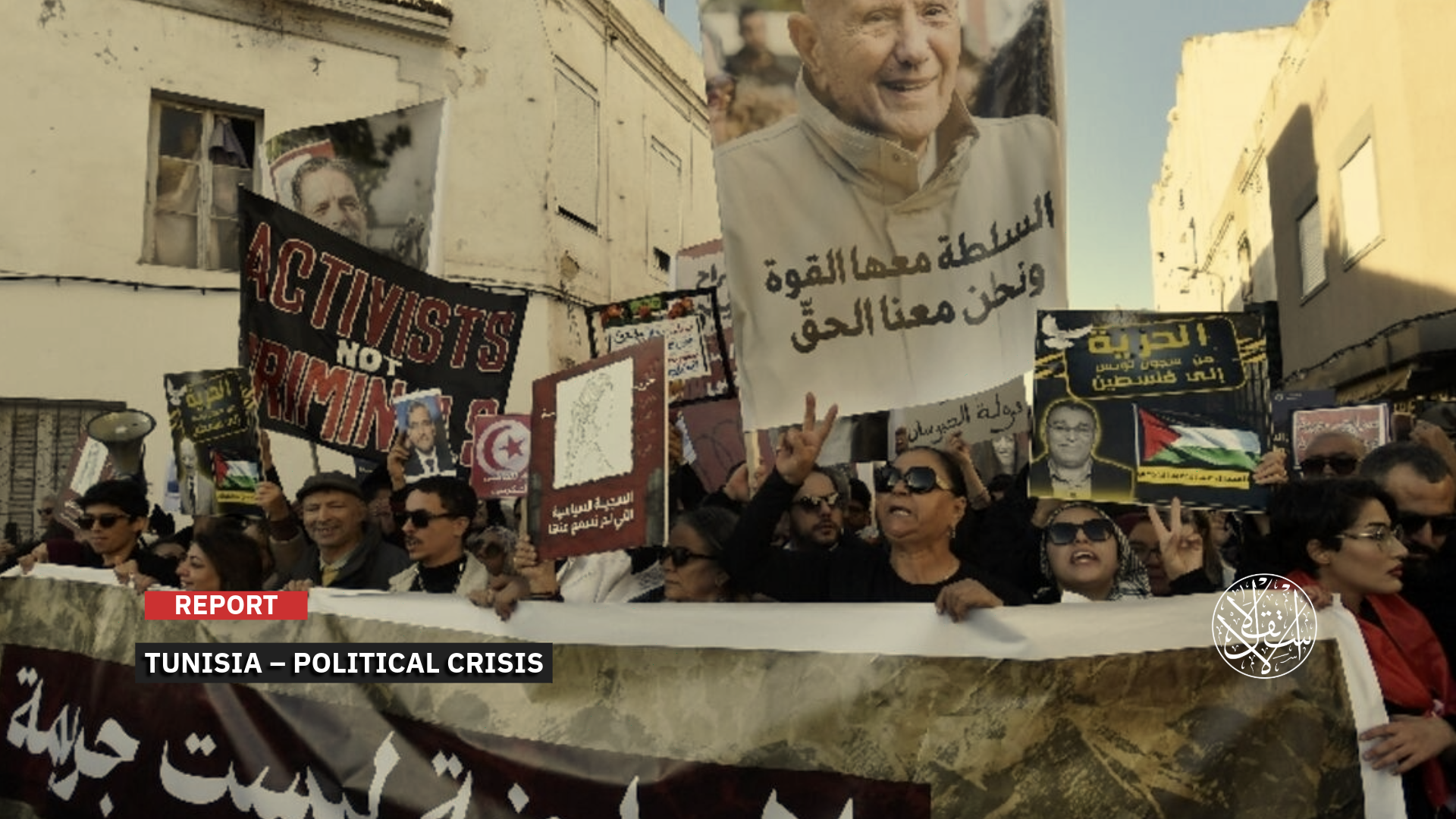
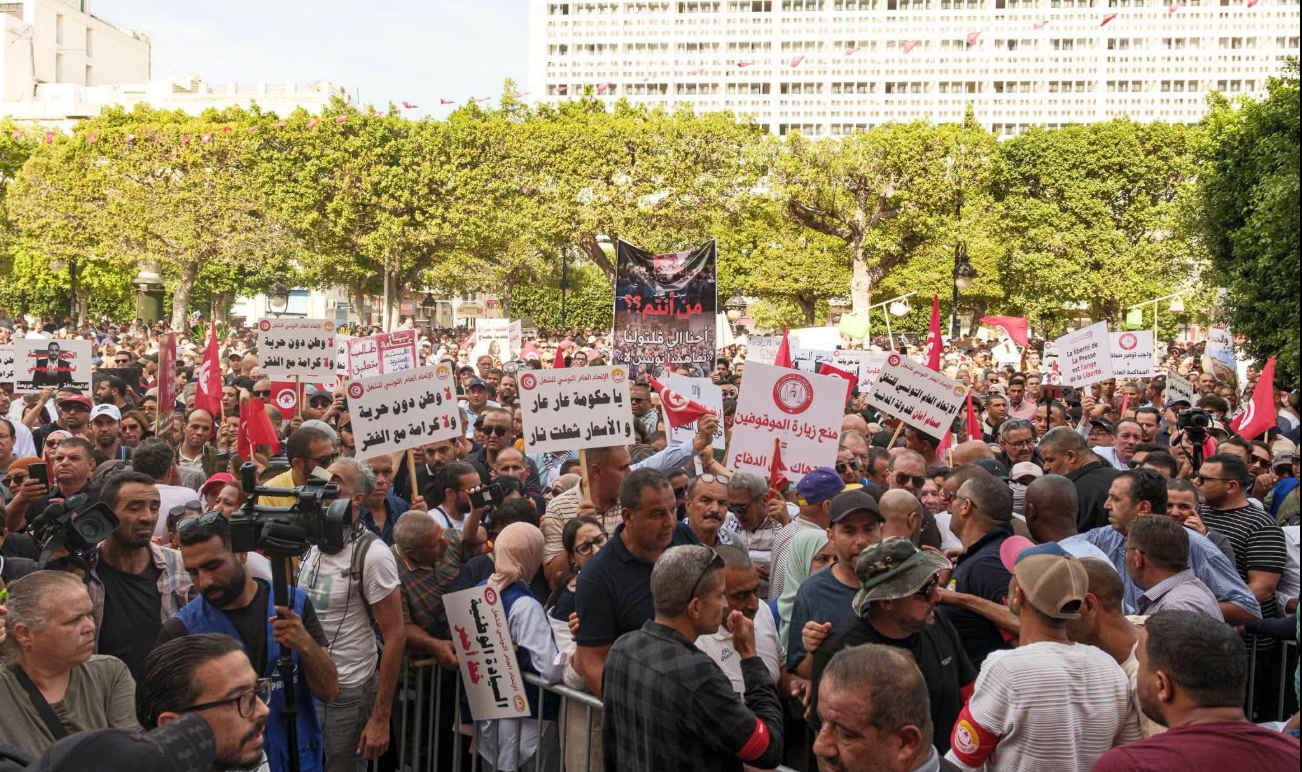
On the ground, thousands of people took to the streets of the Tunisian capital on Saturday, October 17, 2026, in a mass demonstration calling for the restoration of democracy and freedoms.
The protest reflected growing public anger over President Kais Saied's policies, amid accusations that he was imposing authoritarian rule and failing to address the worsening economic crisis.
The demonstration, which brought together the Tunisian General Labor Union (UGTT), the National Salvation Front, the Ennahda Movement, and several civil society organizations, including the Tunisian Human Rights League, the National Bar Association, and the National Union of Tunisian Journalists, was the largest of its kind in years.
It posed a significant challenge to Saied after years of divisions had weakened the opposition's ability to mobilize supporters.
Demonstrators gathered in Mohamed Ali Square, a stronghold of the UGTT, before marching through the capital's streets toward Habib Bourguiba Avenue, a focal point of the protests that sparked the Arab Spring 15 years ago.
The protest was held under the slogan ‘Tunisia First… The People Above All Considerations’. Demonstrators waved Tunisian flags and chanted demands for greater freedoms, judicial independence, an end to the prosecution of opposition figures, and an end to violations of trade union rights.
They also carried banners and chanted slogans expressing growing frustration over widespread unemployment, poor public services, and what they described as false promises.
Protests Against Authoritarianism
In this regard, Tunisian politician Riadh Chaibi said the march marked a new chapter in the struggle against what he described as the coup, as thousands of Tunisians from across the ideological and political spectrum took to the streets to demand change and reaffirm their commitment to freedom, national dignity, and the restoration of democracy.
In a Facebook post, Chaibi stressed that since the July 25, 2021, coup, demonstrations and protest movements rejecting authoritarianism and calling for a return to the democratic process had continued despite repression and restrictions.
He emphasized that the dozens of politicians languishing in prison, the hundreds of young people and bloggers facing prosecutions and prison sentences, and the journalists, trade unionists, and activists paying the price for defending freedom of expression and public engagement must not be forgotten.
He also pointed to businesspeople who have been targeted by legal cases and prosecutions that raise serious concerns about the use of the judiciary and the confiscation of property.
“All of these people are not merely names on lists of detainees and those facing prosecution; they are the faces of a national struggle for freedom, justice, and the rule of law,” he added.
“Today is therefore not just another date on the protest calendar; it is an opportunity to open a new chapter in the resistance to authoritarianism and to build a shared Tunisian hope,” Chaibi continued.
He argued that “change is not brought about by slogans alone, but by sustained popular determination and national forces that learn from their disagreements and recognize that their differences should not obscure the fact that freedom is everyone's right, and that Tunisia is too great to be reduced to a government or a single individual.”
He concluded, “Today marks the beginning of a new chapter in the struggle against the coup. Let us make it the starting point for broader unity, more effective activism, and a democratic horizon in which Tunisians reclaim their right to freedom, dignity, and self-determination.”
In the same context, former Foreign Minister Rafik Abdessalem said Saturday's march had achieved almost all of its objectives, describing it as the beginning of further struggles aimed at uniting the public sphere in opposition to populist authoritarianism and safeguarding the minimum democratic standards.
In a Facebook post, Abdessalem stressed that these protest movements did not belong to any particular political or trade union front, but rather represented a joint grassroots struggle. He called for unity against dictatorship.
Confronting the Coup
Amid these developments, political activist Zied El Hechmi told Al-Estiklal that participating in all forms of opposition to the regime led by Kais Saied, which he described as a coup regime, was a necessity and a duty rather than a matter of personal choice.
He added that Tunisian citizens were not enjoying such comfortable living conditions or such a degree of freedom that they could afford to see no reason to take to the streets and protest. In this regard, he pointed to the existence of more than 33,000 prisoners, not including prisoners of conscience and political opponents, who face various forms of mistreatment and inhumane detention conditions that violate fundamental rights.
He went on to describe Tunisia as having become one vast prison, citing the Italian interior minister's acknowledgment that the number of migrants arriving in Italy from Tunisia had fallen by 82 percent.
El Hechmi further argued that millions of dinars were being wasted in public administration without generating any returns, attributing this to the mismanagement he said characterized the performance of what he called Saied's coup rule. He said these were all objective reasons justifying protests, resistance, and the expression of public dissent.
He also referred to statements by members of Parliament aligned with Saied, who reportedly said that citizens should expect even worse conditions in 2027. Nevertheless, he noted the lack of public response to what he described as unacceptable remarks that amounted to an explicit declaration that pressure on the Tunisian people would continue and intensify.
Regarding the divisions and disagreements among Tunisia's political opposition groups, El Hechmi stressed that attention should not focus on the ideological affiliations of those calling for protests and demonstrations. The national front, he argued, must be stronger than those advocating division and fragmentation.
He concluded that the national duty today was to continue resisting what he called the “tsunami of the coup” and its grave consequences for Tunisia, its state, people, and institutions.
In a related development, Tunisian writer Abdelbaki Khalifa argued that the postponement of opposition meetings and the failure to achieve unity between 2021 and 2026 had amounted to far more than a waste of time in political circles. Rather, he said, they had caused irreparable strategic and structural losses, inflicting economic, social, and institutional damage on the Tunisian state.
In an analytical article published by Al-Thakira on October 19, Khalifa stressed that the absence of a unified opposition front and a civil society capable of speaking with a decisive voice had allowed the authorities to monopolize financial and economic decision-making entirely.
He added that this had contributed to mounting public debt, a deteriorating credit rating, the dismantling of the production and subsidy systems, rising prices, and concerns over the austerity measures anticipated in the 2027 budget.
Khalifa continued, “Tunisia also lost its pluralistic constitutional framework: the consensual 2014 Constitution was repealed, Parliament was dissolved, the Supreme Council of the Judiciary was dismantled, and the judiciary was brought under control, depriving the state of the principle of separation of powers.”
He argued that “the real challenge facing the opposition gathering is whether these forces can transform temporary unity on the ground into a tangible strategic political and economic alternative focused on the battle for development, as Germany and Spain did in the past.”
Khalifa concluded that the October 17, 2026, march was an explicit declaration of the end of the period of unchecked political dominance and a sign that the opposition was regaining its lost direction. He argued that such a development, had it occurred in the fall of 2021, could have spared Tunisia years of suffocating hardship and institutional and economic deterioration.
A Zero-Sum Record
In numercal terms, I WATCH, an organization specializing in evaluating public authorities' performance and combating corruption, said that President Kais Saied's record after seven years in power was negative, as he had failed to fulfill 81 percent of his promises.
In a detailed report published in August 2026 under the title ‘Saied Meter’, the organization said its assessment covered 91 promises made by the Tunisian president since he came to power in 2019, of which only 19 percent had been fulfilled.
Among the most significant developments during Saied's presidency, according to the report, was a setback in the democratic process, particularly regarding the right to run in the 2024 presidential election, in which Saied won a second term with more than 90 percent of the vote.
The report noted that the election was marred by the obstruction of candidacies and the arrest of candidates accused of committing electoral offenses.
According to the same report, Saied also failed to strengthen judicial independence, reform public administration, establish a constitutional court, or tackle the rising cost of living, soaring prices, monopolistic practices, and environmental pollution.
Overall, the Saied Meter report's findings showed that 52 percent of the promises remained unfulfilled, while 19 percent had been fulfilled and 7 percent were still in progress. In addition, Saied had done the opposite of what he had promised in 20 percent of the cases.