The UAE and 'Israel': An Alliance That Transcends Crises—From Security to Politics
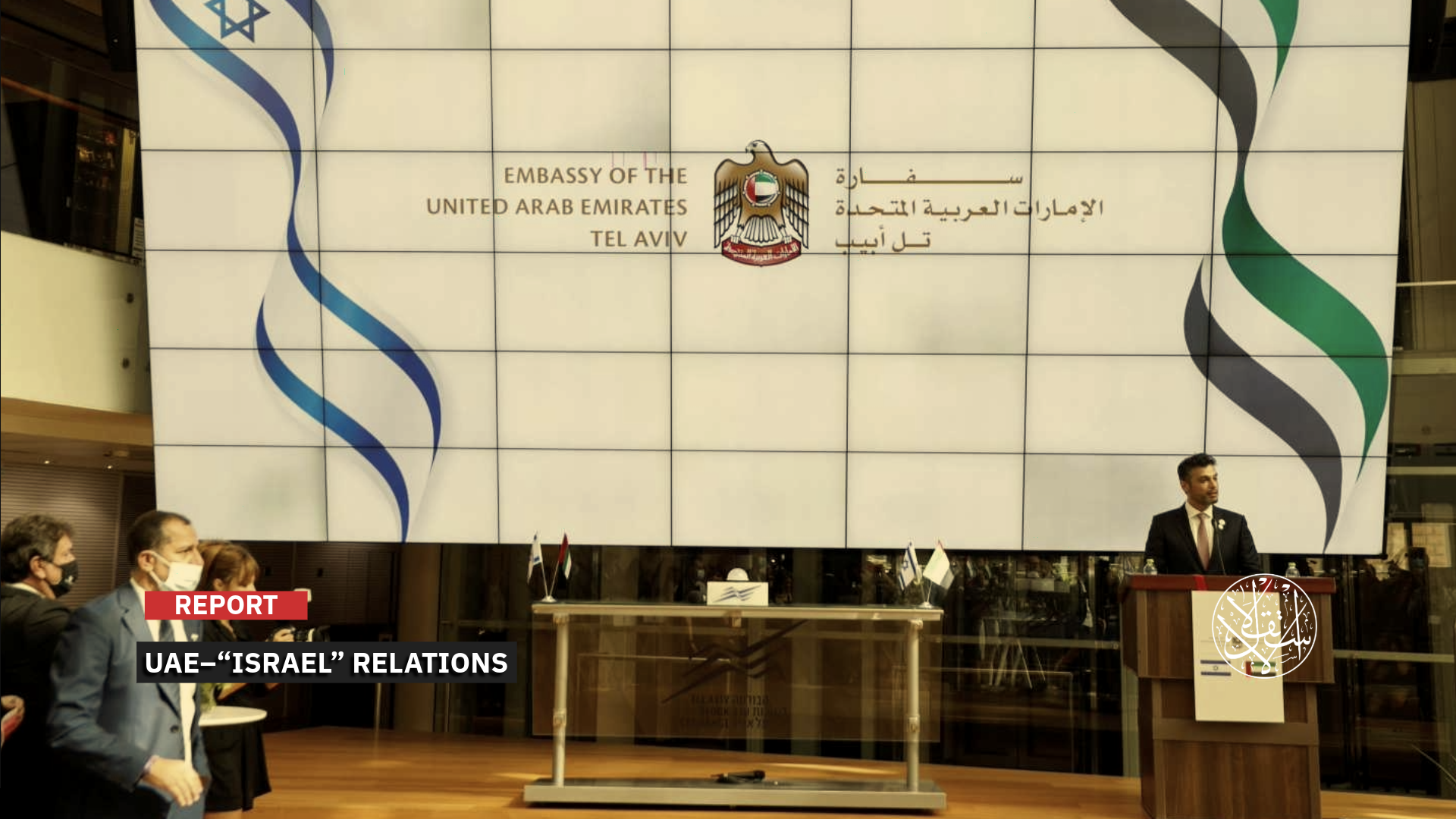
“An Israeli planning committee approved a permanent 15-story building for the UAE Embassy.”
In Dublin, UAE envoy for countering extremism and terrorism Maqsoud Kruse took part in discussions alongside U.S. Special Envoy to Monitor and Combat Antisemitism Rabbi Yehuda Kaploun at a forum organized by the World Jewish Congress in partnership with the European Commission from 12 to 14 October 2026.
Kruse’s participation drew attention in “Israel,” with Maariv hailing it as the UAE’s first appearance at the forum, following an official invitation from the U.S. State Department.
In the same week, an Israeli planning committee approved plans for a permanent UAE embassy building reaching 15 stories.
What is driving Abu Dhabi to expand its presence in circles close to the Israeli Occupation despite the fallout from the genocidal war on Gaza and escalating regional conflict?
Has the relationship become a strategic choice that crises cannot shake? And where does Palestine fit into these calculations?
15 Stories in ‘Herzliya’
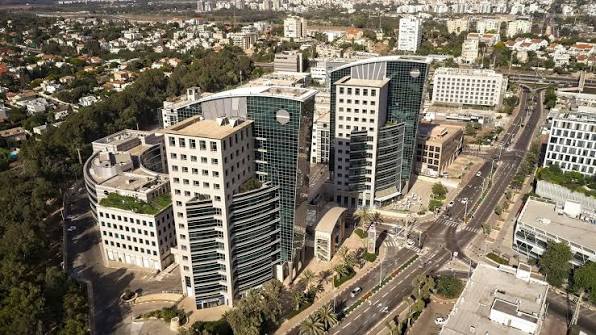
On 13 October, the “Tel Aviv” District Planning and Building Committee approved plans for a permanent UAE Embassy headquarters in Herzliya Pituah, north of “Tel Aviv,” nearly a year after the proposal was first submitted.
The plan calls for a building of up to 15 stories on a roughly 2.5-dunam plot on Sapir Street, with a total floor area of up to 15,000 square meters.
Up to 20 percent of the space will be allocated to residences for the ambassador and diplomatic staff on the upper floors, alongside an underground parking garage and an expansion of the adjacent road.
The project goes beyond urban development. The land, currently owned by the Herzliya municipality, will be transferred to the state through the Israel Land Authority before being leased to Abu Dhabi, with an alternative plot in the marina area allocated to the municipality in exchange.
According to information on the project, this arrangement was initiated at the request of the Israeli prime minister’s office.
Tel Aviv District Planner Erez Ben Eliezer said the project would strengthen international relations and become a prominent landmark in the area, given its proximity to the headquarters of international companies and advanced technology centers.
The UAE Embassy, which opened in July 2021 as the first Gulf diplomatic mission in “Israel”, had been operating out of temporary offices in Tel Aviv and Herzliya.
Moving to a permanent headquarters with residences for diplomatic staff signals an effort to cement the relationship for the long term, even before a construction or opening date has been announced.
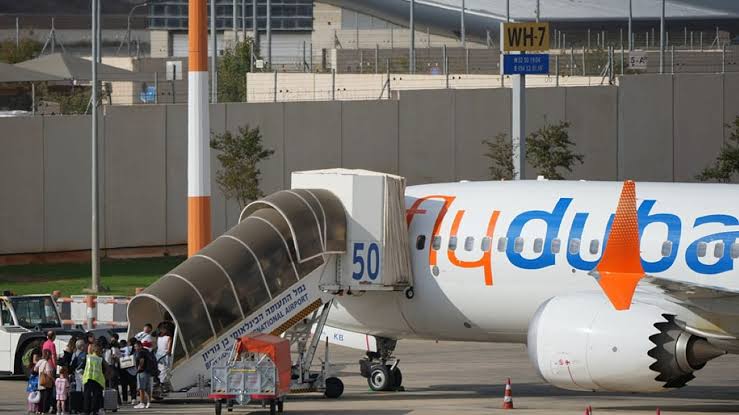
The timing of the approval, however, has prompted political speculation. Hebrew-language business outlet Ice linked it to tensions following the FlyDubai incident, in which a flight made an emergency landing at Saudi Arabia’s Tabuk Airport in late September 2026, suggesting that the approval came at a sensitive moment.
Yet the planning process had been underway for months before that crisis, making the approval a sign that the institutions underpinning the relationship continue to operate despite political turmoil, rather than a temporary response to it.
Disputes That Come and Go
The FlyDubai incident was the latest test of relations between Abu Dhabi and Tel Aviv. After the co-pilot, an Omani national, assaulted the captain of a flight traveling from Dubai to Tel Aviv on 30 September, the Israeli Occupation suspended the airline’s flights.
Transportation Minister Miri Regev accused the company of violating the aviation agreement between the two countries and rejected its request to resume operations.
Channel 12 reported that a senior Emirati official said the UAE felt the incident was being exploited for political purposes linked to the elections scheduled for 27 October. Abu Dhabi nevertheless did not downplay its seriousness. Anwar Gargash, diplomatic adviser to the UAE president, described it as a serious terrorist act.
This was not the first time the relationship had become a tool in “Israel’s” domestic politics. In May 2026, Israeli Prime Minister Benjamin Netanyahu’s office disclosed that he had made a secret visit to the UAE during the U.S.-Israeli War on Iran.
Abu Dhabi vehemently denied the visit, having requested that it remain confidential, according to the same Israeli broadcaster.
In September, Netanyahu visited the UAE again, amid controversy over a Haaretz report that Emirati President Mohammed bin Zayed had warned him before the 7 October 2023 event.
Netanyahu denied the reported warning, while Maariv reported that bin Zayed did not want to become part of Netanyahu’s election campaign.
Nevertheless, Emirates News Agency (WAM) confirmed the visit, and the Foreign Ministry said Abu Dhabi maintained open lines of communication with the Israeli Occupation government and exchanged intelligence with it.
The UAE was also one of only two Arab countries, alongside Bahrain, whose representatives remained in the UN General Assembly hall during Netanyahu’s address.
Taken together, these episodes suggest that the disputes center more on the public visibility of the relationship and its use for electoral purposes than on its underlying structure.
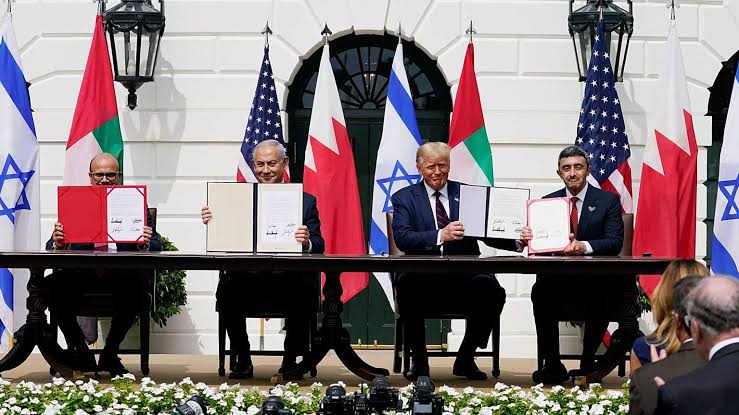
Abu Dhabi rejects allowing its ties with the Israeli Occupation to become an asset in Netanyahu’s campaign, but it has not allowed that objection to undermine the foundations of the relationship established in 2020.
Security Before Trade
Economic figures alone do not explain the UAE’s commitment to the relationship. According to the UAE Foreign Ministry, bilateral trade in goods reached $3.209 billion in 2025, little changed from the previous year and well below the stated target of exceeding $10 billion within five years, set when the two countries signed a Comprehensive Economic Partnership Agreement in 2022.
The trade balance favors the UAE by roughly 80 percent, while Israeli exports are concentrated in precious stones and precision instruments.
The relationship’s real weight, however, lies in security. Since the U.S.-Israeli War on Iran began on 28 February 2026, the UAE has come under Iranian missile and drone attacks, making it one of the most heavily targeted countries in the region.
During the war, the Israeli Occupation deployed an Iron Dome battery on Emirati territory, along with personnel to operate it, in what was described as the first move of its kind in an Arab country.
U.S. Ambassador to “Israel” Mike Huckabee confirmed that the system and its operators had been deployed to the UAE.
Media reports, including one by CNN, say “Israel” transferred a Barak 8 air defense system to Abu Dhabi in 2022 following Houthi attacks, and that the UAE assists “Israel” with signals intelligence.
These details, particularly those concerning intelligence cooperation, require direct and precise attribution to the sources that reported them.
Meanwhile, Gargash criticized his fellow Gulf states, describing their response during the war as “the weakest in history” and predicting that Israeli influence in the Gulf would grow rather than recede.
This came as the UAE withdrew from the Organization of the Petroleum Exporting Countries (OPEC) after nearly six decades of membership, reflecting Abu Dhabi’s push for greater autonomy over its oil policy.
Some Israeli officials interpreted the move as a sign that Abu Dhabi was distancing itself from traditional Gulf policies. However, linking the withdrawal to closer ties with “Israel” remains a political interpretation that requires independent sourcing.
Israeli Calls for a Broader Alliance
On 30 April 2026, “Israel” 24 published an analysis praising the UAE’s role in confronting Iran and arguing that providing military support to the Emirates was a strategic necessity for “Israel”.
On 1 May, a report in Yedioth Ahronoth went further, calling for a deeper alliance with Abu Dhabi and the establishment of a joint regional “defense system” led by “Israel”.
This rhetoric reflects an Israeli view of the UAE as a key partner in confronting Iran and a gateway to expanding Israeli influence in the Gulf.
The approach, however, raises questions about its implications for the UAE’s position in the wider Arab and Muslim world, particularly amid Abu Dhabi’s criticism of Arab countries’ responses to the crisis.
It also reflects “Israel’s” desire to use the war to strengthen its position as a central power in regional security arrangements, capitalizing on shifts in the policies of some Arab states.
Messages From Dublin
The participation of UAE Foreign Ministry envoy Maqsoud Kruse in the Dublin forum was not solely related to ties with the Israeli Occupation. It was also linked to the UAE’s efforts to counter political Islam and extremism. Kruse was the first executive director of Hedayah, a center established in Abu Dhabi in 2012, and currently chairs its International Steering Board. He was appointed the UAE foreign minister’s envoy for countering extremism and terrorism in January 2026.
In June 2026, Kruse presented his country’s approach to European lawmakers, distinguishing between extremism as an ideology and terrorism as conduct that may stem from it. That same month, the UAE ambassador to the European Union took part in a conference at the European Parliament examining what participants described as the threat posed by the Muslim Brotherhood to Europe.
In this context, the Dublin forum appears to be part of a series of initiatives through which the UAE presents itself to Western capitals as a partner in confronting political Islam and extremism. This approach places Islamist movements at its center and overlaps in some respects with Israeli rhetoric. The message also reaches Washington, whose institutions involved in combating antisemitism helped organize the forum.
The move also builds on existing ties. The Jewish Community Council of the UAE joined the World Jewish Congress in 2020.
Sources
- UAE Embassy to Rise 15 Stories as Israeli Occupation Approves Major Herzliya Project [Arabic]
- Emirati Representative Attends Jewish Conference in Dublin, Drawing Praise in Israel [Arabic]
- Committee approves building plans for permanent UAE embassy in central Israel
- Global Jewish Leaders and Government Envoys Meet in Dublin to Advance Action Against Antisemitism
- UAE admits Netanyahu made unannounced visit for talks with MBZ
- UAE 'unlikely' to join international Gaza security force, says Gargash