Shelley Greenspan: A Proud Zionist Chosen by Trump To Gain Democratic Support for His Gaza Plan
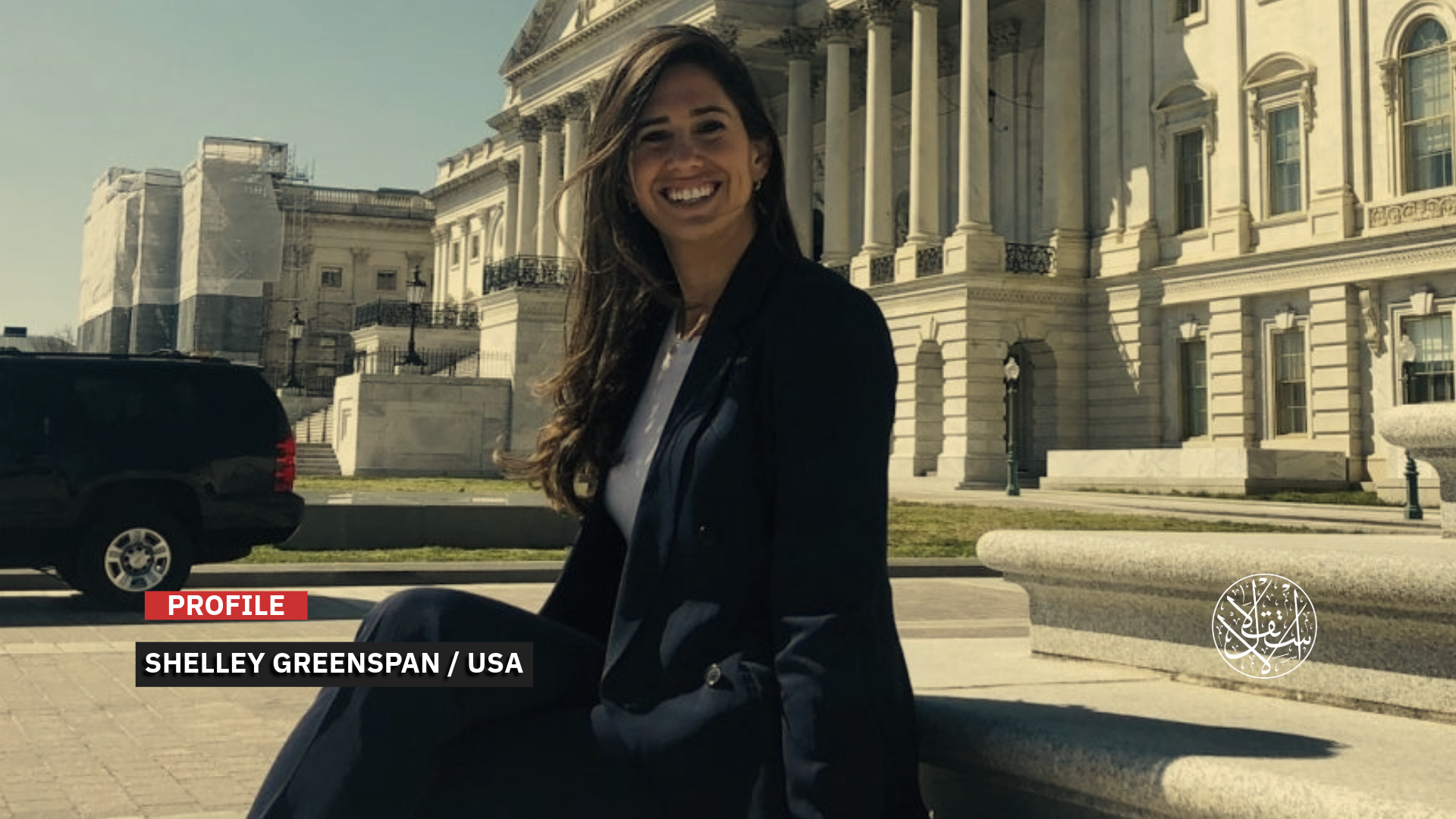
Greenspan’s experience spans AIPAC, election campaigns, the State Department, and the White House.
Seeking to secure bipartisan support for President Donald Trump’s Gaza plan, the U.S. administration has tapped Shelley Greenspan, a former National Security Council official under former President Joe Biden, to lead the Board of Peace’s outreach to Congress and Washington think tanks.
Her appointment comes as the administration seeks to establish governance and reconstruction arrangements for the Gaza Strip and ensure they remain in place after Trump leaves office in 2029, amid congressional objections to the board’s funding and powers.
Greenspan brings experience spanning the pro-”Israel” American Israel Public Affairs Committee (AIPAC), Democratic election campaigns, the State Department, and the White House, where she handled outreach to the Jewish community during the Israeli Occupation war on Gaza.
She describes herself as a proud Zionist. The Trump administration is counting on her experience and connections within U.S. institutions to broaden support for its initiative, which faces political and financial disagreements that could threaten its continuity.
Who Is Shelley Greenspan?
Greenspan grew up in Miami Beach, Florida, in a Jewish family. Her grandfather, Charles, was a Holocaust survivor who spent time in three concentration camps before being liberated from Buchenwald in Germany.
According to a February 2023 report by Jewish Journal, her grandfather took part after World War II in the Bricha network, which helped move European Jews to Palestine during the British Mandate. He died in 2007.
Greenspan attended an Orthodox Jewish school and took part in religious and social activities associated with different Jewish movements before spending a year in “Israel” through a program organized by the Zionist youth movement Young Judaea.
After returning to the United States, she enrolled at the University of Florida in Gainesville, where she became involved in student government and Hillel, an organization supporting Jewish life on American college campuses, as well as pro-”Israel” student activism.
Her entry into Washington politics began with a meeting with Democratic Rep. Debbie Wasserman Schultz of Florida during a university event Greenspan helped organize in the congresswoman’s honor.
In an interview published in early 2020 by Gather DC, a website covering the Jewish community in the U.S. capital, Greenspan recalled moving to Washington just weeks after their meeting to intern in Wasserman Schultz’s congressional office. The experience encouraged her to pursue a career in politics.
While still in college, Greenspan also secured internships at U.S. news network NBC News and the White House during Democratic President Barack Obama’s administration.
After graduating, she settled in Washington and joined AIPAC, one of the most prominent pro-Israeli Occupation lobbying groups in the United States.
She spent three years in AIPAC’s legislative department, monitoring the work of the House Foreign Affairs Committee and the Senate Foreign Relations Committee, as well as legislation related to U.S.-Israeli relations.
In 2016, she joined the research and rapid response team for the presidential campaign of former U.S. Secretary of State and Democratic nominee Hillary Clinton, working on political issues related to the State Department.
After Clinton lost the election to Trump, Greenspan joined the public policy team at U.S. technology and retail company Amazon.
She spent three years in Washington working on global policy issues before moving to the U.S. State Department in early 2020, during Trump’s first term.
There, she helped develop the Academy for Women Entrepreneurs, a program run by the Bureau of Educational and Cultural Affairs that supports women in establishing and managing businesses through training and business skills development.
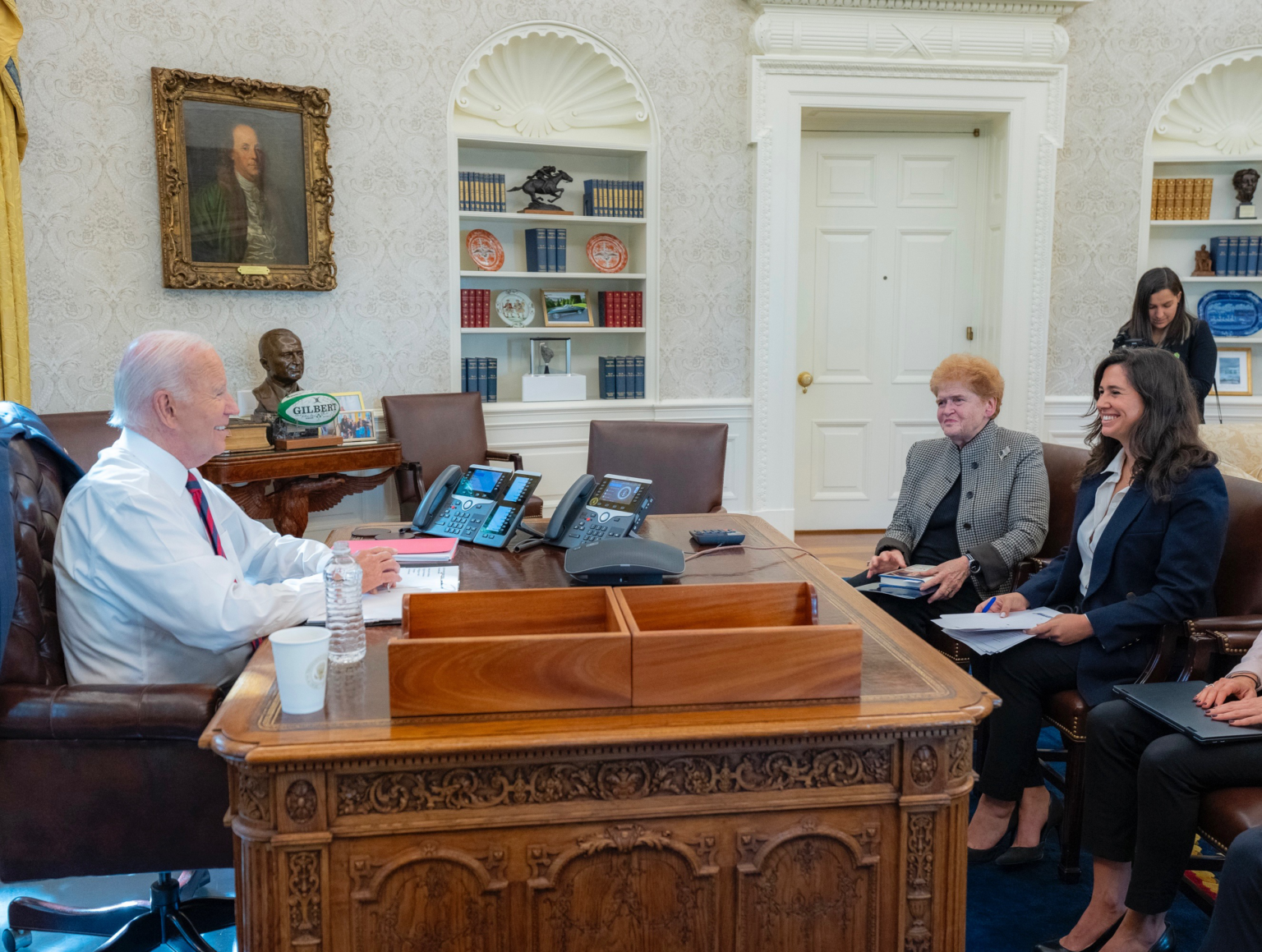
Greenspan remained at the State Department after Biden took office in 2021, moving to the National Security Council in 2022 as an adviser on partnerships and global outreach.
In her 2023 interview with Jewish Journal, she said she had received the offer to join the council while working at the State Department and had spent only a few weeks in the new role before being assigned additional responsibilities at the White House.
On 27 July 2022, her appointment as the White House liaison to the American Jewish community was announced, succeeding Chanan Weissman, who had held the position under both the Obama and Biden administrations.
Greenspan retained her National Security Council responsibilities alongside the new role, which involved liaising between the White House and Jewish organizations and coordinating meetings and briefings with administration officials on domestic and foreign policy issues of concern to the community.
During her first months in the position, she helped organize events and gatherings for the Jewish community at the White House, including a Rosh Hashanah celebration in September 2022, as well as meetings attended by American diplomats and officials.
She remained in the position until Biden left office in January 2025, before returning to the State Department, where she continued working as a career civil servant under Trump’s second administration.

Her Positions and Network of Connections
Greenspan describes herself as a “proud Zionist,” according to a November 2022 interview with Hadassah, a magazine published by the Women's Zionist Organization of America.
In the interview, she discussed making around 15 trips to the Israeli Occupation and explained how her Jewish identity had shaped her career in public service.
She has also served on the boards of several U.S. Jewish organizations, including the Anti-Defamation League (ADL), which works to combat antisemitism and discrimination; the International Council of Jewish Women; and the Jewish National Fund, which supports Zionist projects.
Alongside her ties to these organizations, Greenspan has been active in Democratic politics. She took part in the Jewish Women for Joe initiative supporting Biden’s 2020 presidential campaign and helped launch an initiative in February 2022 to encourage Jewish Democratic women to participate in politics.
In her interview with Hadassah, she also emphasized her commitment to engaging with Jewish Republicans, noting that her White House role required her to work with people across the political spectrum within the American Jewish community.
Her role in the Biden administration became particularly visible through her involvement in efforts to develop the first U.S. National Strategy to Counter Antisemitism, released in May 2023.
In an interview published by Jewish Insider, which covers Jewish political affairs, on 17 January 2025, she revealed that Jewish organizations, including the ADL and the Jewish Federations of North America, had repeatedly urged her to persuade the White House to develop the strategy.
According to her account, she began by drafting an internal memo to build support among administration officials before organizing a meeting on 7 December 2022.
The gathering brought together more than a dozen leaders of Jewish organizations, Douglas Emhoff, then the husband of Vice President Kamala Harris, and senior White House officials.
A week later, Biden announced the formation of an interagency task force to develop the strategy, which was released about six months later. The episode illustrates Greenspan’s role in bringing the demands of lobbying groups to the highest levels of government.
On her positions toward the Israeli Occupation, Greenspan defended the Biden administration’s support for “Tel Aviv” during the war on Gaza.
She described Biden as the most pro-”Israel” U.S. president, pointing to his pride in Zionism and saying his support for the Israeli Occupation was one of the reasons she joined his administration.
After 7 October 2023, Greenspan became a liaison between the White House and the families of American captives held by the Palestinian Resistance Movement (Hamas).
She also helped coordinate outreach to the Jewish community during the Israeli genocide in Gaza.
She also proposed illuminating the White House in blue and white as a show of solidarity with the Israeli Occupation. The proposal was implemented on 9 October 2023.
Her activities came amid disagreements within the Biden administration over support for “Israel” and growing calls among Democrats to condition U.S. military aid to “Israel.”
Greenspan acknowledged facing challenges both inside and outside the administration but continued to defend Biden’s policy, while avoiding discussion of how the Democratic Party’s position on “Israel” might evolve.
Shortly before leaving the White House, she offered to help whoever the Trump administration appointed to replace her, arguing that combating antisemitism and supporting “Israel” were issues that should enjoy bipartisan backing.
Why Was She Chosen for the Gaza Initiative?
On 26 October 2026, Axios reported that Greenspan had been appointed head of external affairs at the Board of Peace, which Trump established in January 2026 to oversee governance and reconstruction arrangements in Gaza before expanding its mandate to include other international conflicts.
Greenspan is responsible for outreach to Congress and U.S. think tanks specializing in Middle Eastern affairs, under the supervision of Josh Gruenbaum and Aryeh Lightstone, senior advisers to the board.
Lightstone previously worked on the “Abraham Accords,” which normalized relations between the Israeli Occupation and several Arab countries, during Trump’s first administration.
In a statement cited by Axios, the board said Greenspan had earned the trust of both Republicans and Democrats through her service at the White House, the National Security Council, and the State Department. It stressed that continued bipartisan support in Congress was essential to implementing the plan.
Greenspan, for her part, said that in her most recent State Department role, she had worked to advance Trump’s vision for the Middle East.
She praised his 20-point plan for Gaza, saying she believed it could deliver tangible results for the people of the Gaza Strip and the Israeli Occupation.
On 26 October 2026, The Jerusalem Post reported that the U.S. administration was seeking to build a political consensus that would ensure the continuation of the Gaza plan and the Board of Peace after Trump leaves office in January 2029, even if a Democratic administration takes over the White House.
According to the newspaper, Greenspan’s mission would focus particularly on engaging Democratic lawmakers amid the congressional midterm elections scheduled for 3 November 2026 and the potential shifts in the balance of power in both the House and Senate.
The newspaper linked this approach to the experience of the “Abraham Accords,” signed between “Israel” and several Arab countries during Trump’s first administration in 2020.
Their expansion slowed during the early years of the Biden administration, before former U.S. Ambassador to “Israel” Dan Shapiro was appointed in 2023 to work on “regional integration.”
Greenspan’s assignment is part of broader efforts to secure the political backing needed to sustain the Gaza initiative despite changes in U.S. administrations.
Several prominent Democrats have expressed support for Trump’s plan, including Hillary Clinton, who defended it in an article published by the Financial Times on 18 June 2026, describing it as the most viable framework under the prevailing circumstances.
Former U.S. Ambassador to “Israel” Jack Lew and Brett McGurk, a former White House Middle East adviser, have also voiced support for the plan.
Greenspan’s mission, however, faces opposition from Democrats. On 11 June 2026, Sen. Jeanne Shaheen, the top Democrat on the Senate Foreign Relations Committee, sent a letter to Secretary of State Marco Rubio demanding clarification of the board’s legal basis and the mechanisms governing the management and oversight of its funds.
She disclosed that Trump had pledged $10 billion to the board, while the State Department had notified Congress in April of its intention to transfer $50 million to cover its initial operating expenses.
On 25 August 2026, Democratic Reps. Jamie Raskin and Gregory Meeks announced that the administration had backed away from transferring the money following congressional oversight objections. They called for disclosure of details about the board’s management and financial resources.
On 26 March 2026, Semafor reported, citing an informed source, that the State Department had redirected $1.25 billion from international aid, “peacekeeping operations,” and other programs to the Board of Peace.
On 29 October, Democrats on the Senate Foreign Relations Committee released a report criticizing efforts to redirect the funds, warning that doing so could circumvent Congress’s authority over government spending and create conflicts of interest in the conduct of foreign policy.
The report, prepared by Democratic minority committee staff at Shaheen’s direction, warned against redirecting funds allocated by congressional decisions and allowing private interests to become entangled in the management of U.S. foreign policy.
These disagreements have coincided with U.S. efforts to fund the proposed International Stabilization Force for deployment in Gaza.
In mid-July 2026, Jewish Insider reported that Gruenbaum, the force’s commander, Gen. Jasper Jeffers, and the board’s security official, Mark Schwartz, had held meetings with congressional offices to request $200 million in support for the force.
On 30 July 2026, the U.S. State Department notified Congress of its intention to provide the $200 million, along with approximately $6.3 million to reallocate nine armored personnel carriers for the force.
According to the two documents, Albania and Kosovo would be the first recipients of the equipment as part of their proposed participation.
These disputes put Greenspan’s ability to broaden congressional support for Trump’s plan to the test, particularly among Democrats. While some have endorsed the initiative, others have called for strict oversight of the board’s funding and powers.
Her ability to build that consensus will be one of the factors shaping the U.S. administration’s efforts to ensure that its proposed arrangements for Gaza remain in place over the coming years, beyond Trump’s current term in office.
Sources
- Trump's Board of Peace taps ex-Biden aide to lead Congress outreach
- Trump looks beyond 2028 as Board of Peace recruits former Biden aide to build bipartisan support
- Trump administration’s Board of Peace taps Biden’s Jewish liaison to leadership role
- White House Jewish Liaison Shelley Greenspan on Antisemitism, Abraham Accords and Jewish Firsts
- meet shelley jewish community builder of the week
- White House to name Shelley Greenspan new Jewish liaison
- Shelley Greenspan: White House Bridge to U.S. Jewry
- White House Jewish liaison Shelley Greenspan on how the kosher sausage gets made
- US provides $206 million for Gaza force despite deadlocked peace plan