Gold-Mining Networks, Weapons and a Volatile Border: What Is Happening in Southern Egypt?
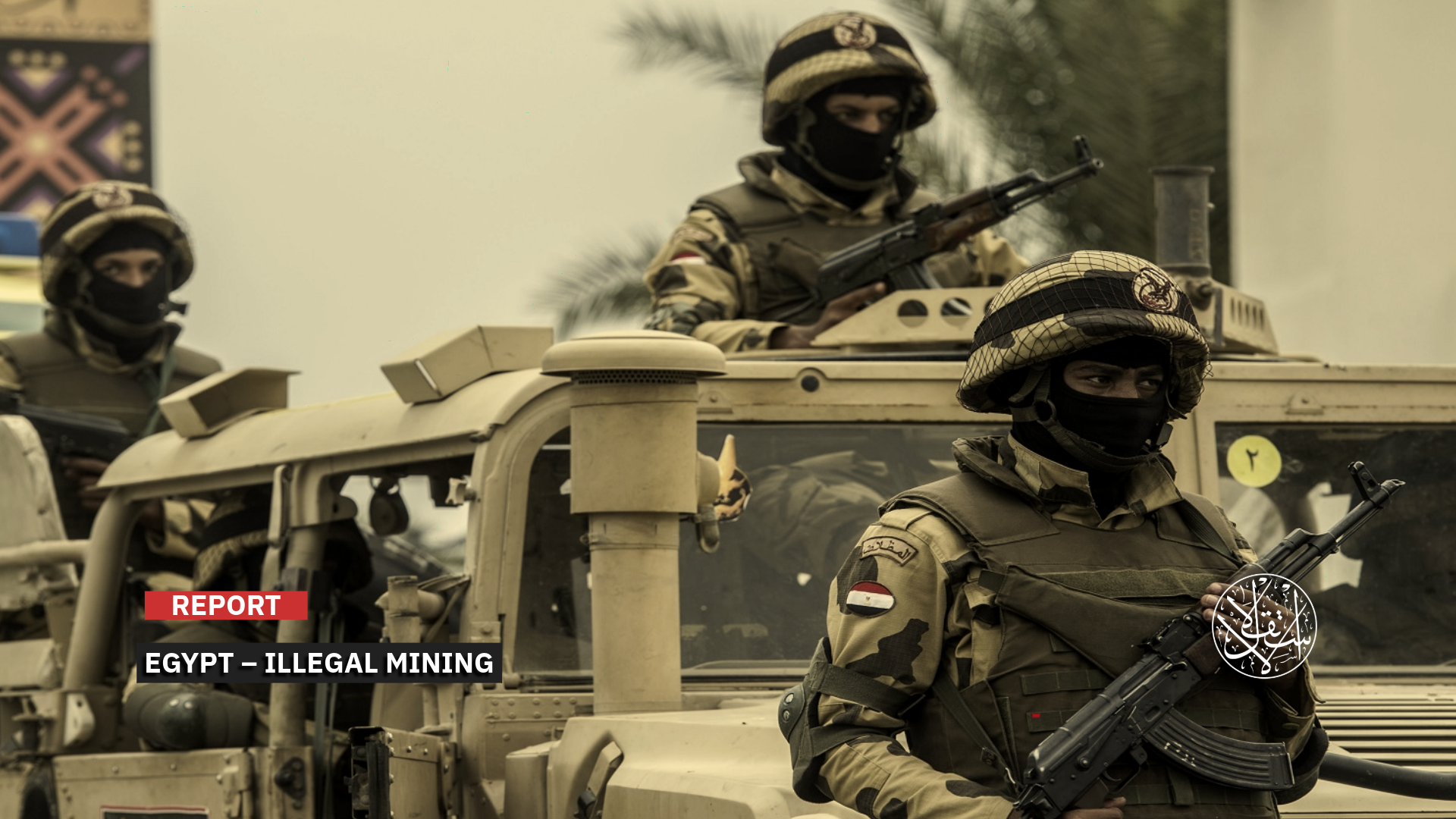
The discourse has shifted from confronting the “illicit gold economy” to warning of armed cross-border networks.
Two senior military officers were killed during a campaign against illegal gold-mining networks in southern Egypt. Their deaths showed that long-standing fears were now a concrete security reality: illegal mining had become entangled with arms smuggling and border unrest.
The confrontation has moved beyond pursuing the “dahaba,” as illegal gold diggers are known, and their mining networks. It has taken on a security dimension, pitting the army against armed groups and gangs that carry weapons and trade in arms and drugs alongside illegal mining.
Cairo has begun to view these networks, which include Egyptians, Sudanese, and Africans of various nationalities, as a threat that goes beyond the economic losses caused by illegal mining.
According to the Egyptian army, some of these groups are linked to cross-border networks and move through rugged desert areas.
Some of their members are armed, and networks linked to them are suspected of involvement in other activities, including arms and drug smuggling and irregular migration.
In recent months, the Egyptian army’s campaigns have expanded into areas in the south and east. As they did, an operation that began as a crackdown on haphazard gold mining appeared to be gradually turning into a broader security and military operation.
The discourse has shifted from confronting the illicit gold economy to warning of armed cross-border networks. This raises questions about whether illegal mining areas are becoming security hot spots. In those areas, smugglers can exploit the rugged desert and the vast border to move gold, weapons, and people.
These questions carry double weight given the ongoing war in Sudan. The war has reshaped the gold economy and the trade and smuggling routes across the region.

Four Military Campaigns
According to details announced by the Egyptian military spokesman on November 6, 2026, the army and border guards have launched four military campaigns under the name “Southern Shield”. The campaigns target those carrying out illegal gold mining within Egypt’s borders, in the Eastern Desert and areas near the southern border with Sudan.
The first phase of the campaign began on June 14 and lasted until June 30, 2026. It included raids and the seizure of miners, equipment, and weapons. No separate toll of dead and wounded was announced.
This phase covered two areas. The first lies west of the city of Marsa Alam and includes two concession sites with a total area of about 1,825 square kilometers, more than 350 kilometers from Egypt’s southern border.
The second is the Jabal Iqat area inside Egypt’s borders, which includes a concession site belonging to a mining company, covering 528 square kilometers.
The second phase took place between July 31 and August 18, 2026. The campaign moved to two new areas: Wadi Dabbour, covering about 200 square kilometers, and the Barramiya area, covering about 2,300 square kilometers and including five concession sites.
The third phase, the bloodiest, took place between October 12 and 29, 2026, and included airstrikes and clashes.
According to the Egyptian army, this phase focused on sweeping the areas targeted in the first and second phases. It aimed to ensure that conditions had returned to normal and to allow legally operating mining companies to resume their work.
According to the military spokesman, the three phases, which ran from June 14 to October 29, 2026, resulted in the following: Two officers were killed, 151 Egyptians and 540 foreigners were detained, 6,614 people turned themselves in before the campaign began, and equipment, weapons, and ammunition linked to illegal mining were seized.

These locations show the wide geographic scope of the operations. They are not limited to areas adjacent to Sudan, but also include mining sites hundreds of kilometers from the border.
The fourth phase was scheduled to begin on November 7, 2026. That date came after the army announced the deaths of the chief of staff of the Southern Region Border Guards and a battalion’s head of operations while confronting illegal gold mining. No information has been released about this phase.
On November 5, 2026, the Egyptian army spokesman announced that the armed forces were preparing to launch the fourth phase of the campaign on November 7. It would cover areas of the Eastern Desert near Egypt’s southern border with Sudan, following the three previous phases.
The results of the fourth phase remain a test of the Egyptian authorities’ ability to turn military deployment into lasting control. That means more than breaking up temporary camps or confiscating equipment. It means shutting down and controlling supply and smuggling routes and preventing haphazard mining from returning.
However, the deaths of two officers during the campaign showed that the confrontation has become more costly and complex than the label “combating illegal mining” suggests.
Egypt’s stake is no longer protecting gold alone. It is preventing mineral wealth in a volatile border region from becoming a gateway to a parallel economy and to armed networks whose consequences may be hard to contain in the future.
On the Sudanese side, political forces and rights organizations accused Egypt of killing 72 Sudanese in an Egyptian airstrike during the third phase, which they said took place inside Sudan. Egypt denied this.
The Egyptian army’s latest attack, on October 10, 2026, was marked by sharply conflicting casualty figures. The Associated Press reported 13 miners killed, while the group Emergency Lawyers said 72 Sudanese were killed. Sources cited by the Sudan Tribune website put the toll at more than 200.
In October 2026, Abdel Fattah al-Burhan, head of Sudan’s Transitional Sovereignty Council, issued a decision forming a fact-finding committee into the killing of Sudanese workers mining for gold near the Egyptian border.
Artisanal gold mining has increased in northern Sudan since the civil war there disrupted livelihoods, and gold has become a major source of revenue during the conflict.
The Egyptian army maintains that its operations target illegal activities inside the country’s borders. It says its forces send warning messages before each phase begins to inform those in the targeted areas that their activities violate the law.
The Egyptian military spokesman said there is coordination with Sudan, including recent meetings between officials from the two countries. He noted that the armed forces of Egypt and Sudan have exchanged information on securing their shared border.

Mining Networks or Armed Groups?
The Egyptian army linked illegal mining to transnational criminal networks. It noted that some of those involved possess “light weapons, heavy and anti-aircraft machine guns, and sniper rifles.”
The military spokesman revealed that clashes had taken place between armed groups competing for control of gold-mining areas. He noted that some of these groups have heavy and anti-aircraft machine guns, light weapons, sniper rifles, anti-armor weapons, armored vehicles, and ammunition.
He also said that 52 gatherings of armed elements had been detected after the deadline for them to turn themselves in expired.
This raised fears that Egypt is facing not merely illegal mining networks but armed groups. As the latest confrontation revealed, these illegal mining networks may have turned into an armed security challenge.
This means that illicit economic interests have become entangled with organized crime and cross-border threats, creating a new threat in southern Egypt.
Egyptian diplomatic and media sources told Al-Estiklal what worried Cairo. They said the army’s official statement on the results and phases of Operation Southern Shield implicitly revealed something like an “illegitimate” state on the Egypt-Sudan border. That state, they said, is expanding as a fait accompli, imposing itself, and entrenching its illegitimacy by force of arms.
They also described it as a “criminal entity” that combines illegal gold plundering with smuggling weapons, drugs, and people across the desert. They said it has developed its presence and operations and become a greater danger to Egypt’s national security.
“What increased the concern is that Egypt fears these areas, which are witnessing chaotic mining and smuggling, could turn into an arena for extremism and for groups such as ISIS or others. That is why the intervention was violent, especially after two senior officers were killed,” said a media source close to the authorities.
According to the military spokesman, the spread of armed groups engaged in illegal mining has threatened workers in the mining sector and pushed some of them to abandon their worksites.
According to the military account, the illegal activities have also harmed domestic and foreign investment, though the value of the losses was not specified.
The targeted areas are important because they contain gold deposits and concession sites belonging to exploration and extraction companies, most notably Jabal Iqat.
In November 2021, Egypt’s Petroleum Ministry announced that Jabal Iqat had been added to the gold production map. It cited reserves estimated at about 1 million ounces and expected investments exceeding $1 billion.
According to the website of the Iqat gold mining company, the commercial discovery at the site dates back to July 2020. Reserves were estimated at about 1.2 million ounces, with a recovery rate of up to 95 percent.
These resources explain why securing the concession areas matters, especially given what the authorities say about the impact of illegal mining on company investments and on the state’s rights to its mineral resources.

When Were the Officers Killed?
In his statement on November 6, 2026, the Egyptian military spokesman, Colonel Ahmed Etman, said confrontations during efforts to stop illegal gold-ore mining had killed Col. Ahmed Samir, chief of staff of the Southern Region Border Guards.
He said they had also killed Lt. Col. Ahmed Gouda, head of operations of a border guard battalion operating within the Southern Military Region.
It is still unclear when the two officers were killed. The military spokesman did not specify when they died, which gave the impression that they had just been killed in the latest clashes with smugglers and armed men in southern Egypt.
However, Sudanese and Egyptian reports confirmed that they were killed earlier. This raised questions and speculation about why their deaths were officially announced by the military only now, a full nine months later.
According to the Egyptian and Sudanese sources, Lieutenant Colonel Ahmed Adel Gouda Attia was killed on February 10, 2026. He belonged to the 103rd class of the Military Academy and commanded the 108th Coastal Border Guard Battalion. His funeral was held at Al-Seddik Mosque in the Sheraton area near Cairo airport.
On February 15, 2026, the newspaper Al-Ahram reported that head of the regime Abdel Fattah al-Sisi “sent Brigadier Hany Abdel Aziz El-Sayed El-Qabbany to offer condolences on the death of Lt. Col. Ahmed Adel Gouda Attia and convey his sincere condolences and sympathy to his family.”
The official page of residents of Al-Rehab City in eastern Cairo said in its condolence message that he “bravely confronted an attempted infiltration by smugglers’ vehicles carrying weapons and drugs on the southern border in Aswan, was hit by two bullets in the chest, and was martyred.”
The funeral of the chief of staff of the Southern Region Border Guards, Brigadier Ahmed Samir Nour El-Din, was also held on March 9, 2026, according to the Masrawy website. His body was laid to rest the following day in a military funeral in the village of Shanshour in Menoufia governorate, northern Egypt.
However, there was no statement from the military spokesman and no explanation of how he was killed. A report by the website Africa Intelligence said at the time that he had been targeted inside Sudanese territory in a drone attack in the city of Kosti, south of Khartoum.
Messages of Sovereignty and Influence
The spread of illegal artisanal mining has created markets, trade routes, and smuggling networks that cross official borders, move between Egypt and Sudan, and attract other African nationalities.
The war in Sudan has widened its reach, as gold has entered the war economy and gold revenues have become a vital resource for Sudan.
As a result, gold has become a sovereign issue for Cairo that reaches beyond its borders, and one it handles firmly. This is especially true since weapons appeared among some miners, who killed two Egyptian officers.
Within this war on the miners, most of whom are Sudanese, another war has broken out that goes beyond gold. It concerns redrawing the balance of influence between the two countries in the Egypt-Sudan border triangle.
The military operations now reflect a broader policy. That policy goes beyond imposing control over a resource-rich area and confronting a cross-border mining economy, to sending messages about sovereignty and influence.
Analysts believe that the targeting of senior Egyptian military commanders, if proven deliberate and planned, may point to an advanced level of organization and intelligence gathering. That would go beyond random clashes with people engaged in illegal mining, they say, and explains why Egypt bombed these areas from the air.
In a post on X dated November 6, 2026, the account of retired Brigadier Engineer Osama El-Hefny argued that the targeting of border guard commanders reflects an advanced level of planning and operational management.
He attributed this assessment to Lieutenant General Ashraf Salem Zaher, without attaching any source proving that Zaher made the statement.
Major General Samir Farag, a former director of morale affairs in the Egyptian army, said: “The dangers of the mining gangs (the dahaba) now go beyond the economic risks to Egypt. Extremely dangerous infiltrators slip in among them, smuggling drugs and weapons, along with irregular migrants, and all of this poses a major threat to Egyptian national security.”
He told the newspaper Asharq Al-Awsat on November 6, 2026, that “the coming period will see strong action by the Egyptian authorities to clear this area, to protect national security, not just protecting resources.”
In its statement, the Egyptian army said that illegal gold mining is linked, in its assessment, to other crimes. These include possession of unlicensed weapons, drug trafficking, irregular migration, and the activities of transnational criminal networks.