From Deterrence to Prevention: How Has ‘Israel’s’ Military Doctrine Changed Since October 7?
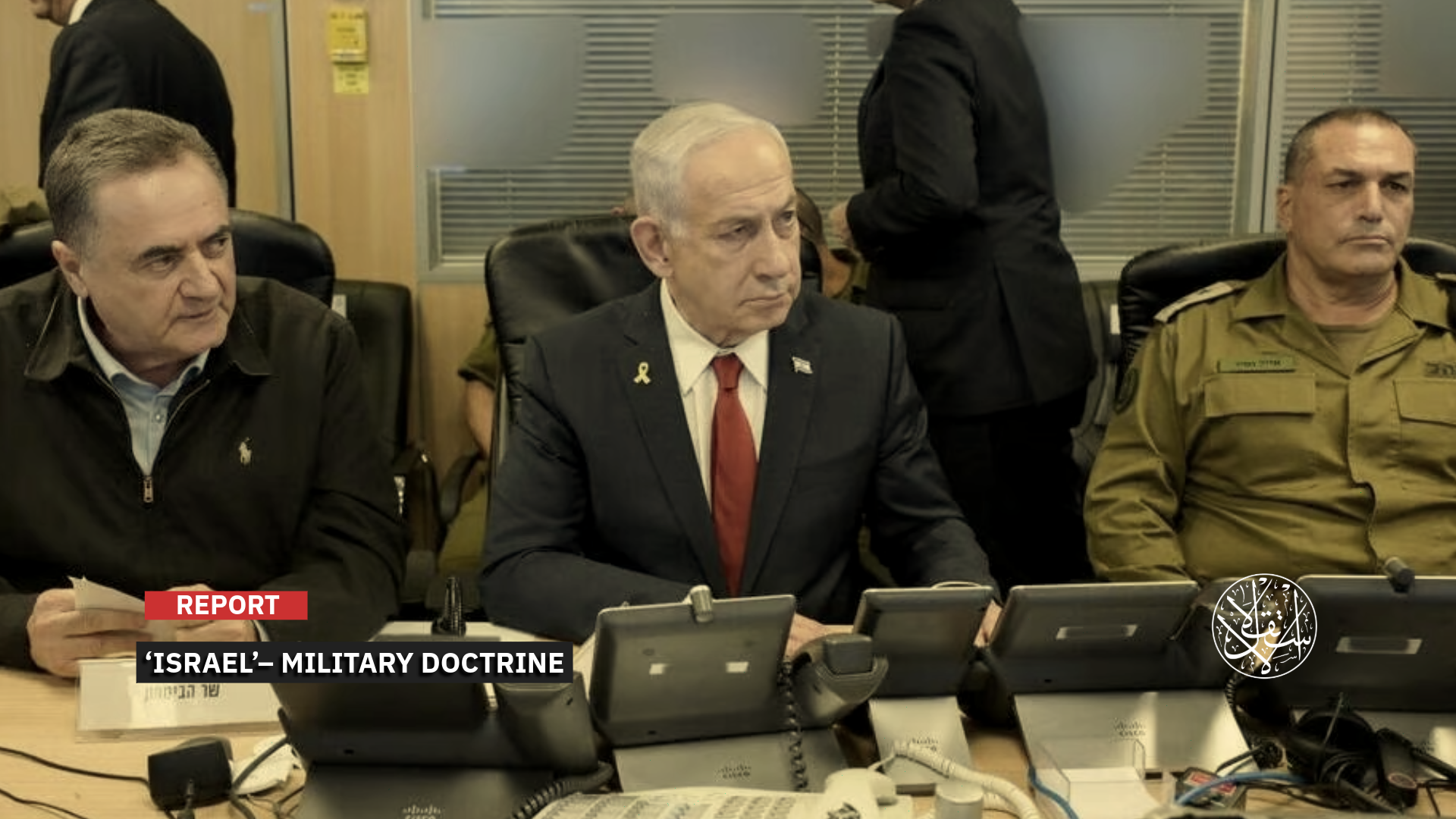
"The open-front model is imposing growing costs on an army that relies heavily on reserve forces."
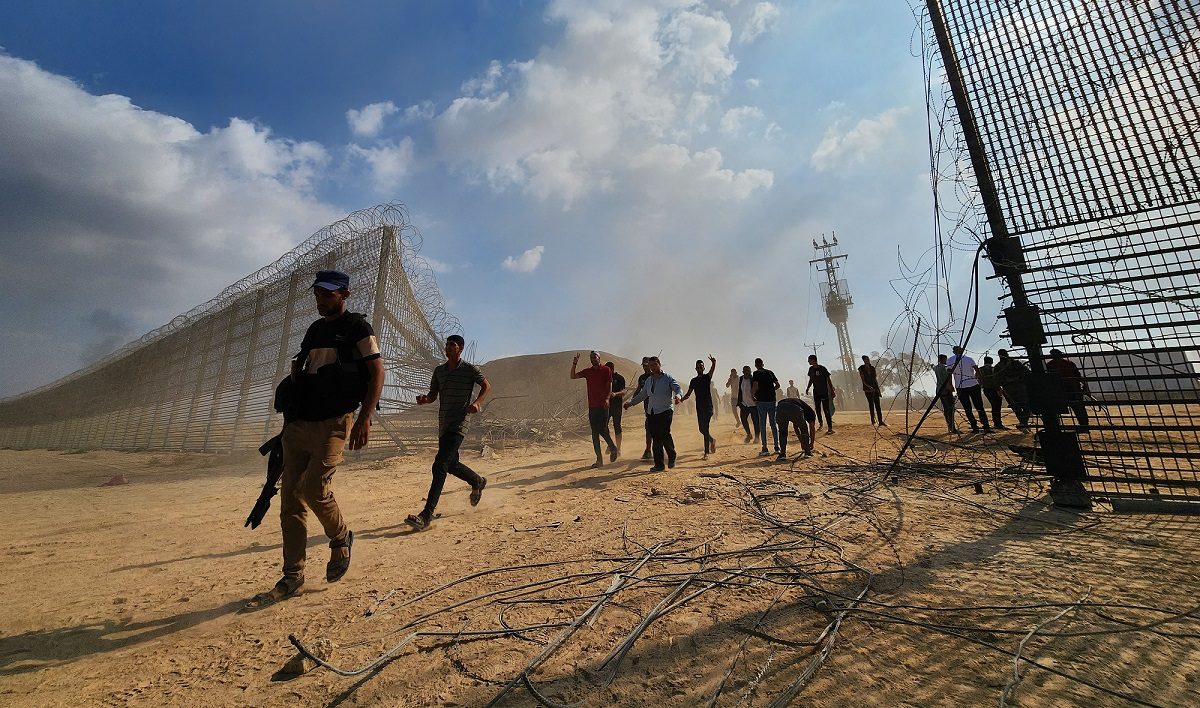
Three years after Operation al-Aqsa Flood on October 7, 2023, “Israel’s” security doctrine has entered a period of extensive reconfiguration under the pressure of the greatest security and military failure “Israel” has experienced in decades.
“Israel’s” security model was built around deterrence, early warning, and rapid victory, later expanding to include limited, repeated military operations aimed at slowing the buildup of adversaries’ capabilities and keeping a full-scale confrontation at bay.
But that model was confronted by the October 7 attack, at a time when “Israel’s” political and military leadership and intelligence agencies viewed Hamas as a deterred force and relied on an advanced border defense system that was expected to detect threats before they turned into an attack.
Since then, the center of gravity in Israeli security thinking has shifted toward preemptive action, pushing armed groups away from the border, preventing them from rebuilding their capabilities, and moving part of the defense system into adversaries’ territory through security zones and forward military positions, while retaining the ability to intervene after large-scale operations subside.
This shift has placed the Israeli Occupation in a different equation. Maintaining military gains has become tied to continued surveillance, strikes, and military deployments, prompting debate within the security establishment over whether preventing the next war is turning into a prolonged war.
Shaken Deterrence
Since the era of David Ben-Gurion, “Israel’s” first prime minister and one of its most prominent founders, Israeli security thinking has been built around three central pillars: deterrence, early warning, and decisive victory, amid the country’s lack of the geographic depth needed to withstand a prolonged war.
In April 2006, a committee headed by Dan Meridor, an Israeli politician who served in several positions, including justice, finance, and intelligence minister and deputy prime minister, presented a review of the doctrine that added defense to the existing pillars as the threat posed by missiles and armed groups on the home front grew.
As “Israel’s” air, intelligence, and cyber capabilities developed, its policy of the campaign between wars expanded. The approach consists of limited and repeated military operations carried out between major confrontations to slow the buildup of adversaries’ capabilities and keep a full-scale war at bay.
In a 2019 study published by the Dado Center for Interdisciplinary Military Studies, Maj. Gen. (res.) Nitzan Alon, a former head of the Central Command and former head of the Operations Directorate, and military researcher Dana Preisler-Swery explained that the model aims to reduce threats, slow the buildup of military capabilities, strengthen deterrence, and push the next war further away.
October 7 brought this framework into its deepest review in decades. On November 10, 2025, the Israeli Occupation military published the findings of an expert team that reviewed internal investigations into the attack, identifying a conceptual failure as one of the main causes of the collapse.
The report also cited intelligence failures, mishandling of signs and warnings ahead of the attack, and internal problems that had accumulated within the military, including entrenched assessments that underestimated the threat and a gap between scenarios the military knew were possible and the level of forces and actual preparedness available to confront them.
The team concluded that the security agencies had unusually significant information that should have prompted a warning. Still, the Intelligence Directorate, Southern Command, and Gaza Division failed to turn it into the readiness needed to prevent the attack. It recommended making the possibility of a surprise war a permanent reference point for force building and preparedness.
The belief that Hamas was deterred was one of the clearest expressions of the crisis. In March 2024, Amir Lupovici, a researcher at the Institute for National Security Studies, wrote that deterrence had long maintained a central place in Israeli Occupation security thinking.
But the years preceding the attack had produced repeated signs that deterrence had limited effect on Hamas, which were interpreted through the assumption that the group did not want a large-scale confrontation. Debate over the actual point of failure continues within Israeli security circles.
On October 7, 2024, Eado Hecht, a researcher in military history and theory at Bar-Ilan University’s Begin Sadat Center for Strategic Studies, wrote that the crisis had accumulated over three decades of changes in the understanding of war, military force building, and the application of the principles of deterrence, warning, and decisive victory.
The disagreement reflects a question that has remained central since the war over whether the problem lay in the principles of the doctrine themselves or in how they were applied.
In either case, military planning has shifted toward preparing for the possibility that both deterrence and early warning could fail while giving greater weight to adversaries’ capabilities when assessing threats.

New Doctrine
After October 7, the security debate inside the Israeli Occupation shifted toward reducing reliance on deterrence alone and giving greater weight to preemptive action in dealing with threats.
Concepts such as prevention, pushing threats away from the border, and maintaining freedom of military attack to prevent adversaries from rebuilding their capabilities have emerged more prominently in this context.
On September 17, 2024, Yedidya Ya’ari, former commander of the Israeli Navy and former CEO of Rafael Advanced War Systems, published an article in Yedioth Ahronoth titled ‘Replacing Deterrence With Prevention’, calling for greater emphasis on preventing attacks before they are carried out.
In its policy document for 2025 and 2026, the Institute for National Security Studies proposed adding prevention to the pillars of “Israel’s” security doctrine alongside deterrence, warning, decisive victory, and defense.
It linked the concept to identifying and thwarting emerging threats at an early stage, while noting its roots in the campaign between wars policy.
On March 24, 2026, Israeli Army Minister Israel Katz said during a military situation assessment that the military would maintain a security zone inside Lebanon extending to the Litani River.
He linked its continued presence there to removing the threat posed by Hezbollah from the border.
On June 30, 2026, Israeli Prime Minister Benjamin Netanyahu said during an incursion into southern Lebanon that creating buffer and security zones on the other side of the border represented a change in the concept, linking it to what the military was implementing in Lebanon and Gaza.
The clearest military formulation came on July 9, 2026, when Israeli Chief of Staff Eyal Zamir said the military was implementing a new security doctrine.
He identified its elements as striking the enemy and eliminating threats in advance, positioning forces between sources of threat and Israeli communities along the border, and establishing demilitarized zones inside enemy territory.
On September 11, 2026, Yedioth Ahronoth military analyst Ron Ben-Yishai estimated that Israeli Occupation forces were operationally controlling about 1,220 square kilometers across Gaza, Lebanon, and Syria and maintaining 63 military positions there.
The approach varies from one front to another. In Gaza, it involves maintaining the freedom to return militarily and pursuing efforts by Hamas and Islamic Jihad to rebuild their capabilities.
In Lebanon, it focuses on pushing Hezbollah away from the border and striking its efforts to rearm and its supply routes.
In Syria, meanwhile, the approach relies on forward positions and strikes aimed at preventing forces viewed by the Israeli Occupation government as “a threat” from establishing a presence.
Toward Iran, the concept of prevention takes on a dimension linked to missiles and long-range strategic capabilities.
The difference from the campaign between wars lies in the broader scope of the mission. The focus has shifted from slowing the buildup of adversaries’ capabilities and delaying the next confrontation toward preemptive strikes, ground deployments, security zones, and preventing the rebuilding of military power.
From War to Attrition
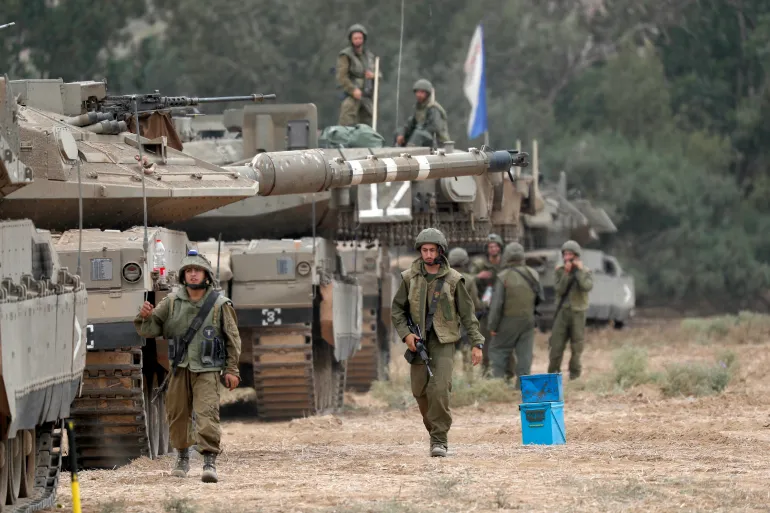
But this model imposes growing costs on an army that relies heavily on reserve forces while also requiring a prolonged deployment across multiple fronts.
As the war drags on, pressure is mounting on manpower, the economy, and military spending, prompting debate inside the Israeli Occupation over the military’s and the state’s ability to sustain a prolonged war of this kind.
Brig. Gen. (res.) Meir Finkel, head of research at the Dado Center for Interdisciplinary Military Studies, wrote on May 5, 2026, that the combination of a prolonged war and multiple theaters had created challenges unlike those for which the military’s previous plans were designed, requiring updates to military strategy, planning methods, and force building.
The limits of this model are also evident in the manpower crisis. An individual reserve battalion served an average of about 140 days in 2025, after 207 reserve battalions were activated in 2024 and 214 in 2025.
The original plan for 2026 had aimed to reduce the average length of service to about 60 days if operational conditions allowed.
On May 10, 2026, Zamir warned during a closed session of the Knesset Foreign Affairs and War Committee that the reserve army will collapse in on itself if the burden continues without expanding the pool of recruits and adjusting the length of service.
Days later, Brig. Gen. Shay Tayeb, head of the Human Resources Planning and Management Division, presented figures showing a shortage of about 12,000 regular soldiers that could rise to 17,000 by early 2027 if current service arrangements remained unchanged.
At the same time, the number of Haredim, or ultra-Orthodox Jews, classified as failing to report for military service was expected to reach about 90,000.
The financial costs have accumulated alongside the manpower crisis. A September 2026 report by the Finance Ministry’s Accountant General showed that direct government spending related to the war totaled about 231 billion shekels between 2023 and 2025, including nearly 166 billion shekels in security spending. The dollar is worth about 3 shekels.
Reserve duty payments totaled about 37 billion shekels in 2024 and 32 billion in 2025, compared with 8.7 billion shekels during the final three months of 2023.
On July 6, 2026, the Bank of “Israel” estimated the budget deficit at about 4.9 percent of GDP and the debt ratio at nearly 69 percent.
Later that month, it warned that raising the war budget to about 183 billion shekels could push the deficit to nearly 5.5 percent.
U.S. military assistance is a key factor in “Israel’s” ability to sustain this level of military activity.
The U.S. Congressional Research Service notes that the current 2019 to 2028 memorandum of understanding is worth $38 billion.
Under the agreement, the Israeli Occupation receives $3.3 billion annually in Foreign Military Financing and $500 million for missile war, in addition to the supplemental funding approved by Congress during the war.
In June 2026, the Israeli and U.S. war ministries began negotiations over a new cooperation framework for the period after 2028, as the prolonged war has increased consumption of ammunition and interceptor systems and the need to replenish stockpiles.
As the definition of the threat that must be eliminated has expanded, warnings have also grown inside the Israeli Occupation about the strategic costs of this approach.
An April 2026 study by the Institute for National Security Studies argued that the pursuit of absolute security was pushing “Israel” toward permanent war.
Sources
- Chief of Staff’s Summary of the Expert Report on the Quality of the October 7 Investigations and Lessons Learned [Hebrew]
- Israeli Deterrence and the October 7 Attack
- The State of Israel’s National Security: Doctrine and Policy Guidelines for 2025–2026
- Replacing Deterrence With Prevention [Heberw]
- Katz says Israel will hold ‘security zone’ in Lebanon until Hezbollah threat removed
- Chief of Staff Warns Foreign Affairs and Defense Committee: “The Reserve Army Will Collapse in on Itself” [Hebrew]
- The War Has Cost the State 231 Billion Shekels, and the Bill Is Far From Settled [Hebrew]
- Research Department Staff Forecast, July 2026
- From Military Achievement to a Regional Settlement [Hebrew]