Betting on Technology: How October 7th Changed ‘Israel’s’ Security
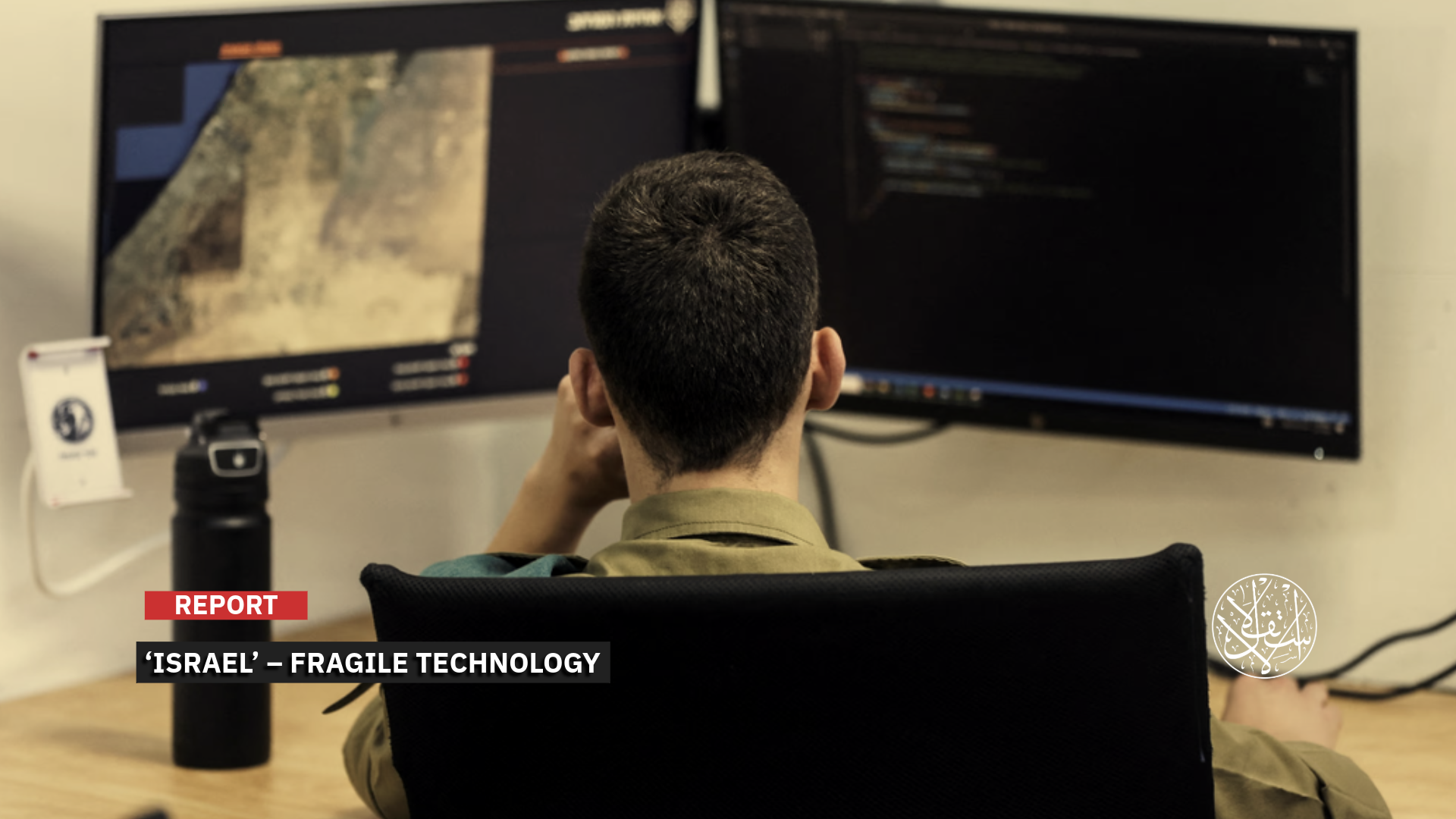
“In recent years, the Israeli occupation government has moved to strengthen what it calls technological sovereignty.”
Three years after Operation al-Aqsa Flood, “Israel’s” security establishment is undergoing a broad transformation in its relationship with technology, after the attack exposed the vulnerability of border fortifications that had cost billions of shekels and were equipped with sensors, cameras, and automated weapons, amid intelligence confidence in their ability to detect and contain threats.
The shock of October 7, 2023, prompted the Israeli military establishment to reassess its surveillance and early-warning systems, alongside the expanded use of artificial intelligence to process information and generate targets during the war on Gaza, as well as the reorganization of technological units and accelerated cooperation with civilian companies.
As these technologies have assumed a growing role, another challenge has emerged: “Israel’s” ability to control the digital infrastructure underpinning its security apparatus, particularly after a U.S. company suspended sensitive intelligence services to the Israeli military.
In response, the Israeli occupation government has pursued plans to strengthen what it calls technological sovereignty by expanding computing capacity, artificial intelligence, chip manufacturing, and data centres, in an effort to reduce dependence on foreign providers.
Smart Fence Myth
On December 7, 2021, the Israeli occupation army announced the completion of the fortification system surrounding the Gaza Strip, following three and a half years of work and an investment of approximately 3.5 billion shekels (one U.S. dollar equals three shekels), along a 65-kilometre stretch. The project was presented as a qualitative leap in border-area protection.
The system included an underground wall equipped with tunnel-detection technology, an above-ground fence more than six metres high, a network of radars, cameras and sensors, surveillance towers and remotely operated weapons, as well as a maritime barrier and control and communications rooms. The project was initially launched in the aftermath of “Israel’s” 2014 offensive.
However, an investigation published by Israel’s Channel 12 on October 19, 2025, revealed major flaws in investment allocation and the design of the fortifications.
The project’s cost had risen to approximately five billion shekels, most of which was allocated to the underground wall. In comparison, only 122 million shekels went towards the above-ground components that were breached during the attack.
The investigation quoted a former Southern Command official as saying the above-ground fence was designed to delay small groups for about 15 minutes.
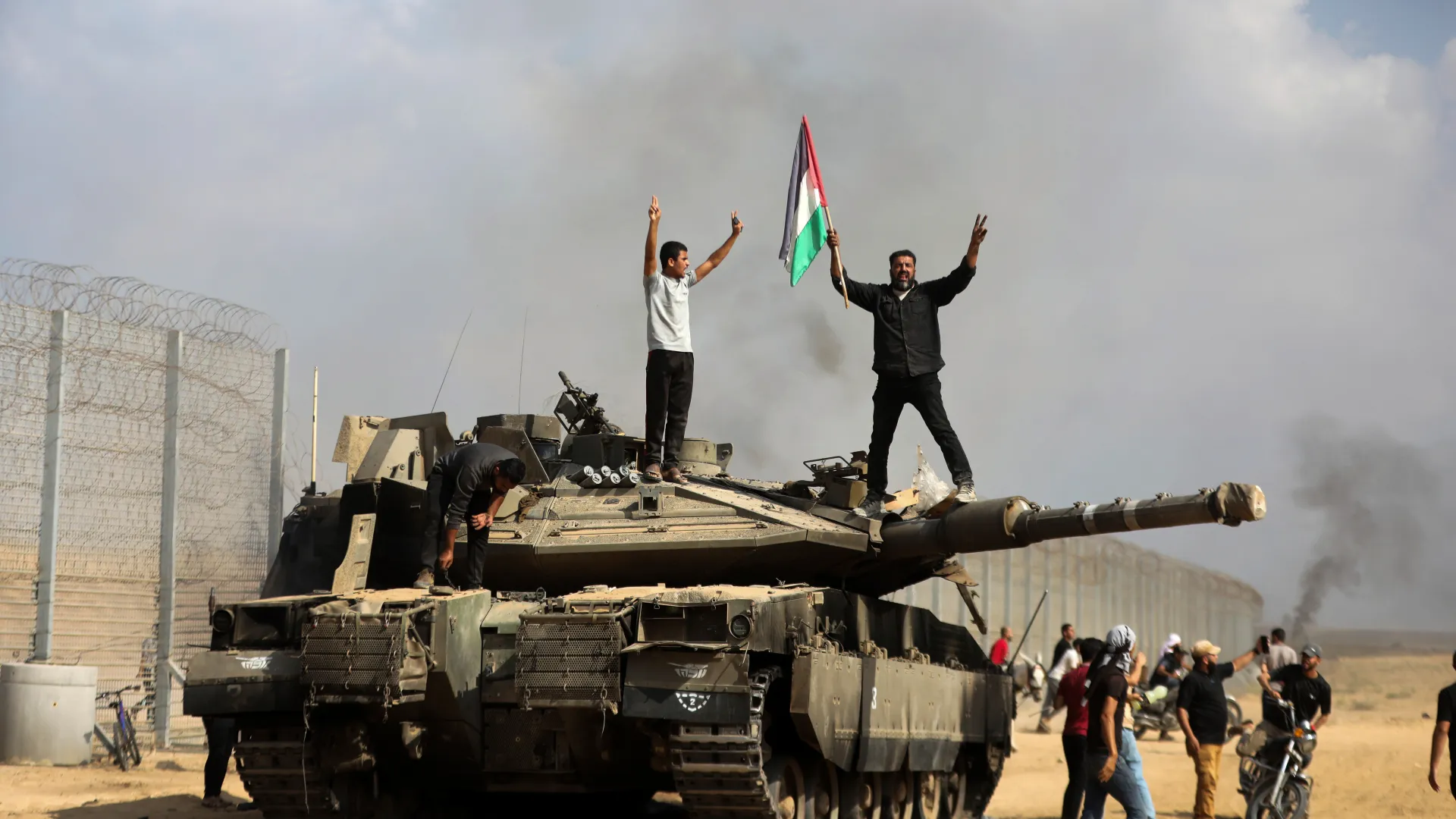
However, Palestinian resistance fighters managed to breach sections of it within three to seven minutes, exploiting its limited ability to withstand explosives and engineering equipment.
This occurred despite military intelligence having received information as early as March 2018 about a plan by the Islamic Resistance Movement (Hamas) to carry out a large-scale ground attack, later known in Israeli documents as Jericho Wall.
The shortcomings also extended to the technological systems accompanying the project. During its construction, the army promoted the use of patrol robots, autonomous drones and machine-learning technologies for surveillance.
However, former officials involved in managing the project confirmed that some of these technologies remained at the development stage and that the robots showcased during press visits were not performing their advertised functions in the field.
The investigation revealed that the automated machine-gun system, which allowed female surveillance soldiers to operate heavy weapons remotely, covered approximately one-third of the border area and could operate four machine guns simultaneously.
Meanwhile, a project to upgrade the system at a cost of 80 million shekels was rejected, and measures to protect its towers against drones were delayed.
On the morning of October 7, Palestinian resistance fighters targeted surveillance towers, cameras, communications equipment and remotely operated weapons using explosive-carrying drones before opening breaches in the fence and crossing it with fighters and vehicles, according to a visual investigation published by the U.S. public broadcaster in December 2023.
The investigation showed that disabling surveillance and communications components disrupted command centres and undermined the army’s ability to track movements on the ground and determine the locations of its own forces.
Three of the seven surveillance aerostats along the Gaza border were out of service because they required maintenance, and the cameras used on them were an older model whose production had been discontinued.
The collapse of the border system coincided with a broader intelligence failure. Israeli investigations revealed that information about Hamas’s training exercises and plans had been available before the attack. However, the assessments had dismissed the possibility that the movement was preparing to launch a large-scale operation.
Meanwhile, indications of unusual activity in the hours preceding the operation did not lead to an increased state of military alert.
On November 10, 2025, the Israeli occupation army published the findings of a review led by retired Major General Sami Turgeman. The review covered 25 military investigations and interviews with approximately 80 officials, identifying failures in intelligence assessments and military preparedness.
On October 5, 2026, the Israeli Institute for Intelligence Methodology Studies concluded that accumulated operational and technological successes had reinforced confidence in prevailing assessments at the expense of critical thinking and human analysis.
This had resulted in a state of structural blindness that undermined the ability to process information contradicting established assumptions.
This assessment helps explain part of the failure exposed by the investigations. Although the Israeli occupation’s security agencies possessed advanced information-gathering tools, they continued to interpret warnings through a security framework that assumed Hamas was deterred and that the surveillance and fortification system would provide sufficient time to respond to any threat originating from Gaza.
Developing AI Systems
The Israeli occupation army began developing artificial intelligence systems for intelligence analysis and target generation years before October 7.
In 2019, it established a dedicated directorate that developed the Habsora (The Gospel) system, which uses algorithms to analyse intelligence data and recommend buildings and facilities for targeting.
Former Chief of Staff Aviv Kochavi said that during the May 2021 war on Gaza, the system generated approximately 100 targets per day, compared with around 50 targets per year previously generated for operations against the besieged enclave, according to the comparison he provided.
The ongoing Israeli offensive on Gaza has seen a major expansion in the use of these capabilities. The army announced that it had attacked approximately 15,000 targets during the first 35 days, compared with between 5,000 and 6,000 targets during the 51-day 2014 war, according to an investigation published by the British newspaper The Guardian in early December 2023.
On April 3, 2024, an investigation published by +972 Magazine and the Hebrew-language outlet Local Call revealed another system, known as Lavender, that analyses personal data, communications, and behavioural patterns to estimate the likelihood that individuals belong to Hamas or Palestinian Islamic Jihad.
The investigation drew on testimonies from six Israeli intelligence officers, who said the system had listed 37,000 Palestinians as suspected members of armed groups.
One source said that some names were reviewed for approximately 20 seconds before being approved as targets, claiming an error rate of just 10 per cent.
Lavender’s role in classifying individuals was integrated with Habsora, which recommends targeting buildings and facilities, and the Where’s Daddy? system, which tracks the presence of individuals classified as targets at specific locations, particularly their homes.
On September 10, 2024, Human Rights Watch warned of the risks of relying on incomplete or inaccurate data in targeting systems and the implications for classifying individuals and assessing the presence of civilians.
In a study published on May 28, 2026, Israeli sociologist Uri Schwartz of Bar-Ilan University concluded that algorithms had accelerated target generation and the targeting of individuals and buildings within a military system that had adopted a broader scope of attacks and increased lethality, contributing to large numbers of civilian casualties.
The military expansion was accompanied by a sharp increase in reliance on American computing and artificial intelligence services, according to an investigation published by the Associated Press on February 18, 2025.
The investigation found that the Israeli occupation army’s use of artificial intelligence services from Microsoft and OpenAI had increased by March 2024 to nearly 200 times its level during the week preceding the October 7 attack.
The volume of data stored on Microsoft servers also more than doubled, exceeding 13.6 petabytes by July 2024. The army used the company’s Azure platform to process, translate and analyse calls, recordings and messages.
Documents revealed that the army accessed to OpenAI models through the same platform. Meanwhile, an Israeli intelligence officer described targeting errors caused by inaccurate machine translations from Arabic into Hebrew.
The transformation extended to the military’s organisational structure in December 2025, when it announced the establishment of a Directorate of Information and Artificial Intelligence, known as Bina, bringing together specialised units responsible for software, data and computing infrastructure.
Six days later, it announced a reserve unit called AiDF, comprising experts from the civilian technology sector tasked with developing military capabilities.
On August 6, 2026, the Israeli Ministry of Defence announced that its purchases from military technology start-ups had reached about one billion shekels during the first half of the year, double the same period in 2025. The number of companies cooperating with the ministry since the beginning of the offensive had reached 322.
On September 8, 2026, Chief of Staff Eyal Zamir announced plans to establish a military branch dedicated to unmanned systems and artificial intelligence, scheduled to open in December. It will cover drones, robots, and autonomous systems operating on land, at sea, and in the air.

Sovereignty or Dependence?
On September 25, 2025, U.S. company Microsoft announced the suspension of cloud storage and artificial intelligence services provided to a unit affiliated with the Israeli Ministry of Army, following an investigation published by The Guardian in collaboration with +972 Magazine and the Hebrew-language outlet Local Call on August 6.
The investigation revealed that Military Intelligence Unit 8200 had used Azure servers to store and process vast quantities of intercepted Palestinian telephone calls.
Microsoft President Brad Smith said an internal review had found evidence supporting parts of the investigation, prompting the company to disable specific subscriptions and services associated with the military unit.
Cooperation in other areas, including cybersecurity, continued. The decision raised Israeli concerns about the ability of foreign companies to suspend sensitive intelligence services.
In 2021, the Israeli occupation government launched Project Nimbus under a contract worth approximately $1.2 billion with U.S. companies Google and Amazon to establish domestic cloud-computing infrastructure serving government and security institutions.
On October 29, 2025, another joint investigation by the same publications, based on documents from Israel’s Ministry of Finance, revealed that the contracts included restrictions on the two companies’ ability to suspend services, alongside a secret provision known as the “wink mechanism.”
The mechanism uses coded financial signals to alert Israeli authorities to foreign requests for data when legal orders prohibit directly notifying the customer. Both companies denied that they agreed to circumvent their legal obligations.
On May 17, 2026, the Israeli occupation government approved an initial artificial intelligence development program with funding of 2.597 billion shekels through 2032.
Approximately 2.502 billion shekels were allocated to computing infrastructure. The program includes providing computing capacity equivalent to at least 5,000 graphics processing units (GPUs) annually throughout 2027–2032.
On June 16, “Israel” expanded its ambitions by approving a plan to make computing capacity equivalent to the performance of 100,000 AI accelerators available within five years.
The plan also includes examining the development of domestic chip-manufacturing capabilities and creating AI models tailored to Israeli needs.
The private sector is expected to develop the required infrastructure, without the government necessarily having to own the processors themselves.
During a Knesset session on July 9, 2026, Erez Eskel, head of the National Artificial Intelligence Authority, estimated that approximately five billion shekels annually would be needed to achieve the country’s technological ambitions.
Orit Farkash-Hacohen, chair of the relevant committee, linked the October 7 failure to the suspension of cloud services and restrictions on the supply of certain weapons.
She argued that securing technological infrastructure had become a national security issue and called for reducing foreign companies’ ability to disrupt military services.
In a study published by Israel’s Institute for National Security Studies on June 30, 2026, researcher Hadas Lorber, a specialist in technology and national security, warned that access to AI models and computing power was becoming an instrument of geopolitical leverage.
She noted that “Israel’s” dependence on foreign processors and cloud services required it to develop domestic capabilities and secure long-term agreements with the United States to ensure continued access to sensitive technologies.
On July 26, 2026, the Israeli financial newspaper Globes reported that the Ministry of Finance had cancelled a grant worth 1.3 billion shekels intended to expand the U.S. company Intel’s factory in Kiryat Gat, south of Tel Aviv.
The decision followed the project’s suspension since June 2024, despite an earlier agreement providing for government incentives of up to 11.1 billion shekels in exchange for a planned investment of approximately 89 billion shekels.
The experiences involving Microsoft and Intel expose the limits of “Israel’s” ambitions to achieve technological sovereignty.
The former demonstrated that a foreign company could suspend sensitive intelligence services, while the latter revealed difficulties in expanding domestic chip manufacturing.
Together, these cases put the government’s plans to the test, raising questions about its actual ability to control the technologies underpinning the Israeli occupation’s security apparatus.
Sources
- The Fortification Failure: The Fence and Technologies Meant to Stop Hamas Collapsed in Just Four Minutes [Hebrew]
- Chief of Staff’s Summary of the Expert Report on Assessing the Quality of Investigations and Lessons Learned from October 7 [Hebrew]
- Organisational Culture in the Israeli Intelligence Community: Rationales, Tensions and Barriers in Light of the Intelligence Failure of October 7 [Hebrew]
- ‘Lavender’: The AI Machine Directing Israel’s Bombing Spree in Gaza
- Questions and Answers: Israeli Military’s Use of Digital Tools in Gaza
- How US Tech Giants Supplied Israel with AI Models, Raising Questions About Tech’s Role in Warfare
- Technologies of Distinction for Indiscriminate Killing: What Can the Israeli War on Gaza Teach Us About the Social Meaning of AI?
- Update on Ongoing Microsoft Review
- ‘No Restrictions’ and a Secret ‘Wink’: Inside Israel’s Deal with Google, Amazon
- The Battle for Access to Artificial Intelligence: Israel’s Next Strategic Challenge [Hebrew]
- Treasury Cancels Intel Grant