Palestinian Activist: We Hit ‘Israel’s’ Arms Industry, So London Banned Us and Washington Sanctioned Us (Exclusive)
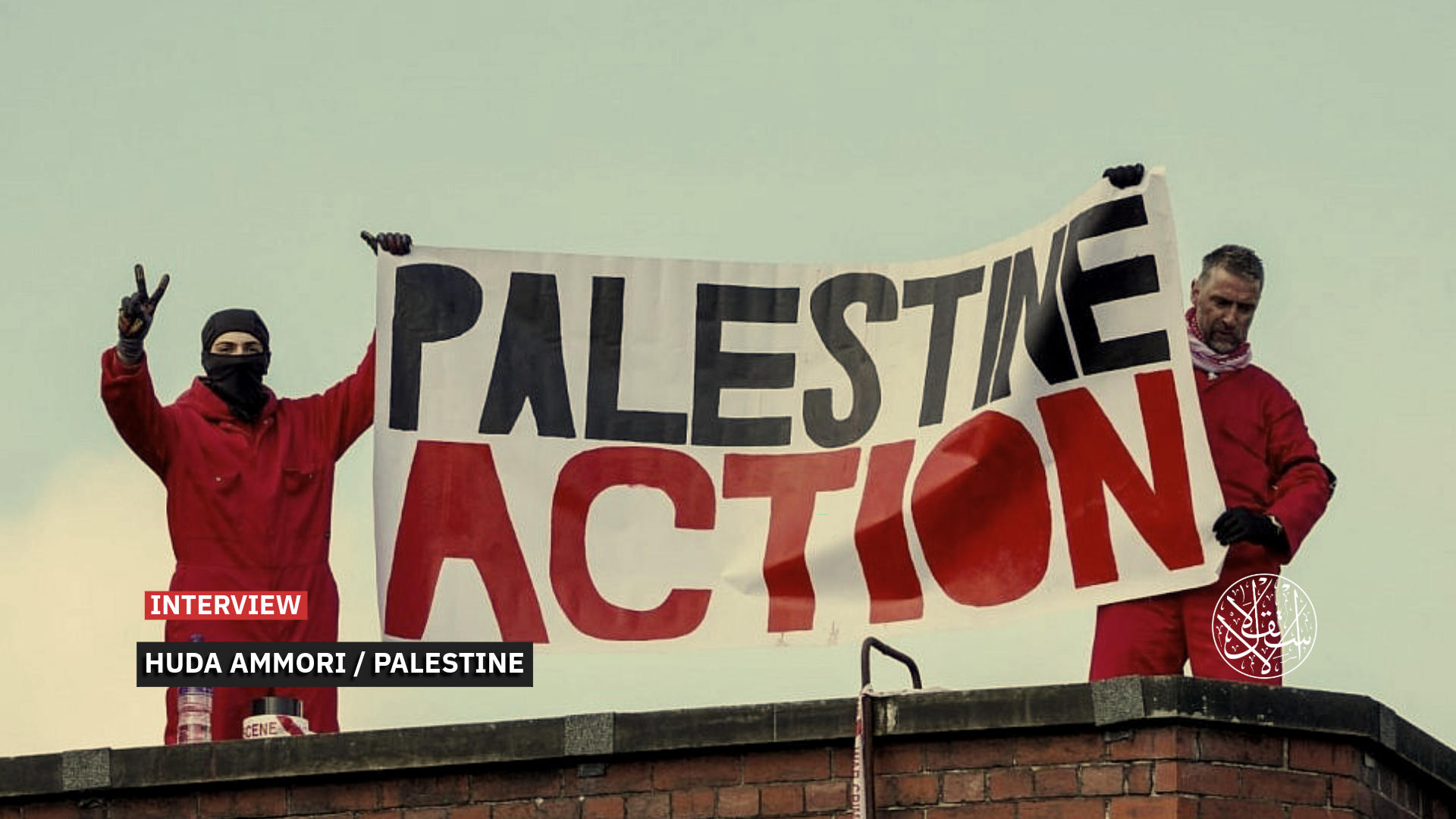
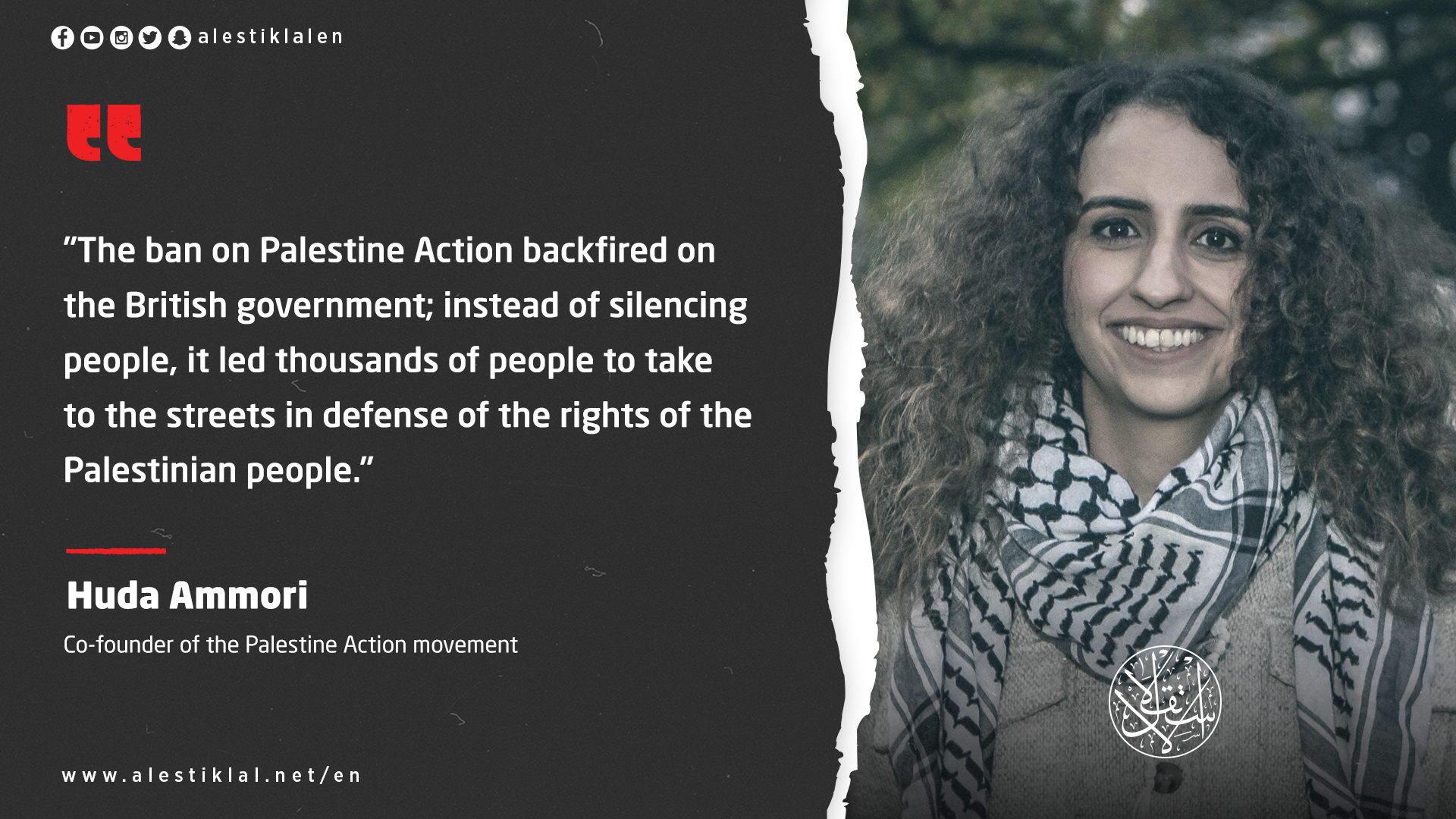
“The UK government’s ban on Palestine Action under counterterrorism laws has backfired.”
Huda Ammori, co-founder of the Palestine Action movement, said that years of direct action against Israeli company Elbit Systems in Britain had led to the closure of four weapons sites and prompted more than 10 companies to sever ties with it, in addition to costing it contracts worth billions of pounds.
In an interview with Al-Estiklal, Ammori explained that these results prompted the Israeli government, the company and pro-“Israel” lobbying groups to intensify pressure on British authorities to take action against the movement.
Palestine Action was founded in 2020 as a direct-action movement targeting the activities of arms companies linked to Israel in Britain, particularly Elbit Systems. The British government banned the group on July 5, 2025.
On February 13, 2026, the High Court of England and Wales ruled that the decision was unlawful, before the Court of Appeal overturned the ruling on June 15 and upheld the ban as lawful.
On July 29, 2026, the UK Supreme Court agreed to hear part of Ammori’s appeal and scheduled hearings for November 4 and 5, 2026.
Ammori argued that the British government’s ban on Palestine Action under counterterrorism laws had backfired, bringing thousands of people into the streets in support of the movement and Palestinian rights rather than silencing its activities. She stressed that direct action against Elbit continued through other groups despite the ban.
The case now centres on whether designating the movement as a “terrorist organization” is proportionate to the rights to freedom of expression and protest.
Ammori said the government’s case is based on inaccurate claims and that the ban has had a far-reaching impact on freedom of expression.
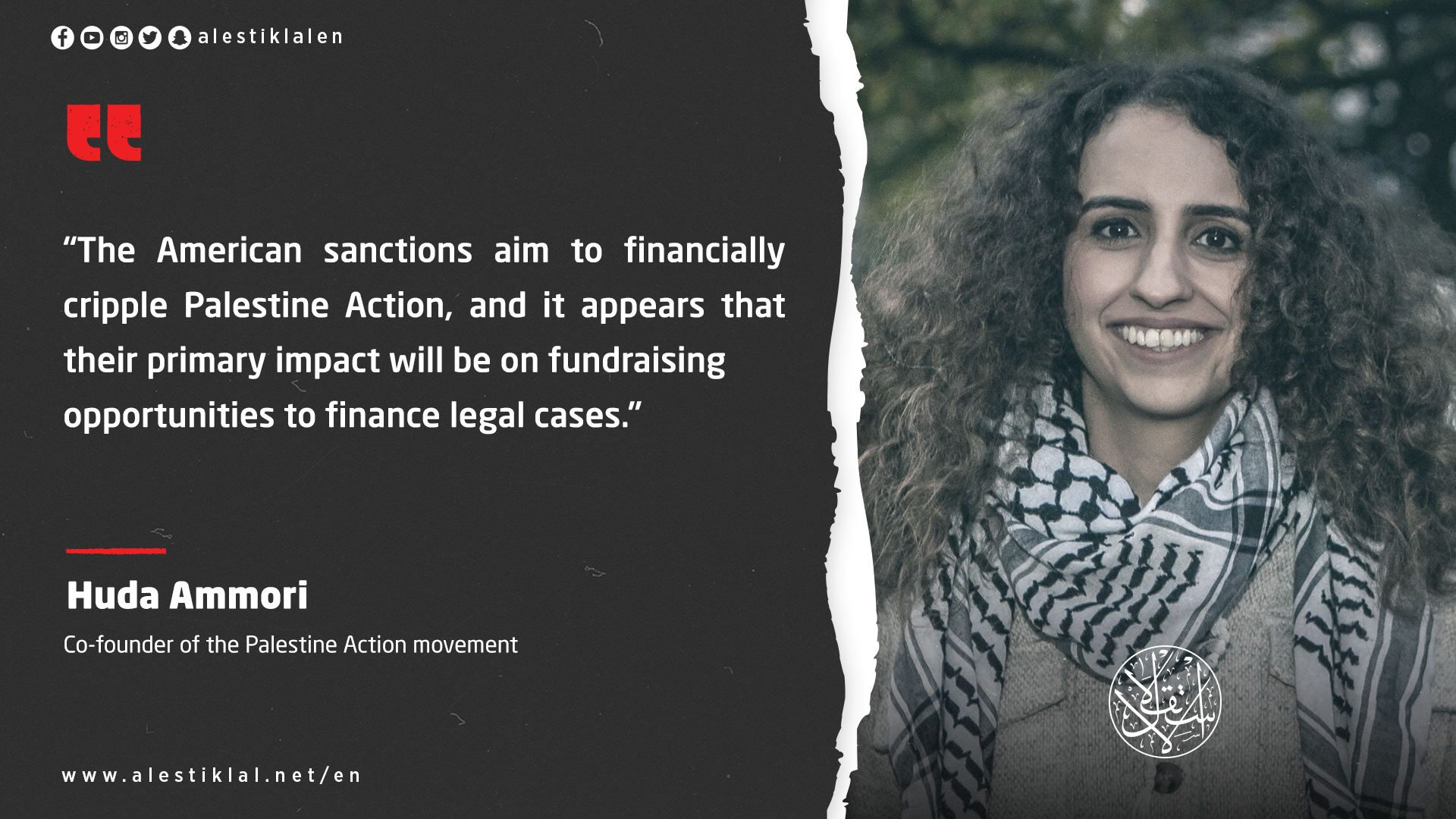
Ammori described U.S. sanctions against Palestine Action as a direct consequence of the British ban, saying they aimed to financially disrupt the movement and affect its ability to raise funds for its legal cases.
At the same time, she maintained that neither the ban nor the sanctions had changed her conviction that direct action was the most effective way to confront the Israeli arms industry.
Huda Ammori is a Palestinian-Iraqi activist who co-founded Palestine Action after years of involvement in campaigns for boycotts, pressure and solidarity with Palestine.
The movement subsequently became one of Britain’s most prominent direct-action groups targeting Israeli arms companies, before becoming embroiled in a legal battle with the British government following its ban and designation as a terrorist organization.
From Campaigns to Direct Action
After Six Years, What Has Changed in Palestine Action and in Your View of the Effectiveness of Direct Action?
Over the years, Palestine Action has grown stronger, with thousands of people joining to take direct action against Elbit Systems, “Israel’s” largest arms company.
This led to the closure of four Israeli weapons sites in Britain and prompted more than 10 companies to sever their ties with Elbit Systems. The Israeli company also lost contracts worth billions of pounds.
As we achieved these successes, the Israeli government, Elbit Systems and pro-“Israel” lobbying groups intensified their pressure on the Crown Prosecution Service (the prosecuting authority in England and Wales), the police and British ministers to crack down on Palestine Action.
This ultimately led to the unprecedented use of counterterrorism powers against participants in direct action, followed by the banning of Palestine Action and its designation as a terrorist organization.
The successes achieved by Palestine Action, and the repressive response it faced from the government, demonstrate the effectiveness of direct action and why it is a necessary tool for stopping “Israel’s” war machine.
How Did Your Palestinian and Iraqi Origins Influence the Founding of the Movement, and Why Were Traditional Campaigning Methods No Longer Enough?
My personal connection to Palestine and Iraq constantly reminded me of the privilege I had in not growing up to the sound of bombs and drones, fearing whether I would make it to the next day or whether my home would be destroyed.
At the same time, I was aware that the arms factories and companies facilitating the destruction of Palestine were operating close to me here in Britain.
Like many others, I felt a moral obligation to do everything I could, from the position I was in, to disrupt the Israeli military supply chain.
After years of intensive activism focused on building boycott and lobbying campaigns, including my work with the Palestine Solidarity Campaign (a British organization advocating for Palestinian rights), I came to realise that traditional campaigning tools were extremely limited.
While we achieved some successes, they were negligible compared with the scale of the global ties with the Israeli apartheid regime.
Political lobbying relies on trying to convince politicians and institutions of the facts, but they are not interested because the British state has entrenched interests in its relationship with “Israel”.
I also came to understand that Britain has been involved in the colonisation of Palestine for more than a century, and successive governments have maintained this reality.
Elbit Systems was operating right in front of us, and instead of fruitlessly pleading with those carrying out the oppression, the most logical step was to shut it down ourselves through direct action.
Limits of Direct Action
What Tangible Results Did the Campaign Against Elbit Systems Achieve?
Palestine Action has been highly effective in disrupting the Israeli arms industry. Just one month after the movement was founded, the Israeli government met with the British foreign secretary and asked him to take action against the new direct-action movement.
It is clear that the Israeli government recognized the power of direct action and the threat it posed to Elbit Systems’ operations in Britain.
Palestine Action’s strategy was based on the continuous disruption of Elbit Systems and the companies that enable it to continue operating. This affected the company’s finances so much that it was forced to close four of its weapons facilities in Britain.
The sustained disruption led to a significant decline in Elbit’s revenues, increased its costs, and prompted companies to refuse to do business with it, making it unviable for the company to continue operating from those factories and offices.
Do You Consider Damaging the Company’s Property an Act of Violence? Why Do You Reject the Label of Terrorism?
This argument is based on the assumption that the value of the weapons used to kill Palestinians is greater than the value of the lives of those victims.
In a single operation at an Elbit facility in Filton, near Bristol in southwest England, in August 2024, activists destroyed more than 40 pieces of Israeli military equipment, including quadcopter drones, each of which could have killed hundreds of Palestinians, perhaps more.
Elbit Systems’ property and weapons are being used to contribute to the continuation of the genocide against Palestinians. Therefore, they should be destroyed to protect lives and support the struggle for a liberated Palestine.
To illustrate this with an example, if a building were on fire with children trapped inside and you had to break down the door to rescue them, would anyone question the damage done to the door?
Palestine Action intended to disrupt, damage, and destroy Elbit Systems’ property, including the machinery and weapons used in the genocide in Gaza. At no point did the movement intend to carry out unlawful violence against people.
In the limited cases where physical confrontations may have occurred, they followed violent confrontations with Elbit security guards, who are former military personnel trained to attack protesters to protect Israeli weapons.
Did the Brize Norton Operation at the RAF’s Largest Base Give the Government a Pretext to Ban the Movement?
The government was already planning to ban Palestine Action before the Brize Norton operation on June 20, 2025, when two activists broke into the base and damaged two military aircraft. The operation was not part of the assessment used to justify the ban.
Before the operation, no major media outlets had been reporting on the role of the Royal Air Force in the genocide in Gaza, including surveillance flights and the refueling of Israeli fighter jets. The operation brought attention to that role.
The British government’s use of the operation as a justification for beginning the process of banning Palestine Action was also a vastly disproportionate reaction.
It was clear that the authorities were deeply embarrassed that people on electric bicycles had managed to enter the base and spray the aircraft with red paint.
It is also important to note that previous actions inside British military bases, some of which involved plans to set fires in protest against nuclear weapons or the illegal war in Iraq, were never treated as terrorism.
The claim that spraying aircraft with red paint could constitute terrorism is absurd and reveals the extent of the discrimination faced by Palestinians and those who act in their defense.

Legal Battle
What Is the Main Issue Before the UK Supreme Court Today, and What Would a Victory Change?
The main issue before the Supreme Court is whether the ban on Palestine Action is proportionate to freedom of expression and the right to protest.
Our argument rests on two main points. First, the government’s case for banning Palestine Action is based on inaccurate claims. Second, the ban itself is disproportionate to human rights.
This is evident in the arrest of thousands of people for carrying signs, as well as the chilling effect that has led hundreds of thousands, if not millions, of people to remain silent about their beliefs for fear of arrest.
Did You Expect the Ban to Lead to Thousands of Arrests? What Does That Reveal?
The ban and the scale of support that emerged afterward came as a huge shock to me. But the ban on Palestine Action has backfired on the government.
Instead of silencing people, it led thousands to come out in defense of our rights in Britain and the Palestinian people.
It is also clear that the ban weakened the counterterrorism framework in ways the government did not anticipate. The state underestimated the level of support for Palestine Action and for the Palestinian people when it decided to ban the direct-action movement.
What Did the Court of Appeal Get Wrong in Classifying the Movement as Terrorist?
First, the ban on Palestine Action is based exclusively on the provision of the Terrorism Act concerning serious damage to property, which the government claims was committed.
But this property consisted primarily of weapons manufactured by Elbit Systems, which could have been used to kill countless Palestinians had they not been destroyed. Saving lives is the exact opposite of what most people understand by terrorism.
The Court of Appeal went far beyond its role of determining whether the ban was lawful based on the evidence before it.
The judgment sought to demonize Palestine Action, revealing the politicization of the case and the bias that undermined the ruling. To rule against us, the court had to distort the facts to such an extent that they simply contradicted the evidence.
The Court of Appeal said that Palestine Action’s secret manual encouraged the use of lethal weapons, but if people read the manual for themselves, they would realize how absurd that claim is.
There is no reference to lethal weapons anywhere in the movement’s manual. It is simply a guide to common direct-action methods involving damage to the property of companies linked to Elbit Systems.
Even counterterrorism police guidance states that possessing the manual does not constitute the offense of possessing material for the preparation of a terrorist act, while the government’s case claims that the manual proves that Palestine Action was “preparing” for terrorism.
The government’s case also claims that Palestine Action glorifies terrorism. To support this, it points only to the movement’s description of the Filton 25, activists accused in connection with the 2024 break-in at the Elbit facility in Filton, as political prisoners, and to its publication of reports by the United Nations and Amnesty International criticizing the use of counterterrorism powers.
There are many other examples that undermine the government’s case for the ban. Our argument therefore focuses on presenting these facts to the court, highlighting the errors made by the Court of Appeal, and presenting a substantial body of evidence demonstrating how disproportionate the ban is.

American Sanctions
What Does the US Designation of the Movement and the Imposition of Sanctions Mean?
It is clear that the U.S. sanctions against Palestine Action came after and as a result of the British ban, which demonstrates how irresponsible the British government was in banning the movement and exposing its own citizens to the risk of sanctions as well.
The sanctions imposed on Palestine Action also reveal that the movement is facing harsher sanctions than those imposed on “Israel”.
The US sanctions have received extensive media coverage, which reported that I was also barred from entering the United States as a result.
This does not affect me at all. I have never visited the United States and have never wanted to visit a country responsible for destroying both of my homelands. The U.S. sanctions are intended to financially disrupt Palestine Action.
Their primary impact appears likely to be on our ability to raise funds to finance legal cases, while also setting another dangerous precedent against the Palestine solidarity movement.
But we are living through a period of repression against the movement as a whole, and we have to adapt to it without backing down.
Whatever repression we face, it remains insignificant compared with the reality that the Palestinian people experience every day.
After the Ban and Sanctions, Has the Campaign Weakened or Has Its Message Reached More People? Do You Still Believe in Direct Action?
The ban on Palestine Action has increased awareness of the idea of direct action and demonstrated how effective it can be as a tool for confronting the Israeli war machine.
Direct action against Elbit Systems has continued through different groups, while thousands of people have taken part in a civil disobedience campaign against the ban. It is clear that the disproportionate and repressive ban has backfired on the government.
Direct action has proven to be the most effective path. The struggle for Palestinian liberation requires all of us to be willing to take risks.