Iraqi Researcher: Iran Lost the Intelligence Battle, Not the State (Exclusive)
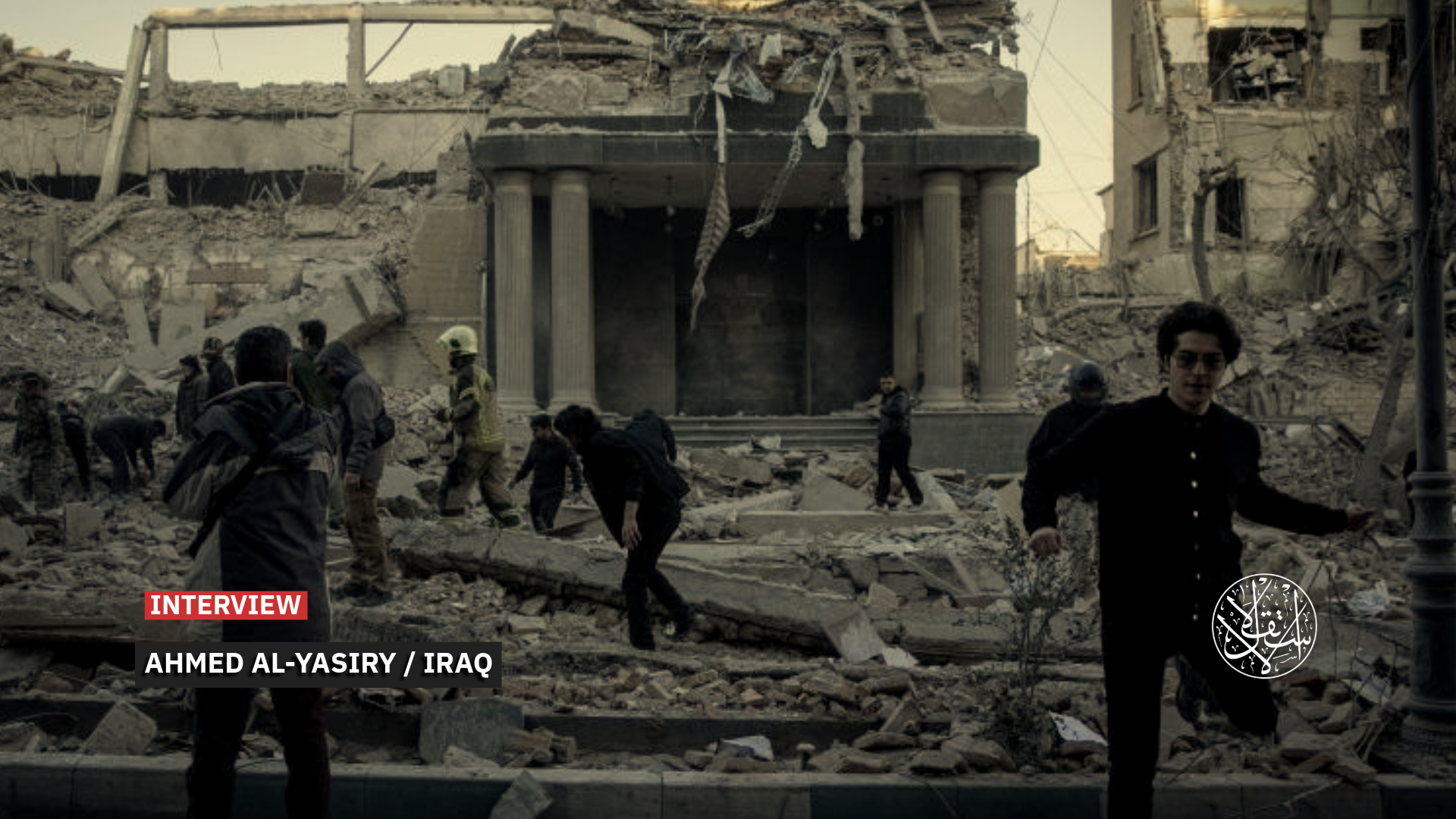
“The intelligence battle weakened Iran but did not bring down the regime.”
Political researcher specializing in Iranian affairs Ahmed al-Yasiry said the military option remains on the table in the confrontation between the United States and Iran, but noted that war and diplomacy have become intertwined tracks.
He explained that Washington and Tehran may use military escalation, geography, and maritime routes to improve their negotiating positions, without necessarily moving toward an all-out war.
In an interview with Al-Estiklal, al-Yasiry said Iran could freeze its regional proxies' and allies' activities if it resumes negotiations with Washington, but would not sever those relationships, as they are part of its security and political system.
He noted that Tehran views the Strait of Hormuz and the Bab el-Mandeb Strait as important leverage in confronting U.S. and regional interests.
He said Iran lost the intelligence battle against “Israel” and the United States, despite succeeding in maintaining the cohesion of its institutions and preventing the regime from collapsing.
He explained that the targeting of senior leaders did not lead to the collapse of the state, adding that the biggest challenge could emerge from the Iranian public’s reaction after the war ends.
He said that if political change occurs, Iran’s future could move toward a transitional phase managed by forces within the existing system, with increased influence from the Islamic Revolutionary Guard Corps and the security establishment, or with a continued role for the religious establishment.
He stressed that the internal conflict centers more on the state's survival and unity than on the political system's survival.
Ahmed al-Yasiry is the head of the Australian Arab Center for Strategic Studies. He is an Iraqi journalist and researcher specializing in Iranian affairs and Middle Eastern issues, with research contributions and published articles in Arab and international research centers and newspapers, as well as a regular media presence on television networks.
The Future of the War and Confrontation
In light of continued U.S. threats against Iran, to what extent does the military option remain on the table for resolving the disputes between Washington and Tehran?
The military option remains on the table; in fact, it is the strongest option at this stage because we are essentially facing a military confrontation, rather than merely a diplomatic conflict as was the case during the Barack Obama administration, when the two sides reached the nuclear agreement under international supervision, with international parties playing a role and an international framework provided through the Joint Comprehensive Plan of Action.
At that stage, the confrontation was diplomatic and protracted, particularly during the tenure of Hassan Rouhani in Iran and the Obama administration in the United States, with experienced figures such as John Kerry and Mohammad Javad Zarif.
But this situation did not last. When Donald Trump came to power, he was able to withdraw from the agreement because it had not been ratified by Congress.
This is an important point: the failure to have the agreement ratified by Congress, amid disagreements between Democrats and Republicans, allowed Trump to withdraw from it.
That is why, during the negotiations preceding the war, Iran focused on the need to restructure any agreement in a way that would prevent a repeat of this scenario, and demanded that Congress and the Senate vote on any new nuclear agreement.
If we look at the confrontation between Iran and the United States more broadly, it has continued since the Iranian Revolution in 1979 and has taken various forms, from direct warfare to the Tanker War, followed by diplomatic and nuclear confrontation.
But military options have always accompanied diplomacy; neither diplomacy alone has resolved the dispute, nor has war alone been able to end it.
Therefore, military action will remain on the table, and Trump may use it to improve his negotiating position, while Iran will respond in turn to improve its own.
We are witnessing a new form of warfare in which geography, economics, and maritime routes are used alongside military force, while negotiations remain part of the confrontation.
If the war resumes, what scenarios could shape its course and objectives, and could it move toward weakening the Iranian regime or pushing it back to the negotiating table?
Iran does not fight in order to expand; rather, it expands in order to fight. In other words, it establishes external proxies and fronts with the aim of protecting the regime.
The Iranian philosophy is not based on expansion for its own sake. Even the concept of exporting the revolution is a political concept more closely linked to protecting the regime than to exporting the revolution in the philosophical sense.
Iran understands that its system is at odds with the values of political modernity in the Western world and is therefore vulnerable to confrontation.
As a result, it has adopted a strategy of building from the outside in, that is, using the external environment to protect the domestic one.
This led to the strategy of establishing external fronts and proxies after the Iran-Iraq War, a strategy to which Qasem Soleimani contributed significantly.
Therefore, a renewed war does not necessarily mean that the U.S. objective would be to overthrow the regime. The goal may instead be to pressure it, weaken its capabilities, and improve the terms of negotiations.
Iran will use its military, regional, and geographic tools to force the United States to reconsider its calculations.
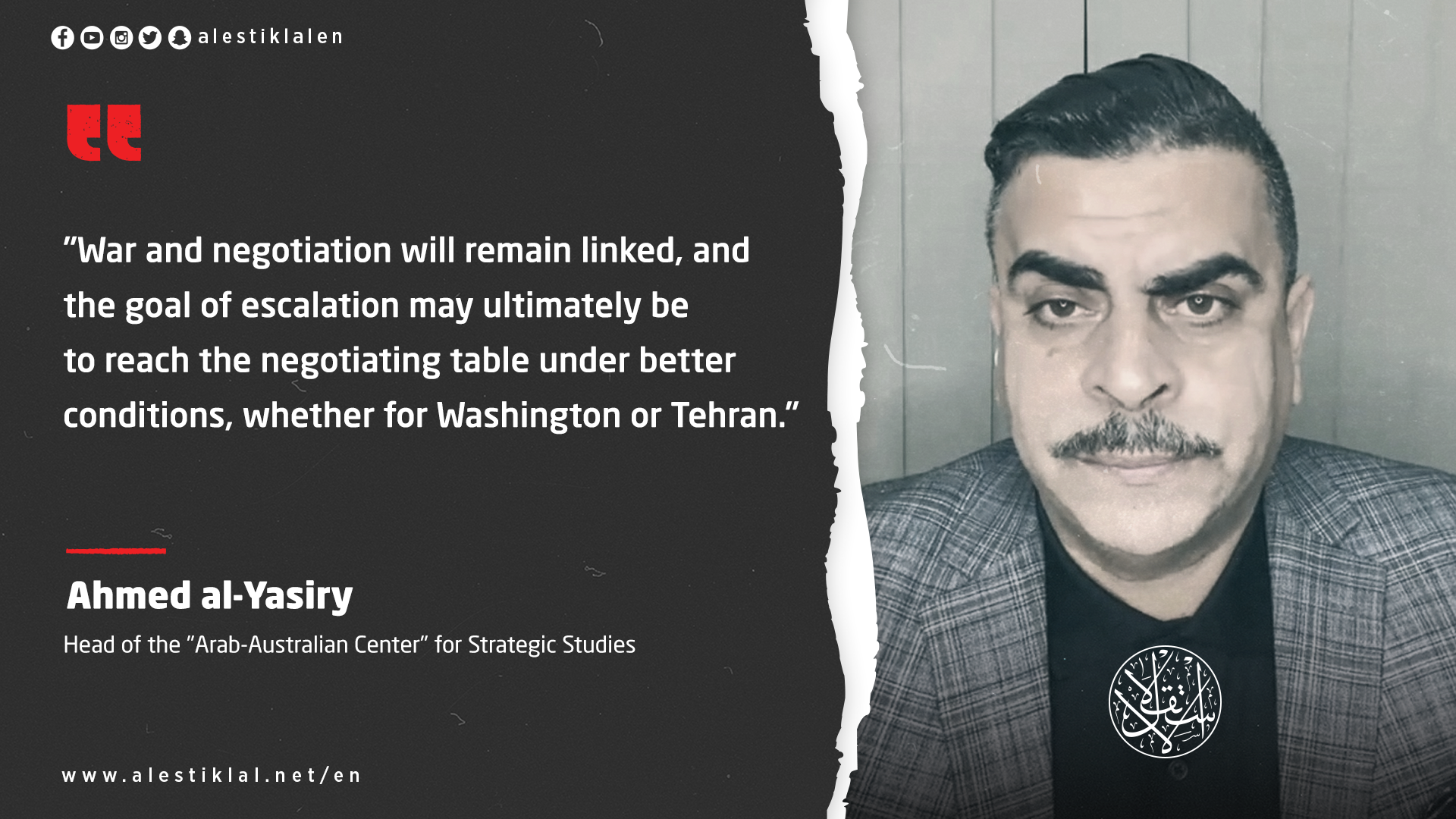
Therefore, war and negotiations will remain interconnected, and the ultimate aim of escalation may be to reach the negotiating table from a stronger position.
If Iran returns to negotiations with Washington, could it agree to reduce the role of its proxies and allies in the region?
I believe Iran may freeze the activities of its proxies, but it will not eliminate them because it may need them at a certain point. It will not end its relationships with them, whether at the political, ideological, or security level.
Iranian decision-making regarding relations with its allies is based on two dimensions: security and political considerations. The security rationale is largely constant, while political doctrine can change depending on interests and circumstances.
If we look at Iran’s history of relations with its allies, such as Hezbollah, Hamas, Palestinian Islamic Jihad, and the Houthis, we find that it has supported them under different circumstances, but during certain political periods it has frozen some forms of support or activity.
This was evident during the nuclear agreement period, when missile and proxy-related issues were discussed alongside the negotiations.
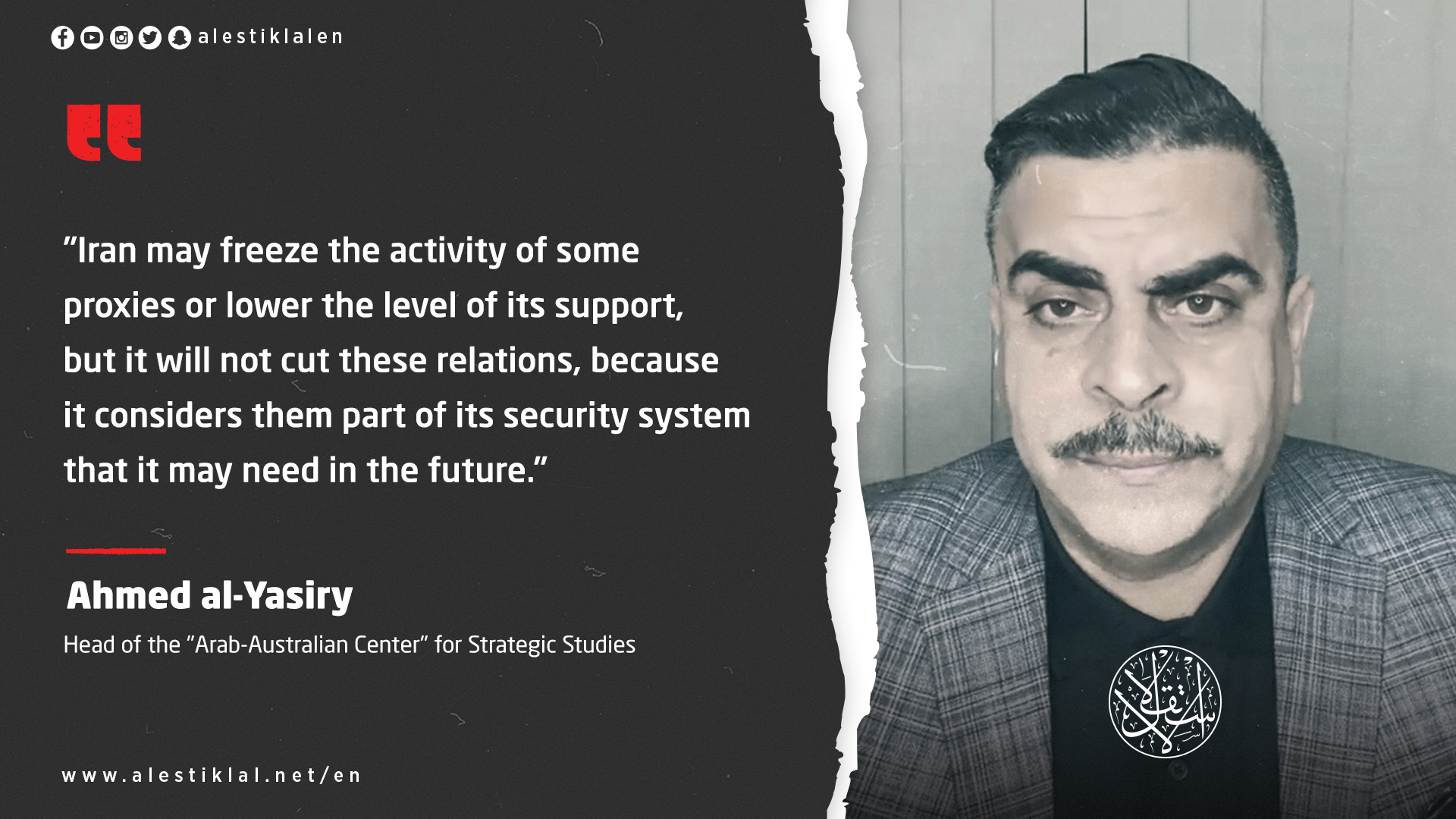
Therefore, Iran may freeze the activities of some proxies or reduce the level of support it provides to them, but it will not sever these relationships because it considers them part of its security system, which it may need in the future.
Iran’s Response and Regional Geography
How could Iran respond if a new confrontation breaks out, and what tools could it use against the United States, “Israel”, and U.S. interests in the region?
Iran has multiple tools at its disposal for exerting pressure, and they are not limited to direct military action. Among the most important are geography and maritime routes.
Reaching an understanding with the United States could also facilitate an understanding between Iran and the Gulf states, because these countries feel geographically and security-wise surrounded.
The Strait of Hormuz is an important bargaining chip in this equation. When the strait is closed, countries such as Kuwait, Qatar, and the UAE are affected to varying degrees because they depend on this maritime outlet, although some countries have alternatives, such as Oman, or greater land depth and other routes, such as Iraq.
Therefore, the Gulf states do not necessarily want to go to war with Iran. Rather, they want to protect their interests and prevent maritime routes from becoming tools for exerting pressure on them.
Iran understands the importance of this leverage and seeks to use it in negotiations and to pressure U.S. interests in the region, making the U.S. presence more costly.
In addition, Iran draws on North Korea’s experience in dealing with sanctions and U.S. pressure by using deterrence, geography, and military capabilities to raise the cost of pressure against it and improve its position in any future negotiations.
To what extent could threats to the Strait of Hormuz and the Bab el-Mandeb Strait affect the calculations of regional countries and the United States?
The Strait of Hormuz is particularly important in terms of energy because it is a major route for oil and gas exports, while the Bab el-Mandeb Strait is more important in terms of global trade because it connects the Indian Ocean to the Red Sea and from there to the Mediterranean, and is directly linked to the Suez Canal.
Therefore, closing the Bab el-Mandeb could force ships to travel around the Cape of Good Hope, increasing the distance, travel time, and costs, with repercussions for trade between Europe and Asia and for the global economy.
Accordingly, Hormuz represents a source of leverage in the energy sector, while the Bab el-Mandeb represents leverage affecting both energy and trade.
This equation pushes countries to protect trade routes, but at the same time makes regional states more inclined toward de-escalation and avoiding further escalation, because a prolonged war becomes an economic and geographic burden for them.
Could a continued confrontation lead Gulf states to reconsider their relationship with the United States?
Regional states could reconsider their foreign policies, particularly their reliance on the United States; the United States under George H. W. Bush is not necessarily the same as the United States under Donald Trump.
U.S. policy toward the region has changed, with greater emphasis on power and direct interests.
Trump does not view international partnerships in the same traditional way. Instead, he places greater emphasis on power and interests and therefore attaches greater importance to countries with clear economic and military capabilities.
This also helps explain the U.S. approach to issues such as Yemen, because the threat to the Bab el-Mandeb cannot be separated from the threat to Hormuz.
As a result, regional states may find themselves needing to develop regional arrangements that reduce the likelihood of becoming arenas for conflict, particularly since a continued war with Iran does not serve their economic and security interests.
The Domestic Front and the Future of the State
With several Iranian military and security leaders targeted, to what extent do these developments reveal internal vulnerabilities that could pose a challenge to the regime?
Over the past decades, Iran has won proxy wars and conflicts involving tankers and maritime routes, and has managed to protect its regime for more than 47 years. However, it can be said that it has lost its most important battle against “Israel”: the intelligence battle.
This battle is not new. There have been previous examples of intelligence breaches and targeted operations inside Iran, culminating in the killing of several senior leaders.
Iran was fighting in the face of Israeli and U.S. intelligence superiority, while “Israel” was carrying out rapid and organized strikes to achieve specific objectives, rather than necessarily engaging in a long conventional war.
At the same time, however, Iran distributed its security and political efforts effectively and remains standing despite losing this battle.
Therefore, I would not describe what happened as either a complete victory or a complete defeat. “Israel” and the United States achieved significant intelligence breakthroughs, but this did not lead to the fall of the regime.
In my view, the real challenge is not limited to the targeting of leaders, but also concerns the reaction of the Iranian public after the war ends.
Iranians do not necessarily defend the regime; rather, they defend the state, and they distinguish between the two. They may stand with the regime if they believe it is protecting the state from fragmentation.
To what extent do Iranian Kurdish opposition forces, particularly those based in Iraq, represent a source of concern for Tehran?
These groups represent a security and political concern for Iran because they are armed and active, operate in difficult terrain, particularly mountainous areas, and receive support from surrounding forces.
At the same time, however, they are geographically limited, concentrated primarily in Iran’s Kurdistan and Kermanshah regions, Marivan, and surrounding areas.
This limits their ability to turn their political project into a nationwide project across Iran because of their differences with other ethnic and national groups.
There is a degree of consensus between the Iranian regime and several Iranian opposition political forces on the importance of preserving the unity of the state, even though they differ over the form of the political system.
Political change may occur in Iran, but that does not necessarily mean that Kurdish regions will become a project for dismantling the Iranian state as a whole.
If the Iranian regime were to undergo political collapse, what scenarios could shape the future of the state, and could this lead to the fragmentation of Iran?
Political fragmentation and separatist tendencies do exist, with movements such as the Baloch movement, Kurdish parties, and the Arab movement in Ahvaz. However, they currently lack a broad popular project capable of dismantling the state as a whole.
If the political regime falls, Iran will face a complex situation. The regime could remain in place for a period while the state becomes weak or nearly collapsed, as has occurred in other cases.
Therefore, the primary focus would be on preserving Iran’s territorial integrity, as this represents one of the state’s main sources of strength. Iran is a large country with maritime and land corridors and an important geographic position. It also has vast mountainous areas that make military control extremely difficult.
For this reason, any system that comes after the current regime would find itself compelled to preserve Iran’s unity.
There are three main possible scenarios:
First, the emergence of an internal force, such as reformists or a faction from within the existing system, to form a coalition that manages a transitional phase, followed by elections and a restructuring of the political system.
Second, Iran could shift from a directly theocratic system to a security-based system, with the Islamic Revolutionary Guard Corps and the security establishment gaining greater influence over the management of the state.
Third, the religious establishment could remain a key player, given the deep-rooted nature of the religious seminaries and their social and historical influence.
For this reason, bringing down the Iranian regime is not a simple matter, because the system is not built around a single individual but around multiple religious, security, and political institutions.
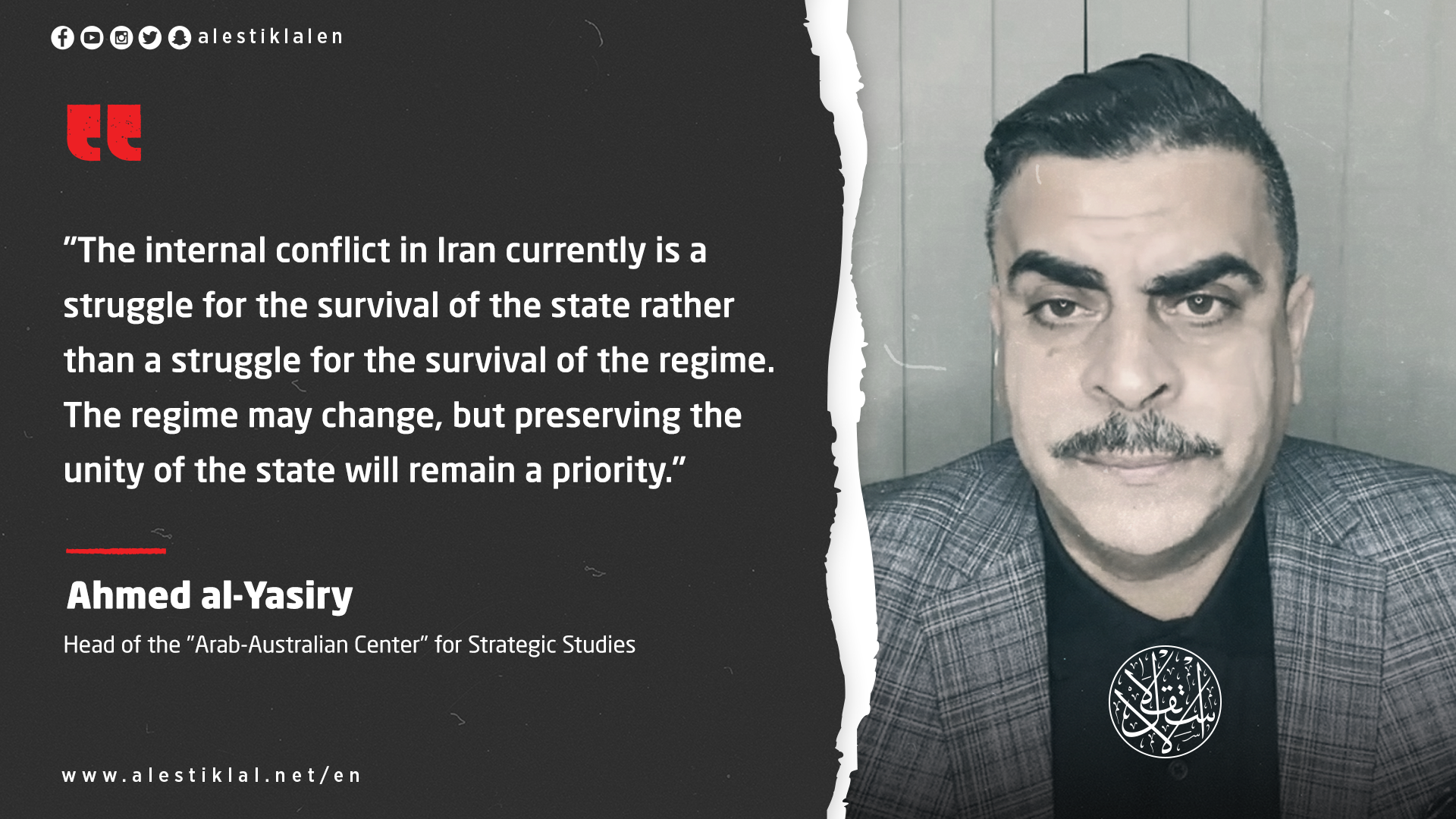
This is where the distinction between the state and the regime becomes important. The regime may change, but preserving the state and its unity will remain a priority for broad segments of the Iranian population.
I believe that Iran’s internal struggle today is more about the survival of the state than the survival of the regime.
The regime has suffered a deterioration in its capabilities both before and during the war, but it has not fallen. Therefore, the current phase can be described as one of declining capabilities and attrition for the regime, rather than necessarily one of complete collapse.
Moreover, a strategy based on “striking the head” and assassinating leaders does not necessarily mean the fall of the regime.
Iran distributes its capabilities across multiple institutions, so the fall of a leader or prominent figure does not automatically lead to the collapse of the entire regime.
This is why Iran’s future will depend on the interaction of military, security, political, social, and religious factors, rather than on the outcome of individual military strikes alone.