Iranian Efforts to Calm Tensions With Gulf Countries: How Do They Affect Its Troubled Economy?
Amid the U.S. sanctions imposed on Iran since 2018, which led to a crippling economic crisis and caused public anger against the regime, Iran is moving to sign developmental agreements with several countries while also trying to resolve its regional problems.
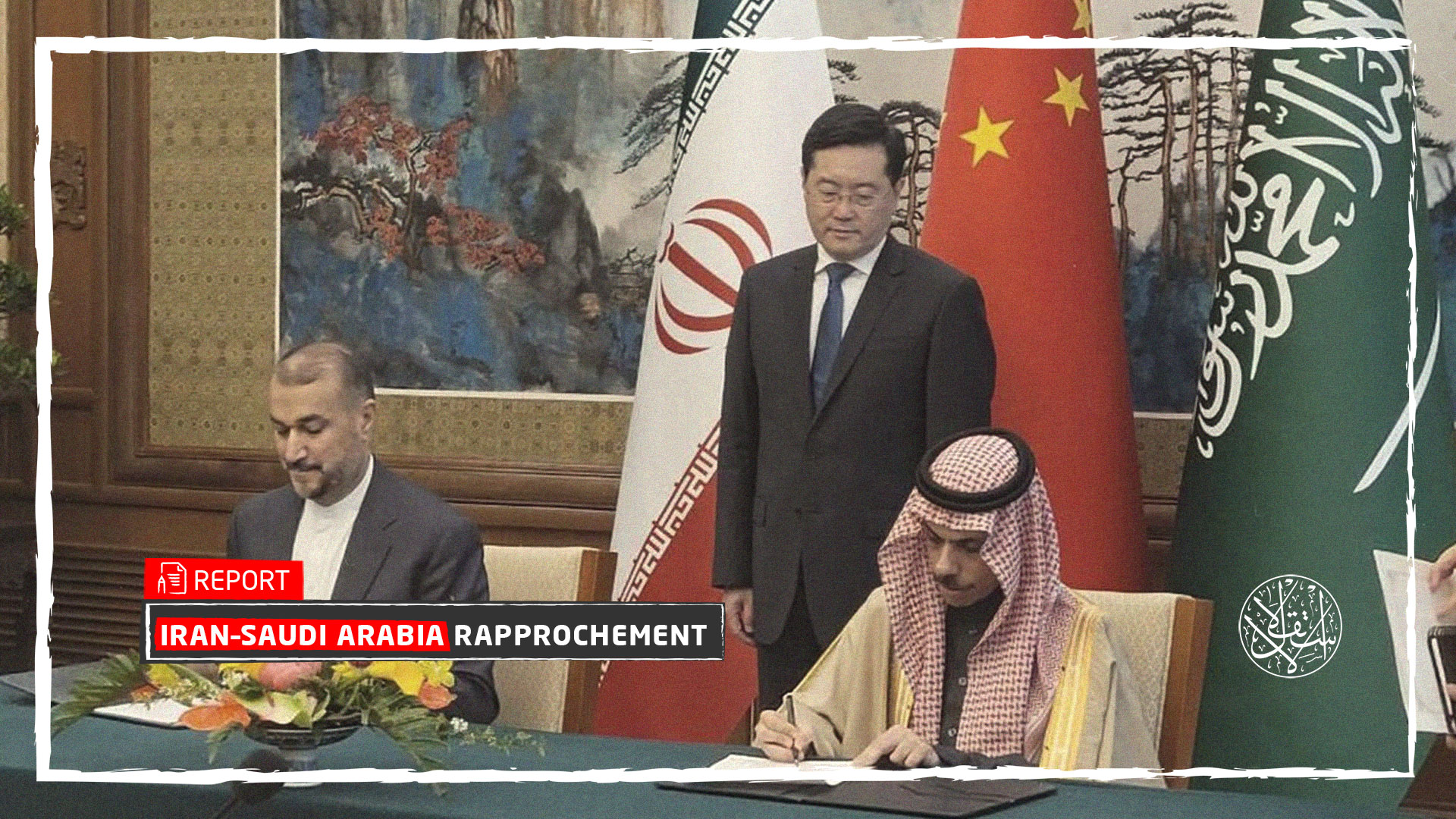
The latest development was the unexpected announcement on March 10, 2023, by Iran and Saudi Arabia of their agreement, mediated by China, to resume diplomatic relations after years of estrangement, proxy wars, and mutual accusations.
Iran's actions, whether to sign agreements or end crises with regional countries, raise several questions about the impact on its economic situation under the sanctions imposed on it following the U.S. withdrawal from the nuclear agreement in May 2018.
Multiple Agreements
On March 20, 2023, Ali Shamkhani, the Secretary of Iran's Supreme National Security Council, spoke about recent agreements made with regional countries that would benefit Iran's economy. Upon his return from the United Arab Emirates, the Iranian news website Entekhab quoted Shamkhani, who is responsible for the peace talks with regional countries, as saying that an agreement had been reached in the UAE to facilitate trade between the two countries using the Emirati dirham.
On March 16, the Iranian official visited the UAE and met with his Emirati counterpart, Sheikh Tahnoon bin Zayed, as well as with Sheikh Mohammed bin Rashid, the Prime Minister and ruler of Dubai. Shamkhani said during his statements that the visits to China and the UAE have achieved important results, and on this basis, it was decided that this process should continue with the visit to Iraq.
He added that new mechanisms have been identified, and an agreement has been reached with Iraq to collect the Iranian amounts due to purchase essential goods and solve foreign exchange problems for Iranian businessmen.
Shamkhani confirmed that this step would improve the currency market situation in the country, in addition to the agreements signed with the Emirati authorities.
During the period from March 10 to March 19, Ali Shamkhani visited China, the UAE, and Iraq, respectively, and during these visits, he reached an agreement with Saudi Arabia to restore diplomatic relations under China's auspices, in addition to signing economic agreements with the UAE and Iraq.
After a hiatus since 2016, Iran and Saudi Arabia agreed on March 10 to resume cooperation in the fields of security, trade, and investment, according to a joint statement they made with their mediator, China.
After five days of announcing the agreement to restore relations between the two countries, Riyadh revealed many opportunities for Saudi investment in Iran.
During the Financial Sector Conference in Riyadh on March 15, Saudi Finance Minister Mohammed al-Jadaan said: "Saudi investments in Iran can happen very quickly after the agreement."
He continued: "There are many opportunities for Saudi investments in Iran. We do not see any obstacles as long as the terms of any agreement are respected."
Al-Jadaan added that there are many opportunities for Saudi investments in Iran, and that Riyadh also has many opportunities for Iranians, indicating that he does not see any obstacles as long as the terms of any agreement are respected.
The Saudi minister concluded that "to focus on economic development and providing what is necessary for the people in your country, you need stability, and they [the Iranians] need both."

Potential Release
In the first signs of the Iranian economic impact of all this, the exchange rate of the Iranian toman witnessed a significant increase against the U.S. dollar hours after the announcement of the settlement between Riyadh and Tehran and the resumption of diplomatic relations.
The exchange rate of the dollar against the Iranian currency in the parallel market on March 11 was about 450,000 against 500,000 rials before the reconciliation announcement, an increase of about 10%.
Regarding the extent to which the agreements and settlements being carried out by Iran affect its economic situation, researcher Ali al-Masari said that "this is likely to relieve Tehran's economic crisis, but it does not mean lifting the sanctions imposed on it by Western countries, especially the United States."
He explained to Al-Estiklal that "America has local and international executive agencies, represented by countries, companies, political figures, ruling parties, and others, all of which are subject to its decisions, or do not act outside its will, and therefore cannot rebel against it."
He pointed out that "Iranian movements, whether represented by agreements or solving crises with countries in the region, undoubtedly have a positive impact on its economic conditions, but they remain largely constrained, as it has frozen capital and stopped contracts for years, in addition to the sanctions that have targeted officials and scientists."
Al-Masari believes that "no matter how prosperous the economic situation may be due to Iran's agreements with China, Russia, and Arab countries, the domestic situation is still confusing due to popular protests against the system more than the economic side."
Since September 2022, Iran has witnessed unprecedented popular protests since the revolution that overthrew the Shah's regime in 1979, following the killing of the Kurdish girl, Mahsa Amini, after being arrested by the "morality police" for not wearing the hijab.
The Iraqi researcher noted that "the existing religious and ethnic rifts in Iran cannot be erased by simple economic respiration, although the current regime is making diplomatic efforts that count in achieving gains."
He added: "They are characterized by a long breath in negotiations, and perhaps their opponent may not gain the same benefits that the system of the Wilayat al-Faqih ultimately reaps."
Al-Masari explained that "the measure of the Iranian negotiator's ability is the resounding success in the nuclear file during the era of former U.S. President Barack Obama in April 2015."
He pointed out that "Iran has altered its policy toward the United States according to the president who is in charge of the White House. Matters deteriorated during Obama's time, became more complicated during his successor Donald Trump's era, then deteriorated again before slightly improving with Joe Biden, and his term may end with a return to the nuclear agreement."

Iranian Circumvention Tactics
In the same context, the Financial Times reported on March 16, 2023, that Iran has used companies in commercial centers in the UAE over the past decade to circumvent the crippling U.S. sanctions in response to Iran's nuclear program.
The American newspaper highlighted that the UAE has been among Iran's largest trading partners for decades, even during the tough times between the two countries.
The latest official figures from Tehran showed that goods worth $13.6 billion were imported into the country via the Gulf state, representing about 31% of all imports during the first ten months of the Iranian year (starting in March), according to the U.S. newspaper.
Iran's recent diplomatic moves have raised hopes among many Iranians and the business community in the country that hard-line leaders may be preparing to revive the 2015 nuclear deal with world powers, according to the Financial Times.
However, despite the thaw in regional relations, there was no strong indication from the Iranian leadership that they are ready to return to the nuclear deal.
The newspaper quoted Iranian political analyst Saeed Laylaz as saying that Iran has no choice but to eventually make concessions to America, where both have reached a dead end in dealing with each other.
Laylaz added that, at the moment, Iranians feel relieved because some progress is being made in foreign policy.

On March 25, 2023, the Iranian government announced that some economic agreements made with China had come into effect, and that the economic impact of these agreements would be seen in foreign trade. Government spokesperson Ali Rabii stated to the Fars News Agency that the importance of the Iranian president's recent visit to China lies in demonstrating Iran's strong and serious desire to strengthen relations with China.
Rabii pointed out that the Iranian government's economic team, consisting of the ministers of industry, mining and trade; petroleum; roads and urban development; agriculture; economy; and the governor of the central bank, signed agreements with China in all areas.
President Ibrahim Raisi conducted an official three-day visit to Beijing on February 14, 2023, during which he met with his Chinese counterpart, Xi Jinping, and signed about 20 agreements to enhance cooperation between the two countries amid tensions with the West.
Under these sanctions, which prohibit Iran from obtaining oil exports, transferring money into the country for investment remains difficult. Therefore, Saudi or other foreign investment in Iran depends on achieving two things: first, obtaining exemptions from U.S. sanctions, and second, lifting those sanctions in the first place.
The lifting of sanctions can only be achieved through the revival of the frozen nuclear agreement, as negotiations have stalled since September 2022, and attempts and mediations have not yet succeeded in resuming them, according to observers.
Sources
- Shamkhani: We have established new executive mechanisms to use Iran's demands from Iraq to purchase basic goods [Persian]
- Saudi Finance Minister: There are many opportunities for investment in Iran [Arabic]
- Iran: Some agreements with China have entered into force [Arabic]
- Saudi investment is knocking on the doors of the ailing Iranian economy [Arabic]
- Shamkhani's visit to Abu Dhabi.. "growing" Iranian-Emirati relations [Arabic]
- Reconciliation with Saudi Arabia raises the exchange rate of the Iranian riyal [Arabic]
- Trump announces his country's withdrawal from the Iran nuclear deal and reinstates sanctions on Tehran [Arabic]
- The visit of the President of Iran to China: political and economic dimensions [Arabic]