Saied’s Regime Detains Pro-Palestine Activists, Raising Questions Over Motives and Signals
Humanitarian issues are being treated as potential security threats.
In his relentless campaign against all independent forces in Tunisia, the head of the Tunisian regime Kais Saied has shown an acute sensitivity to any figures or organizations with social influence that operate outside his control.
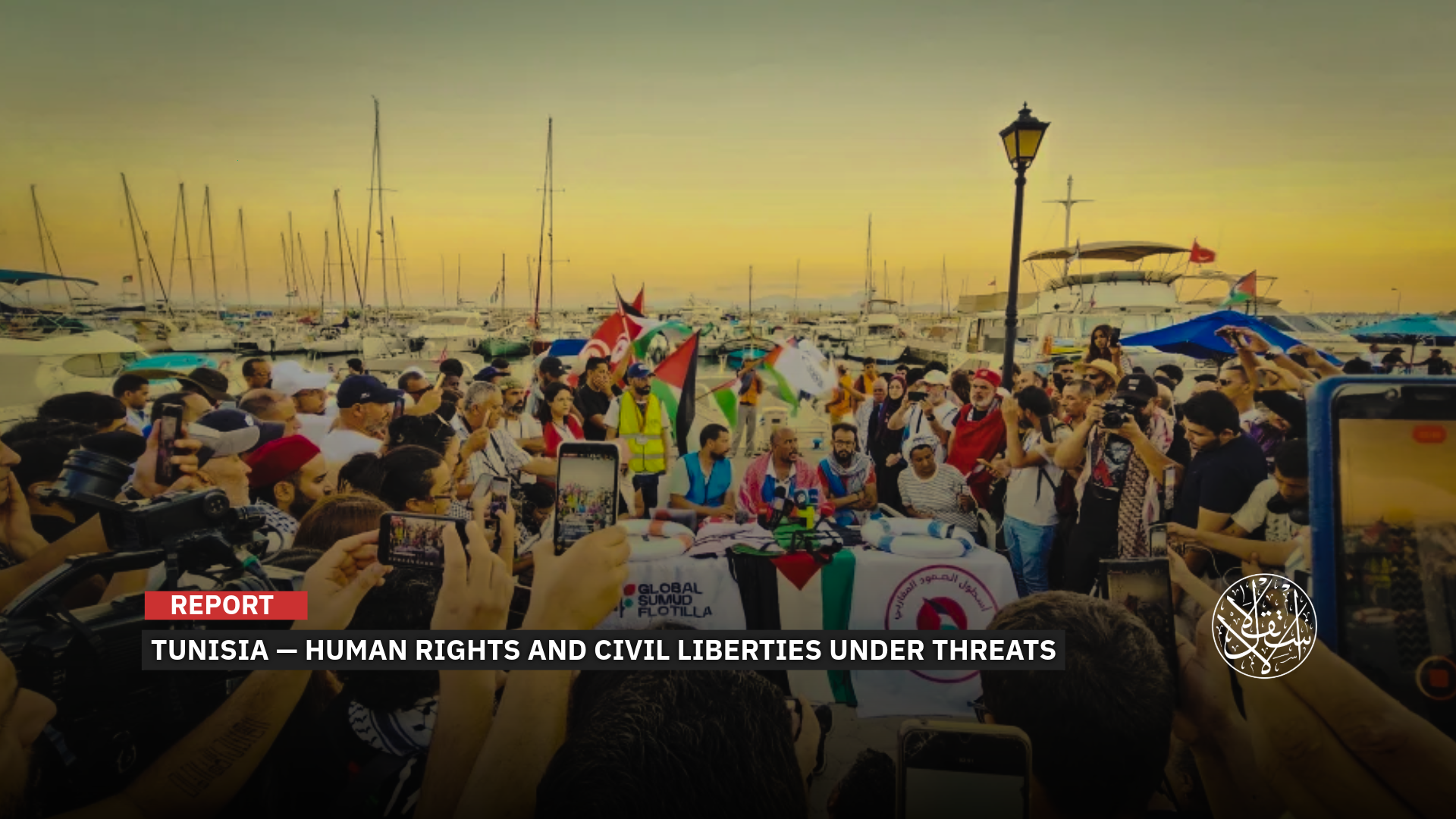
The latest evidence of this crackdown came on March 6, 2026, when security forces moved against civil society activists, targeting members of the Global Sumud Flotilla working to break the blockade of Gaza. Arrests included key figures in the flotilla’s steering committee: Jawaher Channa, Sanaa Msahli, Ghassan Henchiri, Wael Naouar, Mohamed Amin Bennour, and Nabil Channoufi.
Human Rights Outcry
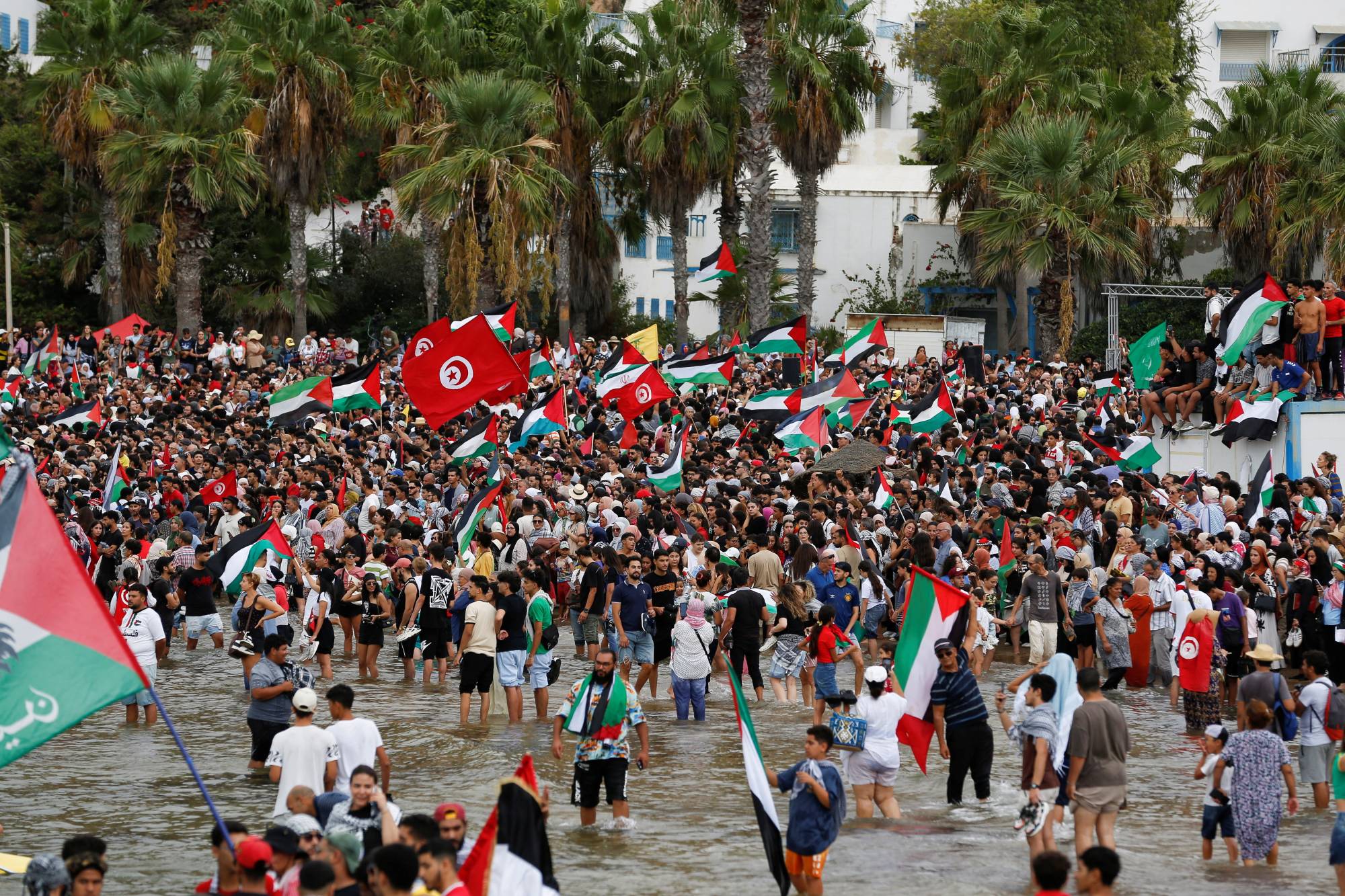
Human rights groups have condemned the arrests. The Tunisian Forum for Economic and Social Rights (FTDES) expressed deep concern, urging authorities to respect the right to peaceful solidarity and civil activism and to stop targeting activists for their views.
On March 9, 2026, the FTDES called for the release of those detained, noting that these young activists helped lead one of the most prominent and genuine grassroots solidarity movements in modern Tunisian history, particularly in support of the Palestinian cause.
The FTDES added that the authorities, initially riding the wave of popular mobilization for political gain, have now moved to suppress it amid shifting regional dynamics and changes in official rhetoric. It also accused the regime of fabricating financial charges to discredit solidarity movements and their activists, undermining their credibility and obstructing future initiatives.
The FTDES added that while pro-Palestine movements have faced repression across many countries under various pretexts, the situation in Tunisia now puts the official narrative to a renewed test and scrutiny.
Amnesty International also weighed in, stating that the arrests, accompanied by financial allegations and prosecutions under counterterrorism and anti-money-laundering laws, are part of a broader pattern of shrinking civic space in Tunisia and escalating pressure on activists and human rights defenders both domestically and globally.
Authorities’ Justifications
Authorities defended the detentions by citing a judicial source who told the Agence Tunis-Afrique-Presse (TAP) that the public prosecutor at the Economic and Financial Judicial Pole authorized the National Guard’s financial crimes unit to open a judicial investigation into suspected collusion involving money laundering, fraud, and personal misuse of donation funds.
The inquiry reportedly targets several members and leaders of the Global Sumud Flotilla to verify the sources of funding and the management of donations, despite the group having previously published a financial report detailing Tunisian contributions, how funds were used, and the status of Tunisian vessels involved in the international flotilla to break the Gaza blockade. In December 2025, the flotilla reported Tunisian donations totaling roughly 1,887,318 dinars, or about $635,000.
The Global Sumud Flotilla is an international maritime initiative aimed at breaking the blockade on Gaza and delivering humanitarian aid, with its previous edition involving around 50 ships carrying more than 500 participants from over 45 countries, including dozens of Tunisians.
In response, the National Committee for the Defense of the Sumud Flotilla Activists and Palestinian Rights called the targeting of flotilla members “a politically motivated act of retaliation.” The committee argued that raising financial or administrative allegations against activists known for their fieldwork in Gaza implicitly acknowledges that official support for the Palestinian cause was primarily a way to avoid clashing with thousands of Tunisians who rallied in solidarity with Gaza and the flotilla.
In a statement on March 11, the committee warned that the government’s view of independent popular solidarity as a “threat” or “act of disobedience” has become clearer through these arrests and public intimidation, which it framed as an attempt to curb civil and popular initiatives and criminalize activism.
The committee added that the arrests, following a campaign of vilification on social media, were aimed at the American-Zionist Western coalition and their allies in Arab regimes, showing that anyone exposing injustices or taking part in the flotilla could face detention.
It stressed that the crackdown on the Global Sumud Flotilla serves as a broader intimidation tactic against civil society, signaling that the regime will convert moral and humanitarian positions into security “suspicions,” smear activists, and block public mobilization in support of the Palestinian cause.
Remaining silent in the face of attacks on the most just and noble causes effectively gives the authorities a green light to continue suppressing all forms of social, economic, and political activism. Those who target solidarity with a people under siege will not hesitate to crush domestic popular demands, according to the committee.
Party Outrage
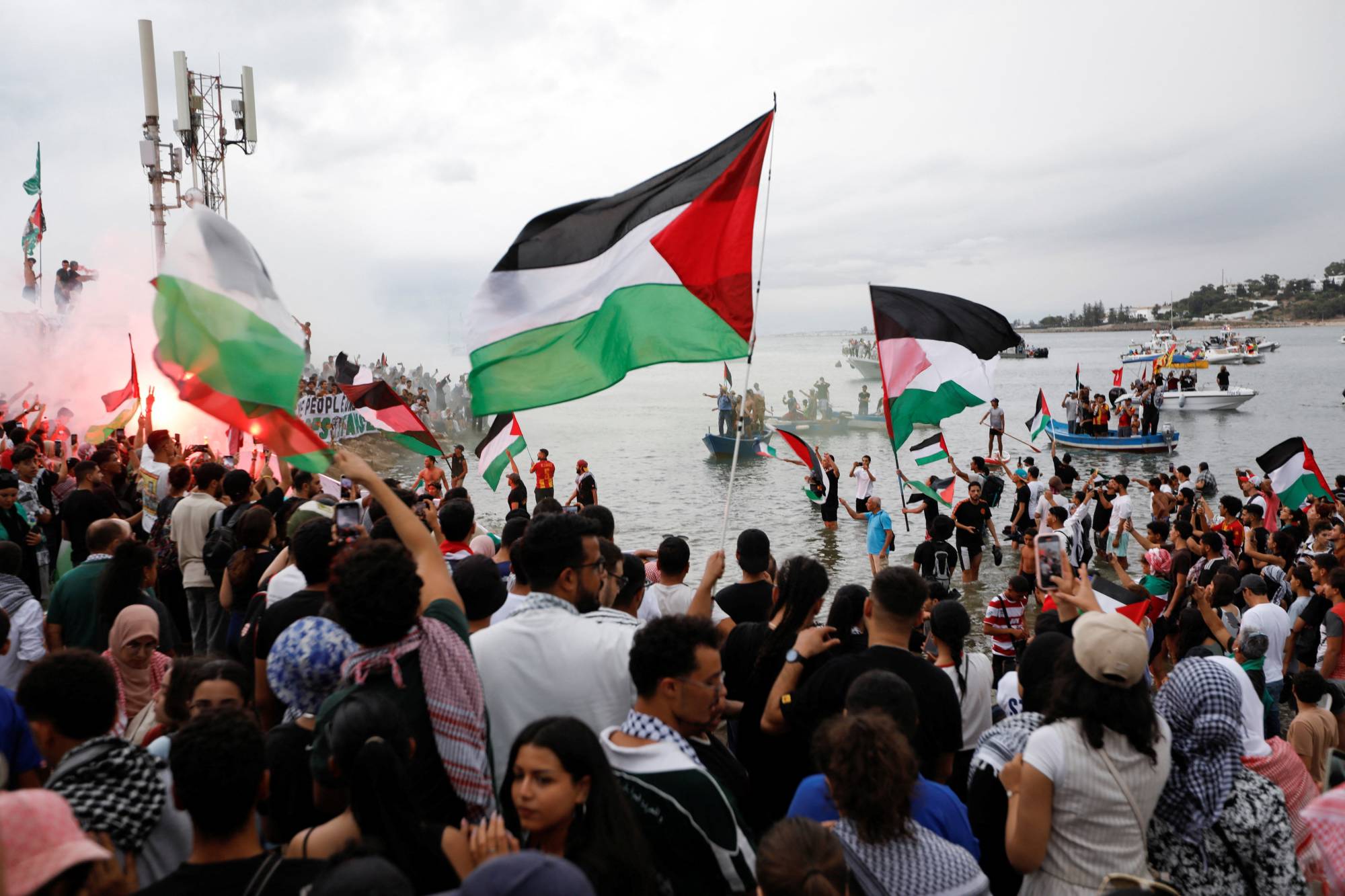
At the party and political level, the opposition National Salvation Front (NSF) expressed deep concern over the continued targeting of independent civil activism, particularly initiatives supporting Palestine and calling for an end to the Gaza blockade.
In a statement on March 10, 2026, the NSF demanded the immediate release of those detained and called for an end to the use of judicial measures to criminalize civil work following suspicious media campaigns aimed at smearing activists.
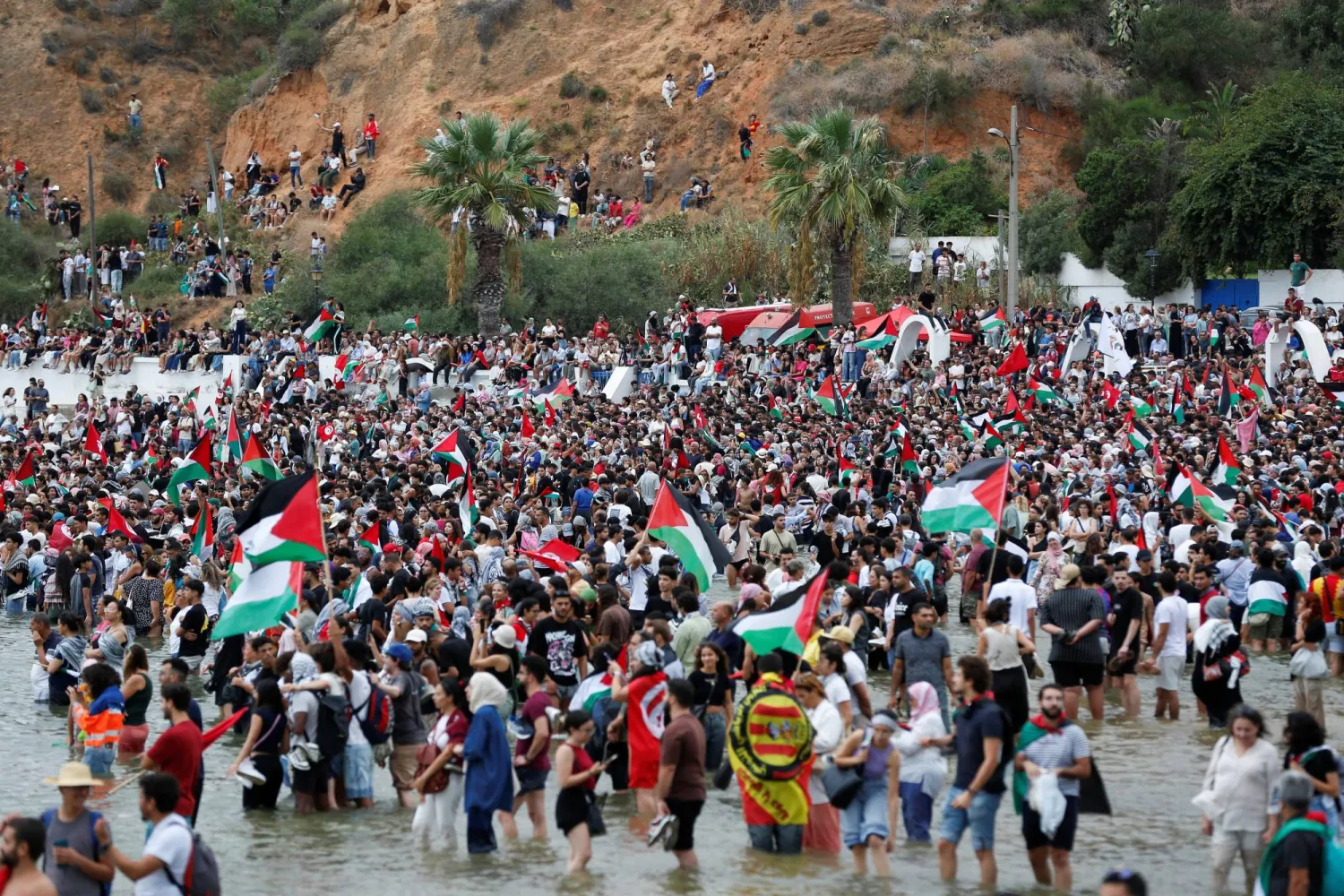
It also called on authorities to release the findings of the investigation into the attack on the Global Sumud Flotilla at Sidi Bou Said port between September 8 and 10, 2025, particularly after a formal inquiry was launched into possible links to the assault and reports that some Israeli circles had acknowledged responsibility.
Emphasizing that the Palestinian cause remains a unifying force for all national groups, the NSF stressed that it must not be undermined by political bickering and affirmed that volunteers serving it are “activists worthy of honor, not defamation or imprisonment.”
The Republican Party (RP) also condemned the arrests, highlighting a widespread campaign of incitement against the detainees on social media, carried out by dubious actors and figures from what it described as “dirty media.”
In a statement on March 6, the RP argued that targeting activists involved in efforts to break the blockade on Gaza and advocate for Palestine exposes the vast gap between the slogans the Tunisian authorities continue to promote and their actual behavior.
The statement called on all national forces and the free citizens of Tunisia to confront this campaign using every possible form of peaceful activism.
Condemnation From Within Parliament
Parliamentary condemnation came most notably from MP Mohamed Ali, who also participated in the Global Sumud Flotilla, emphasizing that the abrupt and forceful arrests of the Tunisian flotilla leaders—carried out in their homes and on the streets—could not be ignored, especially given their well-known public profiles.
Speaking during a parliamentary session on March 10, Ali argued that proper legal procedure would have required official summons and questioning while in custody, rather than immediate detention, a choice that carried clear signals of pressure and public defamation.
He added that the severity of the violation lies not only in the arrest method but also in its timing, following months of social media smear campaigns and during a politically sensitive moment tied to solidarity with the Palestinian cause.
He said the new situation raises legitimate questions: “Why did the authorities remain silent for months over alleged financial accusations, only to move suddenly after the announcement of a new public flotilla? And why did the arrests coincide with a diplomatic speech that seemed intended to reassure foreign audiences amid a shifting regional climate?”
Ali emphasized that “taken together, these factors make it hard to see this as a mere technical application of the law; they suggest a political decision aimed at containing an independent civil initiative and redefining the boundaries of public solidarity.”
“The state itself initially facilitated the flotilla’s organization—from fundraising to receiving delegations and overseeing activities—before these very facts later became grounds for accusations,” he added.
“This gradual shift, coupled with online smear campaigns, appears designed to turn a principled political issue into a shallow moral debate, far from the core of the matter.”
Political Stakes
In his analysis of recent developments, Tunisian political researcher Yassine Nabli argued that the targeting of activists supporting Palestine is part of a long-standing punitive approach built on three pillars: digital incitement, arrests, and financial allegations.
“This paradigm seeks to strip the victims of their political identity, turning them into money launderers, thieves, corrupt officials, and border criminals,” Nabli told Al-Estiklal.
“Most of them are being prosecuted under counterterrorism and money-laundering laws, despite having long histories of activism defending rights and freedoms.”
“These arrests came after a series of restrictive measures against the activities of the Global Sumud Flotilla in Tunisia. On the night of March 4, activists from the flotilla’s steering committee were barred from entering the Sidi Bou Said port in northern Tunis, where they had planned a symbolic and commemorative event for port staff,” he added.
Nabli highlighted that some were assaulted, including Palestinian activist Susan Abdallah, who suffered a broken arm.
“The next day, authorities blocked a seminar the flotilla had planned to hold in a central Tunis venue, coinciding with pro-regime campaigns targeting flotilla activists on social media and calls for the deportation of some participants, including Palestinian activist Saif Abu Keshk.”
Nabli argued that “all these bans fall within an official political discourse that has shifted its language regarding the Zionist project and repeated U.S. and Israeli attacks on the countries in the region.”
He added that Kais Saied and his regime’s stance on the Palestinian issue over the years, especially after the Israeli genocide in Gaza, “has been marked by fragility, contradiction, and a will to exploit the situation.”
“The Global Sumud Flotilla initiative was practically an exception,” Nabli said. “The regime did not claim it yet tolerated it relatively while its security apparatus tried to dismantle it with minimal political cost, feeding into a smear campaign at the same time.”
He emphasized that “the momentum created by the flotilla locally and globally was unexpected by the regime’s security forces; a quiet recreational port in an affluent area, just hundreds of meters from the presidential palace, became a hub of popular support and the launchpad for a massive global pro-Palestine movement.”
“This momentum was built outside the regime’s control,” Nabli noted, “even if the organizers offered some words of thanks—insufficient for a regime that absorbs symbols and history to exploit them for its own ends.”
The researcher argued that the flotilla’s independence from the president’s authority and its rise to global attention pushed him to weigh the political cost of a movement that could put him in an awkward position with his security allies, particularly Italy and the United States.
“The main challenge for the Palestinian solidarity movement is reclaiming the real drivers of activism that the regime seeks to sever—namely, societal engagement in resisting genocide.”
“This struggle is both Arab and international in scope, aimed at reclaiming the Palestinian cause from exploitative regimes and restoring it as a cause of the people,” Nabli added.
Message to the People
In response, the Coordination of Joint Action for Palestine (CJAP) issued an open letter to the Tunisian public, warning that what some present as a mere legal or financial matter is, in fact, a deliberate attempt to mislead.
Published on March 9, 2026, the CJAP said the issue is not just legal but reflects a broader effort to target the political and public climate in Tunisia shaped by support for Palestine.
It noted that the region has been undergoing a gradual political and security restructuring under the banner of normalization and the integration of the Zionist entity into regional frameworks.
In this context, an active popular space that rejects normalization and insists on supporting resistance represents a real nuisance to those seeking to entrench this project.
The CJAP argued that this is not just about individuals; it is an attempt to break a growing popular political dynamic whose hallmarks are anti-normalization, defending Palestinians’ right to resist, and turning solidarity into concrete action.
The statement noted that the parallel between judicial pressure and media mobilization shows that the goal goes beyond managing a legal case; it extends to the public sphere itself: shrinking the space for solidarity with Palestine and weakening the political environment that allowed it to grow.
The CJAP emphasized that for Tunisians, Palestine is not a foreign issue that can be easily removed from public concern; it has been embedded over decades as part of the political consciousness and as a symbol of the broader struggle against domination and colonialism.
It called on Tunisians not to accept the dismantling of this legacy of solidarity or to allow Tunisia to be drawn into the region’s accelerating normalization path, urging resilience to preserve Tunisia’s place within the front of peoples who see the Palestinian cause as a non-negotiable struggle for liberation.