From Yemen to Ukraine: A Cross-Border Recruitment Network Serving the Russian War
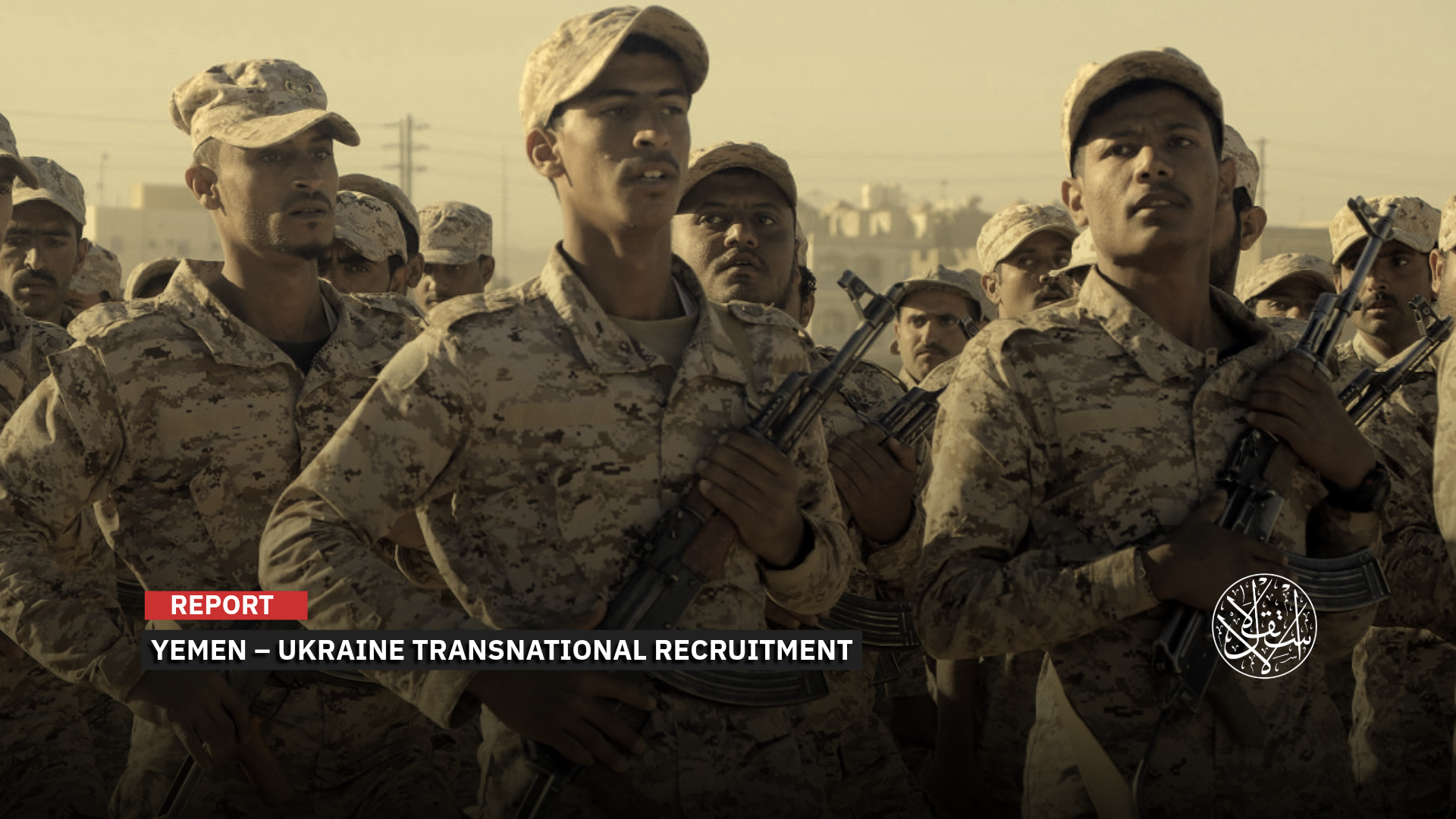
Freed prisoners describe the experience in Ukrainian detention camps as a military nightmare.
As the fires of war raging across Yemeni cities entered their second decade, neither the soldier “Saeed” nor the engineer “Mohammed Hussein,” both affiliated with the Yemeni army, imagined they would end up in frozen trenches thousands of kilometers away, fighting in a war that had nothing to do with them.
These stories are not isolated personal tragedies, but rather a microcosm of an organized transnational recruitment network that exploits Yemen’s fragile reality to feed Russia’s war machine in Ukraine.
Operating under the guise of “civilian job opportunities” and promises of financial rewards and legal benefits, this network ultimately becomes a coercive pathway that turns Yemeni youth into fuel for a conflict they do not belong to.
Recruitment Mechanisms
International investigative reports, including those published by Financial Times, along with testimonies from prisoners of war, reveal a systematic recruitment scheme targeting Yemeni youth, including former Yemeni army soldiers and drone operation specialists.
The offers are presented as civilian jobs in security companies, medical facilities, aircraft factories, or even coal mines, with salaries ranging between $2,000 and $3,000 per month, immediate bonuses of up to $10,000, and promises of obtaining Russian citizenship within a short period.
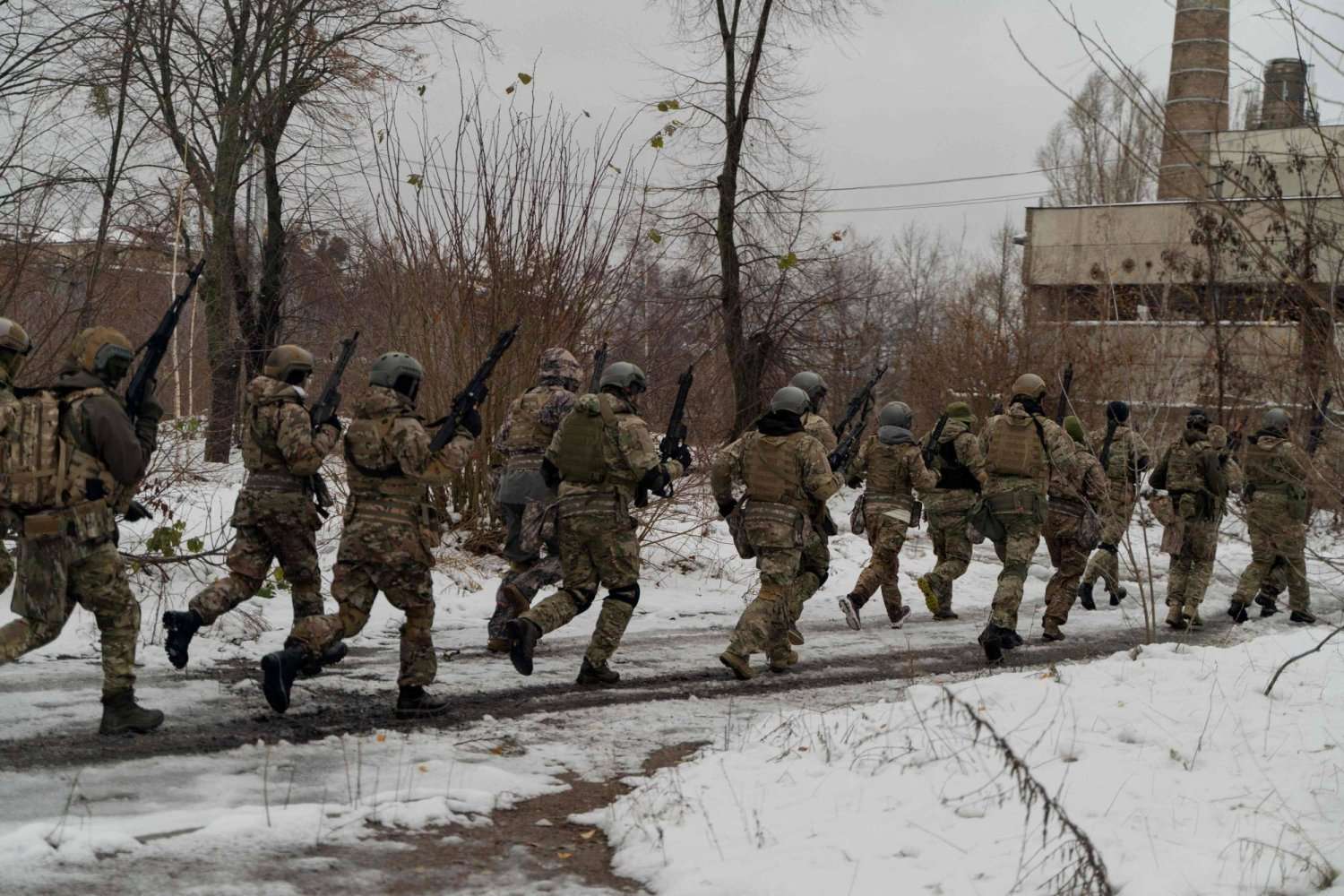
However, the reality changes dramatically upon arrival at Moscow airports. Passports are confiscated, and recruits are forced at gunpoint to sign contracts written in Russian without understanding their contents, turning the alleged “civilian job” into compulsory military service.
The recruits then undergo rapid military training before being sent directly to the frontlines in Donbas and Kursk, where they face extremely harsh logistical and medical conditions, while their monthly pay drops to around $260.
Freed prisoners from Ukrainian detention camps describe the experience as a “military nightmare,” as they are thrown into complex battles without knowledge of the language, geography, or the nature of modern warfare driven by precision strikes and drones.
This mechanism reflects a broader transformation in modern military mobilization. States no longer rely solely on domestic conscription or ideologically motivated volunteers, but increasingly resort to “coercive economic recruitment” as a rapid means of compensating for battlefield losses.
Exploiting the gap between lucrative job offers and the brutal reality on the ground, this model is legally and humanly classified as a form of quasi-military human trafficking.

Al-Jabri Company
Available evidence indicates that al-Jabri General Trading and Investment Company, owned by Houthi parliamentarian and leader Abdulwali al-Jabri, serves as the operational hub of this network.
The company was registered in the city of Salalah as a business operating in tourism and travel, as well as the supply of medical equipment and pharmaceuticals, a deliberate attempt to provide a veneer of legitimacy while concealing its actual activities.
This commercial front was reportedly used to lure young Yemenis through contracts promising employment as “security guards” or “technicians” in Russian facilities, before forcibly redirecting them into military service.
Reports by the United States Department of the Treasury indicate that these operations are not limited to recruitment alone, but also constitute a vital financial channel for the Houthis, with brokers reportedly receiving between $10,000 and $15,000 for every recruit.
The network also relies on field intermediaries inside Yemen, some of them former soldiers who exploit personal trust and social connections to persuade their former colleagues to join.
The use of commercially registered front companies in a third country reflects an advanced model of the “informal war economy,” in which armed groups merge legitimate business activity, cross-border brokerage, and military financing into a flexible network that is difficult to trace or dismantle through conventional oversight mechanisms.

The Omani Transit Station
Although there is no evidence of official involvement by the Omani government, journalistic and human rights sources reveal that the Sultanate played a pivotal logistical role in facilitating the movement of recruits.
Its territory and diplomatic infrastructure were reportedly used as a major transit hub, with al-Jabri Company operating from Salalah and Muscat to manage recruitment operations and contract signings.
In the same context, the Russian embassy in Muscat reportedly played a crucial role in issuing work visas based on documents and applications submitted through the company, enabling the legal-looking transfer of young Yemenis.
Oman effectively became a key transit point, with recruits transported overland from Yemen into Omani territory before being flown to Moscow. Human rights reports, including those by SAM Organization for Rights and Liberties, point to direct coordination between al-Jabri’s office and the Russian side, involving a Russian consular employee identified as “Dmitry,” who allegedly helped facilitate procedures and ensure smooth transportation.
Later, as human rights pressure intensified, Oman also emerged as the primary channel through which a limited number of Yemenis were allowed to leave Russia, underscoring the continued reliance on this geographical route for both recruitment and evacuation.
This role reflects the model of “neutral states as functional corridors” in asymmetric conflicts, where direct political involvement is not necessarily required; rather, the provision of logistical and consular infrastructure alone can enable informal networks to operate.
It also highlights the challenge of “indirect impunity,” amid the absence of international frameworks obligating transit-hosting states to monitor the actual use of visas and contracts signed on their territory.

The Geopolitical Equation
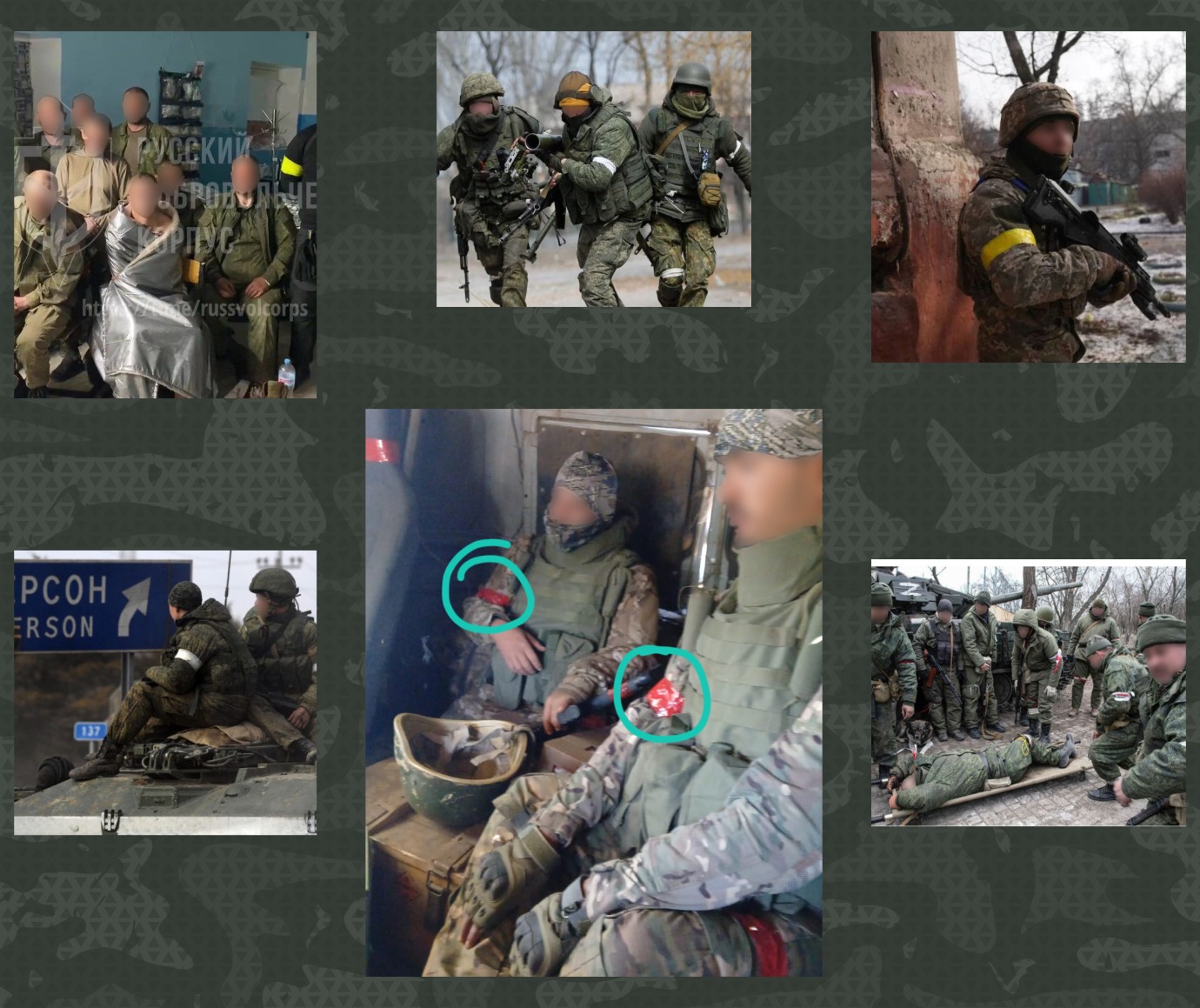
The recruitment of Yemenis has evolved beyond a humanitarian issue into an indicator of a deeper geopolitical transformation. The growing rapprochement between Russia and the Houthis, once considered unlikely before 2022, reflects Moscow’s dual strategy: compensating for manpower shortages in Ukraine while opening new spheres of influence in the Middle East through anti-Western armed groups.
At the same time, the Houthis appear to be using this relationship to strengthen their naval and missile capabilities, turning threats to Red Sea shipping lanes into a tool of international leverage.
The emerging facts point to a clear strategic bargain: by “exporting” fighters, the Houthis seek to build deeper ties with the Kremlin, secure advanced weapons and anti-ship missiles, and benefit from Russian satellite intelligence to target maritime navigation in the Red Sea.
In return, Russia finds in Yemen a “low-cost market” for battle-ready fighters with prior military experience, sparing Moscow the burden of lengthy training programs and easing the domestic pressure caused by large-scale mobilization inside Russia.
These young Yemenis are thus transformed into “cannon fodder” in a prolonged war of attrition.
This relationship represents a model of asymmetrical alliances, in which armed groups such as the Houthis provide Yemeni fighters at minimal cost in exchange for Russian military, technological, and intelligence support, with these interests exchanged through informal and largely opaque channels.
At the same time, Yemen’s transformation into what resembles a “human reservoir” reflects a broader shift in the logic of modern warfare. National sovereignty no longer necessarily means protecting citizens; instead, weakened states can become geographical spaces through which external powers exploit human resources with ease.
In this context, Yemen’s internal fragility and weak institutions have become strategic assets exploited by regional and international actors pursuing their own interests, while ordinary Yemenis continue to pay the price with their lives.
Why Yemen?
This phenomenon cannot be understood in isolation from the Yemeni context. After years of war, the country is suffering from one of the world’s worst humanitarian and economic crises.
Soldiers’ salaries are either extremely low or unpaid, unemployment is widespread, and the local currency has lost much of its value.
In this reality, the Yemeni youth, especially those with military backgrounds, become ideal targets. They already possess combat skills and require little additional training, while simultaneously facing severe economic pressures that push them to accept enormous risks.
Temporary ceasefires on some fronts have also reduced opportunities for local fighting, prompting some combatants to seek “opportunities” abroad.
Journalistic sources indicate that low salaries and the absence of incentives have been decisive factors behind the spread of the phenomenon, as the prospect of fighting overseas, despite its dangers, has become more appealing than remaining without a stable income.
There is also another structural factor: these recruitment networks could not have succeeded without what many describe as the “weapon of hunger.” The war has left behind economic collapse and rampant unemployment.
When a Yemeni soldier earns no more than $30 a month, if he is paid at all, the Russian offer becomes an “opportunity too good to refuse,” even if it carries immense risks. Recruitment networks have exploited this economic fragility, transforming humanitarian need into a tool of international political and military recruitment.
This dynamic demonstrates how “structural crises” can become resources for external mobilization. The absence of a functioning social contract, combined with the erosion of the state’s ability to provide even the minimum conditions for survival, creates a political and security vacuum exploited by transnational networks.
Academically, this model is often described as the “economic militarization of forced migration,” in which individuals are effectively forced to choose between remaining trapped in extreme poverty or risking their lives for uncertain promises.
The Legal and Human Rights Framework
Human rights organizations have played a central role in documenting the phenomenon and exposing its dimensions:
-SAM Organization for Rights and Liberties, based in Geneva, conducted investigative reports concluding that these operations amount to “human trafficking” and exploit the extreme vulnerability of Yemeni youth.
-International Union of Yemeni Migrants led legal and advocacy efforts to track the movements of recruits, receive distress calls, and pressure the Yemeni government, efforts that contributed to the return of 11 recruits from Russia through Oman.
-Himaya Organization for Rights and Freedoms described the recruitment process as a blatant violation of fundamental rights and the right to life, emphasizing that it represents a form of coercive economic exploitation.
Legally, these practices fall under clear violations of the United Nations Convention against the Recruitment, Use, Financing and Training of Mercenaries (1989), anti-human trafficking protocols, and international humanitarian law, which prohibits forced recruitment and the exploitation of civilians in armed conflicts.
At the institutional level, the United States Department of the Treasury imposed sanctions in March 2025 on Abdulwali al-Jabri and eight other Houthi-linked figures, accusing them of using a commercial company as a front to facilitate the transfer of Yemeni civilians into Russian military units in exchange for financing Houthi operations.
Organizations such as SAM and Himaya have also urged the Yemeni government to strengthen border oversight, launch public awareness campaigns, and cooperate with INTERPOL and the International Criminal Court to pursue the networks involved.
Nevertheless, the issue continues to receive limited attention within the agendas of international bodies, including the United Nations. This absence does not necessarily imply direct complicity, but it does reflect shortcomings in international response mechanisms and hesitation to address highly sensitive cases tied to complex political balances. For affected parties, this silence or weak reaction can easily be interpreted as a form of tacit tolerance.
While Yemen suffers from institutional fragmentation, Moscow rejects the characterization of these operations as “forced recruitment,” instead describing the individuals involved as “foreign volunteers.”
Meanwhile, Western states have largely confined their response to monitoring and targeted sanctions, without adopting a comprehensive approach that addresses the economic and security roots of the phenomenon.
This reality exposes significant limitations in existing international legal frameworks, many of which were designed decades ago and failed to anticipate modern recruitment methods.
States and networks alike exploit loopholes in these agreements, particularly because they did not foresee contemporary tactics such as online financial offers or the use of diplomatic and consular channels as official cover for the transfer of fighters.
At the same time, the international community and the United Nations have struggled to act decisively, not only because of legal ambiguity, but also due to a structural flaw within the international system itself.
It is exceedingly difficult to activate collective enforcement mechanisms or impose meaningful measures when the issue conflicts with the interests of a major power holding veto authority, such as Russia, or when intervention risks destabilizing sensitive regional alliances.
As a result, these practices continue within a legal and political vacuum that benefits those involved, while the victims themselves remain deprived of meaningful international protection.
Political Approach To Curb the Phenomenon
The recruitment of Yemenis to fight in Ukraine on behalf of Russia is not an isolated incident, but rather an indicator of state fragility and the exploitation of geopolitical vacuums, where individuals are reduced to resources in external conflicts. Addressing this phenomenon requires a multi-level approach:
-Domestically: ensuring the regular payment of salaries, expanding education and employment opportunities for young people, tightening oversight of borders and airports, and prosecuting recruitment networks through clear legal frameworks.
-Regionally and internationally: coordinating intelligence and customs information sharing, imposing targeted sanctions on companies and intermediaries, and supporting psychological and professional reintegration programs for returnees.
-Legally and humanitarily: formally classifying these practices as human trafficking and forced recruitment, enabling national and international prosecutions, ensuring safe humanitarian evacuation channels for those stranded, and strengthening consular oversight of employment contracts directed toward conflict zones.
The Russian–Ukrainian war has not merely been a harsh experience for Yemenis; it has turned into an unmarked grave. According to Yemeni Ministry of Defense documents and testimonies from families, dozens have been killed, hundreds injured with permanent disabilities, while others remain missing or detained in prisoner-of-war camps in western Ukraine.
The issue of Yemeni recruitment for the Ukraine war is not simply an extension of the Yemeni conflict, but a warning of Yemen’s transformation into a human reservoir for transcontinental wars.
It represents a “trade in human lives” driven by cold geopolitical calculations, paid for by young people seeking dignity and livelihood, only to find themselves as fuel in a global conflict alien to them and to the wounds of their struggling homeland.
Ultimately, this case reveals a deeply uneven equation: an international war in need of fighters, a fragile local environment pushing its youth into forced migration toward combat, and networks exploiting the gap between the two.
Amid these forces, the human being remains the weakest link and the greatest casualty, while underlying interests continue to reproduce the phenomenon in evolving forms.
Sources
- Financial Times: Houthi Rebels Recruit Hundreds of Yemenis to Fight Against Ukraine
- How Did Russia Recruit Yemenis to Fight on Its Behalf in Ukraine? [Arabic]
- Investigative Organization Reveals Houthi Fighters Fighting Alongside Russia in Ukraine [Arabic]
- Financial Times: Russia Deceived Yemenis into Recruiting Them to Fight in Ukraine [Arabic]
- How Did Russia Recruit Yemenis To Fight for It in Ukraine? [Arabic]
- Did Russia Forcefully Recruit Yemenis to Fight in Ukraine? [Arabic]