Saudi Arabia and the Southern Transitional Council in Yemen: Faltering Containment and an Unresolved Crisis
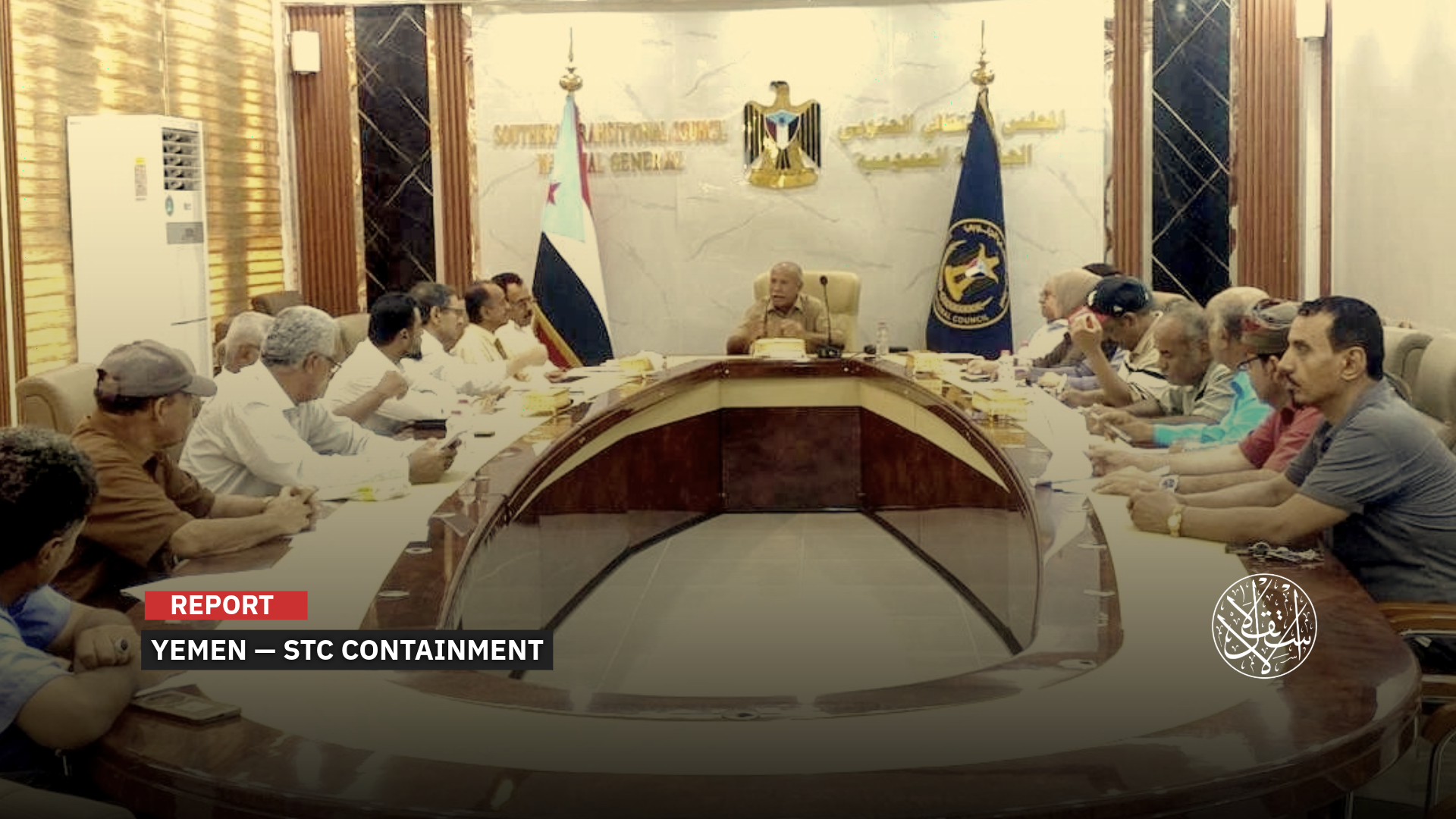
Council-affiliated armed groups still challenge army restructuring and unified command under the Defense Ministry.
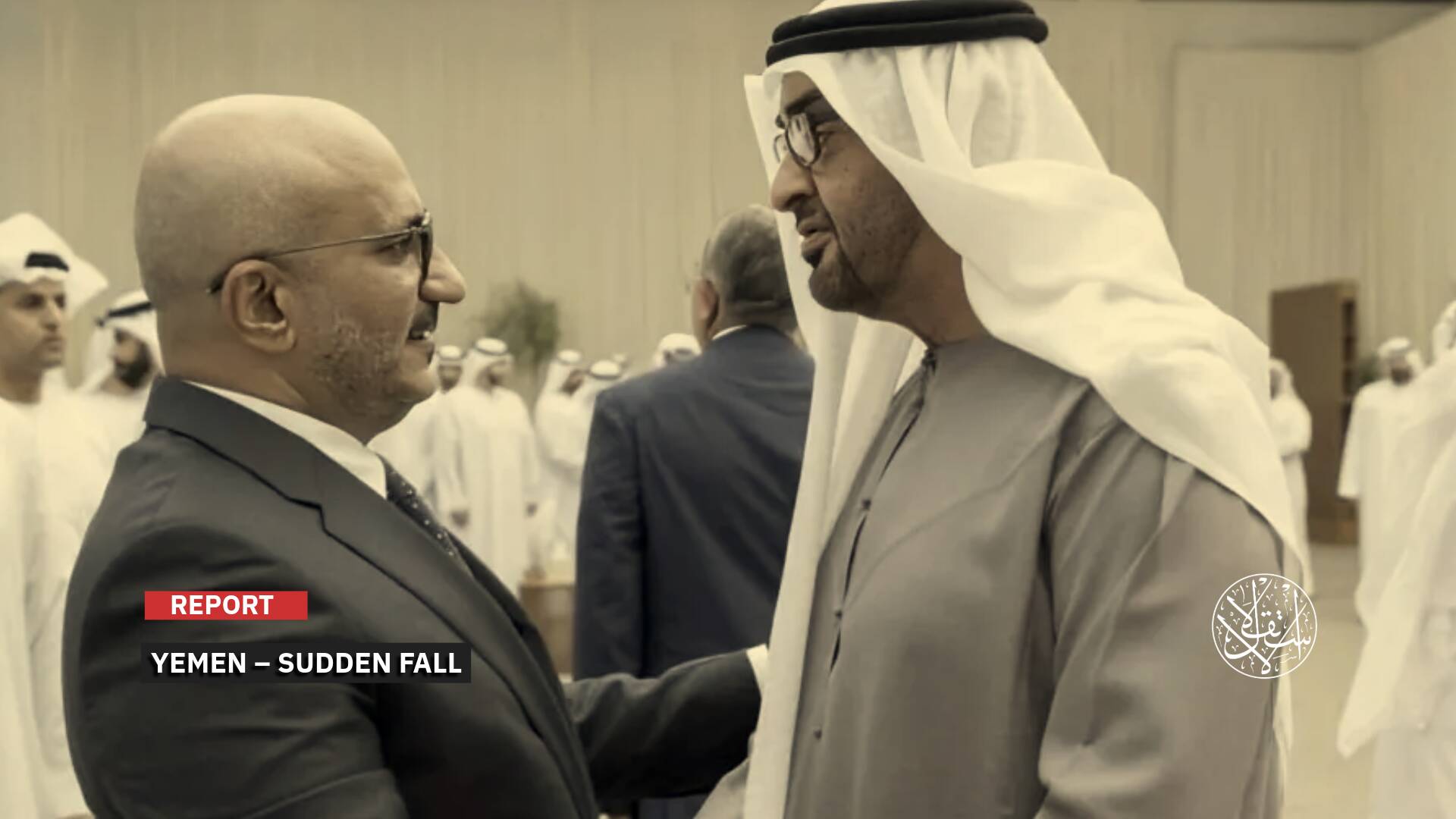
The situation in southern Yemen has entered a new phase of subdued tension, more than three months after the decision to dissolve the Southern Transitional Council (STC) and the departure of its president, Aidarous al-Zubaidi, from the country.
Conditions remain largely unchanged, marked by a high level of fragility and instability, reflecting structural complexities that go beyond the initial expectations following those developments.
Contrary to the expectations of Yemen’s internationally recognized government and its Saudi ally, that the Council’s dissolution would weaken it or strip it of influence, developments on the ground indicate that it continues to maintain a political and popular presence.
It has also demonstrated an ability to reconstitute itself as a key actor in the southern equation, drawing on networks of influence built over previous years.
On the military front, Council-affiliated armed groups still pose a challenge to the government’s efforts to restructure the army and unify command under the Ministry of Defense.
Despite authorities taking procedural steps, including force enumeration, expanding field deployments, and cleaning up personnel records, these efforts face a complex on-the-ground reality, where overlapping loyalties and entrenched power centers make it difficult to dismantle or quickly integrate such forces into a conventional institutional framework.
At the same time, these developments highlight the limitations of the Saudi approach to managing the southern file, both in terms of containing the STC and redirecting its political trajectory.
Political pressure and indirect measures appear to have fallen short of curbing its push toward a separatist project. If anything, they may have unintentionally strengthened internal cohesion and helped the group reorganize along more solid lines.
Accordingly, the current instability in the south does not reflect a real decline in the STC’s weight as much as it reveals a dual failure by the Yemeni government and its allies to capitalize on what appeared to be a window of opportunity to reshape the southern landscape.
At its core, this failure stems from the absence of a comprehensive vision to address structural imbalances and engage with the complexities of the local context, resulting in continued political and security setbacks, and leaving the south locked in a cycle of instability.
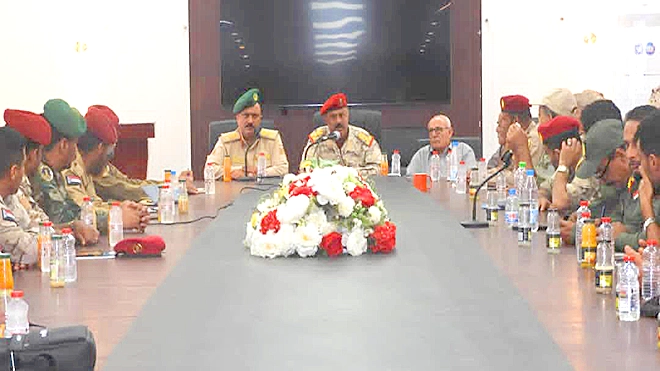
Saudi Moves
Saudi Arabia initially succeeded in pushing the Southern Transitional Council (STC) toward a dissolution track. From Riyadh, on January 9, 2026, the Secretary-General Abdulrahman al-Subaihi announced the Council’s dissolution, including all its bodies and institutions, and the closure of its offices at home and abroad.
The announcement went beyond an organizational step; it also signaled a reorientation of the southern political cause by emphasizing “working to achieve the southern objective” through preparations for a comprehensive southern conference under Saudi sponsorship.
In this context, Riyadh hosted the “Southern Consultative Meeting” on January 18, bringing together a range of leaders, tribal figures, and social personalities, in what appeared to be a preliminary step toward launching a south-south dialogue intended to reorganize the political landscape in the south within a more inclusive framework.
However, this momentum was not sustained, as the declared political track stalled and the anticipated dialogue conference was not convened.
Some sources suggest that the security and military complexities following the dissolution announcement, especially given the armed structure linked to the Council and its backers, forced Riyadh to reassess its priorities.
Instead of pushing quickly toward a comprehensive political settlement, the Saudi approach shifted toward managing short-term stability, prioritizing the containment of field imbalances and the normalization of conditions in the southern governorates.
This approach reflects a shift from a logic of “reengineering the political landscape” to one of “managing existing balances,” with priorities now focused on improving services, ensuring salary payments, and containing security tensions, alongside gradual efforts to integrate armed formations into the official military structure.
However, this shift, despite its pragmatic nature, raises questions about Saudi policy’s ability to achieve a real breakthrough in such a complex file, where local and regional factors intersect, and which is difficult to resolve through procedural tools without a more coherent and comprehensive political approach.
In this context, Ahmed Humaidan, head of the Aden Cultural Forum, said that recent developments do not represent the complete collapse of the STC, but rather the removal of its leadership, while the political structure on which it was built remains intact.
Humaidan explained that what is happening is an attempt to reshape and normalize this structure in a way that serves regional objectives, noting that Saudi Arabia, in his view, is not seeking to fully eliminate the STC, but rather to redirect it into a tool that serves its interests instead of being tied to Emirati influence.
He added that Riyadh is not focused on building state institutions or identifying national leadership, but rather on dealing with actors within the STC in order to reshape it in line with its agenda.
In its approach to the southern file, Saudi Arabia is betting on the possibility of internal divisions emerging within the STC’s structure, which could gradually weaken it and undermine its cohesion, paving the way to engage with alternative leadership that may emerge from within and prove more amenable to redirection.
In this context, the “Supreme Council of the Southern Revolutionary Movement” in Aden announced that it had changed its name to the “Southern National Movement Council,” in a step that, according to observers, reflects a political repositioning within the southern landscape.
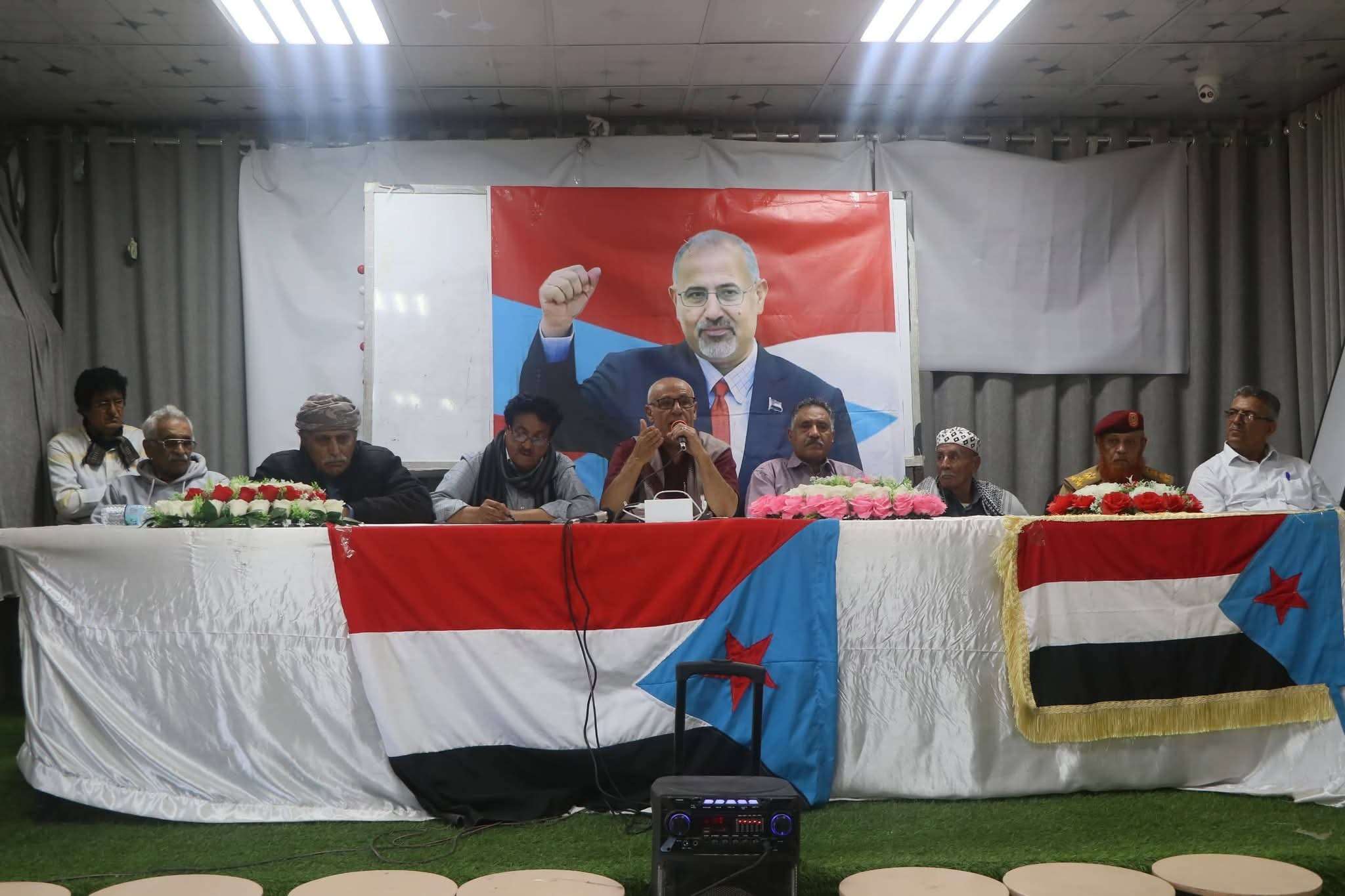
The announcement came during an official meeting chaired by former Southern Transitional Council (STC) figure Abdulraouf al-Saqqaf, who emphasized the continuation of what he described as “peaceful struggle,” alongside adopting pluralistic political work and strengthening partnership with Saudi Arabia.
The shift from the label “revolutionary” to “national” is seen as more than a formal change, reflecting a move from protest-oriented rhetoric to an approach closer to institutional political engagement.
The emphasis on the relationship with Riyadh also indicates the new entity’s attempt to position itself as a southern actor with regional backing, while signaling readiness to engage in a Saudi-sponsored south–south dialogue.
In this sense, the step represents an effort to build an alternative or parallel political weight, placing the STC under additional pressure at a sensitive moment, as it now faces a competitor with overlapping southern rhetoric but a different approach to managing relations with Saudi Arabia and upcoming political developments.
At the same time, observers argue that one of the drivers of the Saudi approach is linked to balance-of-power considerations. Weakening the STC to the point of exclusion could create a vacuum in the south that other forces, particularly the Yemeni Islah Party, might fill, a scenario that does not appear acceptable to Riyadh and its partners.
From this perspective, Saudi policy appears closer to managing delicate balances among local actors, preventing any single party from dominating, and maintaining a controllable equilibrium that preserves influence without triggering an unplanned reshaping of the southern landscape.
The Islah Party also appears aware of the nature of this balance-based approach and understands that any unilateral move could be interpreted as an attempt to dominate the southern scene, potentially triggering political and regional sensitivities.
Accordingly, it has opted to engage within a broader framework through the National Bloc of Political Parties and Components, which, in cooperation with the National Democratic Institute (NDI), launched a workshop on “south–south dialogue” with the participation of its leadership. The move aims to reactivate the consensus-building track among southern forces.
In this context, the bloc’s head, Ahmed Obaid bin Dagher, stressed the importance of moving from competition to complementarity, while relying on Saudi sponsorship as a guarantor for the success of the dialogue’s outcomes.
This initiative reflects an attempt to revive the dialogue process in a more inclusive form, based on broadening southern representation and preventing monopolization of the political scene by the STC.
The explicit reference to Saudi sponsorship also reveals that the objective goes beyond merely launching a political dialogue, and is tied to producing outcomes aligned with Riyadh’s approach of managing balances among local forces, limiting any actor’s dominance, and keeping the southern landscape within a politically controllable framework.
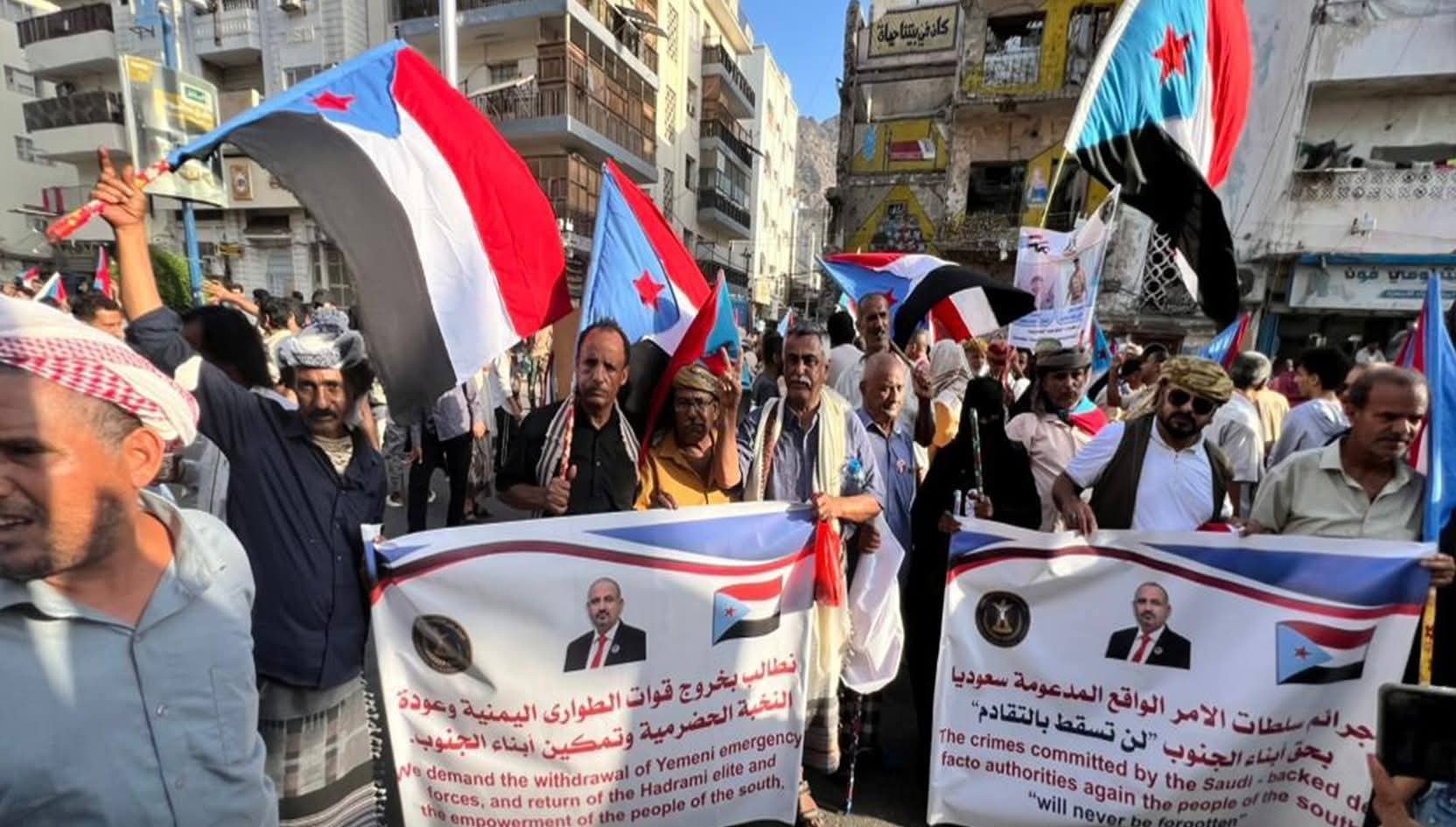
STC Movements
On the other hand, the Southern Transitional Council (STC) shows a degree of cohesion in the face of pressure and containment attempts, despite being described as an unlawful entity following the announcement of its dissolution and the departure of its leader from the country.
At the organizational level, the Council still maintains its leadership structure and continues to hold regular meetings, while also seeking to assert its presence on the ground through public events and symbolic escalation.
In this context, the so-called “Council of Advisors” called on supporters to demonstrate in commemoration of what it describes as Aidarous al-Zubaidi’s “mandate,” reaffirming commitment to escalation and continued action under his leadership.
In parallel, the Council has activated the civil networks it built during its period of control, using them as tools of field pressure.
The “Southern Workers’ Union” issued an ultimatum to the government to address crises related to electricity, fuel, gas, and salary payments, while threatening escalation. This is likely to be followed by moves from other professional bodies, such as exchange and teachers’ unions, reflecting a coordinated use of union structures in service of a political agenda.
Militarily, the Council continues to firmly reject integration of its forces into government structures, with its field commanders declaring non-compliance with any directives issued by official authorities and confirming that orders are received exclusively from their own leadership.
This stance is reinforced by parallel steps to preserve the independence of its military structure, including directives from Abdulrahman al-Muharrami, a member of the Presidential Leadership Council, to reorganize certain units within what is called the “Southern Armed Forces,” keeping them outside the Ministry of Defense framework.
In another operational dimension, a recent document issued by the so-called “Joint Operations Authority of the Southern Armed Forces” revealed the establishment of three new combat axes, geographically distributed across several southern areas, reflecting an effort to maintain the STC’s military independence and enhance its readiness.
At the same time, the STC escalated its political rhetoric by announcing its intention to take legal action against Saudi Arabia, a move that goes beyond the legal dimension and falls within tools of political pressure and repositioning in response to regional constraints.
Meanwhile, the Council has intensified its external engagement by expanding contacts with international and regional actors, seeking to promote its vision and reintroduce itself as a key player in the southern equation.
In this context, Amr Ali Salem al-Beidh confirmed the Council’s continued openness to international and human rights organizations, as well as influential figures in decision-making circles, stressing the cohesion of its organizational structure and its reliance on an active popular base.
These moves reflect an integrated approach by the STC that combines internal escalation with external outreach. Domestically, it continues to consolidate its presence through mass mobilization and the activation of union and institutional pressure tools, while externally working to expand its network of relations and present itself as an organized actor with a political vision.
This dual-track strategy enhances its ability to maneuver, not only to preserve its current position but also to strengthen its negotiating weight and assert itself as a key party that cannot be bypassed in any future political arrangements concerning the south, including the south–south dialogue conference sponsored by Riyadh.

Solution Scenarios
The developments in southern Yemen indicate that Saudi Arabia’s approach toward the Southern Transitional Council (STC) is not based on decisive resolution, but rather on managing complex balances, in an effort to contain the actor without fully dismantling it or empowering it in a definitive way.
Since the announcement of the Council’s dissolution, Riyadh has appeared to be seeking to redirect its trajectory and reshape its structure rather than end it, using indirect political pressure tools, including promoting dialogue, supporting parallel forces, and betting on the possibility of internal splits that could weaken its cohesion.
However, this approach faces several challenges. The absence of a comprehensive strategic vision, and the shift from an attempt to “reengineer the political landscape” to merely “managing the crisis,” have led to inconsistency in policy.
Moreover, reliance on gradual tools, such as fragmenting internal structures or producing political alternatives, has not achieved any tangible breakthrough, amid the STC’s continued ability to maintain a deeply rooted political, military, and popular network of influence.
This contradiction in objectives, weakening the STC without bringing it down, has made the Saudi approach closer to managing an unstable situation, where the Council retains the ability to disrupt without being fully integrated into the state structure.
In light of this reality, Saudi Arabia’s options in the next phase appear open to several scenarios.
The first scenario, and the most likely, is the continuation of a gradual containment policy through managing balances among local actors, while maintaining soft pressure to reshape the STC or reduce its influence without direct confrontation. It is also possible that Saudi Arabia may seek to “recycle” the STC itself by absorbing parts of it or reshaping its leadership to make it more aligned with its vision for the south.
The second scenario involves the possibility of escalating pressure, whether through political or field-level tools, in the event the Council shows further defiance. However, this path carries risks of destabilizing an already fragile situation, something Saudi Arabia is unlikely to accept given its interest in maintaining a “stable south” to support its broader strategic projects.
The third scenario is implicit acceptance of the status quo, treating the STC as an unavoidable force and incorporating it into any future political settlement without dismantling it.
This would effectively mean postponing the southern issue indefinitely, while the STC would remain the most influential actor on the ground.
Sources
- The Southern Transitional Council in Yemen Dissolves Itself [Arabic]
- Yemen: Southern Leaders Look Toward Fair Solutions in the Upcoming Dialogue Conference [Arabic]
- Why Was the “Southern Dialogue” Conference in Riyadh Postponed? Sources Reveal the Reasons to “Arabi21” [Arabic]
- After Regaining Its Headquarters… the STC Escalates Through the Services File, Exploiting Government Hesitation to Resolve the Crisis [Arabic]
- The Southern “Revolutionary Movement” Turns “National”… What Does This Mean for the Dissolved STC? [Arabic]
- The National Bloc Launches a Workshop on South–South Dialogue with Support from the National Democratic Institute (NDI) [Arabic]
- The Council of Advisors Calls on the People of the South to Participate Actively in the 9th Anniversary Million-March of the Popular Mandate for President Al-Zubaidi [Arabic]
- Serious Escalation in Aden… STC Forces Announce Mutiny Against the Government Under Direct Orders from Aidarous Al-Zubaidi [Arabic]
- Al-Muharrami Keeps “Barshid Brigade” Within STC Formations and Blocks Al-Aqeeli’s Move to Transfer It to the Ministry of Defense
- The STC Continues to Form and Deploy Its Forces Outside the Ministry of Defense Framework [Arabic]
- The Dissolved STC Threatens Saudi Arabia from the Heart of Aden [Arabic]
- The Administrative Body of the National Assembly Affirms the Resilience of the Southern Transitional Council and Praises Popular Mobilization [Arabic]