Bennett, Lapid and Eizenkot Alliance: Real Alternative or Another Netanyahu?
The opposition could win around 60 or 61 seats out of the Knesset’s 120-seat parliament.
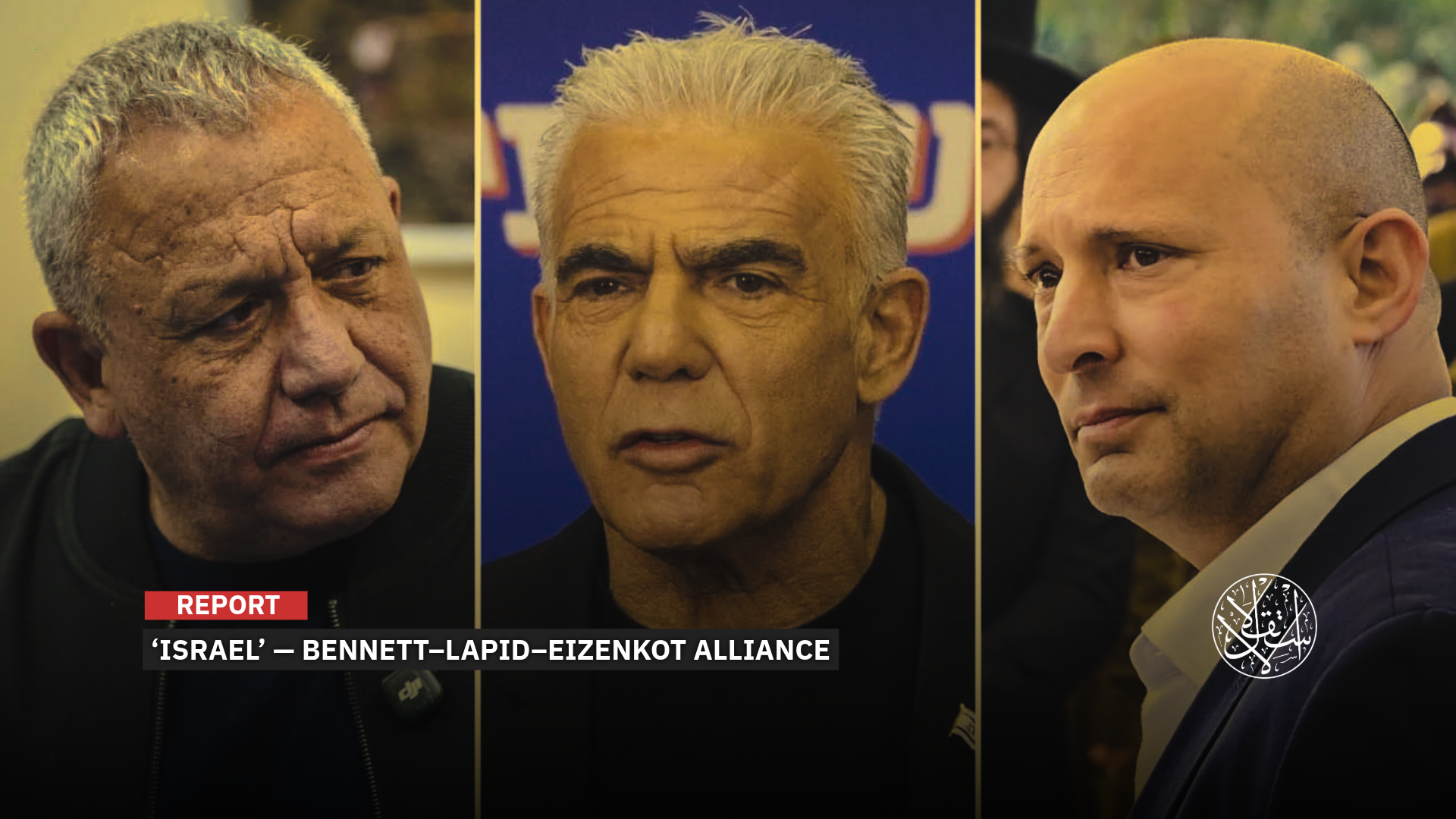
As expected, and as the only viable way to bring down the right-wing ruling coalition in “Israel” led by Prime Minister Benjamin Netanyahu, and to hold him accountable for corruption cases and the failures surrounding the Operation al-Aqsa Flood, former Prime Minister Naftali Bennett and opposition leader Yair Lapid have announced the merger of their parties to run in the upcoming elections under Bennett’s leadership.
The decision announced by the two opposition leaders, which is expected to be joined or supported by former Chief of Staff Gadi Eizenkot, could trigger a political upset in the October 27, 2026 elections and potentially unseat Netanyahu, according to opinion polls.
With this alliance, the contours of the Knesset elections appear to be taking shape: the opposition could secure around 60 or 61 out of the 120 seats in the Knesset (parliament), and may only need the backing of Arab parties, which are expected to win about 10 seats, compared to roughly 50 seats for Netanyahu’s bloc.
Despite Bennett’s hesitation and his concern about being labeled as allied with the United Arab List (Ra’am), as happened in the 2020 elections, Israeli analysts believe he may ultimately be forced to cooperate with the Islamist party led by MK Mansour Abbas, who previously helped form his government in 2021 and contributed to Netanyahu’s removal from power.

Salvation Government
The announcement by former Prime Minister Naftali Bennett and opposition leader Yair Lapid of their alliance in a joint list named “Together,” aimed at unseating Netanyahu, is being presented as a scenario many Israelis hope for to rid themselves of the current prime minister and his coalition, and to hold him accountable for corruption cases and failures in dealing with the Operation al-Aqsa Flood.
If former Chief of Staff Gadi Eizenkot joins this alliance, the result would be a significant bloc capable of easily toppling Netanyahu, especially since he has already expressed his desire to join the opposition camp.
Eizenkot, leader of the Yashar party, called on anti-Netanyahu forces to coordinate with Bennett and Lapid, stressing that such coordination is necessary to secure “61 Zionist and political votes,” thereby avoiding the need to ally with an Arab party.
The latest opinion poll in “Israel” shows that Zionist opposition parties, excluding Arab parties, could win around 60 seats, compared to about 50 seats for the governing coalition bloc led by Netanyahu, and 10 seats for Arab parties.
According to the poll results broadcast by the Israeli Channel 12 on April 23, 2026, Netanyahu’s Likud party is expected to win 25 seats, alongside right-wing and Haredi parties, bringing their total to around 50 seats.
In contrast, Naftali Bennett’s party is projected to win 21 seats, the Yashar party led by Eizenkot 14 seats, and Yair Lapid’s Yesh Atid party around 12 seats, bringing their combined total to approximately 47 seats, with the support of Yisrael Beiteinu, led by Avigdor Lieberman, which is expected to secure 6 seats, raising the total to about 53 seats.
Lieberman said, “We must remember that the goal is to replace the October 7 government.”
Meanwhile, Yair Golan, leader of the Democrats party, welcomed in a statement “any unity within the anti-Netanyahu bloc,” as polls suggest his party could win between 9 and 16 seats, potentially raising the opposition’s total to around 60 seats or more.
The Democrats party is the result of a merger between the Labor and Meretz parties, in an effort to unify the Zionist left, and it plays an important role within the opposition camp.
As for the Arab parties, the Islamist United Arab List and the Hadash–Ta’al alliance are projected to win 5 seats each, bringing their total to 10, making them a decisive factor in supporting a Bennett-led government if he needs their backing.
Analyst Yasser al-Zaatara believes that “the deep state may have intervened to bring about this alliance between the right and the center, after growing frustrated with the first prime minister to challenge it without delivering on his promises of ‘total victory’ over enemies, and without acknowledging any responsibility for the ‘October 7 catastrophe.’”
He added that this alliance comes amid an unprecedented crisis facing “the entity,” saying, “It has never in its history experienced a political and existential crisis like the one it has faced since October 7, along with what is described as Netanyahu’s inability to translate military and security achievements into strategic gains.”

Is the Kingmaker Returning?
In the May 2020 elections, the Islamist United Arab List party emerged as a “kingmaker” after refusing to align with Benjamin Netanyahu and choosing instead to support the opposition bloc led by Naftali Bennett, leading to Netanyahu’s loss and enabling Bennett to form a government that lasted from 2021 to 2022.
With this support, Bennett and Yair Lapid formed a coalition government in June 2021, backed by Mansour Abbas’s party. However, it collapsed at the end of 2022 and was replaced by the current coalition led by Netanyahu.
This marked the first time since “Israel’s” establishment in 1948 that a Palestinian (Arab) party supported an Israeli government.
In that election, Netanyahu’s bloc lost with 52 seats, compared to 57 seats for the opposition alliance, while the four seats held by the Islamist movement proved decisive in reaching the required majority of 61 seats, making Mansour Abbas the pivotal figure in Netanyahu’s ouster.
Mansour Abbas entered politics when he was elected deputy leader of the Islamic Movement in “Israel” in 2010. He later ran in Knesset elections three times and has served as a member since 2019.
However, former Israeli Prime Minister Naftali Bennett said on April 26, 2026, “I am right-wing, and I will not rely on Arab parties. I will lead and align with leaders from both the right and the left.”
He had also stated on February 18, 2026, that he did not favor repeating the experience of forming an alliance with an Arab party, while not ruling out, on the other hand, sitting with the far-right ministers Itamar Ben-Gvir and Bezalel Smotrich to include them in his government instead of relying on Arab parties.
According to recordings published by the Haredi-oriented website Kipa, Bennett confirmed during a meeting in the settlement of Efrat that he had previously invited Netanyahu’s current ally, Finance Minister Smotrich, to join his previous coalition, but he refused.
He added, “Had Smotrich joined, there would have been no need to rely on an Arab party, but he refused, which forced me to do so.”
Despite expectations that Bennett and Lapid might repeat the 2021 experience and unseat Netanyahu with the support of Arab parties, particularly the Islamist party, if they fail to secure the 61 seats needed to form a government, they appear hesitant due to the repercussions of the Operation al-Aqsa Flood.
Following the events of October 7, 2023, a wave of hardline sentiment in “Israel” has intensified against any alliance with Arab parties, accompanied by strong statements from Bennett rejecting this option.
Nevertheless, Netanyahu’s alliance has exploited the formation of this opposition bloc, and the possibility that it may need to rely on an Arab party to reach power, to discredit the opposition and incite Israeli public opinion against it.
National Security Minister Itamar Ben-Gvir claimed that “the Bennett–Lapid alliance means selling the country to the Islamic Movement,” although he posted a photo of MK Ahmad Tibi, who belongs to the left-wing camp, instead of Mansour Abbas, who had previously allied with the opposition.
In contrast, Mansour Abbas, leader of the United Arab List (the Islamist Ra’am party), has left the door open to repeating the 2020 scenario.
Commenting on the Bennett–Lapid alliance, he said, “Incitement campaigns and delegitimization led by the far right against the United Arab List are escalating, but they will not deter us.”
“We are working to shape a pluralistic joint list, in coordination with other Arab parties, with the aim of bringing about real political change and replacing the right-wing government with one in which the United Arab List plays an influential role,” Abbas added.
Netanyahu Unites Rivals Again
After years of failure by Naftali Bennett and Yair Lapid to formulate a convincing alternative vision, and repeated warnings within opposition circles that division only benefits Benjamin Netanyahu, it has become clear that opposition to him has turned into the only common denominator capable of restoring their political ambitions.
Analysts believe that the merger of Bennett’s and Lapid’s parties, despite their sharp ideological differences, reflects a striking political paradox: the former belongs to the religious right with hardline positions toward Palestinians, while the latter represents the centrist secular camp. Yet, they have been brought together by a single rival who has reshaped “Israel’s” party landscape.
These analysts also stress that Bennett’s emergence as the leader of this alliance was not a spontaneous move, but a calculated choice aimed at attracting voters from the right-wing camp within Netanyahu’s coalition.
This makes the challenge one of the most serious Netanyahu has faced since 2021, even though it remains fragile, as it is built on opposition to a common adversary rather than a unified political program.
A statement by the alliance said the move aims to “unify efforts toward achieving a decisive victory in the upcoming elections and leading Israel toward the desired reform.”
The decision by Bennett and Lapid to unite came after earlier statements by Bennett in which he stressed the impossibility of winning as long as opposition forces remain divided, noting that the anti-Netanyahu bloc is paying the price for its political fragmentation.
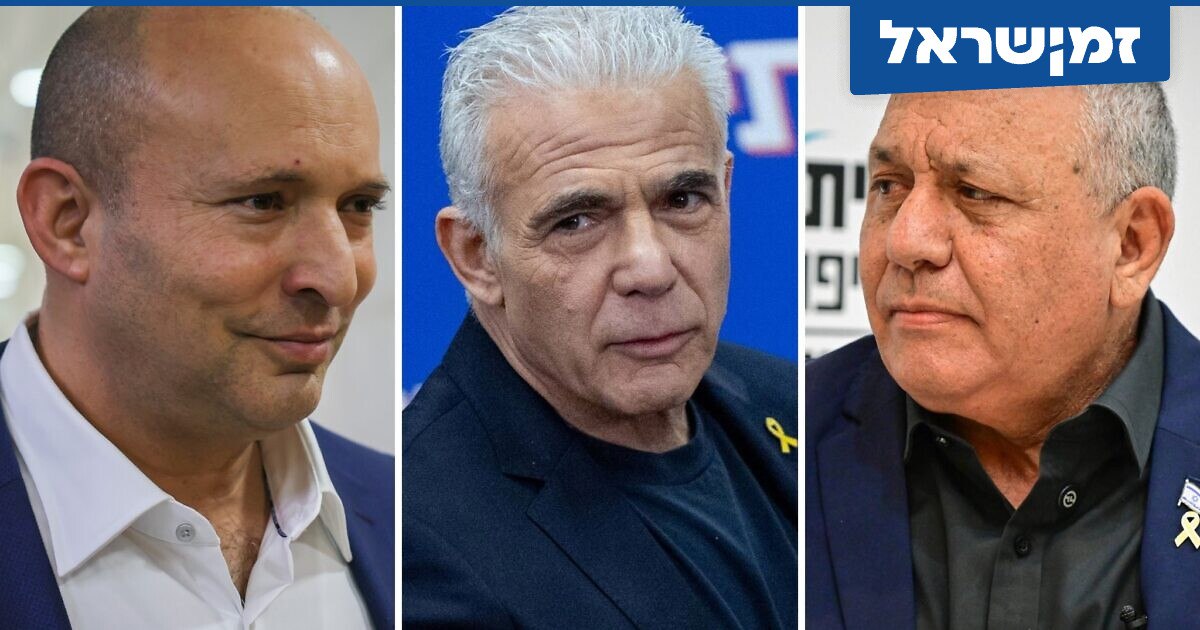
Before the official announcement, the website Zman Israel reported on April 17, 2026, the possibility of forming a tripartite alliance including Bennett, Lapid, and Gadi Eizenkot, which could turn this bloc into the largest force in the next Knesset. This projection was based on opinion polls conducted by political consultant Yossi Tatika in cooperation with the Agenda group, indicating that such a merger could generate electoral momentum exceeding the combined strength of the parties if they were to run separately.

Arab Parties Are the Kingmakers
Opinion polls and past election results indicate that a unified alliance of Arab Palestinian parties in “Israel” is capable of winning at least 13 seats in the Knesset (out of 120), giving it significant electoral weight and making it a decisive factor in government formation equations.
However, internal divisions among these parties and their tendency to run separately have reduced their representation to around 9 or 10 seats, stripping them of much of their ability to act as a “kingmaker” in Israeli politics.
By contrast, when they have united in the past under the Joint List framework, they have increased their representation and political influence. This was evident in the March 2015 elections, when four Arab parties ran on a unified list in response to the raising of the electoral threshold to 3.25%, winning 13 seats and becoming the third-largest bloc in the 20th Knesset.
But in the 2022 elections, running on separate lists reduced Arab representation to only 9 seats, reflecting the cost of fragmentation on Palestinian political influence within the Knesset.
With the 26th Knesset elections approaching on October 27, 2026, observers believe that a unified Arab list (comprising Hadash, the Ta’al movement, Balad, and Ra’am) could increase its representation to between 12 and 15 seats, restoring its position as a third force in parliament.
This scenario is increasingly significant amid what Arab leaders describe as growing exclusionary policies against Palestinians inside “Israel” since 1948, making unified participation an opportunity to strengthen political influence and potentially affect governing dynamics.
In this context, Ahmad Tibi, head of the Hadash–Ta’al faction, stressed the need to accelerate efforts to re-establish a joint Arab list, stating that “the ground is ready” and that continued fragmentation is no longer justified given escalating challenges.
Speaking to Al-Quds Al-Arabi on April 27, 2026, he said that Arab unity is the most influential factor in increasing parliamentary representation and driving change within the Israeli political scene.
Sami Abu Shehadeh, leader of the National Democratic Assembly (Balad), also called for a strong joint Arab list capable of winning 15 to 17 seats, which would give it decisive weight in the Israeli parliament.
He emphasized that the common ground among Arab parties is broader than their differences, and that the scale of current challenges requires overcoming divisions in favor of a unified political framework.
However, concerns are also rising over potential Israeli government efforts to limit Arab party representation or disqualify some from running in elections, according to Haaretz on April 23, 2026, in a politically charged context linked to the war on Gaza and its repercussions, as well as issues of displacement and political rights of Palestinians inside “Israel”. This raises broader risks regarding their electoral representation and the future of their political participation.
Opposition Mirrors Netanyahu
The rise in the prospects of the Zionist opposition alliance between Naftali Bennett and Yair Lapid, and possibly General Gadi Eizenkot, along with their potential ability to form a new government, does not necessarily mean they represent a different or better option for Arabs.
The departure of Benjamin Netanyahu is not expected to lead to any fundamental change in the Zionist system’s approach toward Palestinians or the surrounding Arab region.
According to analysts, any change would likely be limited to form or style within a tactical framework, while the substance of policies would remain unchanged. This is reflected in the shared positions within the opposition camp, particularly regarding the rejection of the idea of a Palestinian state, which has already been endorsed by the Knesset, as well as broader stances on political settlement, relations with the Arab world, and Iran.
Israeli writer Yossi Verter, in Haaretz on April 27, 2026, noted that the common ground among the leaders of this alliance outweighs their differences, pointing out that the issue of a Palestinian state is not practically on their agenda, and that they all largely rule out forming a government with Arab parties in any future governing arrangement.
At the same time, they agree on key domestic issues, including advancing an enforceable conscription law, establishing a formal commission of inquiry into the October 7 events, rolling back judicial reforms introduced by Netanyahu aimed at limiting the powers of the Supreme Court, and reducing what they consider political influence over media and public institutions.
Researcher Ameer Makhoul from the “Taqaddum” Policy Center, in a statement to Arab 48 on April 27, 2026, argues that this Bennett–Lapid alliance does not represent a comprehensive political project, but rather a tactical move to reshape power balances within the Zionist camp.
Makhoul adds that Bennett is in some respects even more right-wing than Netanyahu on core issues, particularly regarding opposition to any political or territorial concessions in the occupied Palestinian territories. He stresses that the Israeli opposition in general lacks a clear political vision for addressing the Palestinian issue or ending the occupation, and that its primary goal remains limited to replacing Netanyahu rather than changing policies.
He further notes that this camp’s rejection of reliance on Arab parties reflects a historical approach that treats them as a “political reserve” used when needed to secure power, without recognizing them as partners in shaping policy or in any process related to ending the occupation or addressing the roots of the conflict.
Sources
- Former PMs Bennett and Lapid Merge Parties Ahead of 2026 Election in Bid to Oust Netanyahu
- Two Former Israeli Prime Ministers Join Forces Against Netanyahu in Upcoming Elections
- Bennett and Lapid Fire the Opening Shot in Israel’s 2026 Election Battle
- Makhoul: Bennett–Lapid Alliance Is Tactical and Lacks a Clear Political Project [Arabic]