20-Year Prison Sentence for Ghannouchi: Political Verdict or Tailor-Made 'Justice?'
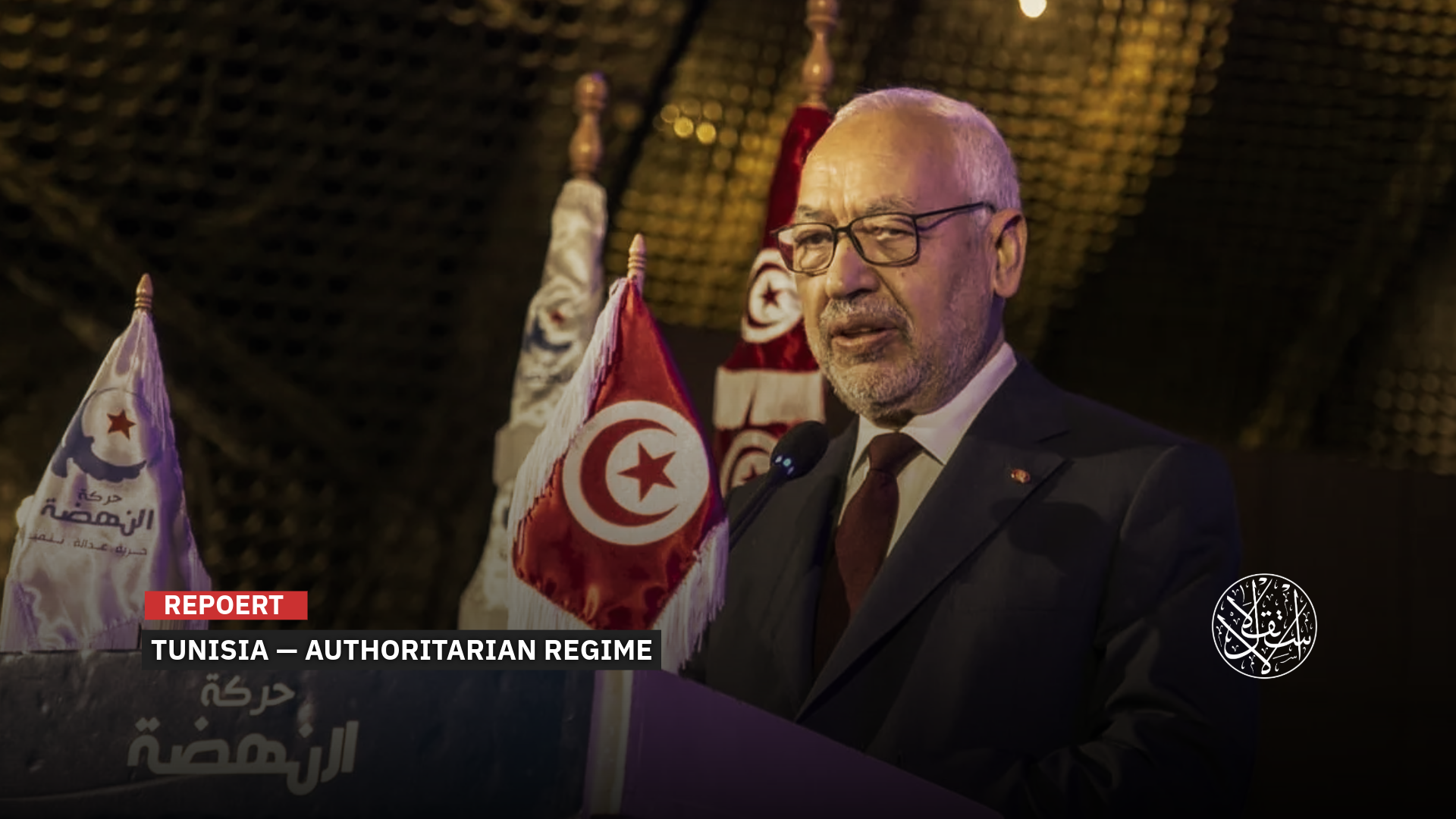
“The veteran in his nineties has, as a result of the stupidity of coup leader Kais Saied, become ‘the detainee of all time.’”
Tunisia’s judiciary, under Kais Saied’s grip, is continuing to side with the authorities in targeting figures of the revolution and Islamic and political activism, foremost among them Rached Ghannouchi.
On Tuesday, April 14, 2026, the Tunis Court of First Instance’s criminal chamber handed Ghannouchi, the former parliament speaker and head of the Ennahda movement, a 20-year prison sentence in what has become known as the “Ramadan Evening Gathering” case.
In a statement issued on the occasion, Ennahda said the unjust rulings also targeted a range of former officials and political figures, including ex-MPs Ahmed Mechergui, Belgacem Hassan, and Mohamed Goumani; former foreign minister Rafik Abdessalem; Shura Council member Youssef Nouri; former Ennahda youth official Mohamed Cheniba; as well as several independent personalities.
The movement strongly condemned what it described as an “unjust trial,” arguing that the defense team had demonstrated that the case was based on a fabricated video that did not match the original footage of the Ramadan Gathering. It also pointed to procedural violations surrounding the arrests, which were carried out without prior summons and allegedly denied Ghannouchi and others the right to have their lawyers present.
Ennahda also said its headquarters was sealed shortly after without a court order, allegedly under the pretext of a search, and has remained closed ever since outside any legal framework, even though the search was completed and an official report filed years ago.
The party reiterated that Ghannouchi’s remarks at the Ramadan Gathering—attended by opposition figures—had called for national unity, rejection of exclusion and violence, and warnings against division, contrary to the interpretation advanced by the investigation.
It also rejected what it called the political nature of the trial, arguing that it criminalizes dissent, undermines the right to organize, and violates constitutional freedoms, particularly freedom of expression, opinion, and political activity.
Ennahda further condemned the use of the judiciary and counterterrorism legislation to sideline political opponents and restrict public freedoms, saying the measures are aimed at intimidating citizens and diverting attention from economic and social failures, as well as the government’s inability to address deteriorating living conditions in Tunisia.
A Dangerous Slide
A number of organizations, institutions, and political forces have voiced their rejection of the court rulings targeting Rached Ghannouchi and others in the case.
The opposition National Salvation Front (NSF) condemned the verdicts in the strongest possible terms, expressing “deep shock and outrage” at the rulings issued by the judiciary under Kais Saied.
In a statement dated April 15, 2026, the NSF said the case originated from a Ramadan evening gathering held three years earlier, organized to mark the first anniversary of its founding.
It argued that the rulings represent “a new step in the process of using the judiciary to criminalize peaceful political activity and restrict freedom of opinion, expression, and association.”
The NSF warned that the danger of the verdicts lies not only in their severity, but also in what they reveal: a “dangerous slide” toward criminalizing even the most basic forms of political and civic engagement, threatening the foundations of the rule of law and eroding remaining guarantees of a fair trial.
It called for the immediate release of all those detained on political grounds and an end to the use of the judiciary in political disputes, holding the ruling authorities fully responsible for the shrinking political space, the worsening social situation, and the increasing reliance on prosecutions as the primary tool for dealing with opponents.
The statement also urged all democratic national forces to unite in defending freedoms and restoring the democratic process through peaceful and responsible political action.
Rached Ghannouchi’s defense team said the ruling issued by the Tunis Court of First Instance falls short of fair trial standards, arguing that the case is politically motivated and amounts to an attack on freedom of expression and opinion.
According to the local outlet Tumedia on April 16, 2026, the defense said Ghannouchi has boycotted all stages of the proceedings since his arrest on April 17, 2023, in protest over what it described as procedural violations. These included the absence of a prior summons, the denial of lawyers’ presence during initial questioning, and the use of counterterrorism legislation in a case that does not fall under its scope.
The defense also insisted that the statements attributed to Ghannouchi during the “Ramadan evening gathering” were distorted, stressing that his remarks had called for coexistence, national unity, and rejection of exclusion.
It reaffirmed its commitment to all legal avenues of appeal, while noting that Ghannouchi himself is unlikely to pursue the appeals process.
‘Detainee of All Time’
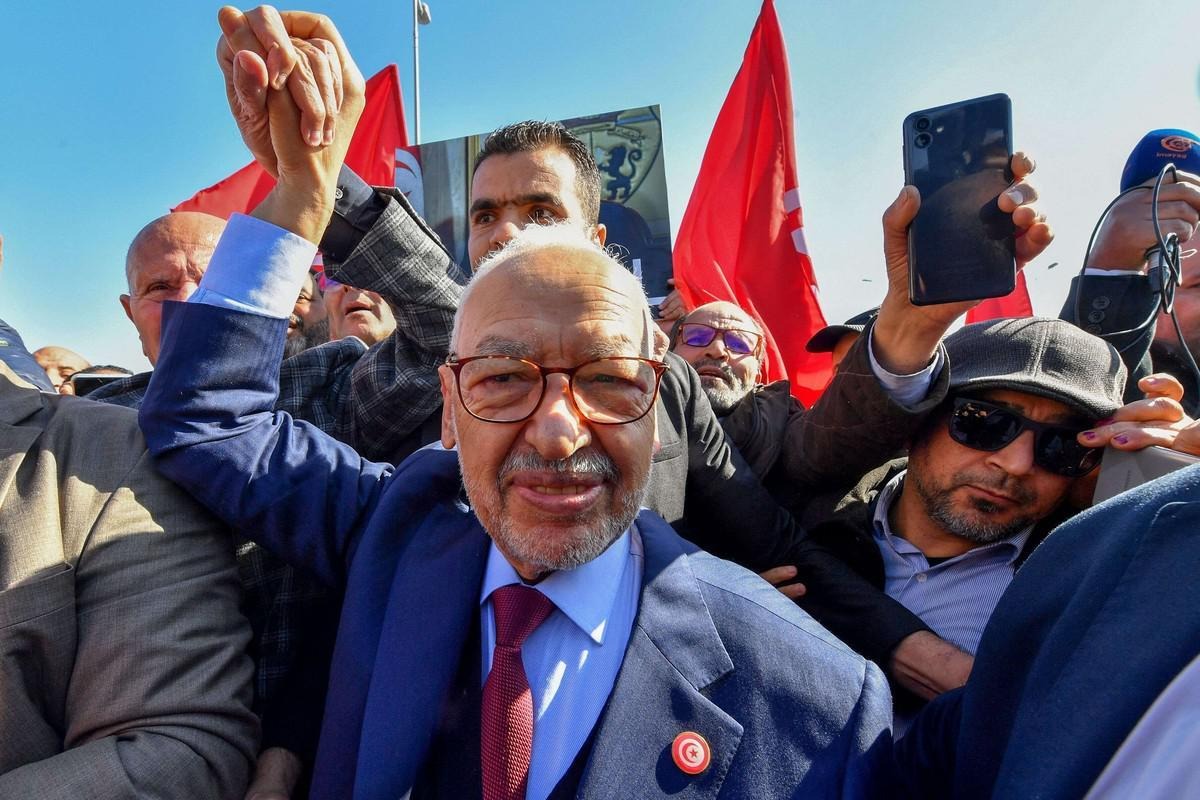
Political analyst and media activist Nasreddine Souilmi said the new ruling against Ghannouchi comes on the third anniversary of his imprisonment, adding that the detained sheikh continues to build on his legacy, confronting his opponents with a record of numbers and achievements.
Speaking to Al-Estiklal, Souilmi said the veteran in his nineties has, as a result of the stupidity of the regime of the coup leader Kais Saied, come to be labeled “the detainee of all time, of all dictatorships and of heavy sentences and the shadow of executions.”
He noted that the Islamist leader, against whom sentences issued under the current ruling authority now total 60 years, had previously been sentenced by the same regime in 1987 to the same prison term, with Bourguiba having even called for his execution. Under Ben Ali’s dictatorship, he was sentenced to life imprisonment in 1991 and again to the same sentence in 1998.
Souilmi traced Ghannouchi’s intellectual and political formation back to the mid-1960s, saying his early ideological development was shaped after a six-month journey across Europe, during which he visited Turkiye, Bulgaria, Yugoslavia, Austria, Germany, and France.
The political activist believes that the sheikh’s journey over these decades can be described as one of triumph for the nation’s beliefs and identity, a victory for freedom and humanity, and a long struggle spanning 60 years.
Souilmi also said Ghannouchi faced successive authoritarian systems, founded a movement that led the opposition from the 1980s, supported the revolution and the transitional period, and won or strongly competed in most elections between 1989 and 2019, while also playing a role in shaping and mentoring the youth of the Islamic awakening.
Souilmi also noted that Ghannouchi was under the scrutiny of Western intelligence services, their ideologies, their agents and servants, and their counter-revolutions and campaigns of exclusion, without ever finding anything to incriminate him.
He said Ghannouchi is now paying, through the unjust rulings, the price for his opposition to the coup and his refusal to accept it, which he argued has only intensified the hostility of his opponents.
‘A Judicial Farce’
With his name included among those convicted in the “Ramadan Gathering” case, former foreign minister Rafik Abdessalem said the “coup regime has lost its reason and balance after turning the judiciary into a global farce unmatched anywhere in the world in its sheer absurdity.”
In a Facebook post dated April 15, 2026, Abdessalem said the 20-year sentences against the legitimate parliament speaker, along with other varying prison terms against senior Ennahda figures, were handed down over a Ramadan gathering that amounted to nothing more than a discussion of political and intellectual ideas.
“As for this humble servant, my share was also two decades in prison for a gathering I did not even attend; I was not even in Tunisia at the time, in addition to more than a century of previous sentences,” he added.
Abdessalem said that what is happening in Tunisia is beyond the bounds of logic, reason, basic political norms, and judicial principles, adding that he is not sure whether this “madness” stems from a ruler acting on unchecked whims or whether the entire regime is driving this kind of absurdity and chaos for reasons known only to itself.
Rached Ghannouchi’s Facebook page also shared a post by British journalist and activist Yvonne Ridley, in which she condemned what she described as “the cowardice of those who imprison the elderly and the wise.”
Ridley said the detention of Ghannouchi is not merely a legal failure but a war on the values of the nation, adding that at 84 years old, he stands taller than any of his captors.
She argued that the accumulation of decades-long prison sentences against him represents a desperate attempt to silence his voice, stressing that a man who has spent decades between exile and imprisonment for his beliefs does not fear iron bars.
Describing him as a lion who refuses to submit to the illusion of guardianship and chooses the cell over the chains of a new dictatorship, Ridley called for his immediate release and the restoration of justice in Tunisia.
Reparations for Harm
Tunisia’s authorities’ retaliatory approach toward Rached Ghannouchi has been sharply criticized by the UN Working Group on Arbitrary Detention, which in Opinion No. 63/2025 concluded that the detention of the dissolved parliament speaker is arbitrary and called for his immediate release.
This condemnation followed a joint submission by the NGO Alkarama and the Association of Victims of Torture in Tunisia (AVTT), published on March 23, 2026.
The UN experts noted that Ghannouchi was arrested on April 17, 2023, at his home without a warrant, followed by 48 hours of secret detention during which his family and lawyers were not informed of his whereabouts.
They stressed that his detention stems from the peaceful exercise of his rights, particularly freedom of expression, and that the conditions of his detention violated his right to a fair trial—including denial of adequate legal preparation, obstruction of access to legal counsel, and holding hearings in his absence.
According to the UN Working Group on Arbitrary Detention, these serious violations render the deprivation of liberty arbitrary and unlawful.
It further stated that the detention is politically motivated, arguing that Ghannouchi, as leader of the Ennahda movement, is being punished as part of a broader effort to silence political opposition and suppress dissenting voices.
In other words, UN experts concluded that he is being targeted for his political role and affiliation with Ennahda, rather than any legitimate legal basis.
They also recalled that Ghannouchi, 84, who suffers from Parkinson’s disease, must be treated humanely and with respect and called for his immediate release, reparations, and an independent investigation into the documented violations.
International Solidarity
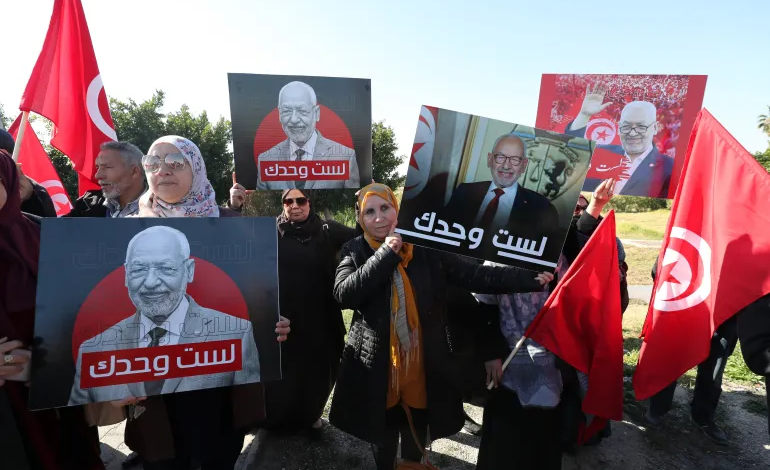
On the occasion of the third anniversary of his arbitrary detention, the International Committee for the Support of Rached Ghannouchi has strongly condemned the continued unlawful detention and the accelerating dismantling of fundamental freedoms in Tunisia.
In a statement dated April 17, 2026, the group said Ghannouchi remains unjustly and unlawfully detained three years after his arrest, stressing that his case is not an isolated judicial matter but part of a systematic effort to roll back the gains of the revolution, silence the opposition, and erode what remains of Tunisia’s fragile political pluralism in favor of authoritarian rule.
The statement argued that the case reflects a broader and deeply concerning pattern, noting that since 2021, Tunisia has witnessed an unprecedented crackdown on political opponents, journalists, lawyers, trade unionists, and civil society activists, alongside a shrinking civic space.
It warned that the continued detention of Ghannouchi represents a broader assault on democracy and a serious violation of Tunisia’s obligations under the International Covenant on Civil and Political Rights (ICCPR).
The statement was signed by a wide array of political, human rights, academic, and Islamist figures, including former Tunisian President Moncef Marzouki; former Bosnian Presidency members Haris Silajdzic and Bakir Izetbegovic; and former Turkish parliamentary speaker Mustafa Sentop.
It also included former Syrian Prime Minister Farid Hijab, former Moroccan Prime Ministers Abdelilah Benkirane and Saad Dine Elotmani, former Libyan Prime Minister Mustafa Abu Shagur, and former Iraqi Vice President Tareq al-Hashimi.
It was also signed by Dr. Nurhayati Ali Assegaf, former vice president of the Inter-Parliamentary Union; Professor Richard Falk, former UN Special Rapporteur on the Palestinian territories; Nobel Peace Prize laureate Tawakkol Karman; and Mandla Mandela, a member of parliament and grandson of Nelson Mandela.
Other signatories included Bilal Recep Tayyip Erdogan, head of the International Union of Popular Sports; Nurul Izzah Anwar, a former Malaysian MP; Ambassador Giuseppe Scognamiglio, a former diplomat and head of the EastWest Institute in Italy; and Ayman Nour, leader of Egypt’s National Forces Union and a former presidential candidate.
The statement was also endorsed by a wide range of political and public figures, including Yasin Aktay, Ebrahim Rasool, Kamel Jendoubi, Mustapha Ramid, Idriss Azami al-Idrissi, Abdelmadjid Menasra, Naim Ghariani, Mohamed Saleh Ben Ammar, Ahmed Kedidi, Abderrazak Makri, Marwa Kaouakji, Abdelwahab el-Affendi, Ennah Gomez, Mohamed el-Feki, Mohamed Denguir, and Husein Kavazovic.
Further signatories included Mustafa Ceric, Burhan Ghalioun, Mohamed Mokhtar Chinguitti, Professor John Esposito, Professor Nader Hashemi, Professor Tamara Sonn, Professor John Keane, Sarah Leah Whitson, Professor Larry Diamond, Ambassador Ridha Ben Khelidoun, Professor Francois Burgat, Oliver McTernan, Professor Lynn Welchman, Professor Jocelyne Cesari, Professor Michael Dunn, Professor John Entelis, Professor Andrew March, Professor Fawaz Gerges, Professor Philippe Schmitter, Professor John Dunn, Professor Bjorn Olav Utvik, and Professor Hele Beji.
Sources
- Tunisia: UN Working Group on Arbitrary Detention Calls for Immediate Release of Political Leader Rached Ghannouchi [Arabic]
- Defense Team for Rached Ghannouchi: Ruling in “Ramadan Gathering” Case Lacks Fair Trial Standards [Arabic]
- Tunisia: Court Sentences Professor Rached Ghannouchi and Several Ennahda Leaders to 20 Years in Prison