Libya’s Unified Budget Between East and West Governments: Real Breakthrough or Mere Formality?
It marks the first agreement on a unified budget across all Libyan territory in more than 13 years.
In a long-awaited move, Libya has announced an agreement to unify the public budget, a step that, while significant on paper, has done little to quiet doubts over whether it can be implemented amid the country’s entrenched political divisions.
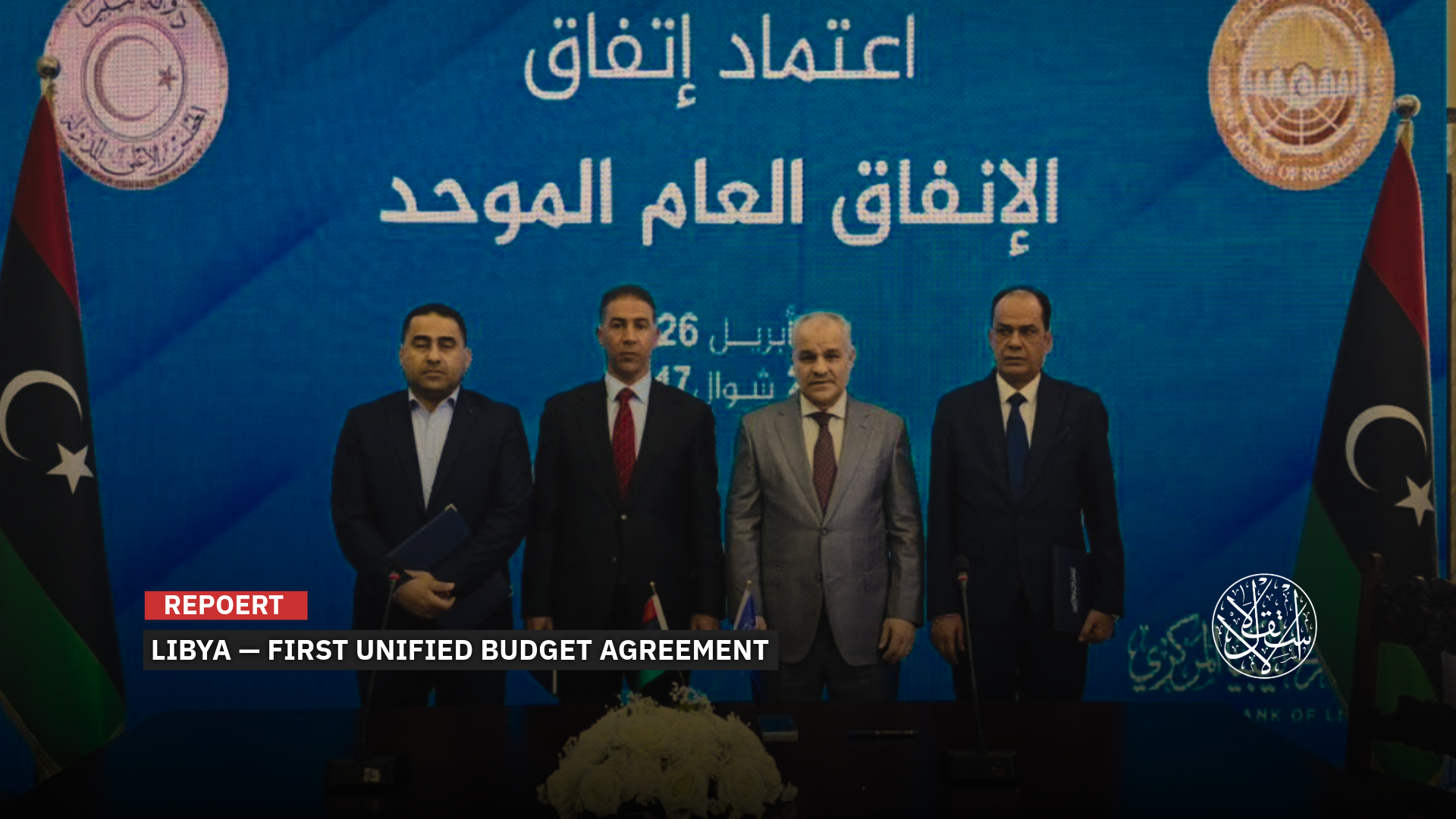
The announcement came from Central Bank governor Naji Issa, who, on April 11, 2026, oversaw the signing of the “Libya Unified Budget Agreement,” attached to an earlier “Unified Development Framework,” in the presence of representatives from both the eastern-based House of Representatives (HoR) and the Tripoli-based High Council of State.
The deal adopts unified state spending tables covering key budget chapters, marking the first agreement on nationwide public spending across all of Libya in more than 13 years.
In brief remarks at the signing ceremony, Issa said the agreement was not just a financial document but the beginning of a new chapter of serious work and genuine cooperation.
“This is a clear declaration that Libya is capable of overcoming its differences when a unified vision for its future is forged,” he added.
“Today, we have agreed to move beyond fragmentation and duplication and to establish a new phase of clarity and fiscal discipline through this historic achievement, which unifies public spending in our country.”
The agreement builds on a U.S.-backed unified development program deal signed in November 2025 by Libya’s rival legislative bodies, aimed at curbing unregulated government spending on construction and development projects.
The Legal Government
Prime Minister Abdulhamid Al-Dabaiba said the agreement to unify financial spending across the country is aimed at addressing imbalances that have built up over the years of division.
In remarks to the press, he said the agreement is designed to establish a single framework for managing public spending, ensuring resources are allocated more efficiently.
The prime minister stressed that ordinary Libyans stand to benefit first, pointing to the potential for improved living standards, more stable prices, and a stronger dinar.
But he warned that the success of the agreement hinges on all parties committing to its implementation in a serious and sustained way, translating it into tangible results on the ground. Comprehensive development, he added, remains a right for all Libyans, in the east, west, and south, without placing additional burdens on citizens.
AlDabaiba described the agreement as a positive starting point for correcting Libya’s financial trajectory, saying it could signal broader economic stabilization in the period ahead.
He welcomed technical support from the U.S. Treasury Department and praised adviser Massad Boulos for his role in backing mediation efforts that helped bring the deal together.
The Eastern Government
In the east, Osama Hammad, head of the parliament-appointed government, said reaching a unified budget agreement marks an important step toward unifying state institutions and strengthening economic stability in the country.
Hammad said the agreement reflects Libyans’ ability to overcome challenges while helping improve the efficiency of public spending, restore confidence in the national economy, support exchange rate stability, and preserve the state’s financial capacity.
He added that unifying public spending and the national budget lays the groundwork for launching balanced development programs across the country, ensuring a fair distribution of resources among all regions.
Hammad also reaffirmed his government’s full commitment to ongoing coordination with the Central Bank of Libya and relevant institutions to ensure the proper implementation of financial measures and translate them into tangible results.
A Political Reading
For Libyan political analyst and writer Ibrahim al-Asifer, the agreement to unify the national budget between the country’s rival governments is, in principle, an important step but one that cannot be separated from the complex political landscape Libya has been navigating for more than a decade.
Speaking to Al-Estiklal, al-Asifer said that since the institutional split that followed the events of 2014, Libya has effectively operated under two parallel financial and political systems—a situation he described as abnormal for any state seeking stability or aiming to manage its resources in a sound and rational way.
“Reaching even a basic understanding on a unified budget signals a growing recognition among all sides that continued financial division is no longer viable,” he said, particularly in a country where the economy depends almost entirely on oil revenues as the main source of state funding.
In his view, the importance of the move lies in the fact that it addresses one of the most dangerous aspects of Libya’s crisis: the fragmentation of public finance.
Al-Asifer noted that government spending during the years of division has been marked by disorder and a lack of coordination, with each administration relying on its own mechanisms—a pattern that has fueled inflated wage bills and subsidies while creating long-term financial obligations for the state.
A unified budget, he argued, could in theory open the door to greater fiscal discipline and a reordering of spending priorities, especially if overseen by sovereign institutions with a degree of technical credibility, such as the Central Bank of Libya and the National Oil Corporation, both of which have largely retained their national character despite the political split.
Academic Atef al-Hassia offered a more cautious reading, suggesting that the latest arrangements on public spending fall short of a full-fledged state budget for 2026 and are better understood as “the beginning of a new political agreement.”
In remarks reported on April 14, 2026, al-Hassia said the deal carries clear political and geopolitical dimensions that go beyond purely economic considerations.
Any level of political stability across Libya’s regions, he noted, will directly shape how public spending is allocated and prioritized in ways that reflect citizens’ needs.
He added that Libya’s situation cannot be divorced from broader regional and international dynamics, particularly those tied to oil production stability, arguing that the country has become part of a wider equation linked to global energy security and market stability.
Al-Hassia stressed that the divide between eastern and western Libya is not simply about how money is distributed, but about each side’s ability to implement projects and deliver tangible results—making execution, not agreements, the true measure of success.
He also pointed to concerns over oversight and financial controls, warning that the success of these arrangements will ultimately depend on what is achieved on the ground, not on theoretical consensus.
While ongoing debates over spending allocation are complex, he said, they still represent an important step toward embedding a development-driven approach, provided transparency and accountability are strengthened.
A lack of transparency around the details of the agreement, however, remains a major challenge. Public trust in official data is still limited among many Libyans, including in some figures released by the central bank.
Ultimately, al-Hassia argued, Libya’s economy needs a shift in spending priorities, away from consumption and toward sustainable investment, particularly in infrastructure and human capital.
Different Reactions
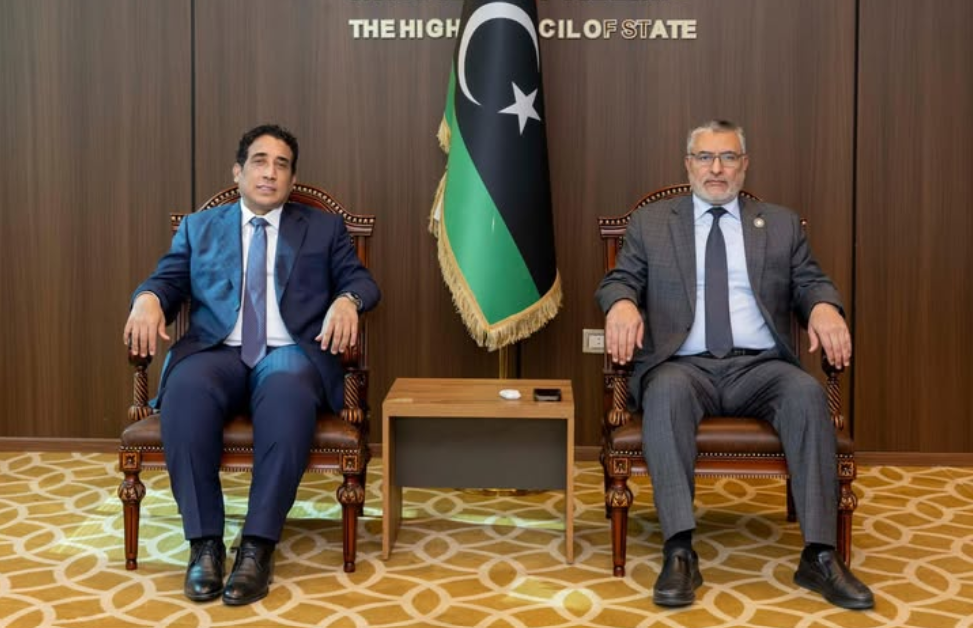
At the official level, support for the deal has been swift, if cautious. Mohammed Takala, head of the High Council of State, reaffirmed the body’s commitment to backing efforts aimed at national reconciliation and stability.
Speaking on April 14, 2026, Takala stressed the need for sustained consultation among Libya’s political institutions to unify positions on critical issues and steer the country toward lasting stability. His remarks came during a meeting in Tripoli with Presidential Council head Mohamed al-Menfi, where the two reviewed the country’s latest political and economic developments.
The United Nations Support Mission in Libya (UNSMIL) also welcomed the signing of the first addendum to the unified development program in Tripoli.
In a statement on April 12, the UNSMIL described the agreement as an important step toward addressing the urgent need for greater discipline in public spending, as well as improving fiscal coherence and accountability across the country—provided there is a strong and sustained commitment to implementation.
UNSMIL added that the deal could also open the door to better governance in the hydrocarbons sector, potentially boosting productivity and strengthening investor confidence.
The mission urged all signatories to ensure the agreement is fully implemented and to enforce strict oversight of public spending nationwide, in line with international standards and relevant Libyan legislation.
It also called on the authorities to unify and strengthen independent oversight institutions, stressing that only effective monitoring can ensure the unified budget framework delivers tangible benefits for all Libyans.
An Economic Reading
From an economic standpoint, Claudia Gazzini, senior Libya analyst at the International Crisis Group, said the agreement on a unified budget is a significant political step, but its real test lies elsewhere.
“The ultimate test will be whether all these sources of parallel and under-the-table payments, which have been ongoing for years, will actually be stopped,” Gazzini told Nova News.
“For now there are only announcements,” she said, adding that it will be necessary to wait for the coming months to assess the agreement’s real impact.
Among the key indicators, the analyst cited a possible decline in fuel smuggling, considered one of the main informal channels for distributing resources.
For years, Libya’s system has been defined by multiple financial flows operating outside the budget, including fuel smuggling, bank-based debt expansion, and opaque practices in the energy sector.
Ultimately, Gazzini argued, the success of the agreement will depend on whether Libyan institutions can translate it into real oversight of public spending and curb the distortions that have long fueled both the economic and political systems.
Still, not everyone sees the deal as a turning point.
Political analyst Ibrahim al-Asifer cautioned that agreeing on a unified budget, in itself, is not a decisive indicator of a genuine breakthrough in ending Libya’s institutional split.
“The core of Libya’s problem is not financial as much as it is a crisis of political legitimacy and a struggle for power,” he told Al-Estiklal.
Any financial arrangement between rival factions, he argued, is likely to remain fragile unless it is embedded in a broader political process that addresses legitimacy and rebuilds state institutions on a clear foundation.
Libya’s recent history is full of agreements that once appeared to mark major breakthroughs, only to unravel when confronted with competing power dynamics on the ground.
There is also what al-Asifer described as an “economy of division”—networks of vested interests that have taken root during years of conflict, both inside and outside state institutions, benefiting from financial chaos and weak oversight.
“These networks may not see a unified budget as reform,” he said, “but as a direct threat to their interests.” The real challenge, he added, is not just agreeing on figures, but enforcing transparent rules for implementation and preventing the budget from becoming another tool for distributing resources among competing centers of power.
In that sense, he said, the agreement can be read in two ways.
On one hand, it could mark the beginning of a gradual path toward reunifying institutions, particularly if financial bodies succeed in imposing discipline and tying spending to effective oversight mechanisms.
On the other hand, it may amount to a temporary financial arrangement among political elites, designed to keep resources flowing without addressing the deeper roots of the crisis. In that scenario, a unified budget risks becoming a way of managing division rather than ending it.
Overall, al-Asifer sees the move as a positive but limited step, one that will have little lasting impact if it remains disconnected from a genuine political process capable of restoring legitimacy and rebuilding state institutions.
“States are not stabilized by unified budgets alone,” he said, “but by a clear political authority capable of making and enforcing decisions across the entire country.”
Without deeper institutional reform and a political pathway toward a unified, nationally legitimate executive authority, he warned, the unified budget may ultimately remain little more than a technical fix in a country still deeply divided.
Sources
- Central Bank of Libya signs addendum to unified development agreement
- Joint Statement on Libya Unified Budget Agreement
- Libya’s Two Factions Sign US Mediated Agreement to Present a Unified Budget
- East, West Libya Strike Deal on Unified Public Spending
- Libya approves first unified budget in more than a decade
- Takala Reaffirms High Council of State’s Commitment to Supporting All Initiatives for National Reconciliation and Stability [Arabic]
- Al-Hassia: Libya’s Economy Could Grow by Up to 7% If Development Spending Stabilizes [Arabic]