Agreement With ‘Israel’ to Sideline Hezbollah: Will Lebanon Join the Abraham Accords?
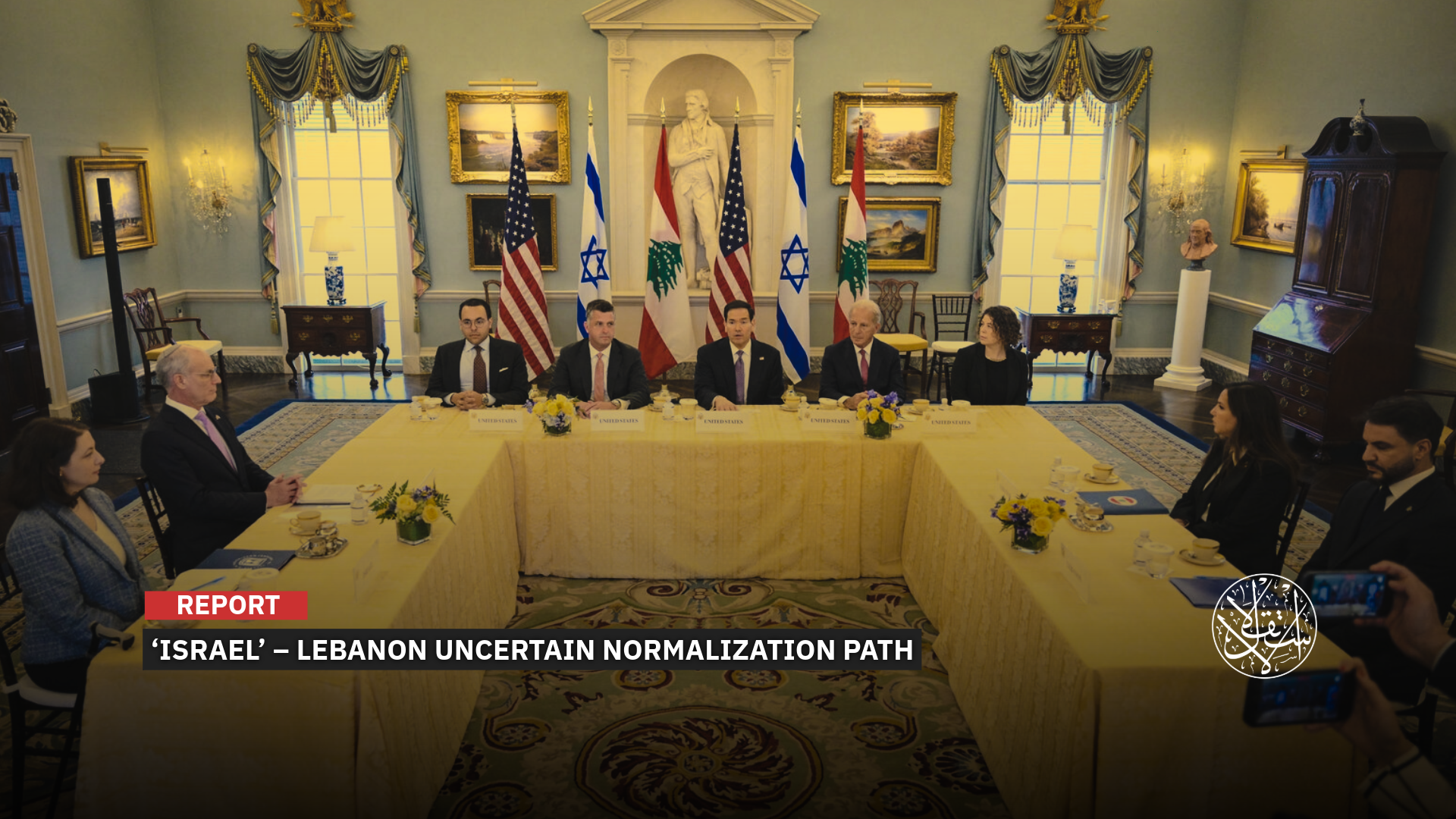
Negotiations pave the way for Lebanon to join the Abraham Accords.
Lebanon stands on the threshold of a historic transformation that could reshape its position in the region, amid growing rapprochement between its president and government and “Israel” under U.S. sponsorship, and the launch of negotiations aimed at normalization between Beirut and “Tel Aviv”.
This could pave the way for one of the most prominent countries in the Shiite axis in the region to join the Abraham Accords.
The negotiation process that Lebanon has already entered remains dependent on the outcome of the war and on the strength or weakening of Hezbollah.
“Israel” seeks to leverage its military superiority to impose a new reality, while the Lebanese government is trying to minimize losses and contain Shiite military influence within political frameworks.
Ultimately, according to the U.S. vision, the goal of these negotiations is for Lebanon to eventually join what are known as the Abraham Accords, as previously stated by U.S. President Donald Trump’s envoy to the Middle East, Steve Witkoff, on February 26, 2025.
However, achieving this goal remains conditional on changing political and military circumstances, according to U.S. reports indicating that the ongoing negotiations aim to create a breakthrough in this direction.
Nevertheless, there is still no national consensus on normalization, amid deep political divisions over relations with “Israel”, as well as the presence of armed forces outside the authority of the state, such as Hezbollah, which opposes this path; meanwhile, there is talk of weakening these forces as a key condition for the success of the normalization process.
The talks on April 14, 2026, are considered the first direct negotiations between the two sides since 1983, though they are not the first in the history of “Lebanon–Israel” relations.
They were preceded by limited negotiation tracks, some of which were direct and public, while others took place through American or United Nations mediation, or were technical and security arrangements rather than an open political process.

Rejection Blocks Normalization
Since Lebanese President (and former Army Commander) Joseph Aoun launched an initiative on March 9, 2026, aimed at ending the war in Lebanon, based on a comprehensive truce and a full cessation of Israeli attack, Washington quickly moved to capitalize on this opportunity to push Beirut toward normalization under what is known as the Abraham Accords.
The administration of U.S. President Donald Trump encouraged the adoption of this initiative, which included the idea of providing international support to the Lebanese Armed Forces, enabling them to extend control over areas of tension near the border with “Israel” and confiscate weapons there, as a prelude to launching negotiations with “Tel Aviv”.
In this context, Trump attempted to push for an early direct contact between President Aoun and Israeli Prime Minister Benjamin Netanyahu, in a step meant to pave the way for normalization.
However, popular Lebanese opposition prevented this contact from taking place, despite American and Israeli pressure. It was eventually replaced by two separate calls made by Trump with each side on April 16, 2026.
According to Lebanese reports, Aoun informed U.S. Secretary of State Marco Rubio of his refusal to engage in any direct communication with Netanyahu, which led to the cancellation of the proposed call, despite expectations promoted by some American and Israeli parties that it was imminent.
As part of efforts to prepare the ground for broader understandings, particularly related to the U.S.–Iranian track, an agreement was reached during indirect contacts on a 10-day ceasefire on the Lebanese–Israeli front, starting that same evening.
According to statements by Netanyahu, this truce means that the Israeli army will remain in the positions it has reached inside Lebanon.
Lebanese sources indicate that a direct call between leaders of two countries in a state of hostility typically comes only after tangible progress in negotiations between negotiating teams, which has not yet occurred, as no substantive talks have resumed amid “Israel’s” continued refusal to withdraw.
These developments also reflect a deep crisis of trust. Netanyahu does not trust Aoun’s ability to disarm Hezbollah or control its elements, while Aoun, for his part, is unable to commit to such steps, whether disarming the group or pushing it out of southern Lebanon, given the limited capacity of the Lebanese state to enforce this on the ground.
In addition, Aoun faces growing domestic pressure amid public anger and accusations of “betrayal” over engagement in a negotiating track with “Israel”, alongside the rejection of any direct negotiations by influential political forces, including Parliament Speaker Nabih Berri and Druze leader Walid Jumblatt. This has led him to pull back from a path that could push the country into a severe political and sectarian divide.
Weakening Hezbollah
In the aftermath of a ceasefire agreement between “Israel” and Lebanon, reports emerged indicating that Israeli military operations prior to the truce taking effect were part of efforts to impose new realities on the ground in southern Lebanon.
According to Israeli reports, “Tel Aviv” sought to accelerate the establishment of what it describes as a “buffer zone” inside Lebanese territory before the agreement entered into force, allowing it to retain on-the-ground influence even after the ceasefire.
In the period leading up to the ceasefire, southern Lebanon witnessed a notable escalation, as part of operations aimed at seizing advanced positions and strengthening the Israeli military presence, thereby improving its bargaining position in any subsequent arrangements.
Israeli analysts believe that Prime Minister Benjamin Netanyahu was seeking to impose a “separation line” deep in southern Lebanon, to remain under Israeli army control even in the event of any agreement, effectively creating a new reality on the ground.
The fiercest clashes at the time were concentrated in the area of Bint Jbeil, which holds strategic importance in the advance toward the Litani River. There, the Israeli army attempted to encircle fighters from Hezbollah, despite suffering field losses, according to a report by Yedioth Ahronoth in mid-April 2026.
According to the same newspaper, the Israeli approach was based on managing the political track separately from Hezbollah, while continuing military operations against it, in an effort to weaken the group both militarily and politically.
In the same context, a report by Haaretz, citing testimonies from officers and soldiers, revealed that the Israeli army worked during the latest operations to expand the number of its positions in Lebanese territory, despite warnings that these could turn into permanent flashpoints.
The report also indicated that “Israel” had maintained five positions in Lebanon following the November 2024 truce, before expanding its military presence again with the resumption of ground operations prior to the most recent agreement.
This expansion also extended to areas known as the “third line of villages,” reaching distances of up to approximately 20 kilometers south of the Litani River, including locations such as Bint Jbeil.
In parallel, field reports indicated that the military operations were accompanied by widespread destruction of infrastructure and homes, as well as damage to agricultural land.
A report by Euronews also indicated that agricultural aircraft were used to spray the herbicide Glyphosate at high concentrations along a border strip, leading to the destruction of crops and contamination of soil and groundwater. This move is believed to have aimed at creating changes in the environmental and agricultural landscape of the border areas.
Internal Conflict
As soon as the first direct diplomatic negotiation session between Lebanon and “Israel” was held under U.S. mediation, the Lebanese public and media became divided between supporters, who see a potential agreement as an opportunity to end the war, and opponents, who view it as a gateway to Lebanon’s involvement in normalization under the Abraham Accords.
One group of observers argued that these negotiations would not have taken place without the military and political pressure faced by Hezbollah, while another group considered them a “betrayal” and an unacceptable concession.
Activists also called for organizing a protest under the slogan “Tuesday of Shame,” rejecting any negotiations with “Israel” or any form of reconciliation or recognition of it.
This division was also reflected in the Lebanese press. The newspaper al-Akhbar, which is close to Hezbollah, ran the headline, “The Power of Shame, on Its Knees in Washington,” while the anti-Hezbollah newspaper Nidaa al-Watan chose the headline, “The Breaking of the Taboo,” suggesting that what happened represents the beginning of a new negotiation track, despite the uncertainty still surrounding its outcomes and the Lebanese government’s ability to impose any agreement on Hezbollah.
In contrast, the newspaper al Jomhouria welcomed the meeting, describing it as “historic,” and noted that the aim of the joint statement is to pursue a “lasting peace” between the two sides.

In line with the Israeli narrative that the negotiations could pave the way for Lebanon’s accession to the Abraham Accords, the channel i24NEWS quoted “Israel’s” ambassador to Washington, Yechiel Leiter, as saying that the goal is to reach a “full peace treaty,” adding that once the security issue is addressed, relations could shift toward a normal framework similar to that of countries already part of the accords.
Israeli media also quoted Lebanese Ambassador Nada Hamadeh Moawad as saying after the meeting, “We discovered that we are on the same side of the equation,” in reference to confronting the influence of Hezbollah.
This was viewed by the U.S. magazine Commentary as an indicator of regional shifts driven by what it described as “Washington’s Arab allies.”
Some analysts have proposed a scenario similar to the experiences of Egypt and Jordan, involving the signing of a peace agreement while maintaining internal opposition within political and democratic frameworks.
This, they argue, could allow Lebanon to move forward toward joining the Abraham Accords, according to estimates published by Politico.
On the other hand, opponents of the negotiations believe that the Lebanese authorities are seeking to engage in a U.S.-backed normalization path aimed at consolidating state authority and ending the role of Hezbollah.
They argue that these bets could fail, particularly if Iran emerges from the current war in a position of strength, according to a report by Maariv.
To encourage Beirut to proceed along this path, Israeli estimates have suggested the possibility of offering field-level incentives, such as a truce or a partial withdrawal from certain areas in southern Lebanon.
However, other reports indicate that Prime Minister Benjamin Netanyahu remains determined to continue military operations until his objectives are achieved, foremost among them control over strategic areas such as Bint Jbeil.
In a broader context, an analysis published by The National Interest pointed to opportunities to expand the framework of the Abraham Accords to include Lebanon, citing what it described as “strategic exhaustion” in the region, growing economic incentives for reconstruction, and the mediating role of the United States.
The report also claimed the existence of military and security coordination between “Israel” and countries within the accords, alongside Egypt and Jordan, during previous confrontations with Iran, reflecting, according to the Israeli narrative, the potential to build a broader regional system.
In parallel, a report issued by the Foundation for Defense of Democracies (FDD) called on Lebanon to choose joining the “Abraham axis” rather than aligning with other regional blocs, considering it a strategic option amid the ongoing reshaping of alliances in the region.
Negotiation Milestones
The talks held in Washington between Lebanon and “Israel” represent the latest chapter in a long and complex history of negotiations between the two sides, a process historically marked by interruptions and closely tied to wars and their aftermath.
From the negotiations of late 1982 through May 1983, Lebanon held around 33 rounds of talks with “Israel”, according to estimates by Beirut Review (April 13, 2026).
However, these rounds did not lead to a lasting agreement, amid repeated Lebanese accusations that “Israel” sought to leverage the outcomes of its military operations to impose political arrangements resembling peace agreements, but tailored to Lebanese conditions.
The April 14, 2026 talks in Washington, conducted directly between Lebanese and Israeli representatives, have reopened this file once again.
This time, however, they come in a different context, closer to a potential normalization track, amid unprecedented internal tension between the Lebanese state and Hezbollah.
The first milestone in this trajectory dates back to the armistice agreement signed on March 23, 1949, following the war that erupted after “Israel’s” establishment in 1948.
Brokered by the United Nations, the agreement was temporary and military in nature, falling short of a peace treaty or mutual recognition, and was limited to regulating the cessation of hostilities along the border. It did not hold for long, as it was undermined during the 1967 Six-Day War.
Another major milestone came after “Israel’s” invasion of Lebanon in 1982, in the operation it called Operation Peace for Galilee.
A direct agreement was signed under Lebanese President Amine Gemayel and Israeli Prime Minister Menachem Begin, following four and a half months of U.S.-mediated negotiations.
However, the agreement faced widespread rejection in Lebanon, as it was seen as a product of occupation, civil war conditions, and the absence of national consensus. It did not last long and was annulled in March 1984.
In a later assessment, former President Amine Gemayel stated that the experience failed because “Israel”, according to his account, was not genuinely seeking to implement the agreement, but rather to secure political gains, including easing U.S. pressure and sanctions imposed after the invasion. He also pointed to last-minute changes introduced to the agreement’s text before its signing.
Another round followed the Madrid Peace Conference, in which Lebanon participated in a U.S.-sponsored negotiation track that also included Syria, Jordan, and a Palestinian delegation.
Around ten bilateral sessions were held between Lebanon and “Israel” over nearly 20 months until 1993, without meaningful progress, largely due to the linkage between the Lebanese and Syrian tracks and ongoing disagreements over “Israel’s” withdrawal from southern Lebanon.
A relatively exceptional milestone came when the two sides reached an agreement, mediated by the United States, to demarcate their maritime border after years of indirect negotiations.
Lebanon emphasized at the time that this was not normalization or a peace agreement, but rather a technical understanding aimed at resolving disputes over gas-rich areas in the eastern Mediterranean.
The agreement was concluded through separate letters to the United States, without a direct meeting between the delegations.
With the outbreak of the Gaza War in October 2023, Hezbollah became engaged in military confrontation with “Israel” along the Lebanese front. In November 2024, a ceasefire agreement was reached, but tensions persisted as “Israel” continued its attacks.
In December 2025, indirect talks were held in Naqoura, with U.S. participation, aimed at reinforcing ceasefire understandings. These meetings did not constitute a direct political track but were instead security and technical discussions within a mechanism to monitor de-escalation.
These milestones show that negotiations between Lebanon and “Israel” have remained limited and rare over the decades, often tied to the context or immediate outcomes of wars.
The Lebanese side has consistently framed such contacts as ceasefire arrangements or technical understandings, rather than a path toward political normalization.
By contrast, “Israel” has, at nearly every stage, sought to expand these arrangements into broader security and political agreements that could pave the way, according to its perspective, for a comprehensive peace deal, a goal that has resurfaced once again in light of the recent Washington talks.
Sources
- For the First Time in Decades, Decisions of War and Peace Are in the Hands of the Lebanese State – Analysis
- America’s Arab Allies Are Making History
- IDF Setting Up More Outposts in Southern Lebanon, Ignoring Officers' Warnings
- Could Syria and Lebanon Join the Abraham Accords?
- Lebanon Must Pick the Abraham Accords Over the Muslim Brotherhood
- Direct Negotiations With the Enemy and Its Conditions on Lebanon Since 1982–1983 [Arabic]
- Amine Gemayel to “L’Orient-Le Jour”: I Encourage Aoun and Salam to Go All the Way in the Negotiations [French]