Israeli Military Builds Five Bases Along the Egyptian Border: Is the Camp David Agreement Over?
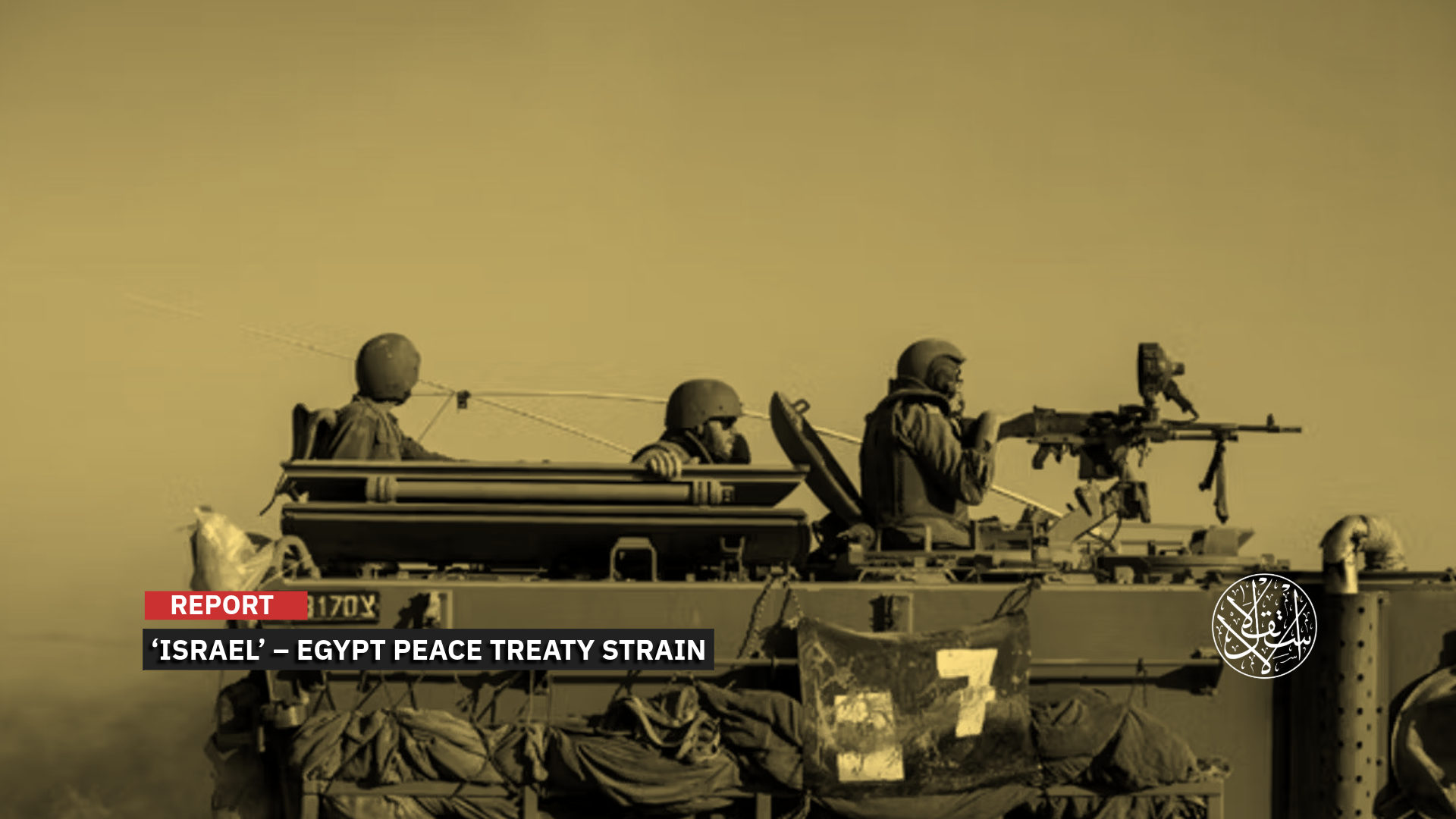
Recent regional developments have led “Israel” to review its military posture, particularly along the perimeter of the Sinai Peninsula.
Recent developments suggest that Egypt and “Israel” are gradually moving away from some provisions of the security annex of the 1978 peace treaty regarding the deployment of forces along the border area, amid the repercussions of the war on Gaza.
This comes as the Israeli occupation has taken control of border areas including Rafah and the Philadelphi Corridor, while Cairo has responded by deploying additional troops beyond the limits set in the Camp David annexes.
Following “Israel’s” control of border areas adjacent to Egypt in the Palestinian city of Rafah and the Philadelphi Corridor, considered a breach of the security arrangements, Cairo has reinforced its military presence in Sinai near the border line, amid rising tensions and reciprocal violations.
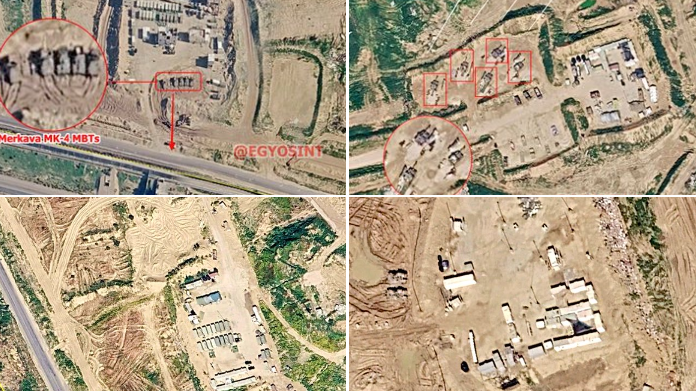
In the same context, open-source intelligence platforms that track military movements through satellite imagery have published new data and images showing the Israeli army establishing a series of military bases in the city of Rafah on the Egyptian border.
The data indicates that the Israeli military has set up five positions equipped with tanks and artillery, in what has been described as a notable field escalation and a violation of the security annex of the peace treaty, which restricts the deployment of heavy weapons in the border area.
On the other hand, some Israeli research centers have justified these moves as stemming from security assessments related to concerns about future changes, noting that Israeli military doctrine is not limited to evaluating the current “intentions” of states, but also relies on assessing their potential military “capabilities.”
These centers explain that this approach is based on the assumption that political regimes may change and alliances may shift, while military capabilities remain, which leads “Israel” to reassess its military deployment, particularly around Sinai, in anticipation of possible future scenarios, despite the controversy this raises regarding compliance with the security provisions of the agreement with Cairo.
The Five Principles
On May 23, 2026, open-source satellite intelligence platforms reported information indicating that the Israeli military had established five military sites or bases inside the Palestinian city of Rafah, near the border with Egypt, following extensive destruction of Palestinian homes in the area and the conversion of large sections into closed military zones.
The platforms “Egypt’s Intel Observer” and “Mario Nawfal” on X stated that satellite imagery shows at least five Israeli military positions, including sites hosting Merkava Mk4 tanks and M109 howitzers, describing it as a notable military deployment within the border vicinity.
The circulated images show these bases located within the area marked in red on analytical maps, which has further intensified debate over the nature of this deployment, its geographical limits, and the extent of its compliance with existing security arrangements in the border area.
In this context, the account “Mario Nawfal” described these movements as a dangerous escalation, suggesting they may conflict with the security annex of the peace treaty between Egypt and “Israel”, which imposes clear restrictions on the deployment of heavy weaponry and military presence in designated areas near the border, particularly Zones C and D under the agreement’s classifications.
The account further noted that the positioning of Israeli tanks and artillery in such density and proximity to the border is viewed as a sensitive development, and could be interpreted as a form of pressure or a direct provocation within the context of the delicate security relationship between the two sides, especially amid tensions linked to the war on Gaza.
According to the provisions of the peace treaty, Article Three concerning Zone “D” stipulates that the Israeli military presence in that area should be limited to a small infantry force, with a prohibition on tanks, artillery, and missiles, except for certain individual air-defense systems. This has made the appearance of heavy equipment such as tanks and artillery a matter of legal and security debate.
However, the satellite images circulated by these platforms reportedly show around five Merkava Mk4 tanks, along with “Namer” armored personnel carriers built on the Merkava 4 chassis. The vehicles were observed positioned at sites believed to be oriented toward areas near the deployment of Egyptian border guard forces, further intensifying the debate over the nature of this military buildup.
Previous maps published in April 2025 showed an expansion of the Israeli military presence along the border between Egypt and the Gaza Strip, following military operations in Rafah. At the time, observers considered this a development that appeared to go beyond the limits set in the security annex of the Camp David Accords, which caps Israeli Occupation Forces in those areas at four infantry battalions and prohibits heavy armor, tanks, and artillery.
In a related context, the account “Egypt’s Intel Observer” is viewed as an open-source platform specializing in tracking military and intelligence activity through publicly available sources, with some debate regarding its proximity to Egyptian official circles, although it is not a government body or an intelligence agency.
The account describes itself as an open-source analysis platform, but its content reflects a clear security-oriented focus on monitoring regional military developments, with particular attention to Israeli movements along the border and an emphasis on what it characterizes as field violations or breaches.

Some observers believe that the accuracy of certain information published by this account may stem from its proximity to individuals or circles concerned with security and military affairs in Egypt, although there is no official confirmation of any direct affiliation with a sovereign state entity.
Others argue that the dissemination of such data through unofficial platforms may aim to highlight developments on the ground in Rafah and to expose what are perceived as violations of security agreements, while also sending political and security messages to international public opinion amid limited extensive media coverage of these details.

Israeli Violations
These developments come amid a series of field movements described as additional breaches of the 1979 peace treaty between Egypt and “Israel”. According to field reports, “Israel” had previously taken control of areas in Rafah in the Gaza Strip and the Philadelphi Corridor (Salah al-Din Axis) in 2024, before mutual accusations escalated over violations of the security annex of the agreement.
On May 29, 2024, the Israeli army announced that it had gained full control over the Philadelphi Corridor, the buffer strip extending about 14 kilometers between the Gaza Strip and Egypt.
The move was widely seen as a major field development, effectively meaning full control over the entire border strip separating Gaza from Egyptian territory.
Satellite imagery and circulated videos have documented the deployment of Israeli military vehicles, including armored personnel carriers and troop transports, along the area adjacent to the border fence with Egypt, increasing concerns about the nature of this deployment and its implications for existing security arrangements in this sensitive zone.
In the same context, field reports indicated that Israeli Occupation Forces constructed a new road between the Kerem Shalom crossing and the Rafah crossing, named the “David Road.”
Observers view this as an attempt to reshape the crossing network, weaken the traditional role of the Rafah crossing, and increase reliance on routes controlled by Israel for movement between Gaza and Egypt.
In this regard, former Egyptian Assistant Foreign Minister Abdullah al-Ashaal stated in press remarks that these developments reflect a dangerous strategic shift, arguing that “Israel’s” actions effectively amount to “separating Egypt from Palestine” and creating a new on-the-ground reality that goes beyond the provisions of the peace treaty and reshapes the nature of borders in the region.
He added that this new reality makes it difficult to speak of stable borders in the traditional sense, given the direct Israeli control over sensitive contact areas, which in turn affects the security and political balance that has governed relations between the two sides for decades.
In a related context, Egypt considers the Israeli military control over the Philadelphi Corridor a clear violation of the Camp David peace treaty, as well as a breach of the security arrangements known as the “Philadelphi Agreement,” which precisely defines the nature of military deployment in this border area.
In October 2025, the Israeli Broadcasting Authority reported that the Israeli military had established an air command center on the border with Egypt within the area of the 80th Division stationed there, under the justification of enhancing aerial surveillance and countering increasing smuggling activities across the border.
Commenting on these developments, Dr. Mohamed Mehran, professor of public international law and member of both the American and European international law associations, warned that the establishment of such an advanced air command center on the Egyptian border constitutes, in his view, a serious violation of the Camp David Accords and raises concerns related to Egyptian national security.
He explained in media remarks that the presence of a military command facility equipped with advanced radar systems, electronic warfare capabilities, and aerial interception tools clearly exceeds the defensive restrictions set out in the agreement, which imposed strict limitations on the scale and type of military presence in these areas.
He also referred to media reports and specialized platforms, including the platform “Detailed Investigation,” which reported that the Israeli army had constructed two elevated observation towers along the border strip.
One is located within a newly established military base, while the other is positioned near the Rafah land crossing. Both towers are reportedly equipped with advanced surveillance systems designed to monitor movement on the Egyptian side of the border.
These measures, taken together, are seen as part of a broader restructuring of the border area between Egypt and the Gaza Strip, amid escalating military tensions and differing interpretations of the provisions of the peace treaty. This reflects what some describe as an ongoing strategic repositioning on both sides of the border.

Military Build-Up
In contrast to what has been described as Israeli breaches of the security annex of the Camp David Accords, reports and analyses indicate that Egypt has, over the same period, deployed additional military reinforcements in the Sinai Peninsula.
Sources suggest these measures were not preceded by publicly announced coordination with the Israeli side, reviving debate over the limits of compliance with the treaty’s provisions amid rapidly evolving developments along the Gaza border.
According to Israeli media reports, including The Jerusalem Post on March 31, 2025, Israeli security sources observed what they described as Egyptian military movements in Sinai exceeding the ceiling set in the treaty’s security annex, as well as the development of logistical facilities, ports, and the expansion of airstrips within the peninsula, actions which “Tel Aviv” reportedly considers to be in violation of the agreed restrictions.
In the same context, Israel Hayom reported on the same date that “Israel” had requested Egypt and the United States to review what it described as newly developed military infrastructure in Sinai.
The report stated that these developments had sparked discussion within the Israeli security establishment regarding their compatibility with the security arrangements of the peace treaty, particularly amid the evolving situation related to the war on Gaza.
The newspaper also quoted Israeli military officials as saying that the entry of additional forces into Sinai, in their assessment, exceeds the agreed-upon quotas in the treaty’s military annex.
They added that this issue has become a priority in Israeli security discussions, amid internal calls to reassess the military reality along the southern border.
In a notable analysis, former Israeli ambassador to Egypt Amira Oron wrote in an article published by the Institute for National Security Studies on March 26, 2025, that Egypt’s increased military presence in Sinai also carries domestic dimensions, as it is presented to the Egyptian public as part of strengthening the state’s power and its ability to secure its borders.
Oron emphasized the importance of maintaining security and military communication channels between the two sides, particularly through joint mechanisms such as the Military Committee and the Multinational Force and Observers, as essential tools for preventing escalation and managing disputes in a highly sensitive security environment.
In a related context, analysts specializing in satellite imagery, including accounts such as Ben Tzion Macales, pointed to indications of unusual development work at al-Joura Airport in Sinai, relatively close to the Israeli border. These included the leveling of old runway surfaces and logistical expansions within the site, according to those analyses.
The same analysis also referred to what it described as signs of tunnel complexes being constructed in areas near the Cairo–Suez Road, which are believed to be intended for logistical or emergency purposes.
It linked these developments to the strengthening of Egyptian early-warning and surveillance systems, including long-range three-dimensional radar systems, sparking widespread debate over the nature of their military or defensive use.
On September 20, 2025, Egypt’s State Information Service issued an official statement responding to reports published in international and Israeli media regarding alleged claims of an increased Egyptian military presence in Sinai. The statement was later withdrawn and replaced with a more restrained and diplomatic version.
The initial statement reportedly used a relatively firm tone, stressing that movements of the Egyptian military within its own territory are governed by national security assessments and decisions of the highest leadership, in light of the serious developments in the Gaza Strip. It was later revised to emphasize adherence to international treaties and a more balanced official tone.
The amended statement reaffirmed Egypt’s commitment to the peace treaty signed with “Israel”, while removing the more strongly worded passages contained in the original version.
These were replaced with more cautious phrasing, reflecting the sensitivity of the political and diplomatic situation at the time, and the interplay between security considerations and external messaging.

Violations of the Security Annex
The security annex of the Egyptian–Israeli Peace Treaty of 1979, formally known as the “Protocol Concerning Israeli Withdrawal and Security Arrangements,” is the first annex to the Camp David framework signed in 1978.
This annex is considered one of the most important frameworks regulating military presence in the Sinai Peninsula. It sets precise and strict limitations on the deployment of Egyptian and Israeli Occupation Forces and weapons, in addition to arrangements for the presence of multinational forces tasked with monitoring compliance with the agreement.
The security annex divides the Sinai Peninsula into three main zones with different levels of armament and military deployment.
In Zone A, located in western Sinai, Egypt is allowed to deploy forces of up to approximately 22,000 troops, including armored formations and mechanized infantry brigades, as well as around 230 tanks, giving Egypt a wider scope of military presence in this part of the territory.
In Zone B, located in central Sinai, only a limited Egyptian military presence is permitted, not exceeding four battalions equipped with light weapons, in addition to border guard forces.
The total number of troops in this zone must not exceed approximately 4,000 personnel, reflecting the more restricted nature of military deployment compared to Zone A.
Zone C, which stretches along the eastern border with occupied Palestine and the Gaza Strip, is largely demilitarized. It is limited to Egyptian civilian police forces responsible for internal security using light weapons, along with multinational forces tasked with monitoring the implementation of the agreement and ensuring compliance with its provisions.

Zone D, a narrow strip inside Israeli territory along the Egyptian border, allows for a limited Israeli military presence under the agreement, without tanks or heavy artillery.
This constitutes one of the key restrictions outlined in the security annex, although both sides have since exchanged accusations of violations or reinterpretations of these limits in light of evolving field developments in the region.
In the context of the debate over the annex, former Israeli ambassador to Egypt David Govrin wrote in Yedioth Ahronoth on September 23, asking, “Is this the end of the security annex of the peace treaty between Israel and Egypt?” He noted that Cairo has long viewed the restrictions imposed on its military deployment in Sinai as an infringement on its national sovereignty, arguing that Egypt’s expanded military presence there reflects, in his interpretation, an attempt to reshape the on-the-ground reality beyond the original constraints of the agreement.
Govrin added that the appearance of Egyptian F-16 aircraft at Meliz Air Base in April 2018, during President Abdel Fattah el-Sisi’s visit to the base in the context of counterterrorism operations in Sinai, was seen by some as an indication of attempts to circumvent restrictions on Egyptian military deployment in the area.
He further argued that these developments reflect, in his view, growing tension between Egyptian national security considerations and the limitations set out in the security annex, amid what Cairo considers “diminished sovereignty” over its full territory in Sinai.