How the Case of Dr. Hussam Abu Safiya Sparked a Political Controversy in Britain
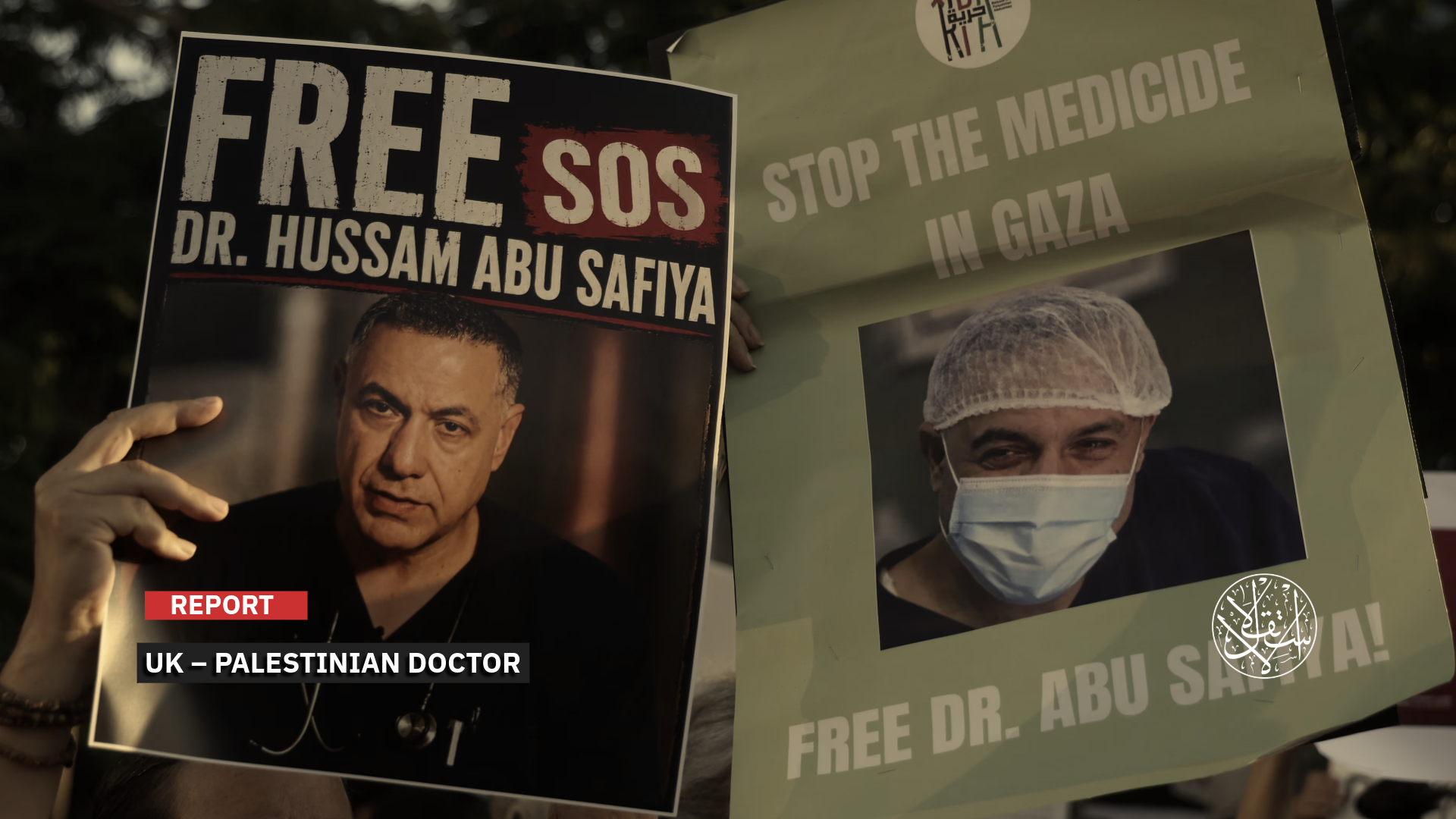
“18 months ago, Dr. Abu Safiya was seized by Israeli forces and has since been held without trial.”
A right-wing newspaper accused a British government minister of leading a campaign on behalf of a Hamas colonel, following his raising the case of Dr. Hussam Abu Safiya, a Palestinian doctor detained in Israeli prisons for 18 months.
The newspaper thus echoed Israeli claims that Abu Safiya, who managed Kamal Adwan Hospital in Gaza, is an officer in Hamas, to justify his detention in solitary confinement under life-threatening conditions, according to his lawyer.
In mid-July, the Israeli Supreme Court rejected a request to release Abu Safiya, who has been held without charge since his arrest in late 2024.
Human rights organizations have documented the continued detention of 82 healthcare workers from Gaza in Israeli prisons, arguing that this exacerbates the collapse of the healthcare system in the Gaza Strip.
Jailed Doctor
British Minister for the Middle East, Hamish Falconer, wrote earlier on X: “I am aware of the disturbing reports about the treatment of Dr. Hussam Abu Safieh, who remains in Israeli detention. We raised his case again today with the Israeli authorities. Britain’s commitment to the rule of law and a fair trial is unwavering.”
On July 12, The Telegraph quoted what it described as a Labour government source: “Officials have become accustomed to Mr. Falconer using the Gaza conflict to curry favor with Labour MPs, but it is deeply disappointing to see a cabinet minister campaigning for a jailed Hamas military doctor.”
The source added: “What is someone in his position doing spreading Hamas propaganda on X? It might help him with Labour MPs, but it damages our credibility and relationships abroad.”
Falconer responded to The Telegraph’s report, saying: “A pointless attack from The Telegraph. Raising Dr. Abu Safieh’s case, along with other issues of concern in Gaza, was the right thing to do, and I stand by it.”
Falconer added, "This was their report yesterday," attaching a photo of a report from the same newspaper just a day earlier, indicating that Abu Safiya was being arbitrarily detained.
In its previous report, the newspaper published: “Detained Without Charge or Evidence: Questions Surround the Arrest of Gaza’s Most Famous Doctor.”
The newspaper quoted his eldest son expressing the family’s fears that he might die in prison, amidst a right-wing social media campaign labeling his father a terrorist.
However, in its new report, the newspaper claimed that Dr. Abu Safiya was described in Palestinian media, as well as in official Hamas-run government communications, as a colonel, and that he had previously been photographed wearing a military uniform.
In a related development, British Foreign Secretary Yvette Cooper condemned the continued detention of Dr. Abu Safiya on July 14, emphasizing that Britain was deeply concerned about his case.
During a hearing before the Foreign Affairs Committee of the British Parliament, Cooper stressed the need to hold Israel accountable for its violations of human rights and international humanitarian law in Gaza.
Her remarks came in response to questions from committee members regarding Abu Safiya’s continued detention for approximately 18 months in Israeli prisons, despite the United Nations considering his detention without charge a violation of international law.
She said his case had gained international attention and that the Israeli government should be held accountable for its decisions, noting that it represented one in a series of cases raising serious concerns about violations of human rights and international humanitarian law.
For her part, Conservative Shadow Foreign Secretary Priti Patel said: “It is inconceivable that Falconer was unaware of Abu Safiya’s alleged position in Hamas. His failure to mention this when lobbying on Abu Safiya’s behalf is simply astonishing and raises questions about the priorities of the Foreign Office under Labour leadership.”

Popular Solidarity
Amid reports warning of the critical condition of Abu Safiya due to torture and deliberate medical neglect, the Palestine Solidarity Campaign quickly organized a demonstration in front of the British government headquarters on July 13 to condemn Britain's complicity in Israeli crimes, including the arrest and torture of medical personnel and children.
Thousands of supporters of Palestine from various medical unions and pro-Palestinian human rights organizations participated in the demonstration.
Four members of parliament addressed the demonstration, during which protesters held up photographs showing Abu Safiya's deteriorating medical condition after his arrest compared to his condition beforehand.
Similarly, the protesters carried banners demanding sanctions against Israel, a halt to arms exports to the country, and the immediate release of the detained Palestinian doctor.
They also chanted slogans against the Israeli occupation and apartheid regime, calling for freedom for Palestine and all Palestinian prisoners in Israeli jails, in a scene reflecting the growing public anger over what they describe as systematic violations.
During a speech, British Labour MP John McDonnell stated that he had met with Minister for the Middle East Hamish Falconer and conveyed alarming information indicating that Abu Safiya could die at any moment, warning that there was no time for further delays or lengthy investigations.
McDonnell explained that he later appealed to Parliament to submit an urgent question to Foreign Secretary Yvette Cooper regarding the matter, but his request was rejected, prompting him to continue his political and media pressure.
For his part, independent MP Jeremy Corbyn called for the continuation of popular protests and urged supporters of Palestine to continue mobilizing and raising their voices.
Corbyn demanded sanctions against "Israel" and a halt to military aid, noting that a number of British MPs are continuing to work to pressure the British government to take action.
In this context, Peter Larry, deputy director of the Palestine Solidarity Campaign, said that thousands of Britons responded to an online campaign calling on the Foreign Office to intervene, stressing that what Abu Safiya is experiencing is a humanitarian tragedy.
British MP Zarah Sultana posted on X, quoting Abu Safia's words during a meeting with his lawyer: "They brought me here to kill me. I don't see myself surviving. This is the end."
She wrote: "His lawyers say he is being held in solitary confinement, has been beaten and starved, and denied medical care. He is now in life-threatening danger and needs to be urgently transferred to a hospital."
She added: "Silence is complicity. Yvette Cooper must demand his immediate release and that he receive urgent medical treatment now."
Nadia Whittum, another British MP, also posted on X, quoting what she said were Abu Safia's words: "They brought me here to kill me. I don't see any chance of survival. This is the end." The End.
British Labour MP Richard Burgon also called on Foreign Secretary Keir Starmer to demand that Israel provide urgent medical treatment for Abu Safiya, stressing that his life is in imminent danger and that he is suffering from new head and eye injuries. And the neck.
From For his part, Chris Nineham, Deputy Secretary-General of the Stop the War Coalition, announced the organization of two national pro-Palestinian marches this July and next October to demand an end to arms sales to Israel and the imposition of sanctions.
He emphasized that public pressure will continue until what he described as British complicity with Israeli violations is brought to an end.

Systematic Targeting
In an article published in The Guardian, writer Nesrine Malik stated that Abu Safiya was transferred last June to Rakefet Prison, an underground facility originally built to detain high-ranking organized crime figures before being closed on the grounds of its inhumane conditions. It was then reopened in late 2023 by Israeli National Security Minister Itamar Ben-Gvir.
She explained that Palestinian prisoners in this prison, including Abu Safiya, do not see daylight. Absolutely, considering it a violation of the Geneva Conventions.
According to his testimony, Abu Safiya was repeatedly beaten with hammers and batons, in addition to daily assaults that left him unconscious several times.
The writer noted that the most recent photos of him reveal a significant decline in his health; he appears much thinner and frailer than when he was one of the most prominent voices defending medical personnel working in Gaza under what she described as impossible conditions.
She said that Abu Safiya told his lawyer earlier this month, "This is the end. I don't see myself as a survivor. They brought me here to kill me.”
In a related development, independent UN experts stated on July 7 that the continued arbitrary detention of Dr. Abu Safiya without charge or trial reflects Israel’s systematic targeting of Palestinian health workers.
On July 8, the UN Independent Commission of Inquiry on the situation of human rights in the occupied Palestinian territory issued a separate statement expressing grave concern over credible reports that Dr. Abu Safiya has been subjected to ongoing and severe violations during his detention.
UN experts described this as part of a policy aimed at creating conditions that would destroy Palestinians in the Gaza Strip.
As part of a media and social media campaign, international and UN figures and organizations, along with healthcare workers, called for his release, using the hashtags #freedomfordrhossamabusafia and #endgenocideIgaza.
Among the most prominent of these was the Director-General of the World Health Organization, Tedros Adhanom Ghebreyesus, who called for his immediate release in a post on X.
The UN Special Rapporteur on the situation of human rights in the Palestinian territories, Francesca Albanese, commented on reports concerning the deteriorating health of Dr. Abu Safieh, asking: "Why is the 'Bring Them Home' campaign limited to only some of the hostages?"
The UN Special Rapporteur on the situation of human rights in the Palestinian territories, Francesca Albanese, commented on the reports concerning the deteriorating health of Dr. Hussam Abu Safieh, asking: "Why is the 'Bring Them Home' campaign limited to only some of the hostages?"
She added that what Palestinians are experiencing under Israel's apartheid regime is not an exception or an anomaly, but rather the very essence of the system itself, considering that the complete silence surrounding this is the precise measure of our collective hypocrisy.
In contrast, a spokesperson for the Israeli Foreign Ministry claimed that Abu Safiya, a Hamas colonel, was lawfully detained by Israel based on concrete intelligence.
He said: "During the war in Gaza, he managed Kamal Adwan Hospital in northern Gaza, which was operated as one of Hamas's terrorist centers."
“Abu Safiya exploited his position at the hospital to divert humanitarian resources intended for civilian needs toward terrorist purposes,” the Israeli spokesperson alleged.
The Israeli diplomatic mission in Geneva also denied reports that his health had deteriorated in detention.