To Revoke Its Recognition of Palestine: How Did Israeli Intelligence Transform the Political Landscape in Slovenia?
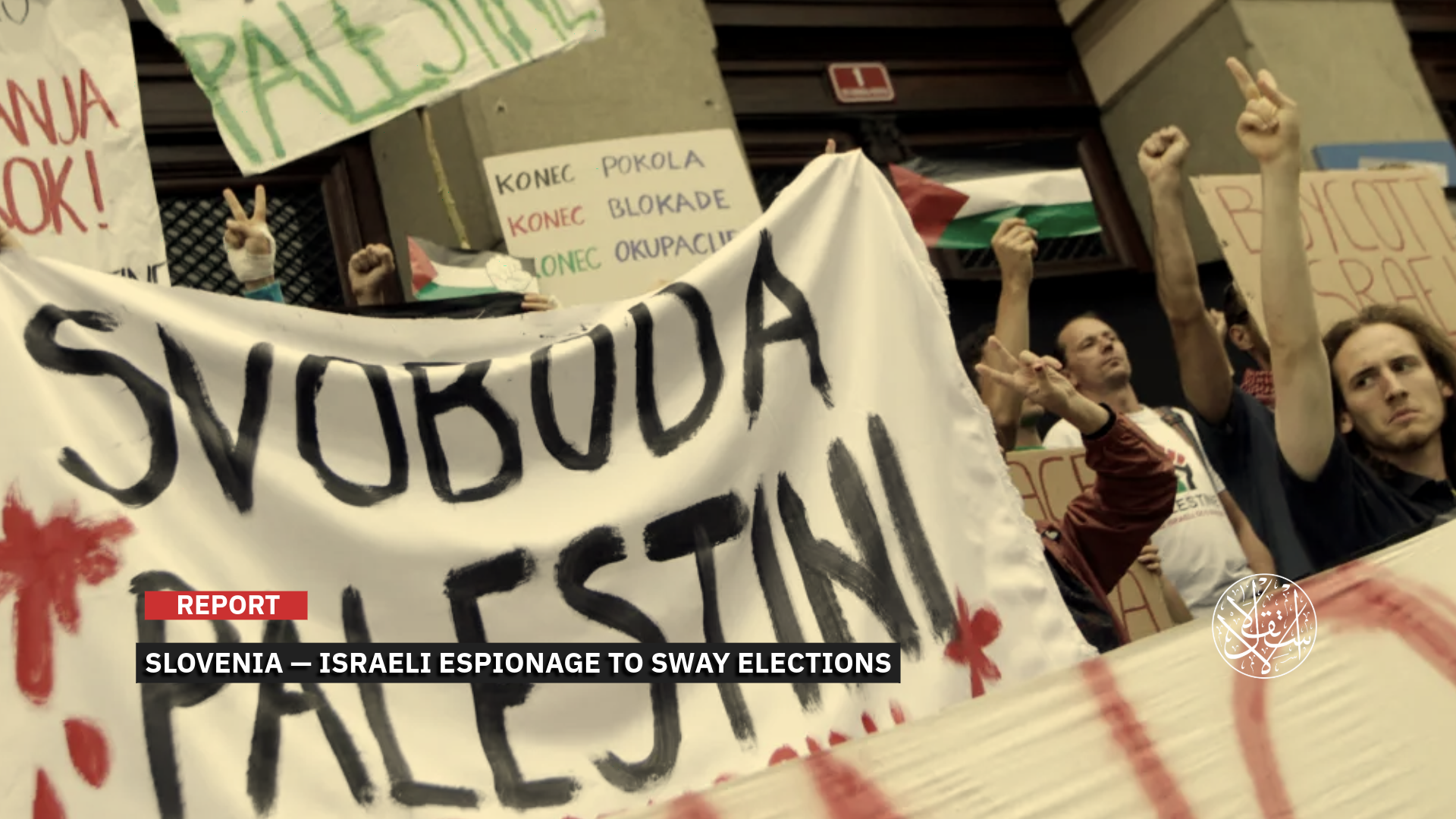
Intelligence revealed that four representatives of Black Cube traveled to Slovenia before the vote to organize the campaign.
In the lead-up to Slovenia’s parliamentary elections in March 2026, the center-left liberal Freedom Movement government, led by Robert Golob, was subjected to a broad cyber and media smear campaign that affected the election results, cost it its parliamentary majority, and paved the way for the formation of a new government.
It later emerged that the campaign had been carefully planned and systematically executed, relying on completely fabricated and misleading information, as part of an operation carried out by an Israeli private intelligence and espionage company. The aim was to weaken the Freedom Movement and punish it for recognizing the State of Palestine and opposing “Israel’s” war on the Gaza Strip while paving the way for a pro-”Israel” right-wing populist party to come to power.
Although the Freedom Movement remained the leading party in the election results, it suffered significant losses as a result of the campaign, with its parliamentary representation falling from 41 seats in the 2022 election to just 29 seats in the 2026 election.
In contrast, the Slovenian Democratic Party—a conservative right-wing populist party led by Janez Jansa and closely aligned with U.S. President Donald Trump and Hungarian Prime Minister Viktor Orban—finished second, just one seat behind, after winning 28 seats.
After the election, right-wing parties succeeded in forming a governing coalition with the support of their allies. Among the new government’s first steps was the cancellation of Slovenia’s recognition of the State of Palestine and the relocation of the Slovenian embassy to al-Quds, a move seen as a clear expression of support for the Israeli Occupation.

What Happened?
Slovenia held its parliamentary election on March 22, 2026, to choose the 90 members of the National Assembly. The vote produced a fractured legislature, with no party securing the 46 seats needed for an outright majority.
Although Prime Minister Robert Golob’s centrist liberal Freedom Movement won the largest share of seats, it failed to assemble a governing coalition. Instead, the right-wing populist camp succeeded in forming a fragile center-right coalition backed by five smaller conservative parties.
As a result, parliament elected Janez Jansa as prime minister on May 22, 2026, returning him to office for a fourth term. His comeback followed the political fragmentation that emerged in the wake of what became known as the "deepfake video conspiracy," which weakened the center-left bloc and cleared the way for a parliamentary majority led by the right.
A vocal supporter of the Israeli Occupation, Jansa succeeded in uniting Slovenia's right-wing parties under a coalition that formally brought him back to power in May 2026.
His government, however, is widely regarded as fragile because it depends on the support of five smaller right-wing parties, leaving it vulnerable to persistent political pressure and internal divisions.
The arrival of Jansa's administration—whose political outlook closely mirrors that of former Hungarian Prime Minister Viktor Orban, known for his right-wing populist rhetoric, anti-immigration and anti-Islam positions, and strong support for “Israel”—marked a dramatic shift in Slovenia's foreign policy. The change came despite Orban's defeat in Hungary's April 12, 2026, election.
On June 11, 2026, the new government revoked Slovenia's recognition of the State of Palestine and announced that it would relocate the Slovenian embassy to al-Quds in support of “Israel.” The decision marked a sharp reversal in the country's foreign policy, moving from backing Palestinian rights to adopting a distinctly pro-”Israel” stance following the transfer of power from the left to the right.
The government also lifted the previous administration's ban on arms exports to the Israeli Occupation and resumed imports of goods produced in Israeli settlements in the occupied West Bank after those products had previously been prohibited.
The policy reversal extended further. The new administration overturned the previous government's decision to designate several Israeli officials as persona non grata and once again welcomed Prime Minister Benjamin Netanyahu and far-right ministers Itamar Ben-Gvir and Bezalel Smotrich as welcome visitors to Slovenia.
Before winning the election, Jansa told Israel Hayom that he intended to "repair" relations between Ljubljana and “Israel” by moving the Slovenian embassy from “Tel Aviv” to occupied Jerusalem (al-Quds).
He also pledged to reverse the previous government's recognition of the State of Palestine, arguing that the decision had violated Slovenian law.

The Intelligence Conspiracy
The central factor behind the decline of the center-left, pro-Palestinian liberal Freedom Movement and the rise of the pro-Israel right-wing populist party was the release of highly sophisticated fabricated videos created using deepfake technology and artificial intelligence. The videos appeared to show party officials discussing corruption allegations and accepting bribes in exchange for approving government contracts.
The footage was widely circulated as part of a covert campaign targeting the pro-Palestinian party, contributing to a loss of support among voters who accepted the narrative portraying the movement as deeply corrupt. The operation formed part of a systematic effort to damage the party’s reputation ahead of the election.
Days before the vote, secretly recorded videos and audio clips spread online, appearing to show senior figures from the then-ruling party—including a former justice minister and lawyers—boasting, according to the recordings, about corruption, political connections, and the use of influence within Prime Minister Robert Golob’s administration.
The Freedom Movement condemned the leaks, describing them as a “coordinated attack on democracy” and insisting that they were fabricated as part of an operation carried out by the Israeli private intelligence firm Black Cube to disrupt its election campaign, according to Politico on March 19, 2026.
Later investigations by Slovenia’s Intelligence and Security Agency (SOVA) found that the campaign, including the fabricated videos, had been orchestrated by Black Cube in coordination with the conservative right-wing opposition led by Janez Jansa.
SOVA and the Slovenian government confirmed the presence and activities of the Israeli private intelligence firm inside the country ahead of the March 2026 election.
The authorities said they had evidence that company representatives had communicated with Slovenian actors and referred the case to police and prosecutors for further investigation, according to the Slovenian government’s official website.
Intelligence officials also revealed that four Black Cube representatives traveled to Slovenia before the vote to organize the smear campaign.
Slovenian State Secretary for National and International Security Vojko Volk said during a press conference on June 18, 2026, that company representatives had visited Slovenia four times. He added that one of its teams spent time on December 11, 2025, on the street where the headquarters of the Slovenian Democratic Party—the right-wing party that later led the new government—is located, which authorities viewed as an indication of links between the company and the party.
Jansa, then opposition leader and later prime minister, acknowledged that he had met with a Black Cube consultant but denied that his party had cooperated with the company or that it played any role in influencing the election outcome.
The Slovenian government also formally announced that foreign interference had taken place in the electoral process, stating that Black Cube representatives had visited the country several times and that some of their activities were aimed at influencing the political and electoral environment, according to the Associated Press (AP).
Responsible Statecraft described the events surrounding Slovenia’s election in a March 30, 2026, report as a story of foreign interference in a democratic process, the weaponization of private intelligence, and an apparent attempt to punish a European state for its pro-Palestinian policies.

Unmasking the Disinformation Campaign
As evidence continued to emerge, Slovenian President Natasa Pirc Musar called on June 30, 2026, for a formal investigation into Israeli interference in the country's parliamentary election.
She said the interference had been carried out through online disinformation campaigns that employed deepfake technology and artificial intelligence, citing findings from investigations conducted by SOVA.
According to Pirc Musar, the ruling liberal Freedom Movement had been targeted by an AI-driven disinformation campaign carried out by an Israeli private intelligence firm in coordination with right-wing opposition forces.
The president had previously accused the Israeli Occupation of committing genocide in the Gaza Strip in response to its aggression there.
In a report published on March 19, 2026, Politico argued that the significance of Black Cube's involvement in Slovenia's election—aimed at helping pro-”Israel” politicians gain power—extended beyond the country itself, coming at a time of growing concern across Europe over covert foreign interference in democratic elections.
The magazine said such operations range from coordinated influence campaigns to political sabotage, arguing that the Slovenian case reflected a broader struggle between pro-European Union, pro-Palestinian liberal forces and right-wing populist movements opposed to those positions.
On June 30, 2026, opposition lawmakers sought to establish two parliamentary committees to investigate the suspected foreign interference involving the Israeli firm, as well as illegal campaign financing. The effort, however, was blocked by the right-wing majority in Slovenia's parliament.

What Is ‘Israel’s’ Black Cube?
Founded in 2010, Black Cube is a private intelligence firm run by former Israeli security officials, with offices in “Tel Aviv,” London, Madrid, and Singapore. The company was established by two former Israeli military officers, Dan Zorella and Avi Yanus.
Its advisory board has included several prominent former Israeli intelligence chiefs, among them Meir Dagan and Ephraim Halevy, reinforcing Black Cube’s reputation as a shadowy intelligence organization linked to covert operations that serve Israeli Occupation interests.
According to Western assessments, the company—created by former Israeli military officers—has at times operated as a private intelligence contractor carrying out indirect assignments on behalf of Israeli intelligence agencies overseas.
Black Cube's operations rely primarily on Human Intelligence (HUMINT). Its agents frequently assume false identities, posing as business executives, journalists, researchers, or investors to gain the trust of targets, secretly record meetings, or obtain information and documents that would otherwise be difficult to access. The company also uses open-source intelligence and digital investigative tools to support its operations.
Critics describe Black Cube as a prime example of the privatization of intelligence, arguing that it leverages the expertise of former Israeli security officials to conduct covert operations for private clients using false identities, undercover meetings, secret recordings, and the collection of sensitive information.
The company, however, maintains that it provides legitimate investigative and litigation-support services, insisting that all of its activities comply with local laws and professional standards.
Operating with a high degree of secrecy, Black Cube combines undercover operations with HUMINT to pursue political and commercial objectives, including gathering corporate intelligence through operatives posing as executives, investors, or entrepreneurs.
One of the firm's most widely publicized operations surfaced in the United States in 2018, when it gathered information on former officials in President Barack Obama's administration and journalists who supported the nuclear agreement with Iran, amid the controversy surrounding President Donald Trump's decision to withdraw from the deal.
Black Cube also became embroiled in the case of disgraced Hollywood producer Harvey Weinstein, who was convicted of sexual assault. The New York Times (NYT) reported that Weinstein hired the firm to monitor journalists and women who accused him of sexual misconduct in an effort to undermine investigative reporting and discredit the victims.
In Romania, authorities arrested two Black Cube operatives on charges of spying on anti-corruption chief prosecutor Laura Codruța Kövesi, harassing her, and hacking her email accounts. Romanian prosecutors filed criminal charges against several company employees before the two operatives were convicted and later released as part of a legal settlement.
The company has also been linked to operations targeting critics of Hungarian Prime Minister Viktor Orban, a close ally of “Israel,” through the use of fake LinkedIn profiles.
Its interference in Slovenia's 2026 parliamentary election—where it was accused of attempting to shape the political environment in favor of a pro-”Israel” right-wing party—has further fueled accusations that the firm operates indirectly in ways that advance the interests of the Israeli Occupation government.
Black Cube has repeatedly faced accusations of surveilling journalists, business executives, and women through operatives using false identities to cultivate relationships and extract information. Critics argue that such operations are designed to intimidate or influence complainants, witnesses, and parties involved in legal disputes.
A Financial Times investigation published on November 3, 2026, reported that the Israeli-founded intelligence firm had earned millions of dollars through covert operations, fabricated narratives, and private investigations.
The report, based on court filings in New Jersey, revealed that documents from a legal dispute between two major European gambling companies showed Black Cube received more than £1.8 million from London-listed Playtech to conduct an intelligence campaign targeting its rival, Evolution.
According to the Financial Times, the company's methods—which rely on undercover operatives, false identities, and fabricated media narratives—illustrate how modern corporate espionage is often conducted through technically legal means while raising significant ethical concerns.
Playtech, a leading gambling technology company, hired Black Cube in 2021 to investigate whether Sweden-based Evolution Gaming was operating in sanctioned or restricted markets.
Over the next three years, Black Cube operatives posed as investors and potential business partners to gain access to Evolution executives, secretly recorded their conversations, and collected information that was later used in the legal dispute.
The evidence was ultimately presented before a New Jersey court, contributing to a lucrative financial return for the Israeli intelligence firm through its investigative services.
Sources
- New findings on foreign interference in Slovenia’s elections
- Slovenia says it has confirmed foreign influence on last weekend’s election
- Black Cube, leaked tapes and corruption: Israeli spy firm crashes Slovenia’s election
- 'Private Mossad' goes after pro-Palestinian leader in Slovenia
- Inside Black Cube: how notorious intelligence firm rakes in client fees
- Parliamentary inquiries into spy scandal and campaign finance thwarted
- Israeli Intelligence Agents in Slovenia