How Trump Exploits His Presidential Position To Immortalize His Name and Achieve Personal Gain
“Forbes now estimates Trump’s staggering net worth at a whopping $6 billion.”
From commemorative plaques and passports, to gold coins and even government programs, US President Donald Trump's name and image are repeated on official projects, sparking widespread controversy.
Trump's supporters see his movements as an embodiment of a new phase in the country's history, while his critics accuse him of politicizing national occasions and promoting the cult of personality.
In the latest step, Trump published, through his Truth Social platform, a bizarre painting of him with the first US President, George Washington, and a robot, along with the most prominent historical symbols of the United States, such as the Statue of Liberty, Mount Rushmore, the moon landing, and a picture of raising the American flag during the famous Battle of Iwo Jima.
Own Stamp
“Put your name on things, or no one will remember you,” has been Donald Trump's slogan since he was a wealthy young man and real estate mogul, as many of his properties he bought from others have his name on them in huge gold letters.
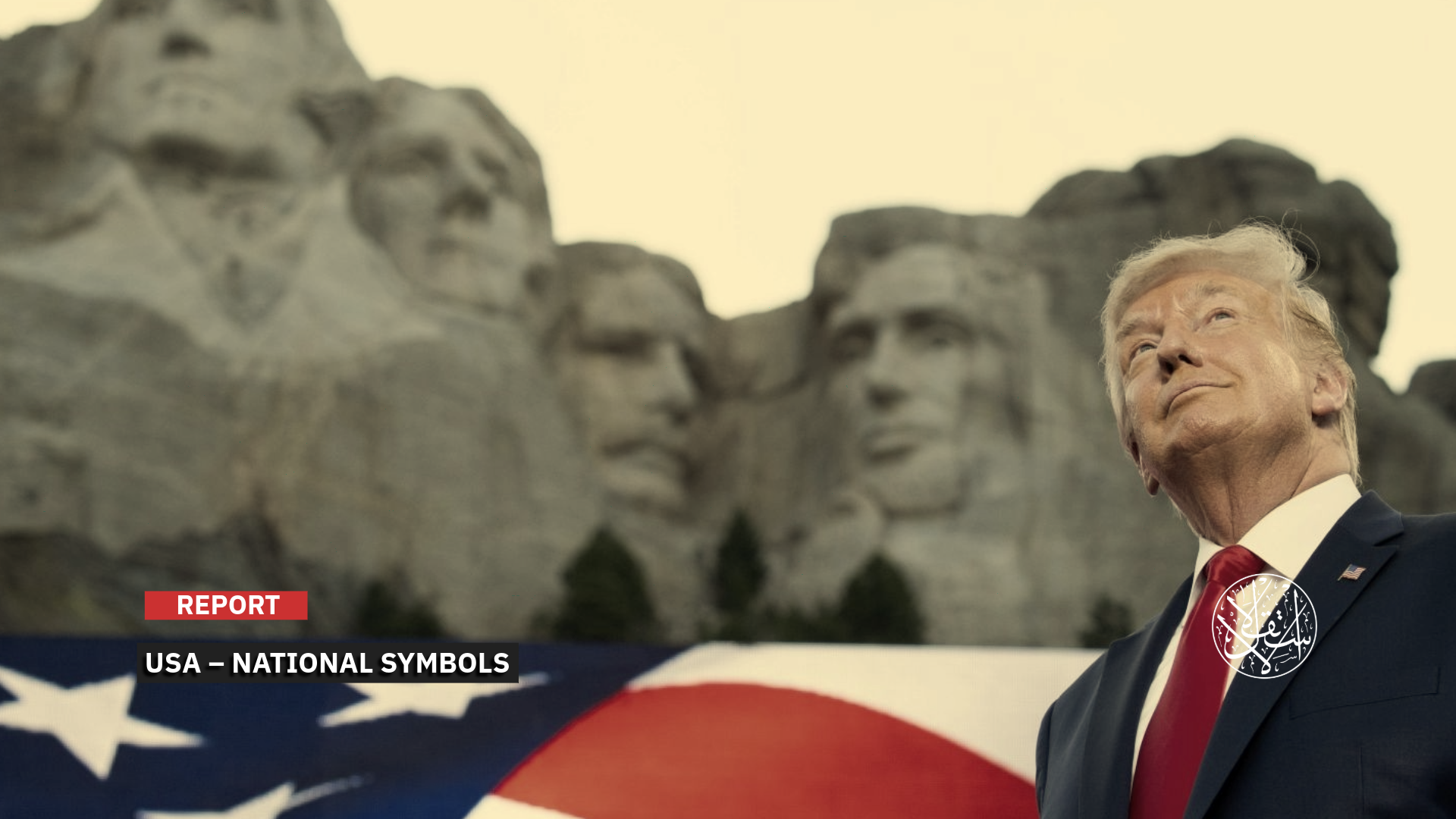
The recent way Donald Trump's administration celebrated the 250th anniversary of independence, on July 4, 1776, raised much criticism.
Huge banners bearing a picture of Trump spread in several American squares, and on top of federal buildings throughout Washington, D.C., which was interpreted by left-wing American media as a style reminiscent of kings, and closer to manifestations of personal glorification.
The Trump administration's attempt to link the historical occasion of the 250th anniversary to the president's personality and political project sparked a wide debate between supporters and opponents about the limits of employing national symbols in American political life.
Observers believe that Trump is trying to put his own stamp on the official celebration, with his second term in the White House coupled with policies that have raised divisions over immigration, the economy, and foreign policy.
Washington, D.C., is witnessing the Freedom 250 initiative launched by the White House to organize celebrations, which includes a two-week exhibition in the National Mall, where President Trump will deliver his speech on July 4 under the slogan Trump Rally, amid accusations that the national celebration has turned into an electoral and political rally for him.
Democratic-led states and a number of bands refused to participate in the events, due to concerns about the exhibition’s close connection to Trump’s personality.
President Trump's private celebrations overshadowed the work of the America 250 Committee, which was formed by Congress with the support of both the Democratic and Republican parties, and which was supposed to coordinate activities related to the occasion.
Democratic Senator Jeanne Shaheen, a member of the America 250 Committee, harshly criticized the White House and expressed her regret at what she called the administration’s attempt to turn the celebration into a partisan event.
At the same time, the authority responsible for issuing the American currency is planning to issue a commemorative gold coin bearing Trump’s image.
A few days ago, Trump unveiled a new, limited-edition design for American passports, bearing his picture in front of the background of the Declaration of Independence, in addition to his signature in gold, as part of the initiative to commemorate the 250th anniversary of the founding of the United States.
The White House called the passport a 'Patriot Passport', while Trump introduced it on his Truth Social platform, saying: “The new passport to the United States, which says: Welcome, but be on good behavior!”
The US State Department said that the limited-edition commemorative passport (25,000 copies) was prepared to commemorate this historic occasion, and will be released in Washington, DC, starting July 6, 2026, until supplies last.
Plans to issue a passport and coins bearing Trump's image have drawn criticism from Democrats, who say they reflect the use of official symbols to enhance the president's personal image.
Earlier this month, Democratic lawmakers called on the US administration to halt the production of a solid gold commemorative coin marking the 250th anniversary of the founding of the United States, which bears the same image of the president found on the new passport, in addition to the phrase “FIGHT FIGHT FIGHT,” in reference to the chant Trump made following his assassination attempt in Butler, Pennsylvania, about two years ago.
Democratic Senators Elizabeth Warren of Massachusetts, and Senator Ron Wyden of Oregon, said that the currency project should be abandoned after reports that part of the gold used by the US Mint comes from countries where gold is extracted illegally.
For his part, California Governor Gavin Newsom mocked the passport plan when it was first introduced, by publishing a satirical model of a gold-colored driver's license bearing his personal photo.
Unprecedented Phenomenon
During his second term, the appearance of Trump's name was not limited to national celebrations, but rather extended to a large number of government initiatives and programs, in an unprecedented step that sparked widespread political debate.
On July 4, 2026, the US administration officially launched the Children's Investment Accounts Program (Trump Accounts), which are savings accounts with tax advantages, in conjunction with the celebrations of the country's 250th anniversary, with the aim of helping parents secure the financial future of their children.
Under the initiative, the federal government grants a direct grant of $1,000 as a free foundation deposit for every U.S. child born between January 1, 2025 through December 31, 2028.
In February 2026, Trump launched a new website called TrumpRx.gov, aimed at selling prescription drugs directly to consumers at discounted prices.
In December 2025, Trump unveiled plans to launch a new class of warships named the Trump-Class.
After the idea of the Trump Gold Card in December 2025, which is supposed to provide - for a million dollars - a visa that allows its holder to stay in the United States, the image of Trump on the annual admission card to the US national parks also raised eyebrows from some.
In addition to marking American documents with his name and likeness, Trump has sought to leave a permanent imprint on Washington DC, including adding his name to the Kennedy Center for the Performing Arts - which was later removed - and announcing plans to construct a so-called Arc de Trump - a massive triumphal arch in Washington mirrored after the Arc de Triomphe in Paris.
A recent report by the German magazine Stern stated that President Trump's signature is also scheduled to appear on dollar bills, which is unprecedented for an American president.
Meanwhile, the US Mint released preliminary designs for a $1 coin bearing Trump's image.
This year, the Fine Arts Committee also approved the design of a 24-karat gold commemorative coin that shows a frowning Trump leaning over a desk.
On the other hand, these plans were met with harsh criticism and ridicule on social media platforms, as some users believed that only despotic rulers or dictators would allow their images to be glorified in this way.
A number of legislators warned of the expansion of the phenomenon of linking government symbols to personal names, and presented a draft law to prevent current presidents from naming public buildings after them.

Historical Legacy
The Financial Times published an article by commentator Edward Luce in which he said that we live in the age of the American Pharaoh.
He said it would be strange if the idea of genetic ancestry wasn't far from Trump's mind.
“If the 25th Amendment to the US Constitution were applied to Trump, his opponents would point to the monuments he is building for himself,” he said.
He pointed out that it seems that the recent wave of naming Trump himself goes beyond just trying to leave a legacy, as many of his trivial projects will take years to bear fruit.
The writer pointed out that Trump offered in February 2026 to release funding for two infrastructure projects in New York, if Democrats agreed to rename Dulles Airport in Washington and Penn Station in New York after him, but they rejected his offer.
He noted that Trump usually loves displays of opulence and royal succession, and craves the power of absolute rule, and last week he hosted King Charles III.
He concluded that, given Trump's enormous ambitions, it would be strange if his dynasty was not on his mind.
In a related context, a recent report published by The Atlantic revealed a remarkable shift in Trump’s political mentality, through his endeavor to present himself as an exceptional historical figure that transcends the limits of time, placing his name alongside prominent leaders such as Alexander the Great, Julius Caesar, or Abraham Lincoln.
In a report titled 'The Great Man Presidency', writer Ashley Parker quoted informed sources that Trump began speaking in private about himself as the most powerful person ever, with frequent comparisons to historical figures such as Napoleon Bonaparte.
In a related context, Trump sparked widespread controversy after linking assassination attempts to political influence, as he indicated in a comment after he was subjected to an assassination attempt that the most influential figures are the ones who are targeted, considering that this reflects the extent of their presence and role.
Analysts believe that this trend explains Trump's disregard for opinion polls and partisan pressures, in exchange for his focus on building a historical legacy based on the concept of greatness, beyond the traditional frameworks of the presidential role.

Conflict of Interest
US President Donald Trump's wealth has recently witnessed an unprecedented boom, while the average citizen faces an ongoing crisis in the cost of living.
Trump's 2025 financial disclosure, which was published on June 30, 2026, revealed that he made billions of dollars over the past year from his investments and real estate, in addition to huge profits from commercial products bearing his name, which renews questions about the nature of this exceptional presidency that combines power and commerce.
Predecessors of modern presidents have opted to stay completely separate from their personal finances to avoid conflicts of interest, such as Jimmy Carter, who placed his family's peanut farm in a closed trust in 1977.
But Trump chose a different approach. He not only kept his business, but created new projects by taking advantage of his position and personal brand, according to CNN.
From luxury watches, perfumes, and sneakers to books, licensed guitars, and even cryptocurrencies, he demonstrates an exceptional ability to leverage his name and brand image to generate enormous returns, in a model that combines political influence with personal branding.
After his income exceeded $2.2 billion in 2025, Trump faced renewed accusations of outrageous corruption from some Democrats.
But amidst these gains, the Trump family's controversial cryptocurrency ventures have stood out.
As Juliana Stratton, Lieutenant Governor for Illinois and Democratic Senate candidate, wrote on social media, "Trump's insatiable greed is disgusting."
"Donald Trump is exploiting the presidency to amass billions while American families struggle to meet their basic needs," she added.
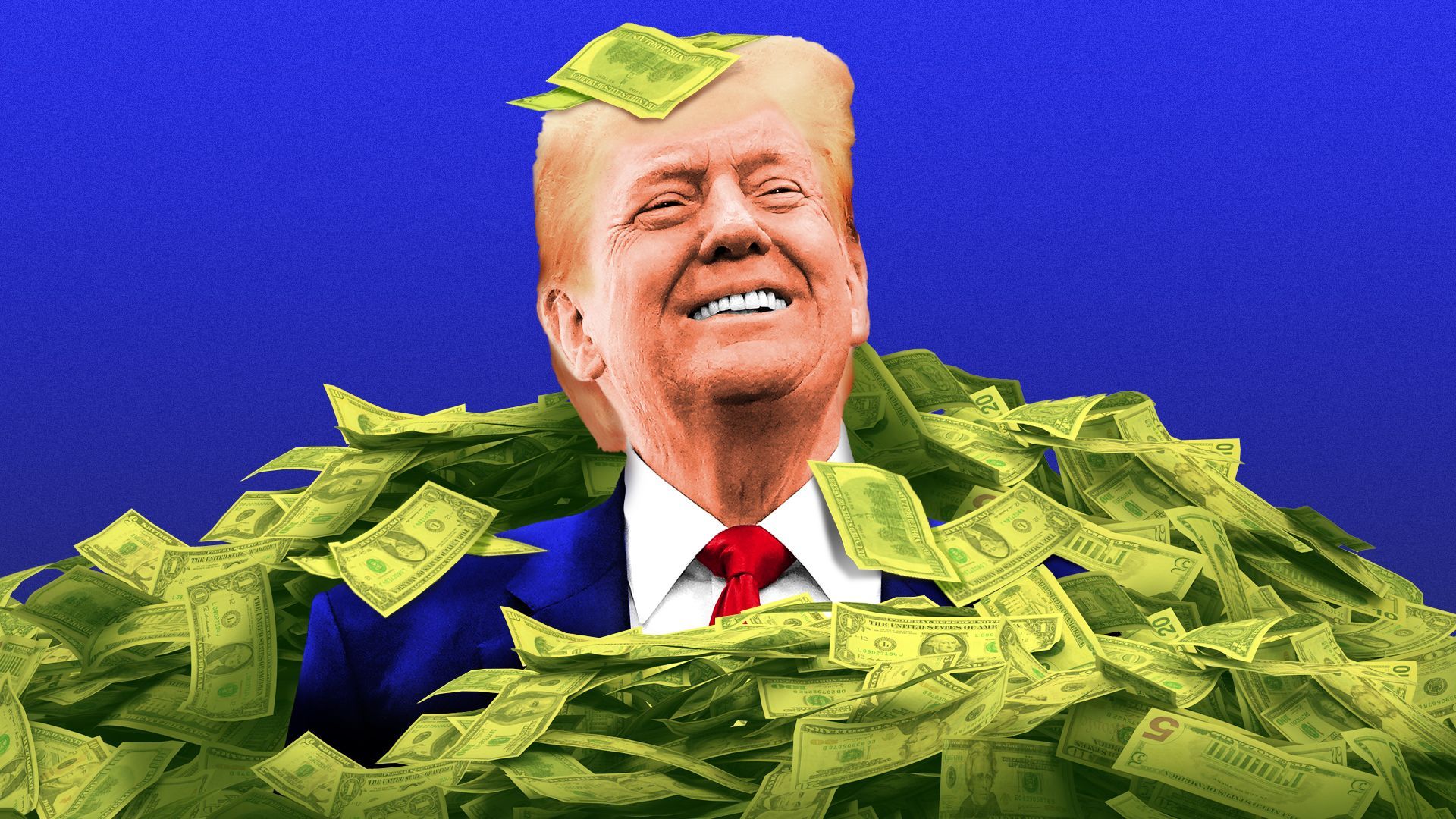
In response, President Trump stated on July 1, 2026, that his income had increased significantly since he took office due to improved conditions in the financial markets.
It should be noted that in his 2024 financial disclosure, submitted a year prior, Trump reported an income of just over $600 million.
Forbes now estimates Trump’s net worth at $6 billion, up from $2.3 billion in 2024.
The White House, however, denied any conflict of interest, asserting that the president had not financially benefited from his position and that his assets were held in a trust managed by his family.
The White House spokeswoman stressed that Trump’s current economic policies have contributed to making the United States a global center for the cryptocurrency industry, and have made all Americans richer and more prosperous.
Sources
- Trump made more than $1bn from crypto in first year back in office
- Trump has made more than $1 billion from crypto in a year. How?
- White House unveils new images of US ‘patriot passports’ for America’s 250th
- The age of the American Pharaoh
- The ‘Great Man’ Presidency
- 12 places Trump's name or image is being added by the federal government