From Water and Power Cuts to Regime Change: Can ‘Nafas’ Stir Tunisia’s Streets?
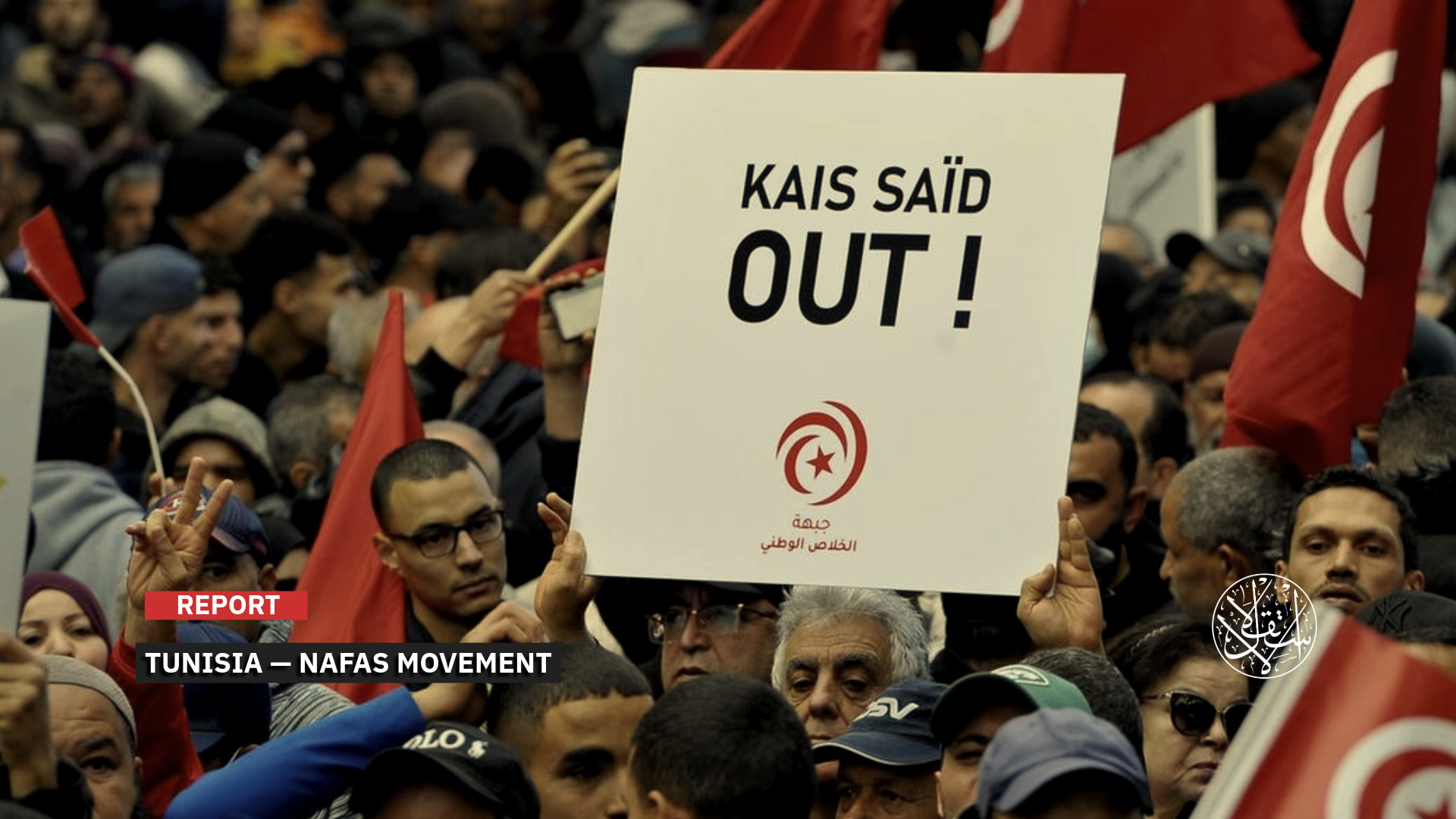
Tunisia has experienced a serious decline in civil and individual freedoms in recent years.
The Tunisian summer took an unexpected turn this year. Rather than passing quietly between a political lull and the economic activity that comes with the tourist season and the return of tens of thousands of Tunisians living abroad, it saw a wave of protests driven by crises over power cuts and interruptions to drinking water supplies.
As coup leader Kais Saied’s regime continues to tighten its grip on political and civic forces, with dozens of opposition leaders, rights activists, unionists, and journalists still behind bars, the Nafas movement has emerged as a new force. It has called for a series of protests in the capital, the latest of which took place on August 20, 2026.
Nafas has emerged as a civic and political movement bringing together political and rights figures across party and ideological lines, while pursuing a different tactical approach from the opposition movements that emerged after Saied’s July 25, 2021, coup.
The movement has shifted the focus of protest away from direct political demands and toward the everyday crises facing Tunisians, centering on economic and social grievances.
The movement now faces a crucial test: whether it can bring Tunisia’s divided political forces together and persuade ordinary Tunisians to embrace its demands, despite the smear campaigns and restrictions it faces.

A Serious Decline
On May 17, 2026, the Nafas movement announced the launch of its activities. In a statement addressed to the public, its founders said Tunisia had for years been experiencing a “serious decline” in public and individual freedoms, reflected in the use of repressive laws to intimidate and silence dissent, particularly Decree 54, which they said had become a sword hanging over journalists, bloggers, activists, and anyone expressing a critical or independent view.
The founders announced the launch of Nafas as an open, peaceful civic movement aimed at defending freedom of opinion and expression, protecting media independence, and confronting attempts to impose authoritarian control, silence dissent, and use state institutions against freedoms. The initiative grew out of a citizens’ petition titled “In Defense of Freedom of Expression and for an Independent Press and Free Journalists,” which drew the support of hundreds of Tunisians defending their rights and freedoms.
Wissam al-Saghir, spokesperson for the Republican Party and a leading figure in Nafas, said the movement was launched as a broad civic and political platform that would move beyond previous political alignments, following the failure of opposition coalitions to the July 25 process to create a common space for political action.
Al-Saghir said the initiative seeks to “unite efforts around priorities led by protecting freedoms, confronting authoritarianism, and addressing the economic and social failures resulting from the absence of vision and programs.”
He stressed that Tunisia’s crisis goes beyond its political and rights dimensions to include a deepening cost-of-living crisis, arguing that the movement’s decision to link the defense of freedoms with the right to a dignified life reflects the priorities of ordinary Tunisians. That, he said, could broaden popular engagement with the initiative while highlighting the severity of the country’s current situation.
Social Mobilization
Numerous reports point to a rapid deterioration in Tunisia’s economic, social, and rights conditions as power has become increasingly concentrated in the hands of Saied, and intermediary institutions, including political parties, unions, and civil society organizations, have been sidelined.
Against this backdrop, demands over basic living conditions, including water and power shortages, rising prices, and high unemployment, are not simply a tactical tool for mobilization. They reflect the daily reality of broad segments of the population, beyond political affiliations.
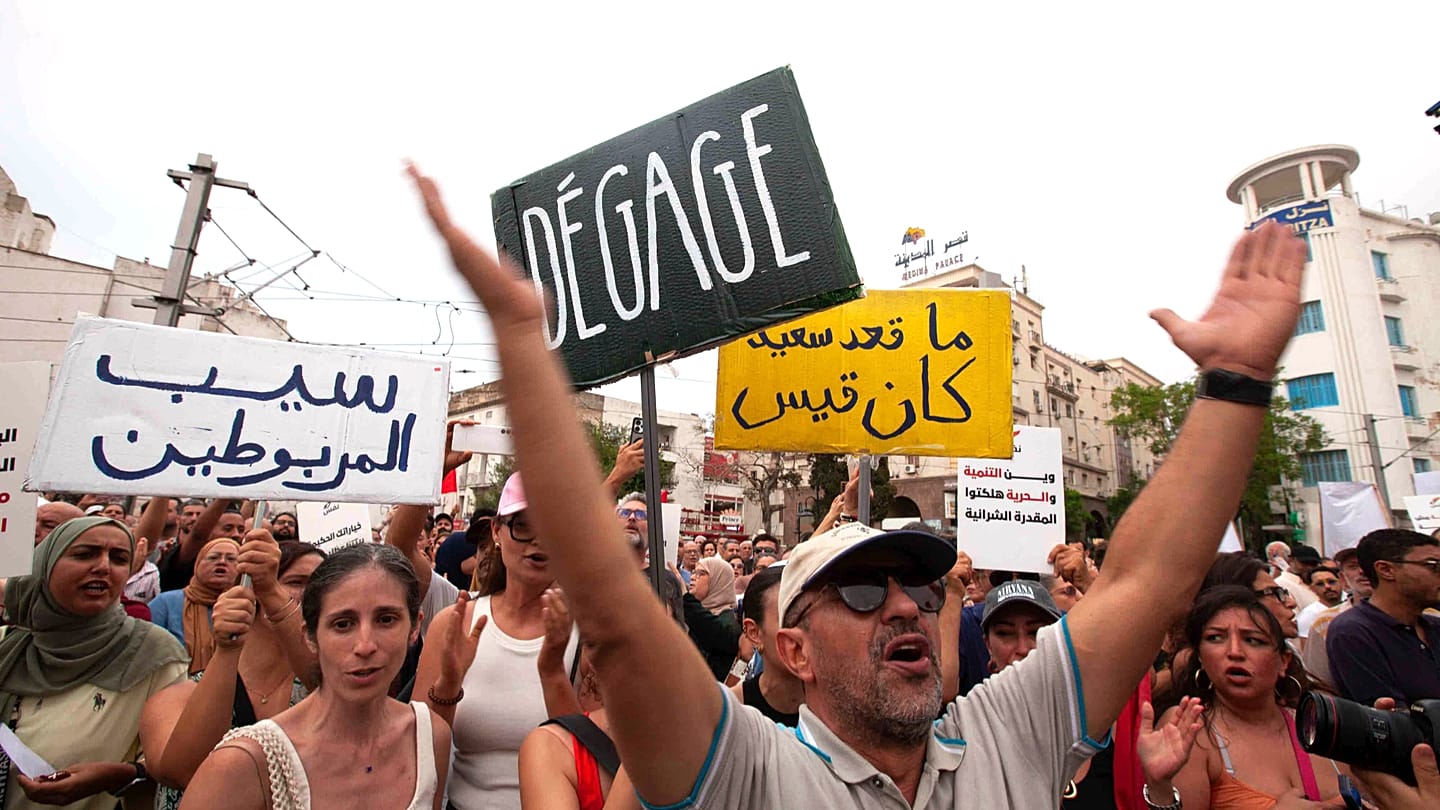
The Nafas movement began to make its presence felt more strongly on the fifth anniversary of the July 25, 2021coup, when thousands of Tunisians took to the streets chanting slogans against Saied, including “Leave” and “The people want the fall of the regime.” But the movement deliberately combined those political slogans with social demands tied to opposition to the current course and calls to address the country’s worsening living conditions.
Repeated power outages have inflicted major losses on business owners and commercial activities and spilled over into the health sector, prompting organizations such as the Young Doctors Association to call for a public health emergency.
It was this convergence of anger over summer water and power shortages with demands for rights that the movement sought to harness in its third call for protests on August 20, 2026, under the slogan “Enough messing with water and electricity,” presenting them as basic rights rather than merely political slogans.
In a post published on its official Facebook page on August 19, 2026, the movement stressed that its top priority was now confronting the rising cost of living.
“Our battle today is against high prices and soaring costs, as citizens’ purchasing power declines and basic goods disappear,” the post said.
The movement ended its message with a sharp criticism of current policies, rejecting the “reckless management of economic and social affairs” and arguing that these policies have made citizens pay for failure with their daily livelihoods and their right to live with dignity.

Bringing the Opposition Together
One striking feature of the movement is the breadth of its participation. The latest protest brought together the Ennahda Movement as part of the National Salvation Front; the Republican Party; the Democratic Current; and the National Coalition and Popular Republican parties.
Also notable was the participation of the Free Destourian Party, led by former lawmaker Abir Moussi, who is currently detained and is known for her fierce opposition to Islamists and deep differences with Ennahda.
These forces stand at opposite ends of Tunisia’s ideological and political spectrum, with Islamists on one side and their modernist and Destourian opponents on the other. Yet since July 25, 2021, they have failed to agree on a formula for building a united opposition front.
That rapprochement remains fragile, however, as illustrated by an incident in which the National Salvation Front posted an image of former President Zine el-Abidine Ben Ali alongside coup leader Kais Saied on its official page as part of a graphic promoting the August 20, 2026, march called by the Nafas movement.
The post angered supporters of the Free Destourian Party, who saw it as a departure from the movement’s goals and a provocation to the party’s base.
The incident prompted the movement to intervene quickly to contain the dispute, calling on all sides to put the “higher national interest” ahead of narrow party calculations.
In a statement issued on August 19, 2026, the movement reaffirmed its commitment to the principle of “unity across the political spectrum,” bringing together all Tunisians without discrimination or exclusion based on their intellectual, political, or civic affiliations.
“Previous protests have embodied this principle by bringing together different civic and political forces around common ground, foremost among them citizenship,” the statement said.
It added that the movement had immediately contacted the National Salvation Front’s leadership, which withdrew and revised the graphic, saying the incident was the result of an ill-advised personal decision by one of the page’s administrators.
Although the movement succeeded in containing the dispute, the episode underscored how fragile its principle of “unity across the political spectrum” remains in the face of deep historical divisions within the opposition. The bigger challenge will be whether this coalition can hold together and endure.
The Security Challenge
The survival and staying power of the Nafas movement will also depend on how the authorities respond to it. Previous opposition coalitions were met with arrest campaigns targeting their leaders, while earlier efforts to bring opposition forces together were accused of conspiracy.
Following the march organized by the movement on the evening of August 20, security forces arrested Nafas activist Seifeddine Arfaoui.
In a statement issued on the evening of August 21, 2026, the movement said that, following “a systematic social media campaign,” security forces went to the home of Arfaoui, a blogger, human rights advocate, and Nafas activist, and took him to the Anti-Crime Brigade in Gorjani, where he was questioned.
The statement added that, after reviewing the case, the public prosecutor ordered that he be held for 48 hours over a post he had published on his personal Facebook page containing slogans that had been chanted during the Nafas protest.
At the same time, the authorities have not prevented Nafas’s three most recent protests from going ahead, which some observers involved in the movement interpret as a sign that its momentum is growing with each demonstration, potentially carrying broader implications for the future of the opposition.
In other words, the authorities appear, for now, to favor a strategy of containment through individual intimidation and selective prosecutions rather than directly banning protests on a broader scale. That marks an important departure from the pattern of repression Tunisia experienced after the 2024 elections.
Whether Nafas can mobilize Tunisians on a broad scale will depend on three closely linked factors: its ability to establish its focus on everyday economic and social grievances as a popular priority that transcends party divisions; its ability to withstand the underlying tensions among its ideologically diverse members; and the authorities’ response, which could shift from selective containment to broader repression at any moment.
As of the time of this report, the signs point to gradually growing participation across the three successive protests. But that momentum is not yet conclusive evidence that the movement can become a force capable of bringing about meaningful political change, leaving Nafas’s future open to several possibilities rather than making it a clear story of either success or failure.
Sources
- Nafas Movement Holds New Protest Over Worsening Living Conditions and Eroding Freedoms in Tunisia [Arabic]
- “Nafas” Movement Protests in Defense of Freedom of Expression [Arabic]
- “Enough with the Recklessness” — Tunisians Protest and Chant “Dégage” at the July 25 Regime [Arabic]
- Living-Standards Protests in Tunisia: What Is Driving Them and Where Are They Headed? [Arabic]
- “Nafas” Movement Calls for Protest March in Tunisia on July 25 [Arabic]