SDF Out of the Military Equation: Is Syria Moving Toward a Unified State Again?
The SDF’s dissolution showed that Damascus is moving toward consolidating the Syrian state.
Syria’s new government has turned the page on the Syrian Democratic Forces (SDF) as a military and political force whose influence stretched across parts of the country for nearly a decade after its commander, Mazloum Abdi, announced its dissolution and the end of its mission.
The move appears to go beyond a military or administrative reshuffle. It carries broader implications for the future shape of the Syrian state, the relationship between its different communities, the limits of decentralization and cultural rights within a unified state, and the regional balance of power.
Dissolution of the SDF
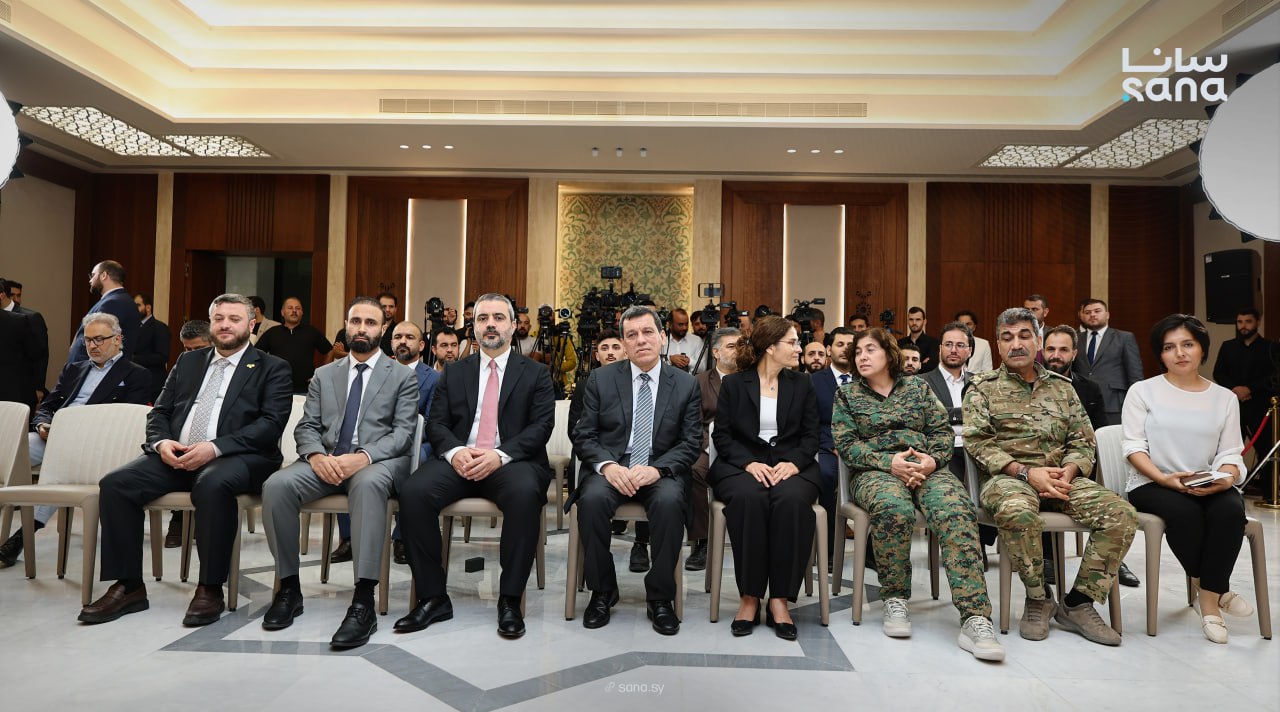
Mazloum Abdi announced the dissolution of the SDF, which he leads, saying their mission had ended, along with all military and civilian formations affiliated with the group. He confirmed that they would be fully integrated into the institutions of the Syrian state.
“Today, we stand at a historic moment in which we turn an important page in Syria’s history and begin to open a new page titled ‘peace, stability, and reconstruction,’” Abdi said in his address.
“We want this day to be the beginning of a true transition from the battlefields to the fields of construction and from the era of weapons to the era of peace.”
Abdi declared the SDF’s military mission over and said the next phase should mark a shift from battlefields to the work of rebuilding the country.
He said the goal was to build a new Syria for all its people, including Arabs, Kurds, Turkmen, and Assyrians, and to create a unified country that protects its citizens’ future and provides its children with a dignified life. He added that President Ahmed al-Sharaa had expressed support for the right to education in the Kurdish language.
The SDF had “carried a heavy responsibility during one of the most difficult periods in Syria’s history,” he said. But circumstances have now changed, with the country entering a new phase of peace.
Therefore, “we announce the end of the mission of the Syrian Democratic Forces and announce with full responsibility its dissolution as an independent military force,” Abdi added.
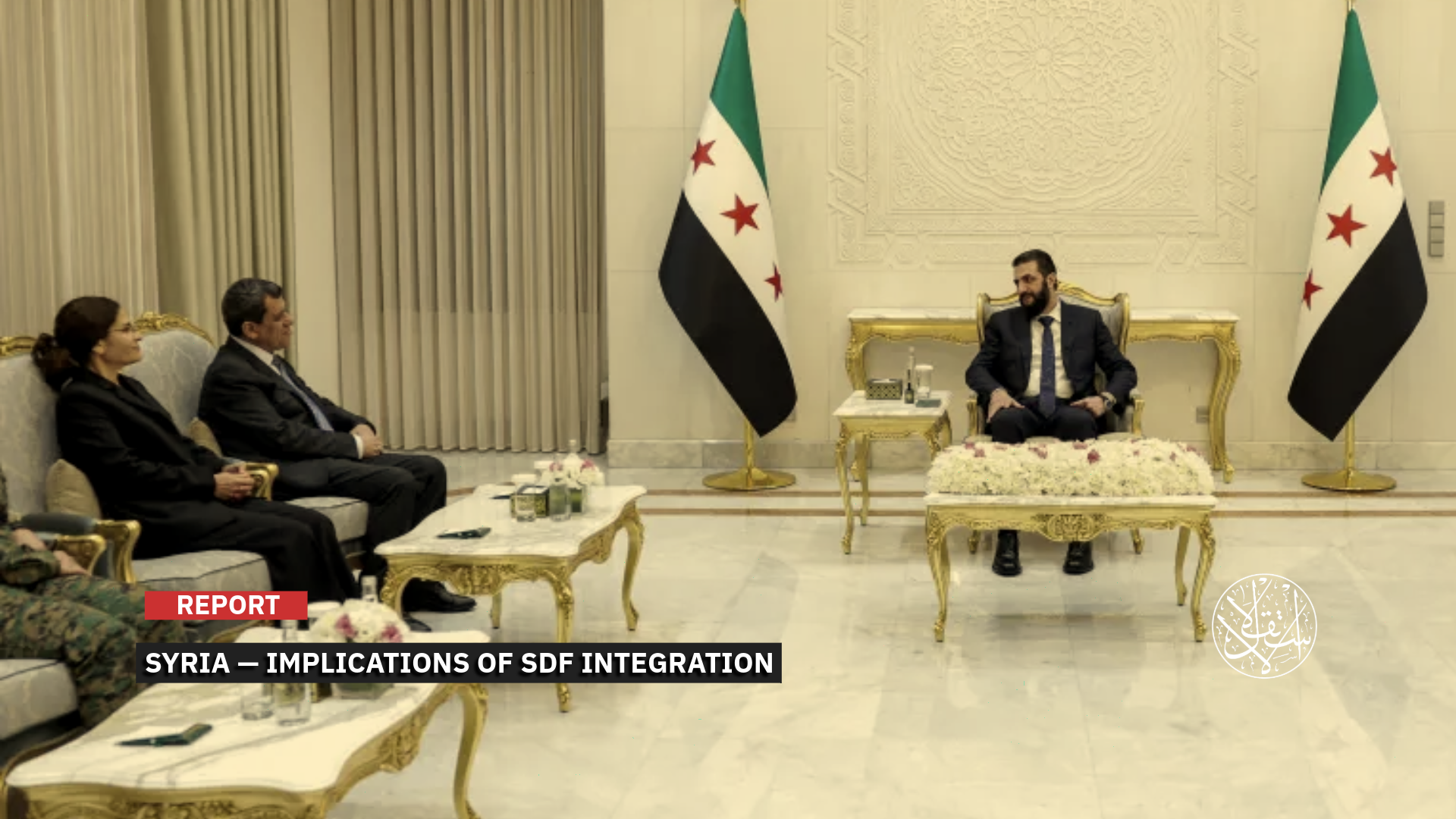
Following the announcement, President Ahmed al-Sharaa met with Abdi at the People’s Palace in Damascus, alongside Foreign Minister Asaad Hassan al-Shaibani, senior Kurdish Autonomous Administration official Ilham Ahmed, and Sipan Hamo, a prominent Kurdish military commander and deputy defense minister for the eastern region.
The dissolution of the SDF caps an integration process that began months ago and reinforces the framework of a unified Syria, particularly after the SDF maintained broad influence across northeastern Syria for years while calls for autonomy persisted.
On August 4, 2026, President Ahmed al-Sharaa received SDF commander Mazloum Abdi at the People’s Palace in Damascus, in the presence of Foreign and Expatriates Minister Asaad al-Shaibani and Deir ez-Zor Governor Ziad al-Ayesh.
The meeting focused on completing implementation of the January 29, 2026, agreement with the SDF and advancing its integration into state institutions, according to SANA.
The SDF was established in October 2015 through the merger of Arab and Kurdish fighters, with support and direction from the U.S.-led international coalition fighting the Islamic State.
The agreement followed a period of military escalation that saw the SDF withdraw from large areas with predominantly Arab populations to its stronghold in al-Hasakah province. Under the agreement, Syrian authorities also took control of facilities previously held by Kurdish forces, including Qamishli International Airport and major oil and gas fields, while SDF fighters were to be integrated into Syrian army brigades.
The dissolution of the SDF as a military organization and its integration into Syrian state institutions mark a significant development both domestically and regionally, with implications for the future shape of the Syrian state and relations among its different communities, as well as for the regional balance of power, particularly involving Turkiye and the Israeli Occupation.

Citizenship and Development
Observers say the formula reached to dissolve the SDF could offer a model for addressing internal divisions within states through what might be described as “cultural self-determination,” meaning the granting of cultural rights to groups with different cultural, linguistic, and ethnic identities within the same state, without necessarily leading to secession or the fragmentation of the country.
From this perspective, the development runs counter to an Israeli strategy that has sought, and continues to seek, to fragment Syria’s geography through Sweida, particularly because one of “Israel’s” calculations since the fall of Bashar al-Assad’s regime has been to push the Kurds toward a separatist path outside the Syrian state as part of a broader vision for Syria’s future.
The new understanding could, therefore, add pressure on the Israeli Occupation. As efforts to unify Syrian state institutions advance, “Israel’s” presence in the south could emerge as one of the main obstacles to completing Syria’s territorial unity and stability.
Ending the SDF’s military role could also strengthen the Syrian state while reducing one of Turkiye’s main sources of concern in northern Syria: the Kurdish issue.
According to observers, the SDF’s dissolution showed that the Syrian government is moving toward consolidating state institutions as the country navigates its political transition.
The Kurdish issue has been viewed as one of the most difficult questions surrounding minorities and the risk of Syria’s fragmentation. Reaching an understanding on the issue could therefore represent a step toward preserving Syria as a unified state.
Tom Barrack, the U.S. special envoy to Syria, described the SDF’s integration into Syrian state institutions as a “historic” development, saying the contours of a unified Syria were beginning to take shape.
In a post on X, Barrack said President Donald Trump’s Middle East plan was moving forward, with a U.S. partner transitioning into a unified Syrian national framework.
The implications of this development extend beyond Syria’s borders, reaching into the wider region. Resolving one of the country’s most pressing internal disputes could, under this view, strengthen Syria’s role as a regional player in the next phase.
Ahmed al-Hawas, an academic and political analyst, told Al-Estiklal that Mazloum Abdi’s announcement of the SDF’s dissolution means the end of the SDF in all its forms, or the end of the project for which it was created. That project could have led to the partition of Syria, not in a geopolitical sense, but by transforming Syria from a unitary state into a compound or federal state.
“The issue the SDF had used to justify its position, namely the Islamic State and its prisoners, has now been taken out of its hands. There is no longer any pretext for the SDF to continue, especially after it handed over, or was stripped of, control of the oil fields,” he said.
“I believe the decision reached by Mazloum Abdi is better than stubbornly maintaining the status quo, which could have led to a conflict in which the SDF would be the biggest loser. The regional reality also matters, particularly Turkiye, which does not want the SDF to continue operating in its current form or as it did in the past.”
“If Syria moves toward citizenship and development that includes all Syrians, that is better than any separatist project or any project that could undermine the structure of the Syrian state,” he added.

Impact on Sweida
The dissolution of the SDF as a military organization and its integration into the Syrian state appears to go beyond a military or administrative arrangement. It represents a political and strategic step, both in consolidating Syria’s unity and addressing longstanding grievances and in reshaping the balance of influence among Syria, Turkiye, and the Israeli Occupation in the period ahead.
Against this backdrop, Ahmed Qarbi, director of the Syrian Dialogue Center and an academic, told Al-Estiklal that the SDF’s dissolution and integration into the Syrian state could serve as a model, albeit only in part. He said there were broader principles that could be drawn from the experience, most importantly that any organization must operate under state institutions and that there should be no “state within a state.”
“Therefore, Syria should not repeat the Hezbollah model, in which one side possesses weapons, an administrative structure, and a bureaucratic apparatus separate from the state.”
“The broader principle is that there should be room for participation and contribution,” he said. “That is what can be generalized from this experience, or what could be considered the minimum lesson to draw from it as a model.”
Qarbi noted that there are fundamental matters over which the Syrian state cannot allow competing authorities, foremost among them the unification of state institutions. The remaining issues concern the details, including how the SDF will participate in state institutions, how that participation will be structured, and what mechanisms will be adopted.
“This could perhaps take the form of some degree of administrative decentralization, with arrangements and details varying from one region to another.”
Against this backdrop, the dissolution of the SDF goes beyond an internal restructuring of the Syrian state. It marks the transfer of one of the last armed actors operating inside Syria into the structure of the new Syrian state.
That, in turn, could put greater pressure on another unresolved issue: Sweida, which remains under “Israeli protection,” particularly after Hikmat al-Hijri, the spiritual leader of Syria’s Druze community, released a video on August 25, 2026, expressing his hope that the future of Sweida would be resolved through joining the Israeli Occupation.
Al-Hijri claimed that “the Druze are united with the State of Israel even in faith and are an integral part of this state.”
“The SDF experience has implications for the Sweida issue, particularly since Hikmat al-Hijri’s vision of establishing an independent state and linking it to Israel is unworkable. It is a utopian proposition,” Qarbi said.
“What al-Hijri is doing is a form of political one-upmanship, perhaps aimed only at raising the ceiling of demands without offering logical or realistic solutions. That is why the dissolution of the SDF will likely send a stronger message to moderates in Sweida that they should engage with state institutions under the authority of the state rather than seek outside backing.”
Sources
- Kurdish-led SDF announces dissolution after merging with Syria’s military
- In Foreign Minister’s Presence, Mazloum Abdi Announces SDF’s Dissolution and Full Integration Into State Institutions [Arabic]
- US Envoy Hails SDF’s Integration Into Syrian State Institutions [Arabic]
- Al-Hijri: Resolving the Sweida Issue Means Bringing It Under Israeli Control [Arabic]
- President al-Sharaa Receives Mazloum Abdi at the People’s Palace in Damascus [Arabic]