From Declining Education to a Test for the State: Gen Z Protests Shake French Democracy
“The protests have become a test of the state’s ability to respond to the demands of a new generation.”
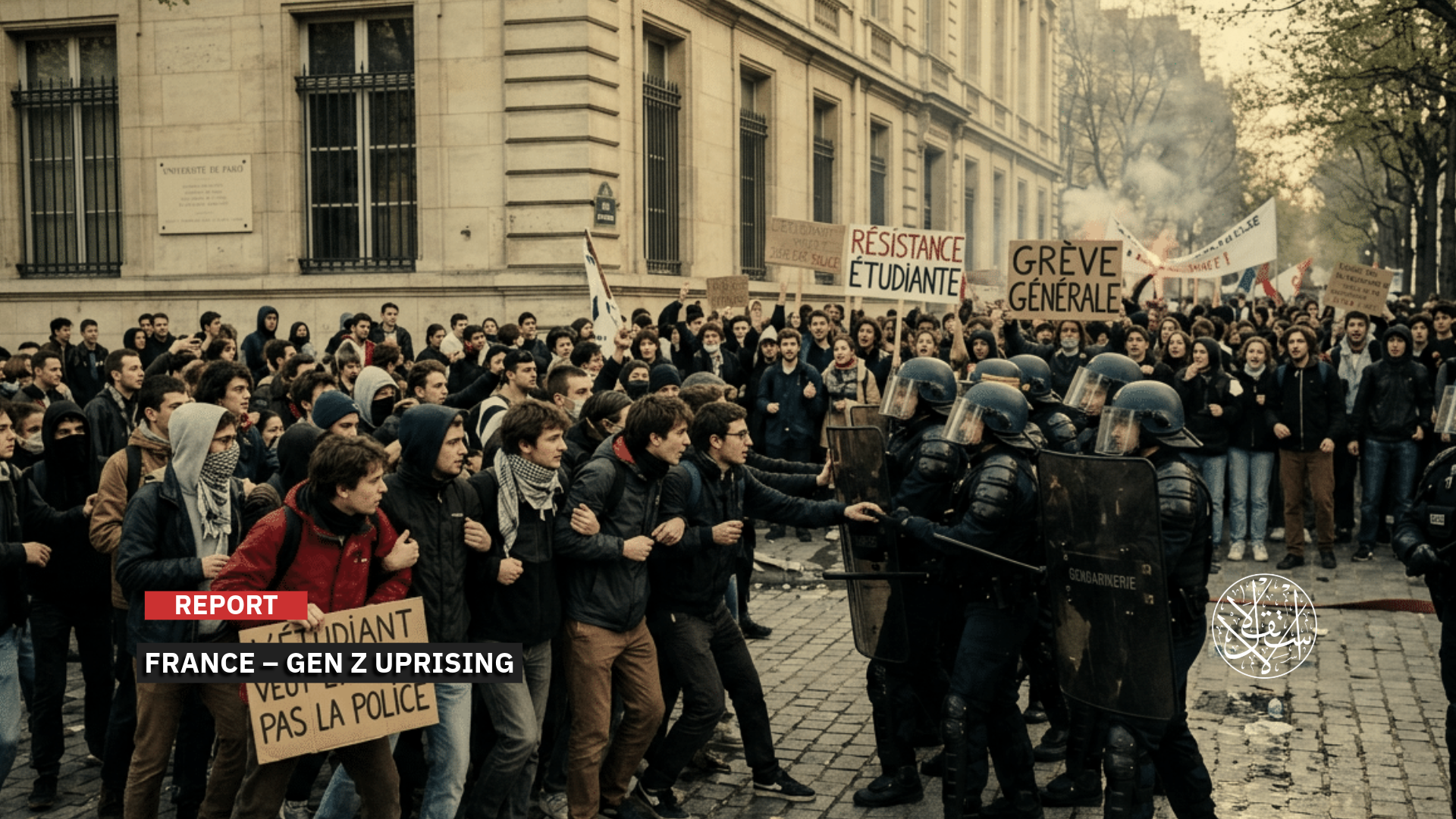
Protests by high school students in France, ongoing for nearly a month, have become a serious test for the state and government after evolving from local demands over school conditions, particularly in poor and marginalized areas, into a broader political and social crisis.
The protests are no longer simply a campaign against teacher shortages and deteriorating learning conditions. They have spread to hundreds of schools and have been accompanied by violent clashes with police, amid growing political polarisation as the presidential election approaches.
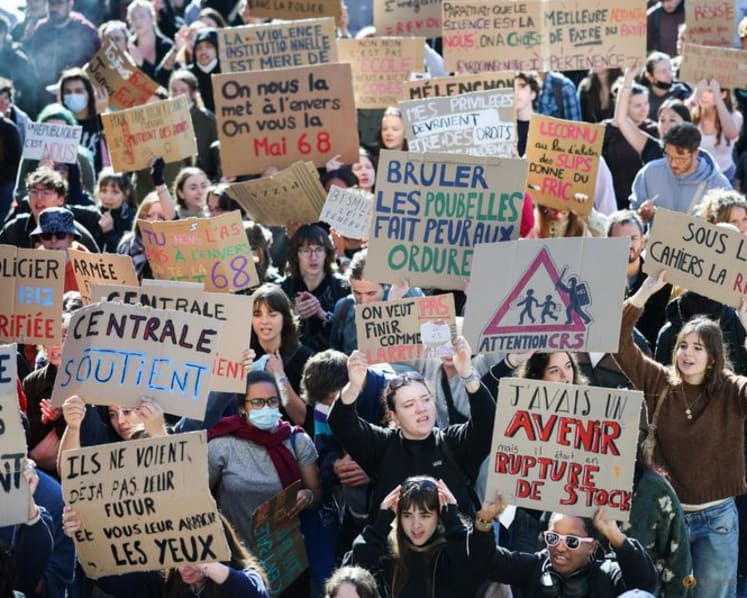
The protests, which began on September 17, 2026, in the Paris suburb of Créteil, over shortages of staff and educational resources, have exposed a deeper crisis involving unequal opportunities between schools and a growing sense among sections of France’s youth that the education system does not provide equal conditions for building their future.
As the government, political parties, and security forces have become involved in the crisis, the protests have become a test of the state’s ability to respond to the demands of a new generation known as Generation Z, without reducing their movement to violence or turning it into a battleground for political score-settling.
The protests have resonated beyond France’s borders. Belgium has witnessed student demonstrations over education costs and proposed reforms, while calls for similar protests have emerged in Italy and Spain, amid growing opposition to cuts in public spending, declining purchasing power, and rising living costs.
Commenting on these developments, Palestinian expert Mustafa Barghouti wrote on X that they could represent “the beginning of a global youth revolt against savage capitalism.”

Roots and Evolution of the Crisis
The protests began in mid-September 2026 at a high school in the Paris suburbs, in response to a severe shortage of teachers, deteriorating school infrastructure, and the loss of around 10 percent or more of classroom hours due to teacher absences and the lack of substitute teachers.
Behind these immediate demands lies a broader problem of inequality between schools and regions. Students in poor neighbourhoods and vocational schools feel they have fewer educational opportunities than their peers in wealthier areas.
The shortage of resources affects not only the quality of education but also students’ future opportunities in higher education and employment, prompting them to take to the streets to demand better learning conditions.
In a report published on October 5, 2026, French newspaper Le Monde said that several schools affected by the unrest were located in poor suburbs and densely populated immigrant neighbourhoods, areas already experiencing greater social and educational inequalities.
The newspaper noted that students in these areas feel they receive a lower-quality education and that their social backgrounds significantly affect their educational opportunities.
These demographic and social factors may help explain attempts to politicise the protests and link them to immigration and Islam. However, they do not establish that Islam is the cause of the protests or that the movement has a religious agenda.
As the crisis continued without its underlying causes being addressed, the protests spread to several French cities. Parents, teachers, unions, and political figures joined the students, leading to the closure or disruption of hundreds of schools and educational institutions.
Violence during clashes further intensified the crisis, particularly after a 15-year-old student was injured and lost a hand when a grenade exploded during a protest in the northern French city of Lens. Hundreds of others were also injured, and authorities detained thousands of people, most of them minors.
These developments sparked widespread criticism of police tactics against protesters, with human rights organisations and political figures calling for a review of the use of crowd-control weapons. Authorities also opened investigations into several injuries.
On October 9, 2026, the Soufan Centre, an independent, nonprofit organisation based in New York that specialises in research and analysis, reported that more than 500 schools had been closed or disrupted by the protests. Estimates of the number of participants in demonstrations across France ranged from approximately 71,500 to 266,000.
For the October 6 demonstrations, authorities estimated the number of participants at around 266,000, while organisers put the figure at approximately 450,000.
These figures showed that the movement had moved beyond local school-related demands to become a broader public issue at the intersection of educational, social, and political concerns.
The protests have drawn comparisons with the student demonstrations in France in 1968, when university protests escalated into a broader social and economic crisis.
That year, student protests coincided with trade union demonstrations, leading to strikes involving around 10 million workers and bringing large parts of the French economy to a standstill. President Charles de Gaulle subsequently announced the dissolution of Parliament and called an early election.
Although the current protests have not reached the scale of the 1968 events, the comparison takes on significance amid France’s fragile political landscape and the approaching presidential election scheduled for April 2027.

A Crisis of the State, Not the Schools
The high school student protests have exposed a crisis that extends beyond the education sector, teacher shortages, and overcrowded classrooms, putting the French state’s relationship with its younger generation to the test.
The demonstrations are no longer simply demands for better learning conditions. Having spread from the Paris suburbs to hundreds of educational institutions, they have become one of the country’s most significant waves of youth protests in recent years.
The initial demands concerned shortages of teachers and staff and deteriorating school buildings. They subsequently broadened to raise more complex questions about equal opportunities, the ability of public institutions to respond to young people’s needs, and the limits of the use of force in handling protests.
The protesting students, many of whom come from poor neighbourhoods, accused the state of allocating substantial resources to education without ensuring an equitable distribution of staff and services. They expressed concern that disparities in educational quality would reduce their future employment prospects compared with those of their peers in wealthier areas.
French Prime Minister Sebastien Lecornu promised to present a plan to address the students’ demands by the end of October 2026 and to facilitate dialogue within schools. However, the violence and political pressure have triggered a crisis of confidence in the government’s ability to deliver on its promises.
The protests reveal the intersection of three crises: a crisis in learning conditions and equal opportunities; a crisis of confidence in public institutions’ ability to respond; and a political crisis over how to handle and interpret social discontent.
While students are demanding better educational resources and fairer opportunities, the government is trying to contain the unrest amid financial constraints and political tensions, as various parties seek to frame the movement within their own narratives about France’s future.
International reports indicate that France’s education spending exceeds the average among member countries of the Organisation for Economic Co-operation and Development (OECD). Nevertheless, complaints persist over teacher shortages, working conditions, and deteriorating infrastructure, particularly in poor and marginalised areas.
In its report published on October 5, Le Monde said that what began as a local protest in the Paris suburbs had evolved into a wave of student anger unprecedented in the country for decades.
The newspaper added that students had taken to the streets to protest learning conditions and uncertainty about their future, but the government’s handling of the demonstrations and its use of force risked fueling further anger and turning the school crisis into a broader crisis of the state.
On October 8, 2026, British newspaper The Independent published a report based on testimonies from students Sophie Martin and Julia Manzano, conveying their concerns about inadequate educational resources, what they described as students’ psychological exhaustion, and anxiety about the future as the protests spread.
“The education system in France is collapsing, and we have no choice but to join the protests,” the two students said, expressing their frustration with the state of schools, teaching staff, and educational facilities.
The newspaper argued that road blockades and widespread student protests “are not merely teenage rebellion, but a direct response to deep-rooted structural problems.”
The report added that years of deteriorating infrastructure, shortages of qualified teachers, and exhausting school schedules had pushed students to the brink, turning mounting tensions between a generation seeking to secure its right to education and a state responding with heavy-handed security measures into a growing source of unrest.
The newspaper maintained that high school students’ participation in the protests reflected their determination to reclaim their right to education, protect their safety, and secure a dignified future.
The protests are likely to intensify pressure on France’s political landscape ahead of the April 2027 presidential election. Growing public discontent and political fragmentation could make it more difficult for the next president to form a stable governing coalition.

An Opportunity for Presidential Candidates
The protests have extended beyond the relationship between students and school administrations, with political parties, trade unions, and local officials becoming involved in the crisis amid growing criticism of the government’s fiscal and social policies.
With the French presidential election approaching in April 2027, the protests have become a focal point of political debate, while incumbent President Emmanuel Macron is constitutionally barred from seeking a third consecutive term.
Jean-Luc Melenchon, leader of the left-wing France Unbowed party, backed the students’ demands and criticised the government’s handling of the demonstrations. Prime Minister Sebastien Lecornu, meanwhile, accused him of attempting to exploit the unrest for electoral purposes.
Mélenchon encouraged his supporters to join the demonstrations while urging them to avoid violence, and continued to appear alongside the protesters.
Although the student movement is not itself a far-left movement, its expansion has given political parties an opportunity to highlight their positions on public spending, education, and social inequality, issues likely to feature prominently in upcoming election campaigns.
According to an opinion poll cited by Le Monde, more than 40 percent of voters aged 18 to 24 said they intended to vote for Mélenchon.
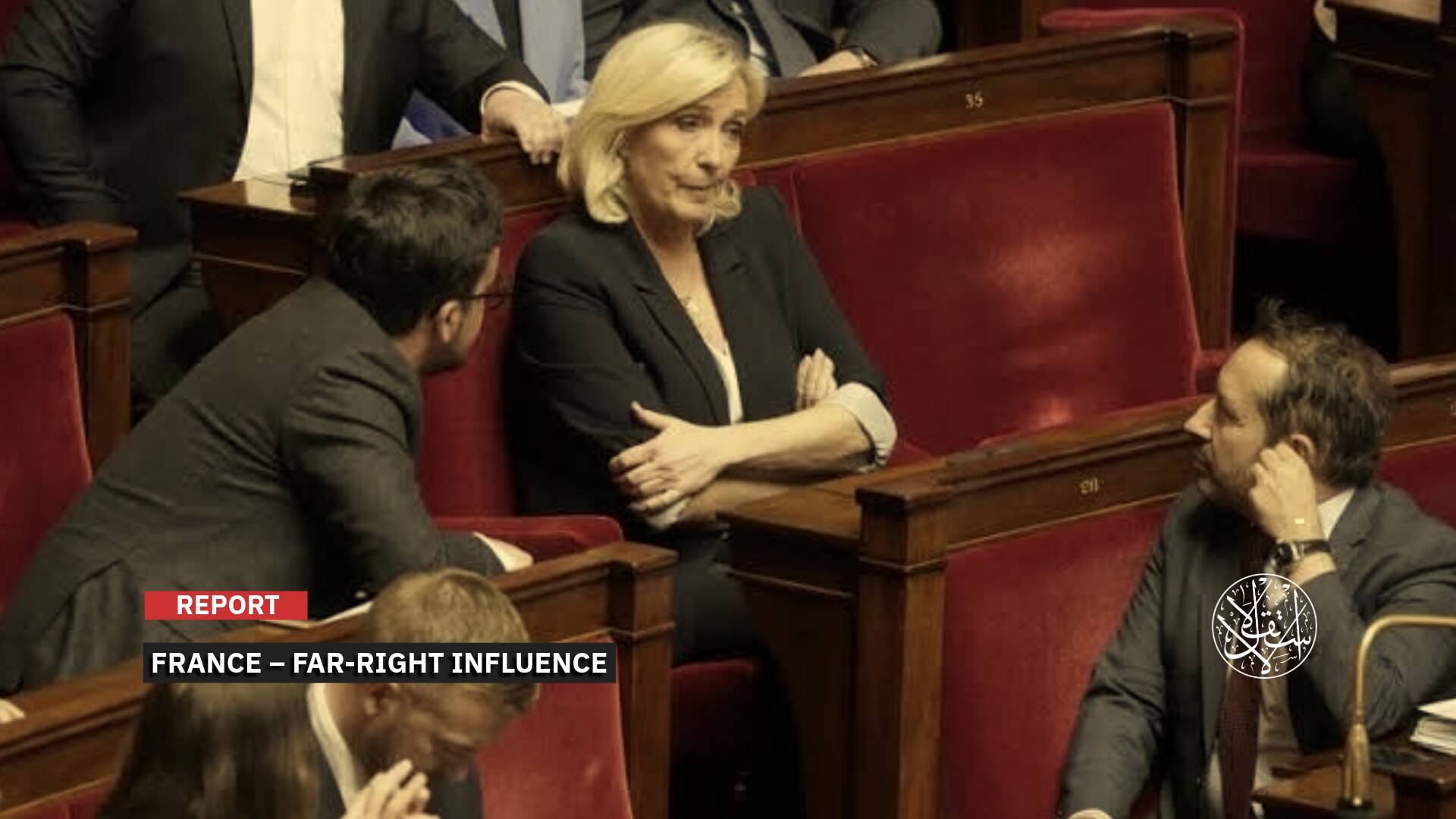
Although opinion polls indicate that far-right candidate Marine Le Pen is leading, young voters could play an influential role in determining which candidates qualify for the second round of the election.
The potential contest between Melenchon and Le Pen highlights growing political polarization in France, as rival political forces seek to attract young voters and turn their economic and social demands into electoral support.
The impact of the protests extends beyond candidates’ electoral prospects to broader debates over public spending, social welfare, and the government’s ability to provide essential services.
Popular discontent combined with political fragmentation could make it difficult for the next president to form a stable governing coalition, particularly if the election once again results in a divided parliament.
Immigration and Islam Rhetoric: Political Exploitation
In an attempt to exploit the protests politically, U.S. President Donald Trump sought to link the unrest in France to immigration and Islam, capitalizing on the fact that the movement began in schools located in poor areas with large populations of immigrant-background residents.
On October 6, 2026, Trump wrote on his Truth Social account that the protests in France were not about a school crisis but stemmed from what he described as uncontrolled mass immigration, linking the issue to Islam.
“What’s happening in France is nothing less than out-of-control mass migration. This isn’t about schools, this is about Islam wanting to take over a once great Country!” he wrote.
This interpretation, which attributes the causes of the protests to Islam, is not supported by the protesters’ stated demands, which focus on teacher shortages, deteriorating learning conditions, and inequalities in educational opportunities.
Furthermore, the presence of people from immigrant backgrounds and Muslims in some areas affected by the protests does not establish that religion or ethnic background is a cause of the demonstrations.
Trump’s remarks came amid a broader social media campaign by American figures associated with the conservative right and the movement aligned with him.
American commentator Dave Rubin shared footage of the French protests, warning that the same scenario could unfold in the United States if Democrats returned to power.
Conservative broadcaster Glenn Beck also argued that what was happening in France was part of an “international network of socialists” seeking, in his words, to dismantle the West.
This rhetoric reflects an attempt to link social unrest in France to the American political struggle and turn the French protests into an example used in domestic debates over immigration, the left, and Islam.
Melenchon responded to Trump’s remarks, arguing that the U.S. president was presenting an “imaginary narrative” about the causes of violence in France. He mocked Trump’s reliance, as he put it, on accounts provided by Marine Le Pen, the far-right leader, to explain the events.
Mélenchon also accused the French right, particularly Le Pen, of presenting an interpretation of events that could fuel the narrative adopted by Trump.
Ultimately, the student protests in France are no longer merely a dispute over school conditions. They have become a focal point where a new generation’s demands for a more equitable education intersect with a crisis of confidence in public institutions, concerns over widening social inequalities, and a political struggle unfolding ahead of the next presidential election.
While the government seeks to contain the movement through dialogue and promises of reform, its main challenge remains addressing the root causes of the protests, safeguarding students’ right to a quality education, and preventing their demands from becoming fuel for further political and social polarization.