A New Triangle of Influence: How Crypto, AI, and Online Betting Companies Stormed the US Elections?
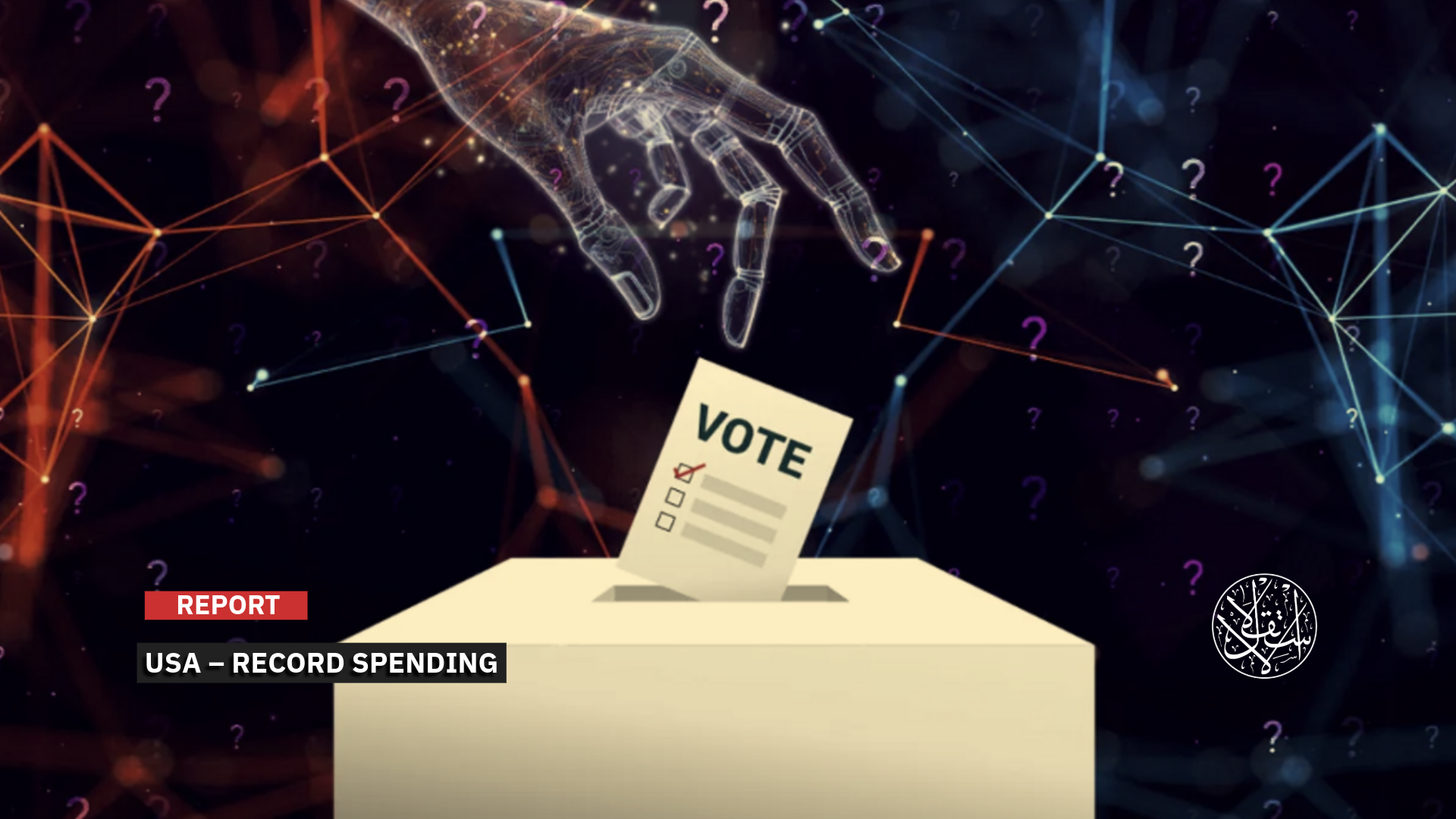
" Polls show a majority of Americans feel there is too much money in politics."
The US political landscape is undergoing a radical shift in the financial forces driving elections, with a new class of billionaires and corporations emerging as kingmakers in Washington.
These new financiers draw their power from burgeoning sectors that were largely absent from political calculations decades ago, most notably cryptocurrencies, AI, and online betting platforms.
According to observers and strategists from both the Democratic and Republican parties, these sectors have become the primary source of funding shaping the congressional races scheduled for November 2026.
Lawmakers across the country are pushing for greater scrutiny and regulation of these sectors, while their founders are using their newfound wealth to cultivate allies and influence the drafting of regulations that serve the interests of these emerging companies, as well as to thwart efforts that target their interests.
This record-breaking spending comes ahead of the anticipated intensification of campaigning in the final stretch before the November 3 elections, in which Democrats hope to seize control of both the House of Representatives and the Senate.
Specialized Legislation
For a long time, Wall Street, oil companies, pharmaceutical companies, and media outlets monopolized financial influence in the corridors of American politics. But nothing lasts forever, and the political landscape seems to have shifted in recent years.
A new alliance has emerged, comprising sectors that were nonexistent, or rather, held little economic weight a generation ago: cryptocurrencies, AI, and online betting.
Their role will undoubtedly be significant in the midterm congressional elections scheduled for November 3.
These sectors, bolstered by the wealth of newly minted billionaires, are pouring record sums into the race for the House and Senate, seeking allies capable of shaping the rules that will define the future of their businesses.
Recent data from a public affairs monitoring organization revealed that American companies spent approximately $517 million on the House and Senate elections.
This figure was recorded during the fifteen months ending in the first quarter of 2026, surpassing the previous record of $461 million spent by companies over two full years for the 2024 election cycle.
Research sources indicate that corporate spending in the current cycle exceeds all historical expectations, noting that the technology, online betting, and cryptocurrency sectors alone spent $294 million.
This financial momentum reflects these sectors' desire to secure a legislative foothold that protects their future investments.
This growing influence relies on a complex network of large political action committees (PACs) and non-profit organizations that enjoy broad legal flexibility.
These entities can receive unlimited funds from donors, giving them immense power to influence public opinion through intensive advertising campaigns.
Although these committees cannot make direct donations to candidates, they fund aggressive advertising, voter mobilization campaigns, and the organization of large rallies.
Critics argue that this influx of money allows a small group of stakeholders to impose their own agenda at the expense of public issues.
Issues such as regulating cryptocurrencies and the energy requirements of data centers are currently at the forefront of the political agenda in Washington as a result of this financial pressure.
Observers warn that focusing on these technical issues could marginalize vital matters affecting the daily lives of Americans, such as healthcare and fuel prices.
Informed sources indicate that the dominance of corporate money in the political discourse weakens the opportunities to discuss the cost-of-living crises that concern the average voter.
While Congress is preoccupied with specialized legislation for AI, the American public is demanding concrete solutions to reduce food prices and inflation.
Conversely, proponents of this spending defend the right of emerging sectors to political representation commensurate with their growing economic size.
They argue that major technology companies should have influence similar to that which the energy and traditional industrial sectors have held for decades in the halls of power.

Personal Investments
The scene isn't limited to corporate spending; it extends to massive personal investments by top Silicon Valley executives to support their political goals.
Elon Musk, owner of X, has allocated more than $90 million to support federal election campaigns, with plans to significantly increase this spending by next November.
For his part, Sergey Brin, co-founder of Google, has spent a staggering sum exceeding $106 million in California alone.
His financial efforts focused on opposing proposed wealth taxes, as well as other local issues affecting the state's business environment.
Meta, the giant that owns Facebook and Instagram, entered the political fray with $65 million in donations.
These funds were distributed to political action committees supporting candidates from both parties in strategic states like Texas, Illinois, and California to ensure a balance of interests.
According to the political advertising research firm AdImpact, a record $11.6 billion is expected to be spent on political ads for the midterm elections, surpassing the previous record of $11.2 billion set in the 2023-2024 cycle.
Despite these billion-dollar inflows, polls indicate that political money does not always guarantee the desired results at the ballot box.
American voters are increasingly resentful of the excessive influence of donors, a sentiment that progressive Democratic candidates have exploited to build their campaigns on criticizing the power of large corporations.
With the November 3rd election fast approaching, advertising research firms predict total advertising spending will reach $11.6 billion.
This astronomical figure positions the 2026 election as the most expensive in US history, further cementing the role of money as a key player in American democracy.

Dark Money
However, public opinion polls indicate that there are clear limits to what political money can achieve, as a majority of Americans feel that money has an excessive and unacceptable influence on shaping policy.
Progressive Democratic Senate candidates, such as James Talarico in Texas and Abdul El-Sayed in Michigan, have successfully capitalized on this public sentiment to build and direct their campaigns based on accusations that major donors and wealthy corporations wield undue influence in Washington.
Experts from both parties believe that this influx of new money into American politics stems from a new class of wealthy individuals and billionaires from sectors that were virtually nonexistent a generation ago and now share power on Wall Street alongside established industries like pharmaceuticals, oil, and media.
This surge in funding comes ahead of the final stages of the election campaigns leading up to the November 3rd vote, an election in which the Democratic Party hopes to seize control of both the House of Representatives and the Senate.
These sectors have adopted a new funding approach pioneered by the cryptocurrency industry during the last election cycle.
This approach relies on organizing and managing donations through a vast and complex network that includes large political action committees (PACs) and their affiliates, as well as non-profit organizations known as dark money entities, which are legally exempt from disclosing the identities of their actual donors.
Companies and their founders typically channel their financial contributions through these parallel networks, in addition to making direct donations to specific candidates.
While these entities can receive unlimited amounts of money, laws prohibit them from making direct donations to candidates or actively coordinating with them. Instead, their contributions are limited to funding political advertising, launching voter mobilization campaigns, and sponsoring campaign rallies.

A Regulatory
The cryptocurrency industry was the first to discover the power of this model. In the 2024 elections, companies like Coinbase and Ripple, along with the venture capital firm Andreessen Horowitz, used the super-political action committee Faircheck to fund pro-crypto candidates, regardless of their party affiliation.
Their primary target at the time was Democratic Senator Sherrod Brown, one of the sector's most vocal critics in Congress, who lost his seat in Ohio.
The experience proved that a single industry can direct tens of millions of dollars against candidates it considers obstacles to its regulatory agenda.
Faircheck began operations in 2026 with approximately $193 million in capital and still has around $130 million to spend, according to disclosures.
Andreessen Horowitz founders Marc Andreessen and Ben Horowitz also contributed $4 million of their own money, while the firm provided more than $81 million to cryptocurrency and AI committees, including at least $23.8 million to Faircheck.
Other sectors are beginning to learn that campaign finance can be a regulatory tool: support those who agree with you, punish those who disagree, and don't make party loyalty a requirement.
If cryptocurrency opened the door, AI entered with unexpected speed. In the 2024 election, the sector's political presence was relatively limited; now it has become an independent player with vast financial networks.
In June alone, groups backed by OpenAI and Anthropic, or their officials, spent more than $23 million on competing Democratic candidates in a liberal New York district, in a scenario observers described as a clash of interests between AI companies rather than a traditional candidate competition.
The political action fundraising committee Leading the Future raised nearly $140 million for the midterm elections, with support from OpenAI co-founder Greg Brockman and his wife, as well as Andreessen Horowitz.
Anthropic, meanwhile, contributed at least $40 million through a political nonprofit, while its CEO, Dario Amode, was affiliated with another political committee.
The conflict isn't just about who wins the election, but about the regulatory model itself: the limits of government authority over AI models, data regulation, data center infrastructure and the energy needed to run them, export controls, and competition rules.
In the first half of 2026, major AI companies also increased their spending on political lobbying in Washington to record levels, confirming that the battle is taking place both inside and outside Congress.

The digital betting industry was quick to join the ranks of donors. Draft Kings, Van DeWel, Fantex, and 365Bet poured more than $72 million into the midterm elections, making it the third-largest institutional donor, according to Public Citizen.
Documents also revealed that PolyMarkets, a predictions company, separately donated $1 million in June, through its parent company Blockracys, to a Republican political action committee backed by House Speaker Mike Johnson.
Today, cryptocurrencies, AI, and online betting are building their networks of influence, and tomorrow other emerging sectors may find that the best way to protect their business models is not to wait for legislation, but to participate in choosing who writes it.