The Squeeze Starts in Dubai: Is the UAE Becoming Trump’s Economic Weapon Against Iran?
Tehran rejected the UAE’s account.
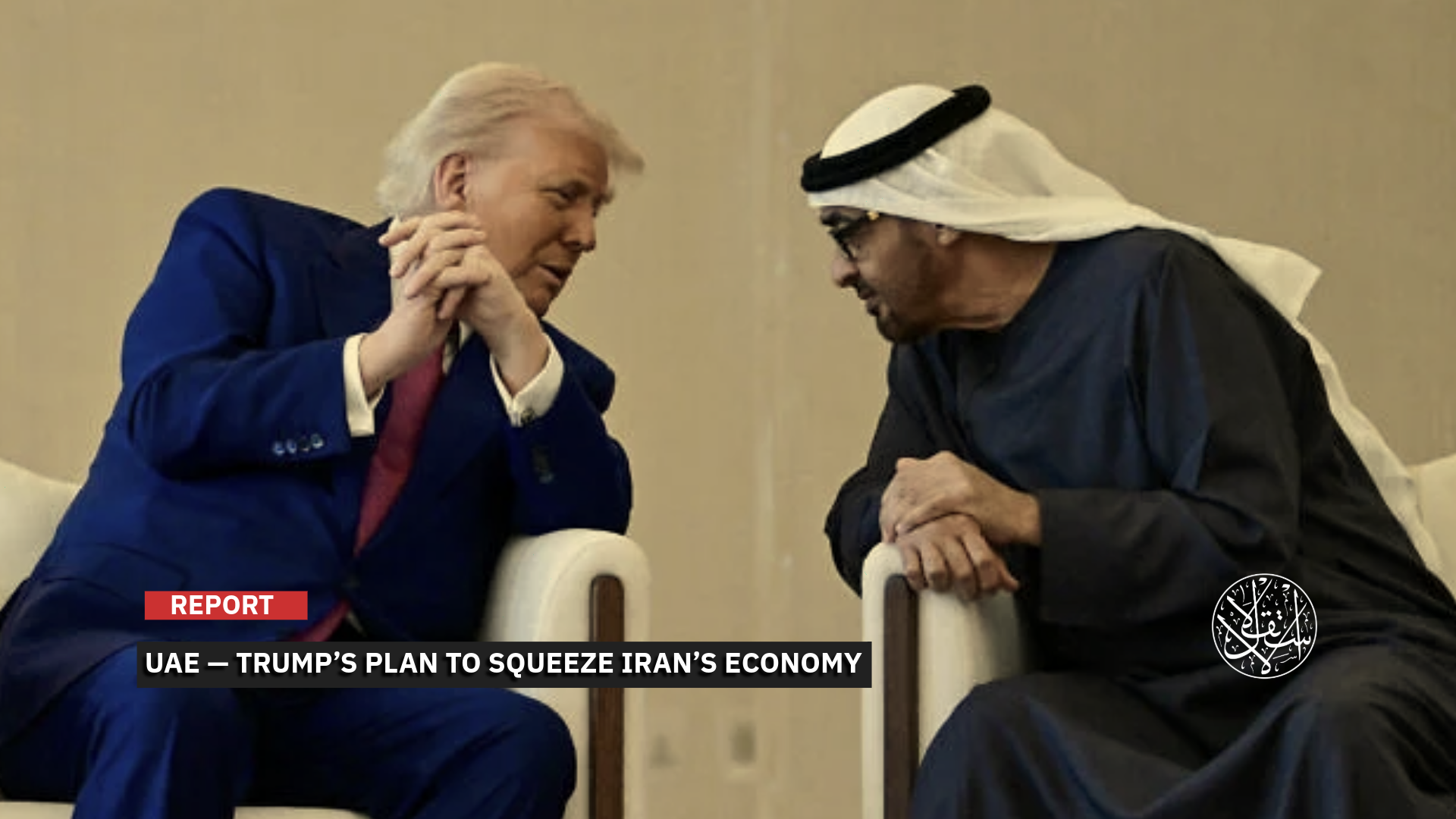
As President Donald Trump threatens to wage an economic war aimed at isolating Iran, comparing the campaign to the “D-Day landing” that paved the way for Nazi Germany’s defeat in the Second World War, the United Arab Emirates (UAE) announced that it would halt all business activity, trade, and financial transactions with Tehran. The move could strike directly at one of Iran’s most important economic lifelines and one of its most closely linked to foreign trade and the circumvention of sanctions.
The UAE’s decision carries particular weight because of Abu Dhabi’s role in Iranian trade. Data show that about 30 percent of Iran’s imports, worth roughly $21 billion, come from the UAE, while the Emirati market receives about 13 percent of Iranian exports, worth as much as $7 billion.
Halting trade and financial transactions would therefore do more than disrupt commerce between the two countries. It threatens a major channel that Tehran has relied on for years to import goods, re-export them, and secure foreign currency under Western sanctions.
The Emirati decision came at a notable moment. Announced on August 18, 2026, it coincided with Trump’s declaration that he was launching what he called an “economic war” against Iran and his threat to impose unprecedented isolation on the country, while warning its trading partners that they could face U.S. sanctions if they continued providing economic and financial support to Tehran.
The developments suggest, according to Western assessments, a clear convergence between the U.S. and Emirati moves as part of a broader effort to dry up Iran’s external sources of financing and choke its trade and financial channels.
The pressure goes beyond curbing trade. It also aims to weaken Tehran’s ability to export oil and access foreign currency, while putting greater pressure on the Iranian currency and domestic markets already struggling with inflation. That could deepen the country’s economic hardships and fuel public discontent, particularly as shortages of fuel and rising living costs add to the pressure.
The UAE is thus becoming more than an important trading partner for Iran. It is emerging as one of the main arenas in the economic war Washington is seeking to impose on Tehran.

Trump and the UAE’s Plan
The outlines of the plan began to emerge on August 18, 2026, when the UAE Defense Ministry said it had detected two ballistic missiles launched from Iran toward Emirati territory. One of the missiles, it said, fell into territorial waters without causing any casualties or damage.
Tehran rejected the Emirati account, with Iran’s Foreign Ministry calling the claims “baseless.” Iranian assessments also questioned where the missiles came from, linking them to other “unidentified” missiles launched during the war that were intended to inflame tensions between Iran and the Gulf states.
Regardless of who actually launched the missiles, the timing quickly took on political and economic significance. Hours later, the UAE announced that it was suspending “all activities, trade exchanges, and financial transactions with Iran until further notice,” according to the official Emirates News Agency (WAM).
Afra al-Hameli, director of strategic communications at the UAE Foreign Ministry, said the decision was taken “in light of the regional escalation that has undermined regional and international peace and security.”
Abu Dhabi did not describe the move as either “sanctions” or a “boycott,” instead saying the suspension would remain in place “until further notice.” That wording gives the UAE room to maneuver politically, whether by maintaining, modifying, or reversing the decision if circumstances change. More importantly, the move shifted the UAE-Iran confrontation into the economic and financial arena, after those areas had remained important channels of cooperation and trade despite years of political and security tensions.
It was not long before Trump intensified pressure on Tehran. On August 20, he announced economic measures he described as the toughest in the history of U.S. sanctions and threatened severe consequences for any country or entity providing Iran with economic support. In a post on Truth Social, Trump said Washington had launched what he called the largest crushing economic operation against Iran, vowing an economic war and “unprecedented” isolation.
Trump’s campaign targeted a range of economic and financial activities that he said Iran and its partners must halt immediately, including oil smuggling, currency exchanges, cash transfers, currency exchange operations, falsifying shipping records, and the use of shell companies. He justified the escalation by accusing Tehran of failing to seize an opportunity to reach an agreement with Washington, saying the goal was to weaken Iran’s economy and reduce its ability to finance what he described as “terrorism” around the world.
In a striking comparison, Trump likened his economic campaign to an “economic landing,” invoking the D-Day landing carried out by Allied forces on the French coast in June 1944 during the Second World War. The reference suggested that he viewed the economic strangulation of Iran as a decisive operation aimed at changing its behavior and forcing it to make concessions.
But according to U.S. reports, the American pressure alone had not been enough to produce the desired impact on Iran’s economy. U.S. Central Command said that by August 19, the maritime blockade imposed by American ships had diverted 65 commercial vessels and disrupted three others, while Iran continued restricting shipping through the Strait of Hormuz after the collapse of a framework agreement between Washington and Tehran aimed at reopening the vital waterway.
Amid the standoff, Trump further escalated his rhetoric over the strait after posting a map he described as representing “new American territory.” At a campaign rally on August 21, he repeated that the Strait of Hormuz was “American territory,” remarks Tehran rejected as a reflection of American “delusions.”
Against this backdrop, the UAE’s move takes on greater significance in the pressure campaign against Iran. It targets a trade and financial channel that had remained relatively open despite sanctions and tensions. World Trade Organization data show that about 30 percent of Iran’s imports, worth roughly $21 billion, come from the UAE, while about 13 percent of Iranian exports, worth around $7 billion, go to the Emirati market.
Data from the UAE Ministry of Economy, meanwhile, show that non-oil foreign trade between the two countries reached $6.6 billion in 2024, with re-exports accounting for the largest share. Over the decades, the UAE, particularly Dubai, has become a major hub for re-exporting goods to Iran, from electronics and equipment to consumer goods and agricultural products. Its banking and financial sector has also played a role in facilitating some trade-related flows involving Iran.
That is why observers do not view the Emirati decision simply as a security measure separate from the military developments. It strikes at one of Iran’s most important remaining economic links to the region. The potential loss extends beyond the value of direct trade to higher import, financing, insurance, and shipping costs as Iranian companies are forced to seek alternative commercial and financial hubs.
Alhurra, the U.S.-funded Arabic-language channel, quoted Emirati economist Hussein al-Qamzi on August 20 as saying the decision represented a major shift because it adds Emirati restrictions to the pressure already weighing on the Iranian economy.
Emirati political analyst Ahmed Khalifa said the move was intended to send Tehran a message that threats to the UAE’s security or freedom of navigation would carry a cost, while keeping the door open to de-escalation.
The decision also carries weight because it cuts into an economic relationship that the two countries had sought to preserve in recent years despite their political differences. In 2024, the UAE-Iran Joint Economic Committee held its first meeting in 10 years to discuss trade, investment, and logistics corridors. Some economic cooperation continued even as Abu Dhabi complied with U.S. and international sanctions imposed on Iranian entities and sectors.
Still, the UAE decision alone does not necessarily give Washington and Abu Dhabi the ability to cripple Iran’s economy. Tehran can redirect some of its trade toward other markets and hubs, but doing so would come at a higher cost, with longer trade routes and increased shipping, insurance, and financing expenses, as well as greater difficulty accessing foreign currency.
Washington appears to be betting on widening that pressure, as shown by Treasury Secretary Scott Bessent’s warning on August 20 to Iran’s trading partners, including China, Turkiye, Pakistan, and India, that they could face consequences if they continued doing business with Tehran.
The economic confrontation, then, is no longer simply a U.S.-Iran dispute. It is becoming an attempt to build a wider pressure network, beginning with the UAE as one of Iran’s most important commercial and financial gateways and extending to the other partners that could offer Tehran an alternative to that lifeline.

The Key to Making the Plan Work
Even before Trump announced his economic war on Iran, the outlines of the strategy had begun to emerge in Washington, with growing attention focused on the role the UAE could play in choking off the financial and trade channels that have kept Iran’s economy moving despite sanctions.
The Wall Street Journal (WSJ) reported on August 19, 2026, that the Trump administration’s efforts to force Tehran to make concessions by squeezing its economy depend heavily on restricting one of its most important economic lifelines through the UAE.
The move followed weeks of pressure from the Trump administration on Abu Dhabi to take tougher action against Iranian financial networks operating on its territory.
U.S. officials told their Emirati counterparts that targeting financial flows linked to Iran’s Islamic Revolutionary Guard Corps (IRGC) could have a greater impact on the Iranian economy than the maritime blockade imposed on Iranian ports, according to people familiar with the discussions.
The WSJ said that a broad implementation of the Emirati plan would severely restrict Tehran’s access to foreign currency and global trade networks at a time when the Iranian economy is already facing mounting pressure from inflation, sanctions, and the effects of war.
But cutting those ties will not be easy. Much of the financial and commercial activity linked to Iran takes place out of public view through complex networks that are difficult to trace.
U.S. sanctions decisions in recent years show that oil revenues, foreign currency, trading, and payments linked to Iranian entities often move through front companies and exchange houses in Dubai without any direct Iranian name appearing in the transactions. Targeting those networks therefore requires extensive financial scrutiny that goes well beyond direct commercial dealings.
Tightening the screws on these channels could also put the UAE in a more complicated position. Cutting indirect financial and trade links with Iran would require a crackdown on opaque activities, potentially affecting Dubai’s role as a global hub for trade, capital, and re-exports.
Max Meizlish, a former U.S. sanctions official who is now a researcher at the Foundation for Defense of Democracies, said Dubai is a major hub for illicit financial flows linked to Iran and for sanctions evasion.
Meizlish distinguishes between measures targeting direct commercial and financial activity and those targeting transactions routed indirectly through banks and exchange houses in Dubai, allowing informal currency networks and illicit financing to continue operating.
The equation highlights the role the UAE has played in Iran’s economy for years. It has evolved into a major financial and commercial hub for Iranian companies and individuals seeking to circumvent Western sanctions.
According to analysts tracking Tehran’s activities and the U.S. Treasury Department, these networks have helped Iran continue selling oil on international markets and transferring part of the proceeds back into the country, as well as financing other activities linked to the Iranian state.
According to U.S. Treasury data and financial analysts, Tehran has relied on front companies in the UAE to collect oil payments, settle transactions, and conceal the origin of funds, making them harder for regulators to trace. It has also benefited from a broad network of intermediaries, exchange houses, and financial institutions that have allowed foreign currency to continue flowing despite the restrictions imposed on Iran.
Miad Maleki, a former U.S. Treasury official, told CBS News on August 21, 2026, that about 80 percent of foreign currency exchange transactions linked to Iran take place in Dubai, making the emirate a major source of the foreign currency Tehran needs.
He said the UAE could play a decisive role in limiting the Iranian government’s access to foreign currency and financial reserves generated from oil sales, particularly revenues tied to the Chinese market and held in various banking institutions.
Maleki added that the success of U.S. sanctions in increasing pressure on Iran’s economy would make the UAE a “vital player” in curbing suspicious Iranian banking transactions, explaining why the UAE’s role is so important to the new U.S. strategy.
But the U.S. bet also carries risks for Abu Dhabi. Emirati policymakers understand that expanding economic pressure on Iran could spill over into vital sectors of the UAE economy, which relies heavily on trade, tourism, and services. It could also prompt Tehran to respond with further military action, particularly if it feels that economic pressure is directly threatening its interests.
The vulnerability of Iran’s financial networks is also tied to the oil sector. Tehran has relied on what is known as a “shadow fleet” of aging oil tankers used to conceal the shipping routes and ownership structures of sanctioned crude. According to the U.S. Treasury Department, several UAE-based companies have been linked to the ownership or management of tankers involved in this trade.
In recent weeks, the U.S. Treasury Department has also targeted several UAE-linked front companies, accusing them of participating in a financial network that functions as a parallel banking system for Iran.
In 2024, the department disclosed a $9 billion financial transaction that passed through correspondent accounts operated by U.S. banks and was linked to covert Iranian financial activity. It said UAE-based companies, most of them in Dubai, received about 62 percent of those funds.
The economic war Washington is waging against Tehran, then, is not simply about imposing more sanctions. It is an effort to reshape the environment that has allowed Iran’s economy to withstand sanctions for years.
If Washington succeeds in shutting down the UAE channels, the next question will be whether Tehran can find alternatives to keep foreign currency, oil revenues, and international trade flowing and whether China, Turkiye, India, and other partners will be able or willing to fill the gap left by the UAE.
Tehran, for its part, rejects the U.S. narrative and argues that Trump’s “economic war” is intended to divert attention from the pressures facing the U.S. economy itself. Iranian Foreign Minister Abbas Araghchi described the campaign as an attempt to distract from the U.S. economic crisis, pointing to the U.S. national debt surpassing $40 trillion and the rising cost of servicing it.
The UAE is therefore becoming more than an important trading partner for Iran. It is emerging as one of the main battlegrounds in the economic confrontation between Washington and Tehran. The success of the U.S. strategy will depend not only on the sanctions imposed by Washington but also on Abu Dhabi’s ability to shut down the financial and trade routes that have served for years as a major gateway between Iran’s economy and the outside world.
Sources
- Trump’s Plan to Squeeze Iran’s Economy Will Live or Die in Dubai
- Why Dubai may be vital to the Trump administration's economic war on Iran
- Iran Hits Back at Trump’s Threat of a ‘Crushing’ Economic ‘D-Day’ Campaign
- Trump warns of ‘economic D-Day’ against Iran, but Tehran is well acquainted with sanctions
- Foreign Ministry Strategic Communications Director: UAE Halts All Trade and Financial Transactions With Iran [Arabic]
- UAE Strikes at One of Iran’s Economic Lifelines [Arabic]