50,000 Tons a Year: Who Is Taking Israeli Occupation Waste to the West Bank, and Why?
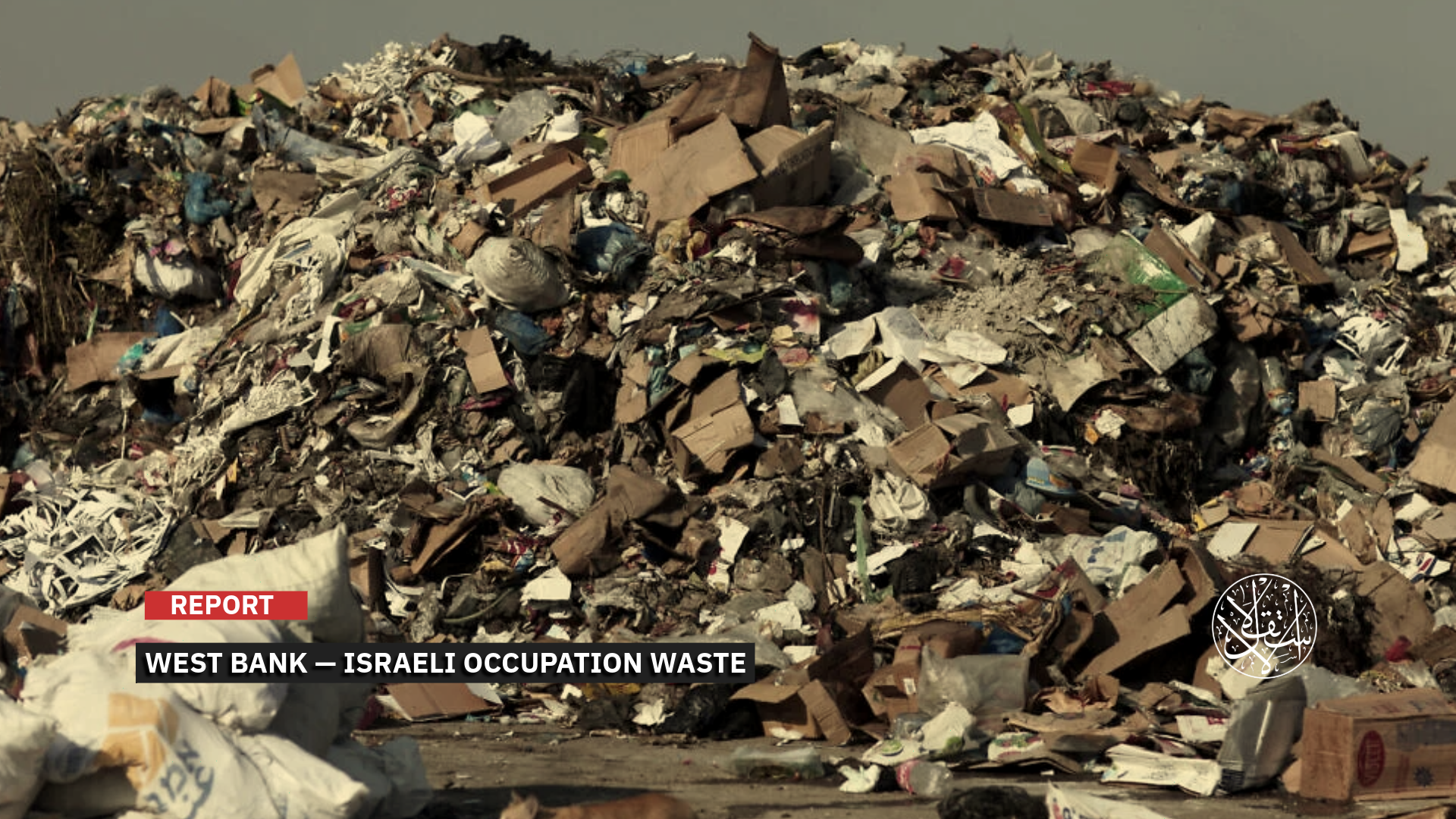
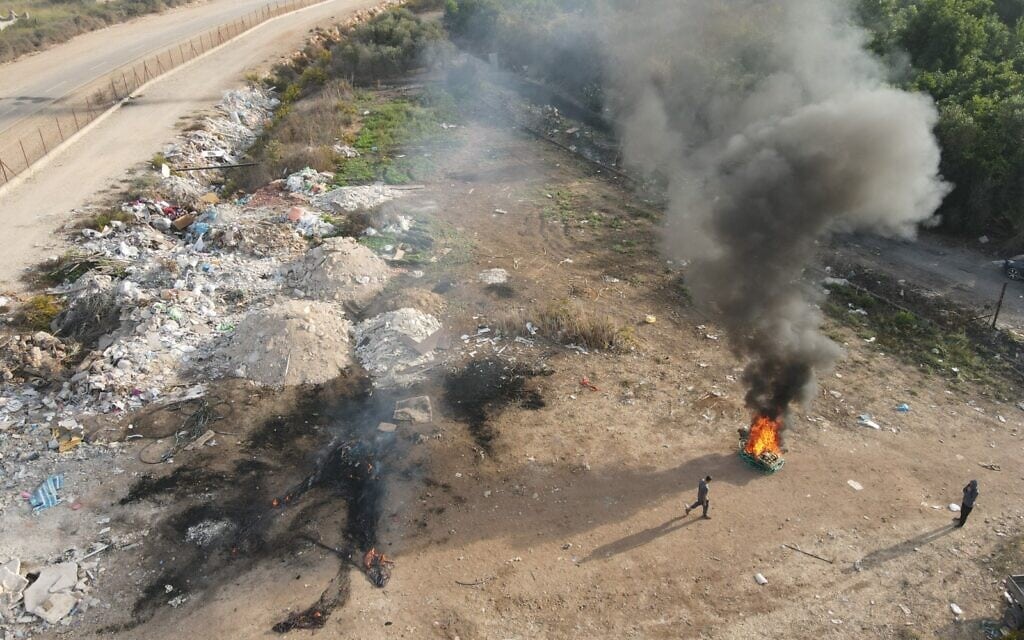
The effects of this industry have emerged in Idhna through waste burning and the pollution of the air and soil.
For more than a decade, waste from the Israeli Occupation has flowed into various parts of the West Bank, while a large market for collecting, dismantling, and extracting metals from electronic waste has taken shape in the southern Hebron area.
A March 2024 report by “Israel’s” state comptroller, the country’s official watchdog, estimated that more than 50,000 tons of Israeli electronic waste entered the West Bank in 2023.
The report also cited an earlier UN estimate that put the flow at roughly 30% to 40% of all electronic waste generated in the Israeli Occupation, equivalent to between 57,000 and 64,000 tons a year based on the data available at the time.
Enforcement records show that the flow of trucks has continued into 2026. Since the civil administration’s so-called David Division began operating in 2014, authorities have recorded more than 2,100 cases involving trucks transporting waste without the required permits.
What Is ‘Israel’ Sending to the West Bank?
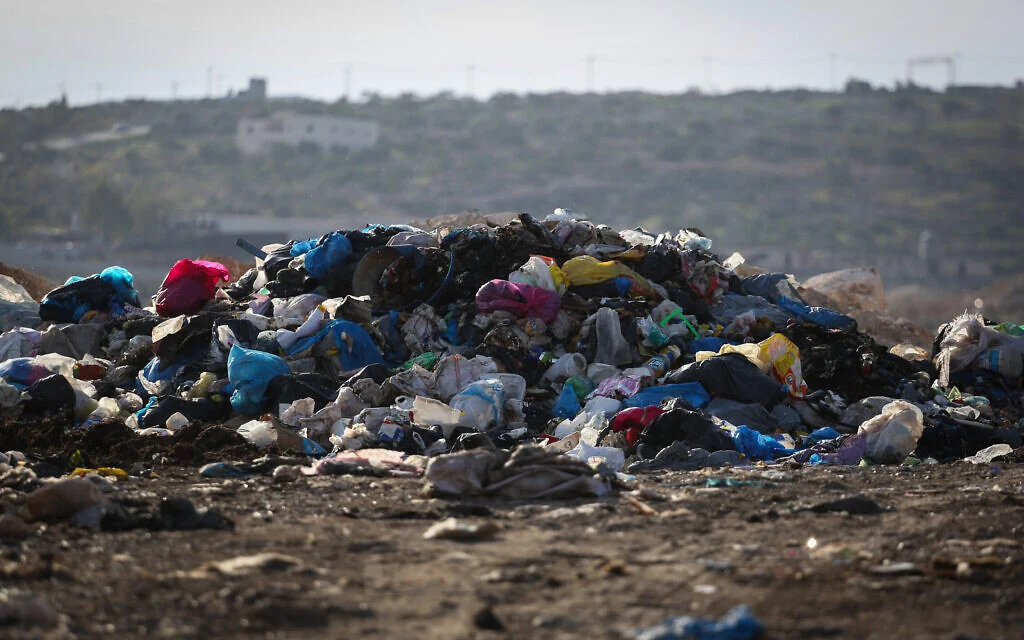
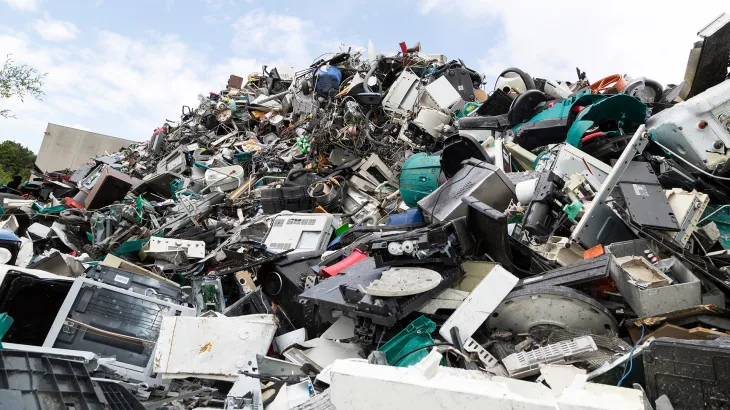
Electrical and electronic waste accounts for the largest share of waste for which clear figures are available on shipments from the Israeli Occupation into the West Bank. Collection and processing are concentrated in Idhna, Beit Awwa, and Deir Samit, south and west of Hebron.
There, appliances, wires, and cables are dismantled to extract copper, aluminum, iron, and steel, while some plastics and insulation are burned to separate the metals that can be sold. In 2017, the Israeli civil administration estimated that the industry included about 380 facilities and provided roughly 1,500 jobs in the area.
Since 2017, Idhna has also had a licensed facility for mechanically processing cables as part of a project supported by the civil administration. The project allowed trucks coming from the Israeli Occupation to deliver cables to a private Palestinian company under specific environmental conditions, which “Israel’s” state comptroller did not name.
The plant processed about 10 tons a day and handled roughly 410 tons between January and May 2023, while the informal market continued to receive other materials, some of which ended up being dismantled and burned.
A document issued by the Knesset Research and Information Center on December 22, 2025, showed that the David Division had intercepted 1,326 waste trucks between 2019 and 2025, including 222 carrying electronic waste, or about 16.7% of all trucks intercepted during that period.
The figure reflects what was detected at checkpoints, while the state comptroller acknowledged the lack of an up-to-date database measuring the total amount of waste leaving “Israel” and actually reaching processing and burning sites in the West Bank.
Louay Qabaja, a former project manager in electronic waste recycling in the West Bank, told Al-Estiklal that the effects of the industry have become particularly visible in Idhna because of waste burning and the resulting air and soil pollution.
He said residents had suffered respiratory illnesses, cancer, and other health problems, which he linked to exposure to smoke, metals, and substances released by burning. He also cited cases of birth defects and health problems affecting both people and animals.
Qabaja added that the buildup of metals, including chromium, had damaged the soil and reduced its agricultural productivity, affecting seasonal crops and fruit trees, particularly olive trees and other fruit crops.
Some farmland, he said, has lost part of its productive capacity, while pollution from burning sites has also affected livestock and grazing areas, with contaminated materials spreading through rainwater.
He also described a local rise in temperatures that residents noticed during the summer in areas affected by burning and criticized the Palestinian response to the problem, saying the Palestinian Authority was working to limit the damage “but not with full seriousness.”
The shipments also include other types of waste. On July 19, 2026, the Palestinian Environment Quality Authority (EQA) and customs police said they had seized two trucks with Israeli license plates in Qalqilya province. One was carrying demolition and construction waste, while the other was carrying red soil.
EQA said the loads had come from inside “Israel” to be disposed of in the West Bank before the trucks were returned to their source. In April 2024, it had also uncovered a site in Izbat al-Madour, Qalqilya, that was being used to receive Israeli waste and referred the landowner and others involved to prosecutors.
On August 10, 2026, a court order shut down an illegal dump in Qalandia, north of occupied Jerusalem, on the road leading to the village of Rafat. EQA said the case involved the dumping of various types of solid waste brought from inside the Israeli Occupation into the site.
Palestinian data also records the movement of used tires. In Bal'a, in Tulkarm province, about 200 tires were seized in 2021 and 2022 and returned to their source.
An Israeli strategic plan in 2026 estimated that settlers in the West Bank generated about 234,000 tons of municipal waste a year, based on 2022 data.
On July 23, 2026, Palestinian authorities returned an Israeli truck seized in Bidya, Salfit province, carrying solid waste to the “Ariel” settlement from which it had come.
Waste from cities and towns inside the Israeli Occupation also reaches processing facilities in the West Bank through official arrangements, including the Massua composting facility and the Tovlan landfill in the Jordan Valley.
Both sites received waste from Israeli local authorities before the Tovlan landfill ceased operations in 2024.
In another case, Veridis Environment and its subsidiary, TMM Integrated Recycling Industries, became the focus of an investigation by Israeli authorities.
On December 20, 2023, the so-called Green Police and Israeli police raided the company’s offices and the Massua and Tovlan sites as part of an investigation into suspected economic and environmental violations involving municipal waste from local authorities in central “Israel.”
The investigation focused on how waste was processed and buried, as well as reporting, fees, and licensing at authorized facilities in the West Bank, while cases involving the David Division concern trucks crossing without the required permits.
Why Is the Waste Sent to the West Bank?
The movement of waste is closely tied to the cost of disposing of it inside the Israeli Occupation, where producers and contractors pay for collection and transportation, fees for entering sorting or processing facilities, and a government landfill tax.
The landfill tax on mixed waste stood at 117.22 shekels per ton in 2023, up from about 83 shekels in 2013 and roughly 111 shekels in 2022. Facility, transportation, and processing costs are added to the tax. (One dollar = 2.96 shekels.)
Illegal disposal sites offer a way to avoid some of these costs. A joint operation by Israeli police and the civil administration in December 2020 found that operators of illegal dumping sites in the West Bank were being paid by truck drivers who collected waste, and in some cases sewage, from areas inside “Israel” in exchange for allowing them to dump it.
Israeli Occupation authorities have not published a standard rate for payments to these site operators, making it impossible to calculate a fixed profit margin per truck.
These incentives have coincided with a rapid decline in landfill capacity inside “Israel.” The state comptroller found that available landfill space fell from 14.41 million cubic meters in 2020 to 7.67 million cubic meters in early 2025, warning in July 2025 that the remaining capacity could run out before the end of 2026 if expansion was delayed.
The Efaa landfill in southern “Israel” alone received about 46% of the country’s landfilled waste in 2023.
For electronic waste, avoiding disposal costs comes with another potential source of income: selling the materials that can be recovered. The state comptroller documented electronic devices and cables being diverted from the formal recycling system through scrap collectors, appliance haulers, air conditioning technicians, and contractors clearing homes and offices.
In some cases, local authorities, companies, and factories offered electronic waste for sale to the highest bidder, allowing the materials to move through informal buyers and eventually reach the West Bank.
The sale of copper, aluminum, iron, and steel extracted from devices and cables provides income for workshops and traders processing the waste in the West Bank.
The experience in Idhna illustrates the cost of the legal alternative. In 2017, the company involved in the project charged about 800 shekels per ton to mechanically strip cables before offering to reduce the price to 600 shekels. Burning the cables, by contrast, allows metals to be separated with less equipment and at a lower cost but at a much higher environmental and health cost.
According to Qabaja, before October 7, 2023, Israeli Occupation authorities facilitated the movement of these materials to processing areas, where the extracted metals were then sold.
He said copper, aluminum, and iron recovered through the process were sold to traders in settlements near Idhna or in the al-Eizariya area before re-entering Israeli trade and export networks and reaching foreign markets.
Who Is Behind It?
The documents reveal a chain that can begin with a waste producer or a company collecting used appliances inside the Israeli Occupation and run through scrap collectors, contractors, haulers, traders, and truck drivers before reaching dumping site operators and Palestinian processing workshops.
Louay Qabaja, drawing on his experience in Idhna, described part of this network to Al-Estiklal. He said numerous operators collect appliances, furniture, and electrical waste from inside the Israeli Occupation, with April typically bringing a rise in the amount of used appliances and furniture discarded by Israelis.
Over time, he said, scrap collectors expanded their work to include copper cables, electrical equipment, and electronic waste before transporting the materials to processing areas in southern Hebron, particularly Idhna, Beit Awwa, and Deir Samit.
The situation changed after Operation al-Aqsa Flood and the tightening of restrictions during the Israeli war on Gaza. Qabaja said waste now enters the West Bank more often through smuggling, although some shipments still get through when they are not considered security risks or suspected to involve stolen goods.
He added that the closure of Idhna’s entrances and tighter restrictions on movement to and from the town have severely hurt the electronic waste collection and processing sector and the businesses connected to it.
The Oslo arrangements, which divide the Palestinian territories into Areas A, B, and C, create additional gaps in oversight. The state comptroller has pointed to difficulties for Israeli inspectors in reaching some dumping and burning sites without military escorts, as well as weak oversight of the electronic waste and scrap collection chain inside the Israeli Occupation itself.
Court cases have identified only a limited number of people involved in transportation. In 2019, Abed Mansour Transport and Investments appeared before the occupied Jerusalem Magistrate’s Court in a case involving a truck detained on suspicion of transporting construction waste into the West Bank without a permit.
That same year, the name Aman Obeidiyah appeared in a case involving a truck that had been held since July 9 over suspected violations, including dumping waste and illegally bringing it into the West Bank. On October 30, the court ordered the truck returned subject to conditions and guarantees.
Both decisions concerned the seizure and release of vehicles during investigations and did not amount to final convictions on the underlying violations.
At the receiving end of the chain, a joint operation by Israeli police and the civil administration in December 2020 led to the detention or arrest of 19 Palestinian suspects and the seizure of 17 trucks. Authorities said operators of illegal dumping sites had been paid to receive waste collected in “Israel.”
Another operation, dubbed “Clean Air,” followed a covert investigation in March 2023. Authorities questioned 34 suspects in a case involving trucks that were reaching dumping and burning sites in the West Bank.
The David Division is responsible for most of the monitoring of trucks at crossings. According to data presented in 2025, the division had a director, two team leaders, 15 inspectors, and an operations coordinator, working mainly at 15 crossings into the West Bank.
Civil administration officials said the available number of inspectors was not enough to cover all crossings. Enforcement relies on cameras, covert operations, and intelligence sources, with particular difficulties at the a-Za'im crossing east of occupied Jerusalem and a need to strengthen operations at both a-Za'im and the Tarqumiya crossing west of Hebron.
The David Division intercepted 196 trucks in 2024 and 170 in 2025, followed by about 100 more through July 2, 2026. Two operations in June alone resulted in the seizure of loads weighing about 120 tons and 110 tons.
Since a police officer and prosecutor were assigned to work with the division in 2022, the number of complaints and referrals reached 152 between 2023 and 2025. Ten indictments were filed, while 64 cases remained under investigation when the data was presented.
Civil administration officials told Knesset committees that weak deterrence was linked to limited resources and penalties that were low compared with the potential profits from illegally disposing of waste.
Sources
- Cross-Border Air Pollution Caused by Waste Burning in the West Bank [Hebrew]
- Environment Protection Ministry: Enforcement in Environmental Protection [Hebrew]
- Treatment of Electronic Waste in Israel Knesset Research and Information Center report [Hebrew]]
- Strategy for a Sustainable Waste Sector, 2021–2030 Israeli Ministry of Environment Protection document [Hebrew]
- Abed Mansour Transport and Investments 2007 Ltd. v. State of Israel, Environment Protection Division, Government Ministries, Case No. 49297-01-19 [Hebrew]
- Aman Obeidiyah v. State of Israel, Environment Protection Division, Case No. 72256-07-19 [Hebrew]
- Qalqilya: Environment Authority Seizes Two Israeli Trucks Carrying Waste and Returns Them to Their Source [Arabic]
- Environment Authority: Illegal Dump in Qalandia Shut Down Under Court Order [Arabic]