From the Tents: How Gazans Are Living the World Cup
The Palestinian Football Association says it has lost 570 members since the start of the Israeli genocide.
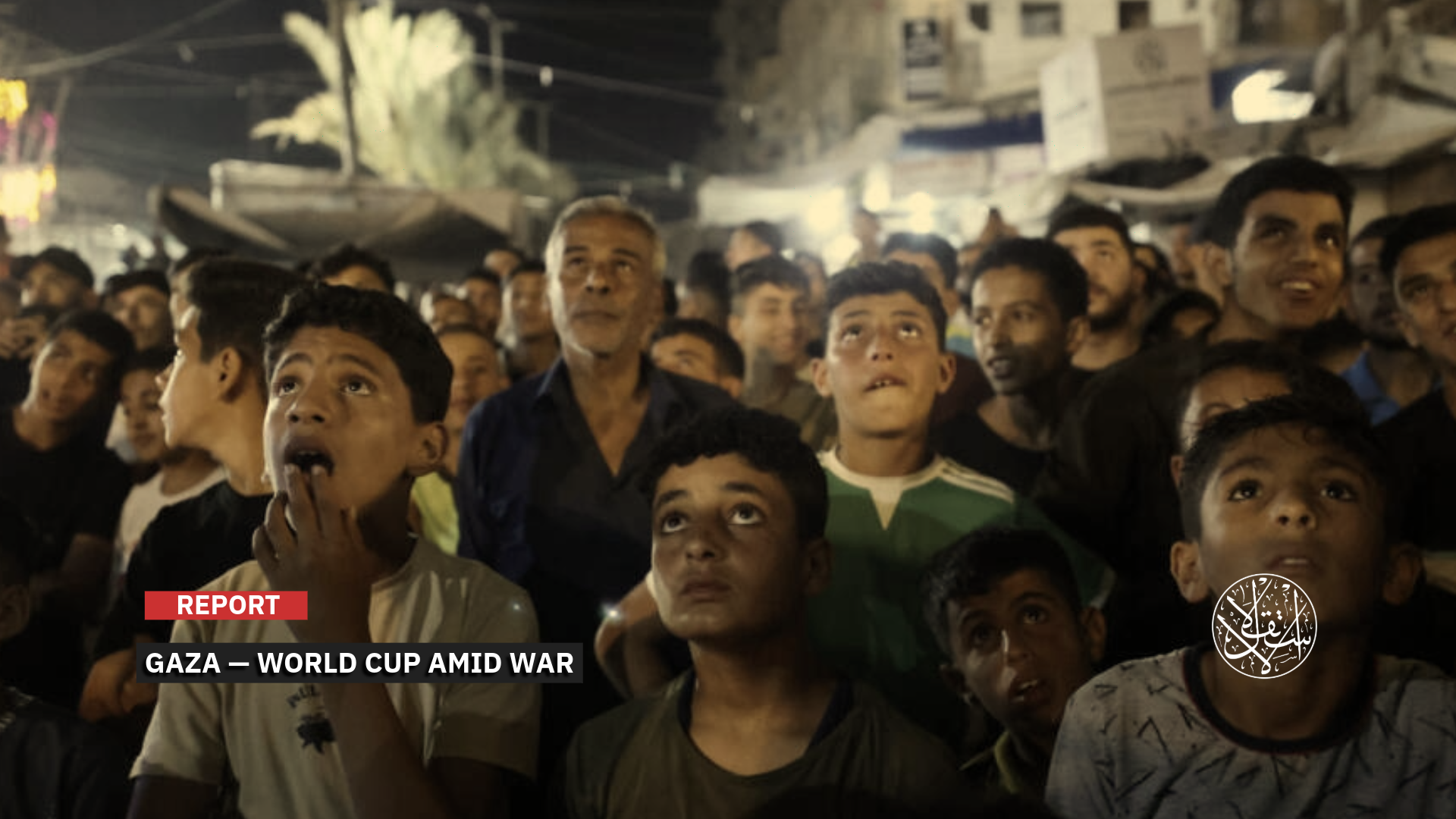
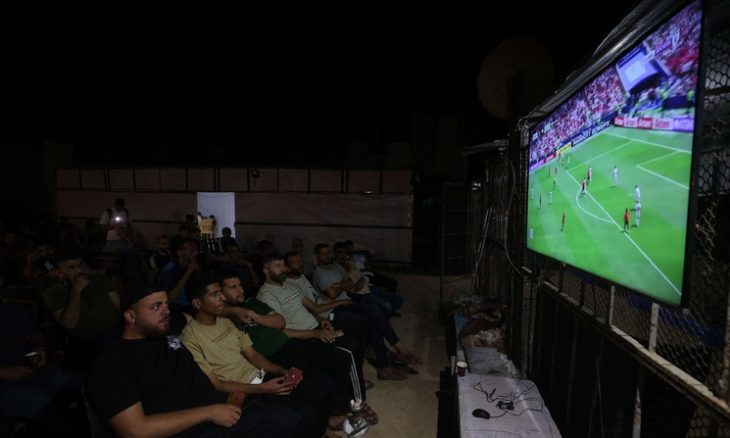
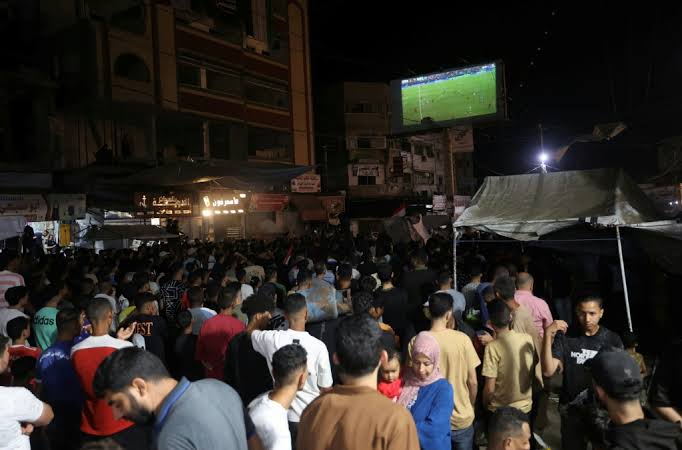
Thousands of Palestinians across Gaza gather each night in makeshift viewing areas fashioned from worn-out tents, beside the rubble of bombed homes, or along the shattered streets of the besieged enclave, crowding around giant screens to watch the FIFA World Cup.
Before “Israel’s” genocidal war stripped Gaza of nearly every trace of ordinary life, the tournament was a cherished occasion—one that brought families, neighbors, and entire communities together in a rare atmosphere of celebration. Today, the same matches unfold against a backdrop of displacement, destruction, and grief, where ninety minutes of soccer offer a fleeting escape from a war that has transformed every aspect of daily life.
Chasing a Familiar Feeling
This World Cup bears little resemblance to the tournaments they once celebrated. After the Israeli genocide that has reshaped every corner of the Strip, soccer has become less a festival than a fragile attempt to reclaim a sense of normal life.
For most Palestinians, however, even that escape remains out of reach. Displacement, hunger, and the daily struggle to survive have left little room for following the tournament.
Still, many Gazans cling to whatever fragments of ordinary life remain, even if they now look nothing like they did before the Israeli Occupation war.
In years past, the World Cup transformed Gaza into one long celebration. Flags of competing nations fluttered from balconies and storefronts, cafés overflowed with fans until dawn, and families gathered along the Mediterranean coast to watch matches together.
Today, those scenes have been replaced by tent camps, piles of rubble, and relentless power outages. Even watching a single game has become a challenge for many displaced families.
Al-Estiklal visited several makeshift viewing sites in the al-Mawasi area of southern Gaza to see how displaced Palestinians are experiencing this year’s tournament amid war and exile.
Inside one tented café, dozens of young men sat shoulder to shoulder before a large screen powered by a small diesel generator, watching Egypt defeat Australia and secure a place in the next round.
“This World Cup has none of the atmosphere we used to know,” said Mazen al-Rahal, who runs the makeshift café. “Everyone knows why. The Israeli genocidal war has destroyed every aspect of life and left people weighed down by grief and hardship.”
Speaking to Al-Estiklal, al-Rahal said interest in this year’s tournament is far lower than in previous editions. Attendance peaks mainly during matches involving Arab teams, which still draw relatively strong support.
He explained that the circumstances in Gaza prevent many residents from watching most games. With the public electricity grid completely collapsed, power is available only through commercial generators that operate for a few hours each day—often at times that do not coincide with match broadcasts.
Kickoff times create another obstacle. Games played at dawn or early in the morning are difficult for exhausted families already drained by the daily realities of displacement and survival.
Many Gazans, he said, have resorted to following matches on sports radio instead, listening to Arabic commentary without ever seeing the action because they have no electricity to power a television.
“It takes away much of the excitement,” al-Rahal said. “But people still do it to follow the Arab teams. They hope a victory, even in soccer, can give them a few moments of happiness in the middle of everything they’re living through.”
He said enthusiasm for the tournament has inevitably faded as people’s priorities have shifted.
“When you’re worried every day about finding bread or clean water for your family,” he said, “it’s hard to stay up late watching soccer as if life were normal.”
A Brief Escape
For some young people in Gaza, the World Cup has become more than a soccer tournament. Amid the relentless trauma of war and displacement, it offers a rare chance to step away—if only for ninety minutes—from memories of bombardment and the harsh routines of life in the camps.
Osama Labda, a displaced Palestinian living in the al-Mawasi area of southern Gaza, says the tournament provides one of the few emotional outlets left for people trapped between fear, loss, and uncertainty.
“The World Cup gives us a little time to escape the bitter reality we’re living through in Gaza,” Labda told Al-Estiklal. “With displacement, war, and constant attacks, these matches may be the only moments that bring even a little joy.”
Labda follows Arab national teams alongside Brazil, watching matches whenever electricity is available or gathering in makeshift cafés inside displacement camps.
“I’m especially a fan of Algeria,” he said. “I stayed awake until four in the morning to watch Algeria play Argentina, even though Algeria lost. I support all the Arab teams, and I hope they do well.”
He describes the atmosphere in al-Mawasi during Arab matches as one of shared anticipation, particularly for games played in the morning as families emerge from their tents.
Whenever an Arab team scores, cheers ripple through the camp.
“You hear people shouting and celebrating from every direction,” he said. “It’s something we haven’t experienced in a very long time.”
“For a few moments,” he added, “it feels as though people have forgotten the war. You hear applause and chanting everywhere, as if everyone were holding on to any chance to feel happiness.”
Even Gaza’s brutal summer conditions—stifling heat inside the tents and swarms of insects—make the matches feel like a welcome break from the crushing routine of displacement.
“Whenever we get the chance to watch the World Cup, especially the Arab teams, we try to create a little happiness and hold on to a bit of hope,” Labda said. “And we dream of the day the Palestinian national team plays in the World Cup—with players from Gaza who survived this war, the hunger, and everything we’ve been through.”
Memories That Refuse to Fade
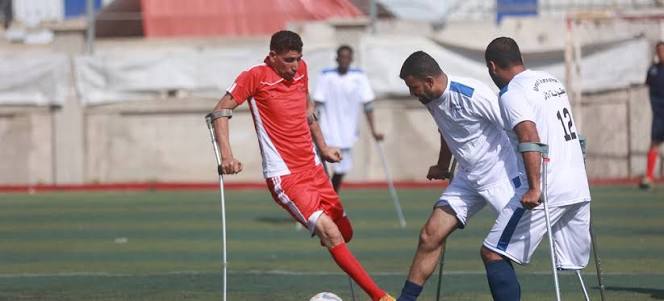
The losses suffered by Gaza go far beyond the changed atmosphere of watching the World Cup. The Israeli war has also devastated Palestinian sports itself, taking the lives of athletes and destroying the facilities that once served as gathering places for communities.
Mohammed al-Khaldi remembers previous World Cups in Gaza with sadness, recalling a time when matches became social occasions that brought neighbors, friends, and families together in celebrations that often lasted late into the night.
Speaking to Al-Estiklal, al-Khaldi said this year’s tournament arrived amid extremely harsh humanitarian conditions, carrying none of the familiar atmosphere that surrounded previous editions.
He said he was only able to watch one match—Egypt against Belgium—at a small viewing area set up inside a displacement tent. The experience, he added, was nothing like the past, despite the joy he felt watching the Egyptian team’s performance.
He remembers how Gaza’s neighborhoods once transformed into shared spaces of celebration during the World Cup.
“We would gather from the beginning of the tournament and decorate our neighborhood with the flags of the teams we supported,” he said. “We would meet with our neighbors to watch matches along Gaza’s coastline in the al-Sudaneya area.”
Young people also organized prediction contests, he recalled, with winners who correctly guessed match results often receiving free entry to watch games at local cafés.
“The atmosphere was beautiful,” al-Khaldi said. “We documented every moment with photos and videos. The World Cup was an opportunity for long gatherings with friends and neighbors.”
But those memories, he said, now feel distant and almost impossible to recreate after a war that has left behind destruction, loss, and displacement.
“Today, many of our neighbors are either martyrs, missing, wounded, or detainees,” he said. “We have lost relatives and family members, the entire neighborhood has been destroyed, and people have been scattered across different areas because of displacement. When you stop and think about it, you realize those days may now belong to the past.”
The impact of the war has not been limited to Gaza’s social fabric. Palestinian sports have suffered unprecedented damage.
According to the latest figures from the Supreme Council for Youth and Sports, the Israeli Occupation war on Gaza has killed 1,015 athletes, including 45 women, as well as 34 employees of sports federations and institutions.
The Palestinian Football Association alone has lost 570 members, while the Palestinian Scout Association (PSA) has reported more than 125 deaths among its members since the start of the Israeli genocide.
The destruction has also targeted Gaza’s sporting infrastructure. A total of 265 sports facilities have sustained direct damage, including 184 completely destroyed facilities and 81 partially damaged sites.
The losses include the destruction of 23 major stadiums, with 19 completely demolished and four partially damaged, alongside 35 indoor sports halls, 58 administrative headquarters of sports clubs, and 12 football pitches funded by FIFA, all of which were completely destroyed.
The war has also wiped out three club swimming pools and 15 basketball, volleyball, and tennis courts and damaged dozens of gyms, equestrian facilities, five-a-side football fields, and sports education centers.