A Call for Unity and Struggle: Will It Save Tunisia from Kais Saied’s Fierce Dictatorship?
“The Tunisian opposition agrees on the rules of shared democratic life and the rules of political competition.”
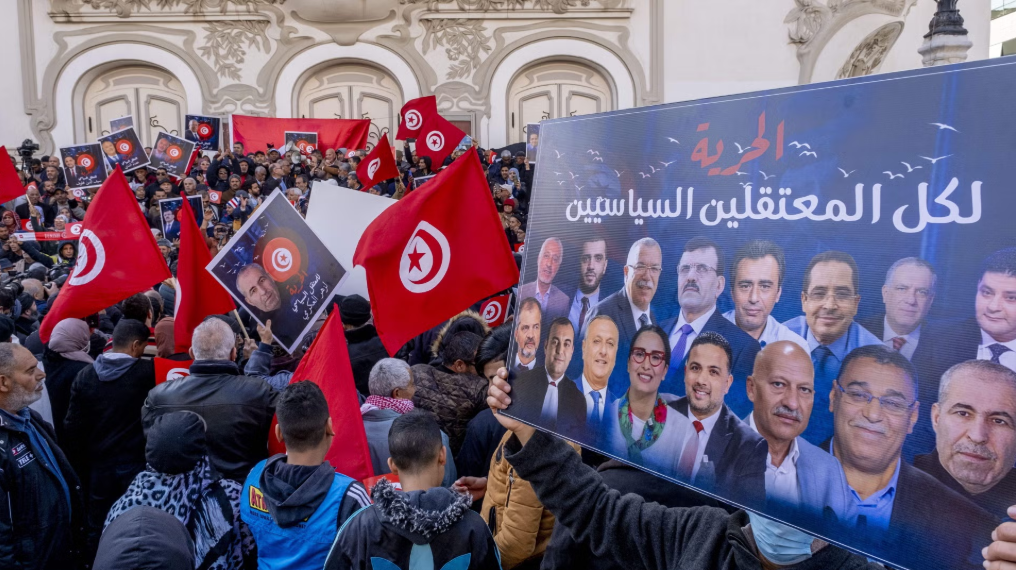
Tunisia is experiencing a dark political period under Kais Saied's rule, prompting a number of prominent political and human rights figures to issue a call for change from within their prison cells.
The appeal, signed by political prisoners from diverse ideological and political backgrounds, calls upon their democratic friends and civil society forces to unite and work towards restoring freedoms and reviving the democratic process, making this a means to preserve Tunisia's dignity and sovereignty.
Prisoners' Appeal
In their appeal dated June 24, 2026, the prisoners stated that Tunisia is passing through a critical phase in its history. The coup of July 25, 2021, has led to the loss of all the gains of the 2010-2011 revolution and the entire democratic transition process.
He added, among these are "the supremacy of the constitution, the rule of law, the separation of powers, the independence of the judiciary from political authority, the flourishing of freedoms, media pluralism, freedom of social communication, free elections under the supervision of an independent body, and freely elected representative institutions."
Today, the appeal continues, "Tunisia has returned to square one of despotism and absolute autocratic rule, making the restoration of the gains of the democratic transition the shared and unifying task of all democrats, and the central task of the current historical phase."
The signatories stressed that all intellectual or political disagreements must be postponed until democracy is restored and freedom prevails.
They affirmed that all disputes that are difficult to resolve, whether related to subsidiary issues or even fundamental reforms, can be decided by Tunisians through constructive dialogue, and based on that, by the ballot box.
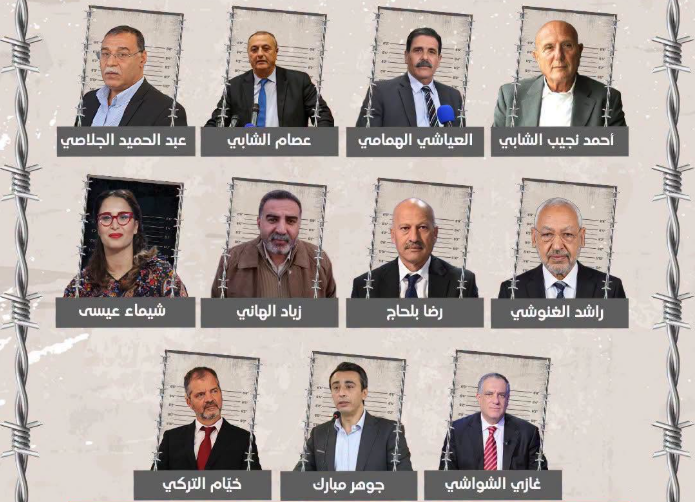
The appeal was signed by Ahmed Najib Chebbi, Ayachi Hammami, Rached Ghannouchi, Issam Chebbi and Jawhar Ben Mbarek, Abdelhamid Jelassi, Ridha Belhaj, Zied Hani, Chaima Issa, Ghazi Chaouachi, and Khayyam Turki.
Tunisia has been living under a state of tyranny and autocratic rule since President Kais Saied came to power, overturning the revolutionary constitution, closing parliament, dissolving the government, and implementing other exceptional measures announced on July 25, 2021.
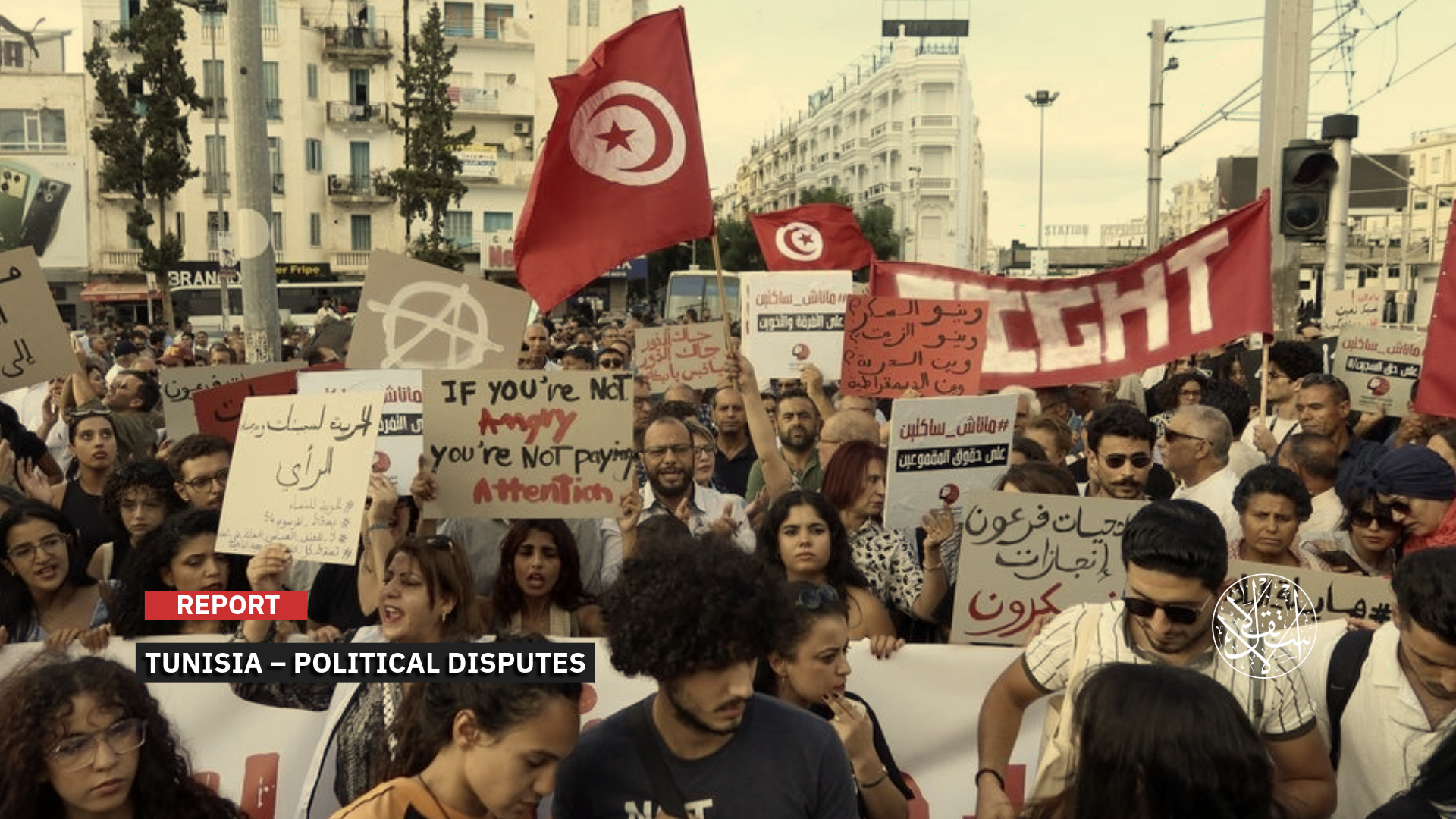
In this political climate, which has returned the country to the pre-Jasmine Revolution era that toppled Zine El Abidine Ben Ali's regime in 2011, dozens of political activists, human rights defenders, journalists, academics, and others languish in the regime's prisons on various charges.
Numerous international, local, and regional human rights organizations are calling for their release and an end to the exploitation of the judiciary for settling political scores and the systematic curtailment of public rights and freedoms in the country.
National Sentiment
This appeal was welcomed by opposition forces, most notably the National Salvation Front, which stated that it received with interest and appreciation the message issued by a number of political prisoners from diverse intellectual and political backgrounds.
In a statement issued on the occasion, the Front expressed its welcome for the authors of this sincere initiative and the high sense of national sentiment they demonstrated, despite the blatant injustice inflicted upon them for more than three years.
It emphasized that their appeal is of particular importance at this critical juncture for the country, as political, economic, and social crises worsen, public and individual freedoms decline, and politically motivated prosecutions and trials continue.
It stressed that the struggle to restore the rule of law and institutions, guarantee the independence of the judiciary, secure freedoms, and release all political prisoners and prisoners of conscience represents a unifying national priority that takes precedence over all intellectual and political differences. Tunisians can address these differences democratically and submit to the will of the people through free and fair elections.
In this context, the Front called on various political, civil, labor, and human rights forces, as well as national democratic figures, to intensify consultations and engage in dialogue to develop a vision for resolving the political and economic crisis facing the country, and to work together.
It also called for prioritizing what unites Tunisians over what divides them, in order to build the broadest possible peaceful national front to defend freedom, democracy, and citizens' rights.
The Front emphasized that Tunisia today needs a comprehensive national dialogue and the combined efforts of all its sons and daughters to rescue the country from its complex crisis and open a new political horizon that restores to the Tunisian people their right to freedom, dignity, and popular sovereignty.

Betrayed Democracy
For his part, former Tunisian Foreign Minister Rafik Abdessalem said that the joint statement issued from within the dictator's prisons, which included leading political and intellectual figures from all backgrounds and families, is a step in the right direction.
In a Facebook post on June 24, 2026, Abdessalem added that the call for unity and solidarity around the demand to restore the betrayed democracy, while urging the postponement of all ideological and political differences, whether minor or fundamental, until after the defeat of the coup and the coup plotters.
He emphasized that the call is a step that definitively confirms that the Tunisian political movement has become unified and cohesive, with its leading figures rallying around the broad project of freedom and democracy.
"All that remains for the political and social forces on the scene is to join this unifying national movement in order to liberate Tunisia from the empire of fear, poverty, and charlatanism," he added.
Hayyan al-Hami, the general coordinator of the Tunisian Resistance Coalition, believes the appeal comes within the context of the Tunisian opposition's efforts to unify its ranks.
He noted that the opposition has been working for months to organize joint demonstrations and marches, despite its differing political and ideological orientations.
In an interview with France 24 on June 29, 2026, al-Hami explained that the appeal of political prisoners warns that the gains of the nation-state and the revolution have disappeared, particularly in the field of human rights and freedoms, the stability of state institutions and public policies, and the decline of Tunisian diplomacy, which once held significant regional and international influence.
He further pointed out that the appeal also comes amidst the difficult social and economic conditions faced by the general Tunisian population and the lack of a clear vision from the authorities for resolving the crisis.
Regarding the announcement by some supporters of President Kais Saied that they are withdrawing their support, al-Hami stated that there is a kind of collective agreement on the government's failure and its inability to find solutions to the escalating crises plaguing the country at various levels.
He noted that the Tunisian opposition agrees on the rules of shared democratic life and the rules of political competition, noting that several political forces in the country are working on this issue, and it will generate visions and outcomes reflecting this trend in the coming period.
The Battle for Freedom
In his analysis of the appeal, its background, and its messages, Tunisian politician Ahmed Najjar emphasized that this appeal is not a mere passing statement, but rather, at its core, a call to rearrange priorities at a moment when the political devastation has reached a point where further verbal maneuvering or entrenchment behind old disputes is no longer acceptable.
Mr. Najjar told Al-Estiklal that the appeal poses a direct question: Is there still anyone in the country who understands that the battle for freedom takes precedence over all other battles, and that disagreements, however deep, should not become a pretext for coexisting with the coup and tyranny?
He explained that the significance of the message stems not only from its content, but also from its timing and the identity of its signatories, given that they are figures who do not share a single political line, and some of whom were, until recently, at the heart of sharp, even damaging, rivalries within the Tunisian public sphere.
He added, "The message doesn't simply tell political and civil forces: Stand with us because we are oppressed, but rather something far more profound."
Therefore, Najjar adds, "The message should not be read merely as a stance against the authorities, but also as a silent condemnation of the opposition's own shortcomings, specifically the failure of the political elite to distinguish between the primary contradiction and secondary contradictions."
The political activist stated that "the appeal presents political and civil forces with a difficult test. They are not required to issue yet another statement on the necessity of unity and then go their separate ways, nor are they required to simply express humanitarian sympathy for the detainees, important as that may be."
Rather, they must publicly acknowledge that what Tunisia is experiencing is not a passing crisis of governance, nor merely a deviation that can be rectified from within the existing system. Instead, it is a comprehensive political impasse that threatens what remains of the very idea of politics.
He stated that this recognition requires that the forces that consider themselves democratic cease treating the issue of detainees as a matter concerning only their families, parties, or intellectual circles, and that these forces move beyond mere verbal solidarity to building a minimum level of joint action.
He continued, "It is also required that they agree on clear ground: the release of political prisoners, an end to the use of the judiciary in political conflict, the defense of the independence of institutions, and the opening of the public sphere to pluralism and diversity."
Mr. Najjar emphasized that the democratic transition failed not only because its opponents conspired against it, but also because a segment of its elite managed disagreements with short sightedness, squandered public trust, and left the field open to those who presented themselves as the saviors from chaos and the whims of political parties.
He stressed that this harsh reality is not a valid excuse for neutrality today, but rather makes the duty twofold: resisting tyranny and reviewing the mistakes that paved the way for it.
Therefore, Mr. Najjar believes that the appeal is not a test for the detainees, but for those outside the prison, to understand that the country cannot be saved by sectarian rivalries, nor by opposition groups waiting for each other's downfall, nor by elites who see prison only as a fate for others.
He concluded that if the detainees' message is not read as an urgent plea to reclaim politics from the clutches of fear, it will not be only they who are behind bars, but Tunisia itself.
The Ghannouchi Model
Rached Ghannouchi, head of the Ennahda Movement and former Speaker of Parliament, is among the signatories of the appeal and one of the most prominent political figures defending freedom and democracy in the country.
In light of his arbitrary detention by the authorities of Kais Saied, a number of academics, former officials, human rights activists, and civil society activists launched an international petition demanding Ghannouchi's immediate release, coinciding with his 85th birthday and his continued imprisonment in Tunisian jails.
According to the appeal published at the end of June 2026, the campaign gathered approximately 190 signatures in just a few days, including prominent figures from the United States and several other countries.
The organizers aim to reach between 400 and 500 signatures within the following week to strengthen international pressure for Ghannouchi's release.
They called on signatories to broaden the circle of solidarity by reaching out to influential figures, including former heads of government and foreign ministers, parliamentarians, diplomats, academics, human rights defenders, religious leaders and journalists.
The petition stated that the signatories were not necessarily issuing this appeal in agreement with Ghannouchi's political positions or party affiliations, but rather in defense of democracy, human rights, and the rule of law.
They emphasized that political disagreements in democratic systems should be managed through dialogue, elections, and peaceful competition, not through imprisonment and exclusion.
The petition noted that Ghannouchi, for over five decades, has been a leading advocate for peaceful political participation, democratic governance, and national dialogue in Tunisia and the Arab world.
It added that he endured imprisonment, persecution, and exile for more than twenty years, yet remained steadfast in his rejection of violence and his commitment to peaceful political action.
The signatories also noted that Ghannouchi was one of the key architects of Tunisia's democratic transition after the 2011 revolution, and that during moments of political polarization, he chose dialogue and compromise over confrontation, and national unity over narrow partisan gains.
The petition called on the Tunisian authorities to immediately release Rached Ghannouchi, as well as all those detained for their peaceful political activities or expression of opinion. It also demanded respect for freedom of expression, political participation, and the independence of the judiciary, and the reopening of the space for democratic dialogue and peaceful political competition.
It concluded by emphasizing that Tunisia's future will not be strengthened by imprisoning political opponents, but rather by returning to a commitment to democracy, human rights, and the rule of law.