9 Military Sites: What Lies Behind ‘Israel’s’ Deepening Presence in Syria?
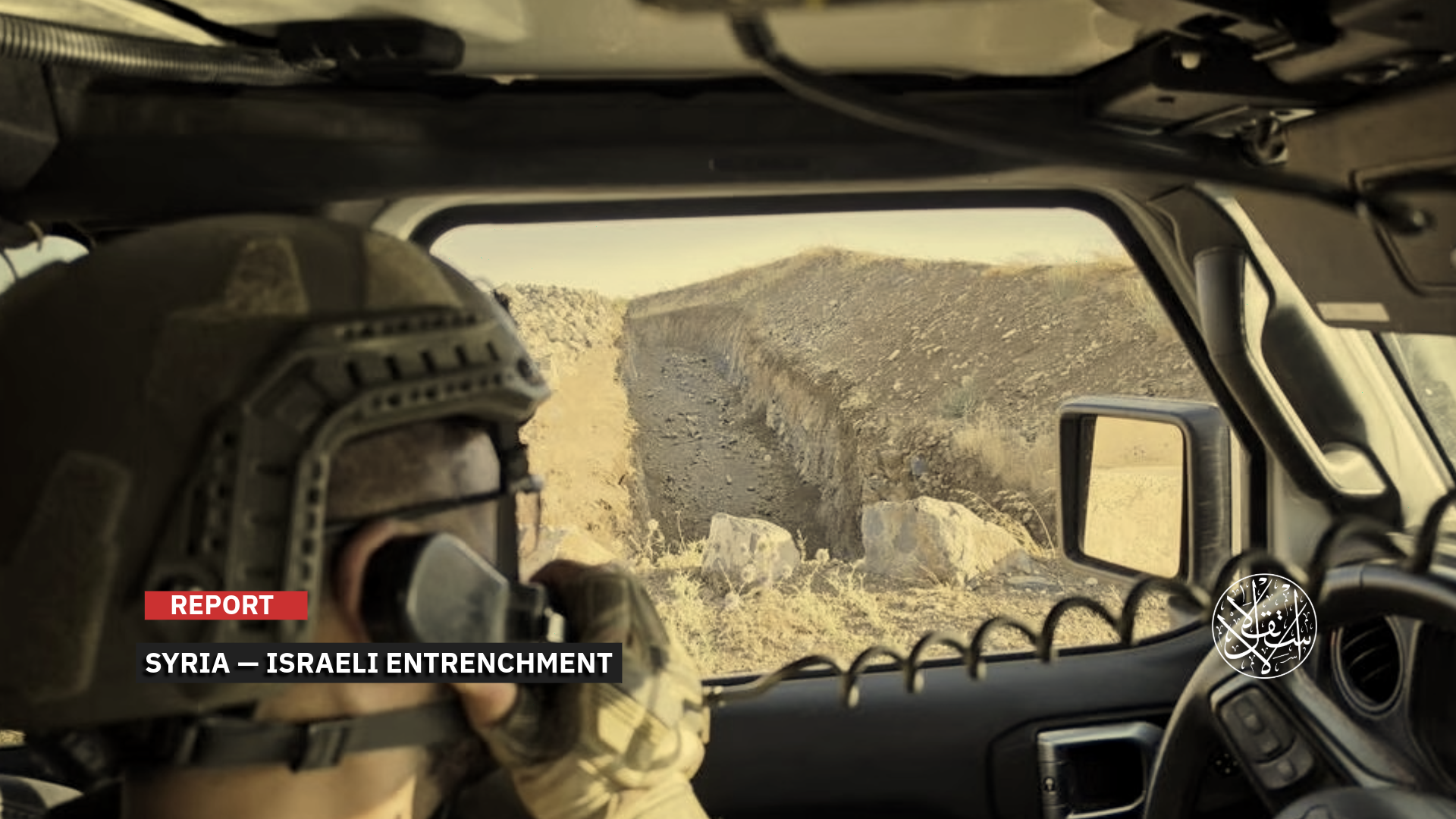
So far, 80 percent of trenches stretching from the Majdal Shams area in the north to the border triangle with Jordan in the south have been dug.
New Israeli data, reported by the Israeli newspaper Yedioth Ahronoth on August 9, 2026, revealed that the Israeli occupation army has shifted from a policy of “temporary incursions” to a model based on “control on the ground,” entrenching in southern Syria a policy similar to that pursued in the West Bank, based on repeated raids into Syrian villages and towns.
The newspaper’s Israeli correspondent, who entered Syrian territory alongside the occupation army, explained how the Syrian-Israeli border is being redrawn for the second time since its alteration following “Israel’s” occupation of the Golan Heights in 1967.
The additional areas seized by “Israel” after the collapse of the al-Assad government in December 2024 are currently being incorporated into the occupied Golan area, indicating that the situation is moving toward “permanent occupation” and a long-term presence.
The Israeli rationale for these aggressive measures, despite the new Syrian government’s acceptance of U.S. President Donald Trump’s proposal to negotiate a “new security agreement,” is based on distrust of President Ahmed al-Sharaa, as well as fears that Syria could regain its strength and once again pose a security threat to “Israel”. This has reached the point where Israeli media have quoted the expression, “We no longer ask who the enemy is.”
At the same time, the sighting of old Syrian fighter jets flying over northern Syria, specifically Idlib, has caused concern and anger in “Tel Aviv”, despite the flights taking place far from the south of the country and the border with “Israel”.
These fighter jets survived the Israeli bombardment that targeted Syrian aviation and air-defense systems on December 12, 2024. “Israel” fears that their return to the skies could signal that the Syrian military is regaining its strength.
The Israeli Kan broadcaster confirmed on August 10, 2026, that “the Israeli military establishment is detecting a significant acceleration by the Syrians in rebuilding their air force,” a year and eight months after the Israeli army announced that it had destroyed their aircraft.
It added that, despite talk of a future security agreement with “Israel,” the Israeli military establishment continues to monitor the return of Syrian aircraft to the skies and developments related to them, as well as the extent to which they could affect “Israel’s” freedom of action in Syrian airspace, particularly amid the consolidation of the Turkish presence there and the deployment of air-defense systems.
On December 9, 2024, coinciding with the fall of the Assad regime, “Israel” occupied an additional area of approximately 400 square kilometers and unilaterally annulled the “Disengagement of Forces Agreement” signed in 1974.

'New East' Operation
The operation launched by the Israeli army to deepen its occupation in southern Syria, dubbed “New East,” and whose details were published by Israeli media, suggests that it plans to remain there for many years.
The decision by the Israeli army’s Northern Command to invite a correspondent from the Hebrew-language Yedioth Ahronoth newspaper to tour the occupied Syrian territory, accompanied by a senior officer, to familiarize the Israeli public with its occupation activities was a serious indication of these intentions, as if conveying a message to the world that Mount al-Sheikh (Mount Hermon) and Quneitra will join “Israel” just as the Golan Heights did.
The plan calls for “a shift from temporary incursions to a model based on control on the ground and regular movement inside Syrian villages and towns in the south, with the aim of remaining for a long period that could last years.”
To this end, the occupation army revealed that it has been working for about two years on an engineering project called “New East,” aimed at establishing a system of fortifications along the border area in southern Syria.
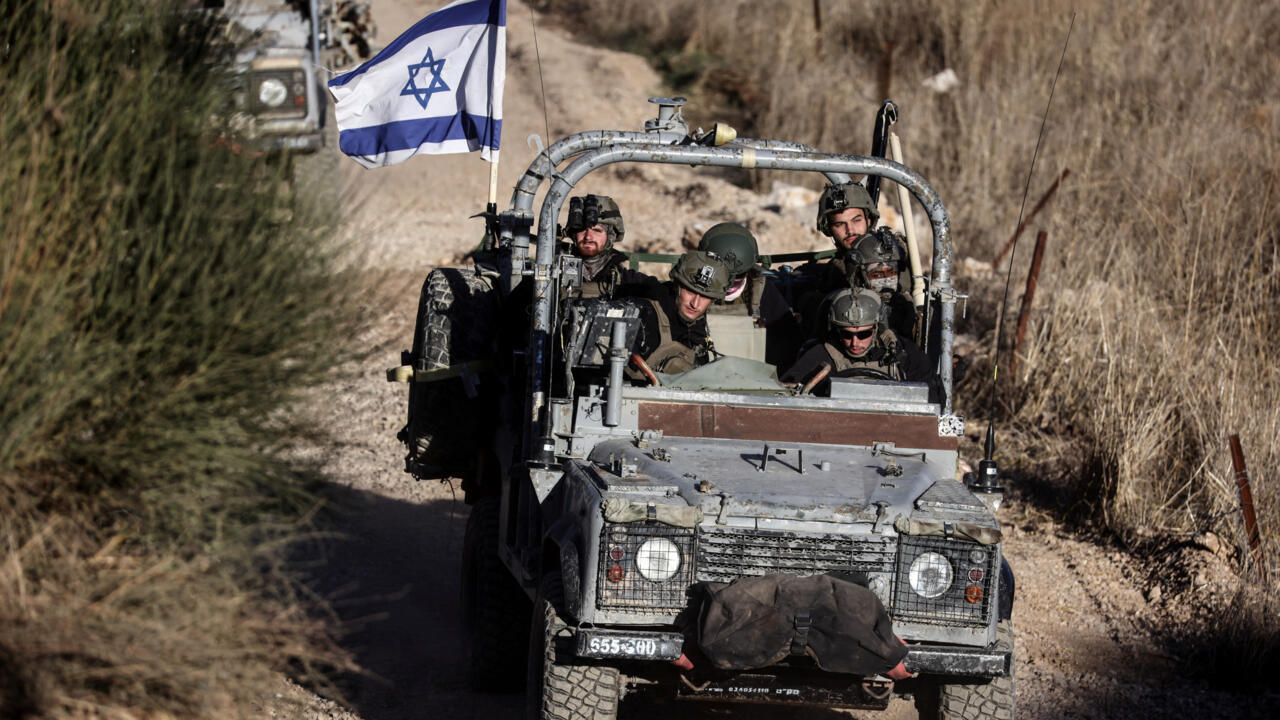
Nine military positions have been established, each roughly the size of a company-level military base. Their purpose is to monitor and oversee the area, as well as to serve as launching points for incursions carried out around the clock in all the villages, towns, and open areas.
According to the report, the Israeli army has so far completed about 80 percent of the excavation of trenches stretching from the Majdal Shams area in the north to the border triangle with Jordan in the south.
The stated objective is to “prevent any militias from carrying out an attack on Israeli settlements similar to Hamas’s attack on October 7, 2023,” according to the newspaper.
Israeli and Syrian sources say the plan is believed to be linked to concerns over the emergence of “popular resistance” groups, possibly backed by the authorities, that could carry out operations similar to those taking place in the West Bank and inside “Israel”.
On February 11, 2026, the emergence of a new armed formation in southern Syria called the “Occupation Deterrence Movement,” also referred to as the “Occupation Resistance Movement,” was announced. It explicitly pledged to liberate the Golan Heights and confront the Israeli military presence in southern Syria.
On July 5, 2026, a branch of the Occupation Deterrence Movement was announced in Daraa, southern Syria, with the aim of confronting the Israeli army, which occupied areas following the collapse of Bashar al-Assad’s rule. The movement called on “all Syrian youth” to join it.
According to Syrian reports, the movement comprises armed groups made up of remnants of the Syrian revolution. In video clips it released, it called for attacks against Israeli Occupation Forces in the Golan Heights and for forcing them to withdraw from the territories they occupied in the south following the end of al-Assad’s rule.
This coincided with the start of limited shooting incidents targeting occupation soldiers and the placement of large rocks on roads to prevent Israeli occupation armored vehicles from passing through and advancing into Syrian towns, actions that are expected to develop and intensify.
In late June 2026, Israeli Occupation Forces carried out an incursion and search operation in the Abdeen area west of Daraa province. The soldiers came under stone-throwing attacks, and during the forces’ withdrawal, unidentified individuals later opened fire at the occupation force. The soldiers fled, leaving one of their military devices behind.
The Israeli army said its forces responded with gunfire and mortar shells, while an Israeli attack helicopter also carried out a strike on the area.
Under “Israel’s” “New East” plan in southern Syria, trenches approximately 4 meters wide and 4 meters deep have been dug, with earthen embankments several meters high constructed along them. Numerous observation posts equipped with advanced defensive systems, including guns and unmanned vehicles, are being established on these embankments.
These operations are being carried out by forces belonging to the Golan Brigade 474, which operates in what “Israel” calls the “security belt” extending along the Syrian highlands from Jabal el-Sheikh to the Jordanian border. The belt ranges from 5 to 12 kilometers in width.
Israeli army officers say they are dealing with the area “according to a new security mindset that keeps the battle with the enemy on its own territory, regardless of which side is identified in advance as the enemy, whether Hezbollah, the Syrian army, or other armed groups.”
Yedioth Ahronoth quoted one officer as saying, “We no longer determine the defensive response based on who the enemy in front of us is, but on what capabilities they have and what they are capable of doing.”
He also revealed that “the army suspects every Syrian of being an armed enemy,” even if the person is a civilian or a shepherd, while acknowledging that the area contains impoverished villages and civilian families whose livelihoods depend on raising small numbers of sheep and poultry, and that Israeli Occupation Forces routinely move among the homes of these villages.
9 Military Sites
Analysts say the danger posed by this Israeli disclosure of the “New East” plan lies in the fact that Israeli operations are not limited to the area adjacent to the ceasefire line.
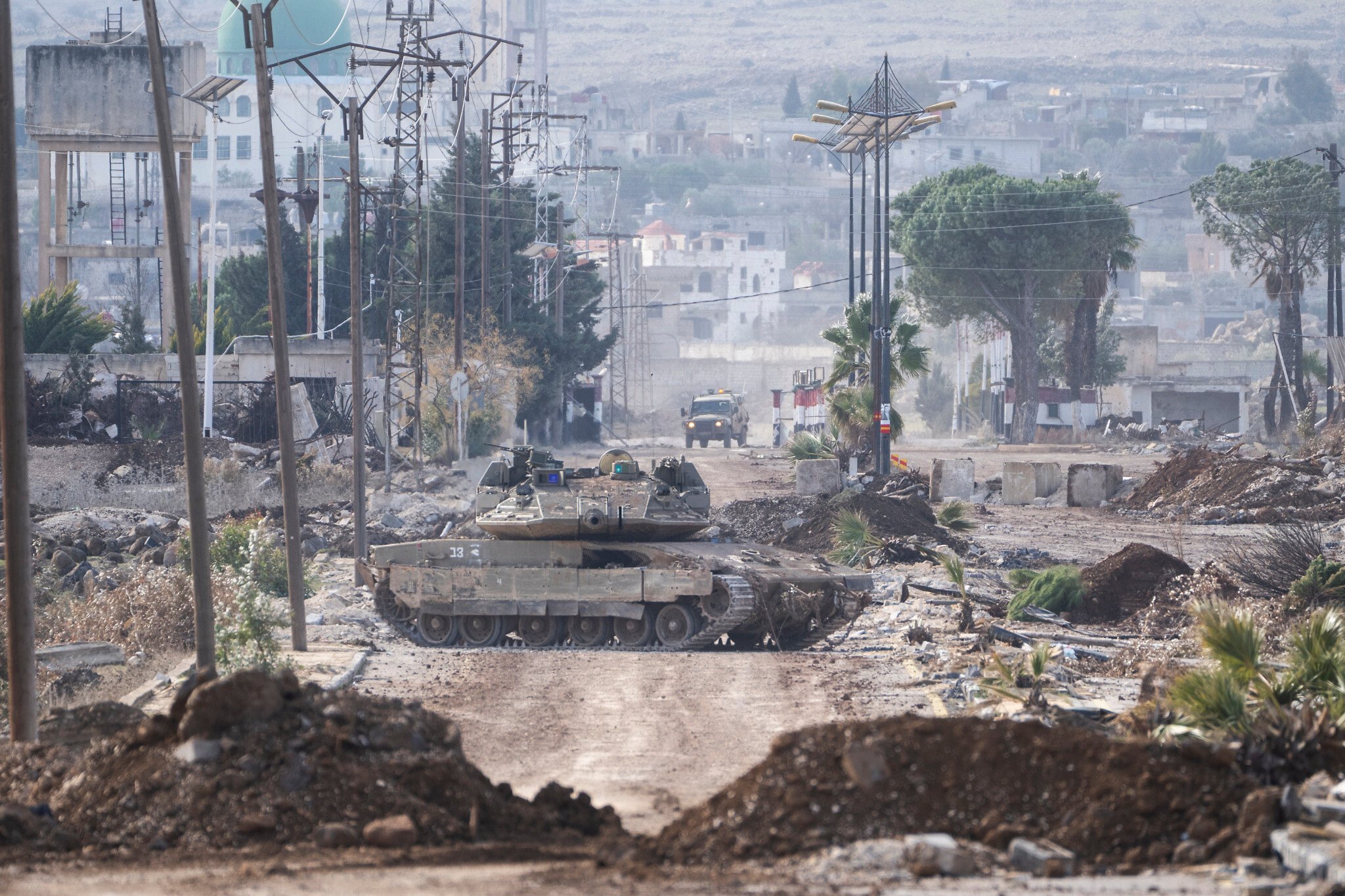
The Golan Brigade 474 currently maintains a military strip inside Syrian territory containing around nine positions, each roughly the size of a company-level military base.
A “company” is a military unit typically consisting of 3 to 5 platoons, with between 60 and 200 personnel. It is commanded by an officer and constitutes a basic component of a battalion’s organizational structure in ground forces.
The most significant indication is not simply the number of bases established by the occupation, but their geographical distribution.
The Israeli positions extend from the Jabal el-Sheikh area in the north toward Quneitra and southward toward areas near the Yarmouk Basin. This gives the Israeli army strategic points from which to monitor, move, intervene, and overlook Damascus itself.
This changes the function of the area established under the 1974 agreement. The original arrangement provided for the separation of Israeli and Syrian forces and the establishment of a buffer zone supervised by the United Nations, while the territory east of the separation line remained under Syrian administration. “Tel Aviv” now controls that territory.
From these permanent Israeli army positions, Occupation Forces carry out continuous and ongoing incursions into Syrian towns and villages, including villages in the vicinity of Daraa and Quneitra.
These operations include the establishment of military checkpoints, searches of passersby and homes, and the detention of civilians.
Rights groups have said that 60 Syrians are being held in occupation prisons, five of whom have been released in stages.
In February 2026, the Syrian Observatory for Human Rights confirmed that it had documented, according to its sources, 15 sites, bases, and observation posts established by Israeli Occupation Forces inside Syrian territory since late 2024.

Aggression Instead of an Agreement
Since the collapse of the al-Assad regime, the Trump administration, along with Israeli political currents and research institutes, has advised the “Tel Aviv” government against resorting to aggression and instead pursuing security and economic agreements with Damascus, viewing this as a strategic opportunity.
However, other Israeli right-wing and military assessments have continued to warn about the identity of the new government in Syria, describing it as “Islamist jihadist,” as reflected in the new military appointments within the Syrian army.
They argue that it is pursuing a policy of de-escalation in order to build up its strength before escalating against “Israel”.
A previous analysis by the Institute for National Security Studies (INSS), published on May 8, 2026, called on the Israeli government to seize what it described as a “strategic opportunity” in Syria following the collapse of Bashar al-Assad’s regime, and to focus on normalization rather than military confrontation.
It stated that “Israel should seize the opportunity to advance a process of normalizing relations with Syria, beginning with security and cooperation agreements.”
It argued that “such normalization could help reduce the risk of extremist Islamist groups returning, weaken Iran’s influence in the region, and enhance regional stability.”
A more recent analysis by the same Israeli institute, published on July 5, 2026, reiterated the need to “break the strategic deadlock,” calling for the renewal and acceleration of security negotiations with the new Syrian government.
According to the INSS, “a breakthrough along this path would serve four vital Israeli and regional interests”:
First, alignment with President Trump’s strategic vision: This step would directly align with Trump’s aspirations to expand the Abraham Accords and incorporate Syria into them.
The Trump administration views reintegrating Syria into the “moderate Arab sphere” as a key tool for weakening Iran. “Israel” could play an operational and security role supporting this broader diplomatic effort, according to the Israeli institute.
Damascus had previously stated that it wanted to reach a security agreement with “Israel”. President Ahmed al-Sharaa said in July 2026 that “Syria seeks an agreement that could later pave the way for a comprehensive peace,” while emphasizing that Syria would not abandon its claim to the Golan Heights.
Second, containing and deterring Turkish influence: Syria represents a central arena for Ankara’s ambitions for regional dominance. Accelerating Israeli security dialogue with Damascus, with support from the Gulf states, could weaken Turkish influence in Syria and across the broader Middle East.
The third Israeli interest in renewing security negotiations with Syria is achieving stability and preventing the entrenchment of Iranian influence. Providing the Syrian government with an “exit route” from the Iranian axis, through economic incentives and security guarantees, could enable it to restrict the operational freedom of Iran’s Islamic Revolutionary Guard Corps and Hezbollah on Syrian territory.
“Weakening the foothold of terrorists in Syria would also create a continuous physical buffer zone, disrupting Iranian supply lines to Beirut,” according to the INSS.
The fourth Israeli interest is reducing the military deployment and freeing up resources. The current security situation requires the Israeli army to maintain large and permanent forces in the Golan Heights and along the northern front.
Any temporary or limited security arrangement with a sovereign government in Damascus could contribute to long-term stability while simultaneously allowing for the necessary reduction in “Israel’s” military deployment.
This would also “improve Israel’s international standing.” Accelerating negotiations with Syria and withdrawing to the pre-war ceasefire lines, as stipulated in the 1974 agreement, would strengthen “Israel’s” image as a state with no territorial ambitions.
On the ground, however, the Israeli government and occupation army are doing the opposite, entrenching their presence across nearly 400 square kilometers seized after the fall of the al-Assad regime and adding them to the areas already occupied in the Golan Heights and surrounding territory.
This forms part of a military policy based on using the occupation of Syrian territory as a bargaining chip against Damascus and creating a “fait accompli” before any new agreement.
This policy has also gained traction because of the dominance of the security outlook of “Israel’s” ruling far-right Jewish political camp, which views the current Syrian government as more dangerous than the al-Assad regime, because it is a Sunni ideological government and, in their view, would pose a threat to “Israel” if it manages to consolidate its position.
Fears Over the Regime’s “Islamist” Character
There is strong evidence that Israeli concerns over the Islamist background of Syria’s new leadership were one of the key factors shaping “Israel’s” policy toward Damascus, based on the assessment, expressed by Israeli right-wing circles and intelligence agencies, that the current government is more dangerous than the al-Assad regime because it is a Sunni Islamist government.
According to these Israeli assessments, with the fall of Bashar al-Assad, “Tel Aviv” got rid of a regime associated with Iran, Hezbollah, and Russia, but at the same time found itself facing an Islamist force, Hay’at Tahrir al-Sham (HTS), led by Ahmed al-Sharaa, whose past was linked to al-Qaeda.
“Israel” lost a regime it knew how to deal with, but found itself facing a new authority whose strategic identity remains unclear.
This helps explain its initial hostile reaction toward the new government and its bombing of Syria, as indicated by a study published by the Israeli Institute for National Security Studies on May 8, 2025.
Israeli reports indicate that “Israel’s” concern over the “Islamist” character of Syria’s new government stems from the armed background of the new leadership, represented by Hay’at Tahrir al-Sham and President al-Sharaa.
Although he severed his ties with al-Qaeda in 2016 and subsequently reshaped his political and military project before adopting a more pragmatic discourse, this background has remained part of Israeli calculations.
In a televised interview with Al Jazeera on July 26, 2026, Syrian President Ahmed al-Sharaa said that Syria was actively working to reach a security agreement with “Israel” through international mediation.
He said Damascus wanted the agreement to serve as a gateway to comprehensive peace, while stressing that this would not mean abandoning Syria’s claim to the Golan Heights.
He added that Syria was avoiding confrontation with “Israel” because it did not serve its interests, noting that the future of the relationship would depend on the proper implementation of each stage of any agreement.
He explained that the success of a potential security agreement with “Israel” could pave the way toward comprehensive peace, without relinquishing Syria’s right to recover the Golan Heights.
The Israeli Alma Research and Education Center, which specializes in terrorism and intelligence, stated in a report published on November 13, 2025, that al-Assad’s fall and the rise of al-Sharaa’s government had altered the map of Salafi jihadist activity in Syria, and that members of former armed groups had entered the new state security institutions.
The Israeli concern is not limited to what al-Sharaa is doing today, but also to what Syria could become if he succeeds in consolidating his rule. The fear is of a stable Islamist government hostile to “Israel”, and this lies at the core of Israeli security thinking.
Israeli officials and analysts view a stable, centralized Syrian state with a unified army, control over the entire Syrian territory, and a Sunni Islamist base of support as potentially more capable, in the long term, of threatening Israel than a fragmented Syria.
In other words, according to Israeli right-wing and intelligence hawks, a weakened Syria may represent a short-term security gain for “Israel”, while a stable Islamist Syria could become a long-term strategic problem.
For this reason, following al-Assad’s fall, Israeli policy focused on preventing the rebuilding of a centralized Syrian military capability in the south, rather than solely confronting Iran and Hezbollah.
This concern has become more acute under the right-wing government of Benjamin Netanyahu, as well as among ministers and political currents that view political Islam as an existential threat rather than merely a political adversary.
The “Jihadist” Army
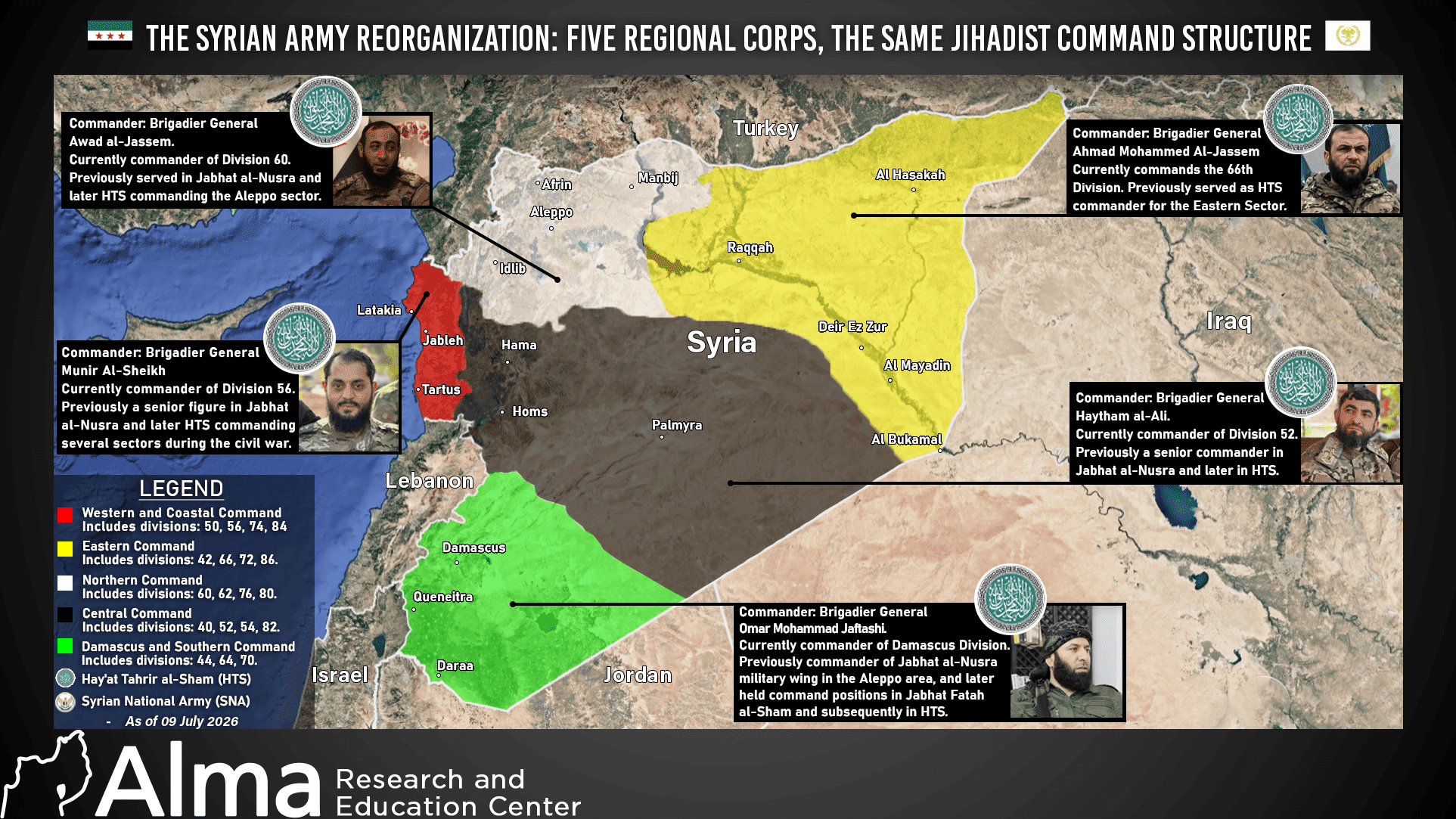
What concerns the Israeli occupation authorities even more is that the new Syrian army is an army of “jihadists,” as described by the Israeli Alma Research and Education Center, which is close to the military establishment, in a report published on July 12, 2026.
The report said that the Syrian authorities are carrying out a comprehensive restructuring of the new Syrian army, replacing the existing system based on military “divisions” with a structure consisting of five “corps,” or regional commands, led by figures with “jihadist” backgrounds.
The Israeli institute explained that four of the five corps commanders had previously held leadership positions in Hay’at Tahrir al-Sham (HTS), which emerged from the al-Nusra Front.
The same institute, Alma, noted in a report published on November 13, 2025, that four of the six senior commanders in the General Staff of the new Syrian army had “jihadist” backgrounds.
It also said that 13 of the 21 division commanders came from similar “jihadist” backgrounds, according to the Israeli institute, which does not rule out the possibility that the “jihadists” could turn against al-Sharaa if his current pragmatic approach were to deviate from the Islamist path.
This is the same concern that emerged when Syrian Su-22M4 and MiG-23 fighter jets flew over northern Syria on August 10, 2026, for the first time since the fall of the Assad family’s rule and the Israeli occupation army’s destruction of military infrastructure, including aircraft and airfields, in an effort to weaken the new government led by Ahmed al-Sharaa.
The development alarmed the Israeli military establishment, which said it had “detected an acceleration in the rehabilitation of the Syrian air force, alongside the recruitment of new pilots and the conduct of aerial training using trainer aircraft, helicopters, and fighter jets,” according to the Israeli official Kan broadcaster.
The broadcaster reported that Israeli assessments indicate that Syria is working at an accelerated pace to restore its air capabilities, around a year and eight months after the fall of Bashar al-Assad’s regime and the extensive Israeli strikes that targeted Syrian military bases, airfields, and aircraft at the time.
The return of the aircraft to Syrian skies is seen as an indication that the air force was not completely eliminated, and that some aircraft either remained outside the scope of the Israeli strikes or were subsequently rehabilitated. Syrian sources believe that Syria has between 10 and 25 operational Sukhoi aircraft.
According to Israeli assessments published by Israeli media, the Israeli aggression that followed al-Assad’s fall destroyed around 40 percent of the Syrian air force, including squadrons of Su-22 and Su-24 aircraft, as well as 85 percent of the air-defense system and 90 percent of the surface-to-air missiles.
In March 2025, Israeli Foreign Minister Gideon Sa’ar described Syria’s new leadership as a group of unelected “jihadists” and linked “Israel’s” position to the need to protect the Druze and other Syrian minorities.
Netanyahu and Defense Minister Israel Katz also announced their readiness to act to protect the Druze south of Damascus.
On July 14, 2026, Netanyahu told Trump that the Israeli army would not withdraw from the buffer zone in Syria as long as the threat from “jihadist groups” remained there, according to Axios.
The occupation authorities use these concerns over the “Islamist” character of the army, its efforts to restructure itself, and its attempts to rebuild its military strength, which could pose a future threat to “Israel”, to justify maintaining permanent military positions inside and around the buffer zone and advancing toward strategic positions on Jabal el-Sheikh.
“Israel” is also using the issue of minorities as a security and political entry point to constrain Damascus’s authority in the south.
The Washington Post documented on December 23, 2025, how “Israel” carried out covert operations to support Syrian Druze militias in an attempt to weaken al-Sharaa’s ability to consolidate control over the country.