Despite Hamas Concessions, Why Did Netanyahu Reject Trump’s Gaza Plan?
Netanyahu’s rejection of Trump’s plan will have three consequences.
The “Gaza Board of Peace” agreement was supposed to pave the way for a new phase, ending the war and laying the groundwork for new security and political arrangements in the territory, particularly after Hamas made a significant concession on an issue it had long treated as a core principle: its weapons.
Instead, the Israeli Occupation rejected the 15-point plan approved by the “Gaza Board of Peace” in full, despite U.S. President Donald Trump welcoming it and calling it a historic agreement.
Since the agreement was announced on July 31, 2026, between “Trump’s Gaza Board of Peace” and Hamas, Israeli efforts to derail it have continued.
For the first time, the deal included a sensitive concession on the collection and storage of heavy weapons in exchange for the Israeli Occupation withdrawal and the implementation of other conditions.
“Israel’s” rejection stems from its view that some provisions amount to a political trap that could produce a repeat of the failure of October 7, but this time within “Israel’s” political system, in what could be described as “a political October 7.” The agreement would also constrain “Israel’s” ability to continue its genocide in Gaza.
Trump had repeatedly threatened to destroy and wipe out Hamas if it rejected the deal, but after the Palestinian Resistance Movement agreed to it, the Israeli Occupation rejected the plan.
The move has fueled speculation in Israeli and U.S. media that tensions could emerge between Washington and “Tel Aviv,” with reports saying that Netanyahu sent an adviser to meet with the Trump administration in an effort to contain and ease the disagreements.
Why Did Netanyahu Reject the Deal?
Israeli assessments link Netanyahu’s rejection of the “Gaza Board of Peace” agreement to the Knesset elections scheduled for October 2026 and his desire to project himself as a strong leader unwilling to make concessions. They also point to “Israel’s” view that the agreement contains what Israeli officials see as a political trap, or a “political October 7.”
Former deputy head of “Israel’s” National Security Council Itamar Yaar told Israeli media that Netanyahu’s rejection was aimed at the Israeli public, signaling that the government had not backed down from its demand for disarmament ahead of the election.
The assessments also link Netanyahu’s rejection, along with that of his ministers and military commanders, to provisions that would restrict “Israel’s” ability to continue its genocide and targeted killings in Gaza. The deal would require the Israeli Occupation to withdraw from the territory before Hamas’s heavy weapons were removed and handed over to a Palestinian administration rather than destroyed.
Article 8 of the disarmament section of the “Gaza Board of Peace” agreement states that procedures to disarm heavy weapons, dismantle military production sites and weapons depots, and destroy tunnels would begin after the obligations under the Sharm el-Sheikh Protocol were completed, the National Committee for the Administration of Gaza (NCAG) entered the territory, and the international stabilization force was deployed.
That effectively ties the removal of heavy weapons to “Israel’s” fulfillment of the Sharm el-Sheikh ceasefire protocol, signed on October 9, 2025, particularly provisions involving withdrawals, the reopening of the Rafah crossing, and the return of displaced Palestinians, among other commitments the Israeli Occupation has yet to fulfill.
The agreement also states that the NCAG would oversee the process and carry it out gradually according to a 14-day implementation timetable. The process would be tied to “Israel’s” phased withdrawal from areas under its control and the disarmament of militias affiliated with the Israeli Occupation under Article 10 of the roadmap.
The same provision calls for Palestinian factions to participate in collecting weapons and stipulates that no weapons may be transferred or handed over to the Israeli occupation or any non-Palestinian party.
“Tel Aviv” rejected three of the plan’s 15 provisions, particularly the disarmament clause, and persuaded Trump’s envoy, Nikolay Mladenov, to reverse the three points he had personally agreed on with Hamas and Arab mediators.
First, ”Israel” sought to include all weapons, not only heavy weapons, including light, personal, and family-held firearms.
Second, it demanded that the weapons be disarmed and destroyed rather than contained or stored, as originally agreed, and that a third party, rather than the new Palestinian administration in Gaza, carry out the disarmament and destruction.
Third, it demanded that all weapons be removed and destroyed before any Israeli withdrawal, whether from the Yellow Line or elsewhere in Gaza, effectively allowing the Israeli Occupation to continue indefinitely without guarantees compelling Israel to honor its commitments.
After Israeli Prime Minister’s Office spokesman Doron Spielman claimed that Israeli intelligence had determined that Hamas had been rearming and recruiting since Trump announced a ceasefire in October 2025, Netanyahu rejected the entire agreement on August 9, 2026.
“Israel rejects the 15-point document,” Netanyahu said, reiterating that Israeli forces would not withdraw until Hamas was disarmed.
The Israeli army “will not carry out any withdrawal until Hamas is genuinely disarmed [...] and will continue to thwart threats against our forces and our citizens,” Netanyahu added, saying that “Israel” is “talking to the Americans about this issue.”
“They have ideas, some of which are acceptable to us and some are not acceptable to us, and we know how to stand firm on these things.”
The Guardian reported on August 9 that the rejection was unusually forceful and explicit and appeared to be directed at the Trump administration, as Trump and Netanyahu faced difficult elections.

‘A Political October 7’
On August 7, Shin Bet chief David Zini warned the security cabinet against moving ahead with the “Gaza Board of Peace’s” roadmap for the second phase of the Gaza agreement, arguing that, from Hamas’s perspective, the plan amounted to a “political October 7.”
He claimed that Hamas’s acceptance of disarmament was part of a deception campaign designed to buy time and prevent “Israel” from resuming its attacks.
According to sources quoted by Yedioth Ahronoth, Zini said the roadmap was, in Hamas’s view, a “political October 7,” referring to what he saw as the prospect of the group achieving a political victory over “Israel” similar to the one it achieved on October 7, 2023.
He alleged that Hamas’s declared acceptance of disarmament was a deception operation and that the group’s goal was to buy time on the assumption that “Israel” would not attack it until after the Israeli elections scheduled for October 27, 2026.
Ghazi Hamad, a member of Hamas’s negotiating delegation, said the main purpose of the concessions the group made, including its acceptance of disarmament, was to save Palestinians in Gaza from continued Israeli aggression and the Israeli Occupation’s criminal schemes.
But Israeli analyst Eyal Zisser, writing in Israel Hayom on August 8, argued that Hamas had shown no sign of dismantling its weapons or relinquishing control of Gaza. On the contrary, he said, evidence from the ground indicated that it was working to strengthen its control, rebuild its capabilities, and recruit new members to its military wing.
Zisser argued that Hamas could not give up its weapons because of its ideological commitment to continuing the conflict against “Israel,” which he described as central to the group’s existence. The weapons, he said, would be preserved for a moment when an opportunity arose, even if that meant waiting months or years to restore control over Gaza and fight “Israel.”
Lt. Col. C, commander of the Israeli military’s 202nd Paratroopers Battalion in Gaza, told Yedioth Ahronoth on August 9 that Hamas fighters were moving between buildings and rubble, digging underground and emerging from buildings carrying bags and moving around with cases, which he said indicated that they were hiding weapons inside.
He added that Hamas was seeking to rebuild its capabilities despite having fewer resources than before, including by recovering unexploded bombs dropped by “Israel,” repairing them, and turning them into roadside explosives.
Hamas is consolidating its presence and recruiting new fighters, he said, describing efforts to connect wires to unexploded aerial bombs and attach explosive charges, warning that “Israel” could eventually face the threat of Hamas drones carrying explosives.
Maariv reported on August 7 that Trump’s announcement of a historic agreement in Gaza was preceded by eight months of difficult negotiations between Hamas, the United States, and Egypt.
During those talks, Hamas’s leadership had repeatedly rejected disarming or handing its weapons to others, making the ambitious plan championed by Trump appear close to collapse.
But after Khalil al-Hayya took over as head of Hamas’s political bureau, the group informed mediators within days that it was willing to hand over its military wing’s weapons in Gaza, along with tunnel maps and rocket production facilities, provided they were placed under Palestinian control.
Trump and his team, along with the countries involved in the mediation, viewed the move as a breakthrough and quickly announced the agreement and the new roadmap.
Hamas, however, attached several conditions to its acceptance, including that the handover take place gradually and in parallel with the withdrawal of Israeli occupation forces from Gaza.
Under the proposed arrangement, Hamas would hand over its weapons in one area while Israeli forces withdrew from another, with the process continuing area by area until all weapons were handed over alongside a complete Israeli withdrawal. The process would follow a predetermined timetable and agreed-upon geographic areas.

US-Israeli Tensions
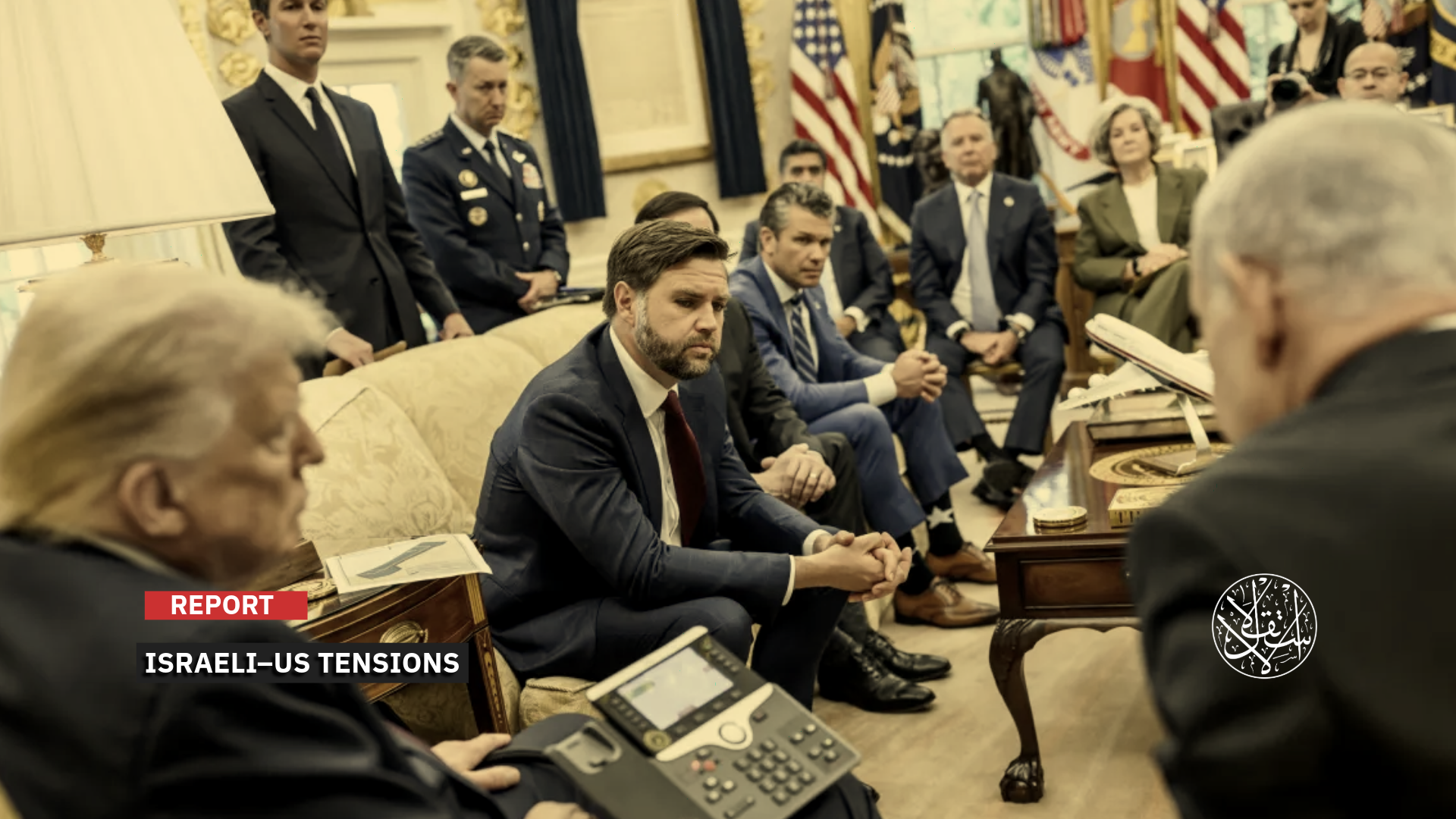
With Trump describing the agreement accepted by Hamas as a major and historic concession while Netanyahu rejected it, Israeli media reported growing disagreements and a potential crisis between the two leaders. U.S. media, however, suggested that Trump understood Netanyahu’s position and was not particularly concerned by it.
Israel Hayom, citing Israeli political sources on August 8, reported growing disagreements between “Tel Aviv” and Washington over the 15-point Gaza document, warning that the dispute could escalate into a confrontation with the Trump administration if the two sides fail to reach an understanding.
Jared Kushner, Trump’s adviser and son-in-law, was leading efforts to reach an understanding consistent with the “Gaza Board of Peace’s” approach, while Trump had so far refrained from directly pressuring the Israeli Occupation over the document, according to the Israeli report.
A senior U.S. official told Axios on August 9 that the White House was not concerned by Netanyahu’s rejection of the 15-point document proposed by the “Gaza Board of Peace.” Washington understood Netanyahu’s political calculations and viewed his position as linked to “Israel’s” election season, the official said, but expected the Israeli government to continue implementing Washington’s demands, particularly by limiting attacks on Gaza.
In an August 9 analysis, Haaretz said Netanyahu’s rejection of “Trump’s peace plan” had come as no surprise, arguing that he was trying to reconcile two opposing sides.
Netanyahu, the paper said, was caught between Trump and far-right Finance Minister Bezalel Smotrich over Gaza and was seeking to buy time until the election.
He was trying to balance Trump’s demands for Gaza’s reconstruction against pressure from his right-wing partners to make no concessions, Haaretz said. With the election approaching, his strategy appeared to be waiting for international pressure to ease.
A Washington Post report on August 9 said Israelis were concerned that the growing turmoil in the U.S. political debate over support for “Israel” could mark a lasting shift.
As the U.S. political consensus around support for “Israel” continues to erode, the paper reported, fears are growing in the Israeli Occupation that the change may become difficult to reverse.
The newspaper said the war on Gaza, along with a perception among some Americans that Netanyahu had pushed Trump toward a war on Iran, had widened the gap between the two countries as more Americans came to view U.S. support for Israel as excessive.
The Washington Post also pointed to a notable shift in U.S. public opinion as divisions over continued support for “Israel” deepen, raising Israeli concerns that changing attitudes among voters and both Democrats and Republicans could become a lasting trend.
In an August 2 article in Haaretz, analyst Zvi Bar’el warned that “Trump’s Gaza peace plan” could become a new front in “the conflict” involving Iran and “Israel.” Trump, he argued, viewed Gaza as a potential victory over Iran because Hamas’s acceptance of the agreement with “Israel” ran counter to Tehran’s position.
That, Bar’el said, underscored Gaza’s growing role in the regional conflict led by the United States against Iran. If fighting resumed in Gaza, Trump’s interests could therefore become an obstacle to renewed Israeli military operations.
“Israel’s” public broadcaster Kan reported on August 8 that the United States was pressuring “Israel” to begin a two-week ceasefire in Gaza as a prelude to implementing the plan to disarm Hamas.
According to the report, several Israeli ministers opposed the truce during a meeting of the security cabinet, arguing that there was still justification for continuing “military operations” in Gaza.

What Comes Next?
According to U.S. and Israeli assessments, if Trump insists on the plan in its current form, the relationship between the two men could face an unprecedented test: Can Trump impose a postwar arrangement on “Israel,” or can Netanyahu block the U.S. plan despite Washington’s announcement that it has secured Hamas’s approval?
Hamas’s partial acceptance and Netanyahu’s public rejection of the plan are seen as more than a negotiating dispute because they shift the center of the crisis from “Israel” and Hamas to Washington and “Tel Aviv.”
The Wall Street Journal reported on August 10 that “Israel’s” rejection does not mean Trump’s agreement is dead but that the battle has shifted to how it will be implemented.
If Trump insists on a phased Israeli withdrawal alongside phased disarmament, while Netanyahu insists on Hamas’s complete disarmament before any withdrawal, the two men could be headed for a direct confrontation unless negotiations produce a compromise, such as internationally verifiable, gradual disarmament alongside limited and simultaneous Israeli withdrawals.
The Guardian reported on August 9 that Netanyahu’s rejection was a blow to Trump’s efforts to present himself as a peacemaker in international conflicts, particularly with the November 2026 U.S. midterm elections approaching.
The Wall Street Journal described Netanyahu’s rejection of the U.S. plan as a rare public split between Trump and Netanyahu. A failure of the plan would deprive Trump of a major foreign policy achievement as he faces other regional challenges and the congressional elections.
Experts told Reuters on August 9 that if Trump pressures Netanyahu to withdraw, the Israeli prime minister could face a dilemma: complying could threaten the cohesion of his governing coalition, while refusing could damage his relationship with the U.S. president.
For now, Netanyahu has sought to keep the door open. Rather than rejecting every element of the plan, he has said some U.S. proposals are acceptable and others are not, while negotiations with Washington continue.
That distinction matters because it suggests the current rejection is closer to an attempt to renegotiate the plan than a declaration of political war on Trump.
In any case, experts expect Netanyahu’s rejection of Trump’s plan to have three main consequences.
First, the second phase of the Gaza agreement could be frozen. It could become effectively suspended because the Israeli withdrawal and Hamas’s disarmament are supposed to proceed together.
If “Israel” refuses to withdraw before Hamas is fully disarmed, the process could become a vicious cycle: Netanyahu says “Israel” will not withdraw until Hamas gives up its weapons, while Hamas says it will not disarm until the Israeli military begins withdrawing.
That is precisely the scenario The Wall Street Journal warned about before Netanyahu announced his rejection.
Second, the “Gaza Board of Peace” could be weakened. The board is supposed to oversee the transition in Gaza, including the international stabilization force, a technocratic administration, and reconstruction.
But “Israel’s” refusal to withdraw as required under the roadmap, coupled with the board and Miladinov’s collusion with “Israel” and acceptance of its terms, would render the board effectively meaningless, at least in the eyes of the mediators and Hamas.
Questions are already emerging over the board’s purpose if one side of the war refuses to implement the core of the plan. That could turn it from an implementation mechanism into a platform for negotiations and political pressure.
Third, the war could return. If the political process fails, the more dangerous alternative would be a return to large-scale attacks, particularly after the Israeli election if Netanyahu returns to power or a more hard-line government adopts the same aggressive approach toward Gaza. This is precisely what Washington is trying to prevent.
Axios reported in May 2026 that the United States and the “Gaza Board of Peace” were even considering implementing parts of the plan in areas outside Hamas’s control after negotiations over disarmament reached an impasse.
That impasse remains after Hamas accepted the plan and “Israel” rejected it. Washington is therefore expected to revisit the proposal, potentially implementing it in what has been described as “New Rafah,” an idea previously put forward by the UAE to build a tent complex in Israeli-controlled areas beyond the Green Line, free of Hamas.
Sources
- Israel Rejects Next Phase of Trump’s Gaza Peace Plan
- With support for Israel roiling U.S. politics, Israelis fear a permanent shift
- Analysis Torn Between Trump and Smotrich on Gaza, Netanyahu Plays for Time Until Election
- Netanyahu rejects US-led 15-point Gaza peace plan in rare public break with Trump
- 'Hamas is still working. They are entrenching themselves': ynet reporter with IDF forces on the Yellow Line
- Analysis How Trump's Gaza Peace Plan Is Becoming the New Front in the Iran War